PART 1
Clara Paredes was 24 years old, living a life so tightly packed that there was no room for even a single dream.
She lived in Ecatepec with her younger brother, Emilio, 17, in an apartment where the ceiling dripped when it rained and the refrigerator made more noise than it did cold.
Their parents had died years ago. There were no rich uncles, no generous grandparents, no hidden inheritance.
It was just Clara.
And it was Emilio.
Emilio had a heart condition since childhood. He needed medication every month, expensive check-ups, and a diet they could barely afford.
That’s why Clara worked double shifts at an old burger joint called La Parrilla del Norte, on a pothole-filled avenue, choked with microbus exhaust and taco stands.
She served reheated coffees, smiled at rude customers, wiped sticky tables, and counted tips in the bathroom to decide whether she could afford rent, electricity, or medicine.
Almost never all three.
One rainy night, after 14 hours on the job, Clara stopped by San Rafael Hospital to pick up Emilio’s prescription.
The emergency hallway was chaos.
Doctors were running.
Nurses were shouting.
A gurney sped past her like a bullet.
—We’re losing him! —someone yelled.
—He’s lost too much blood!
—We need AB negative now!
A nurse responded, her face pale:
—There’s none in the bank.
Clara froze.
AB negative.
Her blood type.
The rarest.
Without thinking too much, she stepped forward.
—I have AB negative.
The nurse looked at her as if a miracle had just appeared.
—Are you sure?
—Yes.
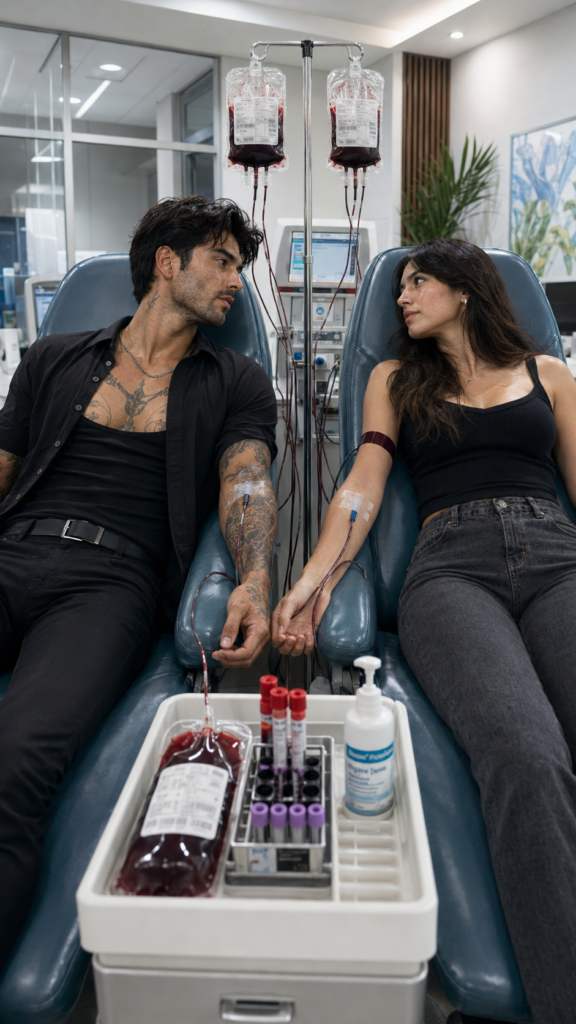
In less than 10 minutes, Clara was seated with a needle in her arm, watching her blood fill a clear bag.
She didn’t ask who the patient was.
She didn’t want to know if they were rich, poor, young, or old.
She just thought that someone inside had a family waiting.
When she finished, she took the juice they gave her, picked up Emilio’s medicine, and went home on the combi, dizzy and soaked.
By 5 a.m., she was awake again.
Three weeks later, Clara was carrying a tray with four burgers, fries, and two sodas when the whole restaurant fell silent.
First, a black SUV pulled in.
Then another.
And another.
Six in total.
Customers stopped chewing.
The cook peeked his head through the window.
Marlene, the owner, turned off the blender.
From the SUVs stepped men in dark suits, with discreet earpieces and shoes that cost more than Clara’s monthly salary.
One of them walked in.
He looked around.
And his eyes locked onto her.
—Clara Paredes?
Clara nearly dropped the tray.
—Yes… that’s me.
The man nodded respectfully.
—Mr. Alejandro Cárdenas wants to speak with you.
Someone at a table muttered, “No way.”
Another customer whispered:
—The Cárdenas Global guy?
Clara felt the floor shift beneath her.
Alejandro Cárdenas.
Tech entrepreneur.
Mogul.
The second richest man in Mexico.
Before she could respond, the door swung open again.
Alejandro Cárdenas entered La Parrilla del Norte as if the pothole-filled avenue had suddenly transformed into a red carpet.
He was tall, serious, with the weary face of someone who had just beaten death in a fight.
He walked straight to Clara.
—You donated blood at San Rafael Hospital three weeks ago —he said.
Clara swallowed hard.
—Yes.
Alejandro took a deep breath.
—You saved my life.
The burger joint was frozen in shock.
Clara lowered her gaze, uncomfortable under so many eyes.
—I just helped.
—No —he said softly—. You did much more than that.
He pulled out a sealed envelope from his jacket.
Clara opened it with trembling hands.
Inside was an old photo of her mother pregnant, legal documents… and her name tied to a trust worth millions of dollars.
Then Alejandro spoke the words that froze her blood:
—Clara, there’s something about your family that someone has worked very hard to keep from you.
PART 2
For several seconds, Clara couldn’t speak.
The smell of burnt coffee, roasted onions, and hot grease seemed to vanish. Only the envelope remained in her hands, and the photo of her mother, Ana, smiling by a lake, hand resting on her belly.
Next to her was a man Clara had never seen before.
On the back, written in almost faded ink, it said:
“For our daughter.”
—Our daughter? —Clara whispered.
Alejandro glanced at the customers recording with their cell phones.
—We need to talk privately.
Clara clenched the envelope against her chest.
—I’m not getting into any SUV.
He nodded immediately.
—You decide where.
That threw her off. A man with six SUVs didn’t seem like the type who asked.
—There’s a little park across the avenue.
—Let’s go there.
Marlene took the tray from her hands.
—Go, girl. The burgers can wait.
Under the light rain, Clara crossed the street with Alejandro walking at a distance, as if he didn’t want to invade her fear.
They sat on a damp bench.
—Start —Clara said—. And don’t sweet-talk me. Just tell me the truth.
Alejandro pulled out another photo.
In it, her mother appeared younger, in front of a little white house. Beside her was the same man from the lake. And next to him, a much younger Alejandro, arm draped over his shoulders.
—That man was my older brother —he said—. Julián Cárdenas.
Clara felt her hands grow cold.
—My mom said my dad’s name was Adán Paredes.
—Julián used that name for a time.
—Why?
Alejandro looked down.
—Because someone tried to kill him.
The noise from the avenue faded into the background.
Alejandro explained that Julián had had a plane accident 24 years ago near Monterrey. He was officially declared dead. But for months, doubts lingered. The body was never fully returned, the papers appeared too quickly, and the family lawyer, Pedro Landa, closed everything before Alejandro could investigate.
—My brother left a trust for the daughter he was expecting with Ana —Alejandro said—. Back then it wasn’t huge. But with investments, stocks, and returns, today it’s worth about $48 million.
Clara let out a dry laugh.
—No.
—It’s real.
—It can’t be real —she said, standing up—. If that were real, Emilio wouldn’t be splitting his pills when money runs low. I wouldn’t have sold my mom’s ring to pay rent. I wouldn’t have had to choose between electricity and a cardiologist twice last year.
Her voice broke.
Alejandro didn’t try to touch her.
—Someone presented documents saying Julián’s daughter died at birth.
—Who?
—Pedro Landa.
Clara paled.
That name she knew.
Pedro Landa had visited her mother two years earlier when Ana was sick. He arrived with a leather briefcase, smelling of mint, and a soft voice that always gave Clara a bad vibe.
—He knew my mom —Clara said—. And he knew about us.
Alejandro clenched his jaw.
—Then it wasn’t a mistake.
Clara thought of Emilio.
Her skinny, stubborn, proud brother, pretending his chest didn’t hurt to avoid worrying her.
—I have to tell him.
—Yes.
—But no SUVs. If six SUVs show up at his school, he’ll jump out the window.
For the first time, Alejandro almost smiled.
—One SUV. No visible escorts.
Clara agreed because her fear for Emilio weighed more than her pride.
She found him in the auditorium of the high school, debating in the debate club. When he saw her, he stopped speaking.
—What happened? Are you okay?
—I need to tell you something.
In an empty music classroom, Clara showed him the photo.
Emilio stared at it for a long time.
—That’s mom.
—Yes.
—And that man?
—His name was Julián Cárdenas.
Emilio looked up.
—Cárdenas like the millionaire?
Clara told him everything.
The donation.
Alejandro.
The trust.
The lie about their father.
The forged documents.
Emilio listened in silence until anger overcame his face.
—So someone watched us sink.
Clara didn’t know how to respond.
—$48 million, Clara. Do you know how many check-ups, how many medicines, how many nights without fear that is?
—We need answers.
—We need justice.
At that moment, Clara’s phone rang.
Unknown number.
She answered on speaker.
—Clara Paredes —said a smooth, elderly male voice—. I’m Pedro Landa.
Emilio lost all color.
—I understand Alejandro Cárdenas has already found you —the lawyer continued.
—How did you get my number?
—That doesn’t matter. You’re involved in something you don’t understand.
—Then send me the truth in writing.
There was a pause.
—Your mother left a letter and a recording for you.
Clara felt a punch in her chest.
—Why didn’t you give them to me when she died?
—Because she requested they be delivered only if Alejandro Cárdenas found you.
—Where?
—Tonight. Alone. No lawyers. No reporters. And without Cárdenas security.
Emilio shook his head in despair.
Pedro lowered his voice.
—Your mother didn’t hide it out of ambition, Clara. She hid it to keep you alive.
The call ended.
Then came a message with an address in the Roma neighborhood and a photo.
In the photo, Ana was in a hospital bed, holding an envelope with Clara’s name on it.
Behind her, reflected in the window, was Pedro Landa.
And next to him, a man identical to the one in the photographs.
Julián Cárdenas.
Alive.
Clara called Alejandro.
She didn’t go alone.
She arrived at Pedro’s office with a hidden microphone in her sweater, Alejandro waiting two blocks away, and Emilio in the SUV, furious because they had forced him to stay.
Pedro opened the door with a sad smile.
—You look so much like your mother.
—Don’t use that on me —Clara said—. Give me the letter.
The lawyer sighed.
He handed her a yellow envelope and a USB drive.
—Ana wanted to protect you from the Cárdenas.
—From all of them?
Pedro looked at her too intently.
—from those that remained.
Clara played the recording on her phone.
Her mother’s voice filled the office, weak but clear.
“Clara, my girl, if you’re listening to this, it’s because Alejandro found you. I’m sorry. I didn’t know how to give you a truth that could kill you.”
Ana recounted how Julián survived the plane crash but had to hide for years because he discovered embezzlement within the family business. It wasn’t Alejandro who was after him. It was a group led by old partners, with Pedro’s help, who had forged signatures to seize shares.
Julián took the name Adán Paredes to live with Ana.
Clara was born.
Seven years later, he reappeared one night, wounded and desperate. Ana was already pregnant with Emilio.
Then he disappeared again.
“Your brother is also Julián’s son,” Ana’s voice said. “I never told you because Pedro swore that if the Cárdenas knew about you, they would use you or make you disappear. I was a coward, daughter. But my fear was real.”
Clara cried quietly.
Pedro walked towards her.
—Your mother knew not all Cárdenas were innocent.
—But you weren’t either.
Pedro’s face changed.
—Be careful.
Then Alejandro’s voice echoed from the door.
—The one who should be careful is you.
Pedro froze.
Alejandro entered with two agents from the prosecutor’s office and a woman in a gray suit who introduced herself as a notary.
—Everything is recorded —she said—. Also your transfers, licensed attorney.
Pedro tried to laugh.
—You have nothing.
Alejandro held up a folder.
—We have the forged documents where you declared Clara dead. We have accounts in Panama. We have Julián’s altered signature. And now we have Ana’s recording.
Clara, her legs trembling, opened the final letter.
It was from Julián.
The handwriting was irregular, like someone writing in pain.
“Clara, if you ever read this, forgive me for not being the father you deserved. I didn’t leave because I didn’t love you. I left because they were looking for me. I left a trust for you and another for any child Ana might have with me. If Emilio lives, he’s my blood too. Don’t let my fear be the greatest inheritance you receive.”
Emilio walked in despite the orders.
He had listened from the door.
—Am I also your son? —he asked, voice breaking.
No one answered immediately.
Alejandro approached slowly.
—We’ll do DNA testing. But from what we know… yes.
Emilio gritted his teeth.
—So my dad was alive, and I grew up believing I had no one.
Clara hugged him.
—You had me.
—I know —he said, crying for the first time without hiding—. But you needed someone too.
Pedro was arrested that night for forgery, fraud, concealment of documents, and threats. Three other ex-partners of Cárdenas Global fell weeks later.
DNA tests confirmed the truth: Clara and Emilio were Julián Cárdenas’s children.
The trust was released.
$48 million.
But the first thing Clara bought wasn’t a house or a car.
It was Emilio’s complete medicine for two years.
Then she paid off all debts.
Afterward, she brought Marlene a check to save La Parrilla del Norte, which was about to close.
—I don’t owe you anything, girl —Marlene said, crying.
—You do owe me —Clara responded—. You owe me to keep scolding me when I try to act tough.
Alejandro asked for permission to be in their lives, not as a savior, but as an uncle.
Emilio took months to call him that.
Clara took longer to forgive her mother.
Some days she understood her.
Other days she hated her a little for every night of hunger, for every split pill, for every lie told in the name of fear.
With part of the money, Clara created a foundation for patients with rare diseases and accessible blood banks.
She named it “Julián’s Blood.”
At the inauguration, in front of cameras and neighbors, Clara didn’t speak as an heiress.
She spoke as a waitress.
As a sister.
As the daughter of a woman who lied out of fear and a man who loved from the shadows.
—Sometimes the truth comes too late —she said—. But when it arrives, it not only changes what we have. It changes what we are willing to allow.
Emilio, now with better treatment, squeezed her hand.
And amidst all the applause, Clara understood something painful:
The blood she donated to save a stranger didn’t only return Alejandro to life.
It also opened the grave of a lie that had been breathing among them for 24 years.