The blood was already leaving her arm when the nurse asked her name a second time.
Not because she hadn't heard it the first time. Because she was staring at something — a clipboard, a chart, a number — with the particular stillness of someone trying not to react.
"Cole," Mara said again. "Mara Cole."
The nurse — young, freckled, second-year at most, clearly not the one who should be having this conversation — nodded slowly and excused herself.
Mara watched her walk away. Fast. Too fast for a routine check. The kind of fast that only happens when someone has just seen something they don't know what to do with.
The ER at St. Michael's had been running at capacity since noon. It was now past nine. Mara had come in after her shift at the diagnostics lab one floor up — a mass casualty intake from a highway collision, six critical, one of them AB-negative, the rarest blood type, and the blood bank two units short. She'd rolled up her sleeve before anyone asked. It was the kind of thing she did without thinking: practical, immediate, useful.
She had been her mother's only practical thing for most of her life. She had learned young that usefulness was a kind of love language — the one you spoke when all the other ones had been taken from you.
The donor chair was at the edge of the ER bay, separated from the trauma rooms by a half-curtain that had been pushed slightly to the left at some point during the chaos. Through the gap, she could see the feet of the patient they were working on. Black Oxford shoes. Expensive, from the look of the leather — that particular dull lustre that only came from handmade things. One of them had been cut at the toe by the trauma scissors.
There were five people in that trauma room. She could see them moving.
She looked away. She was a lab tech. Blood draws and centrifuge results. She did not watch trauma.
The nurse came back. She had a doctor with her now.
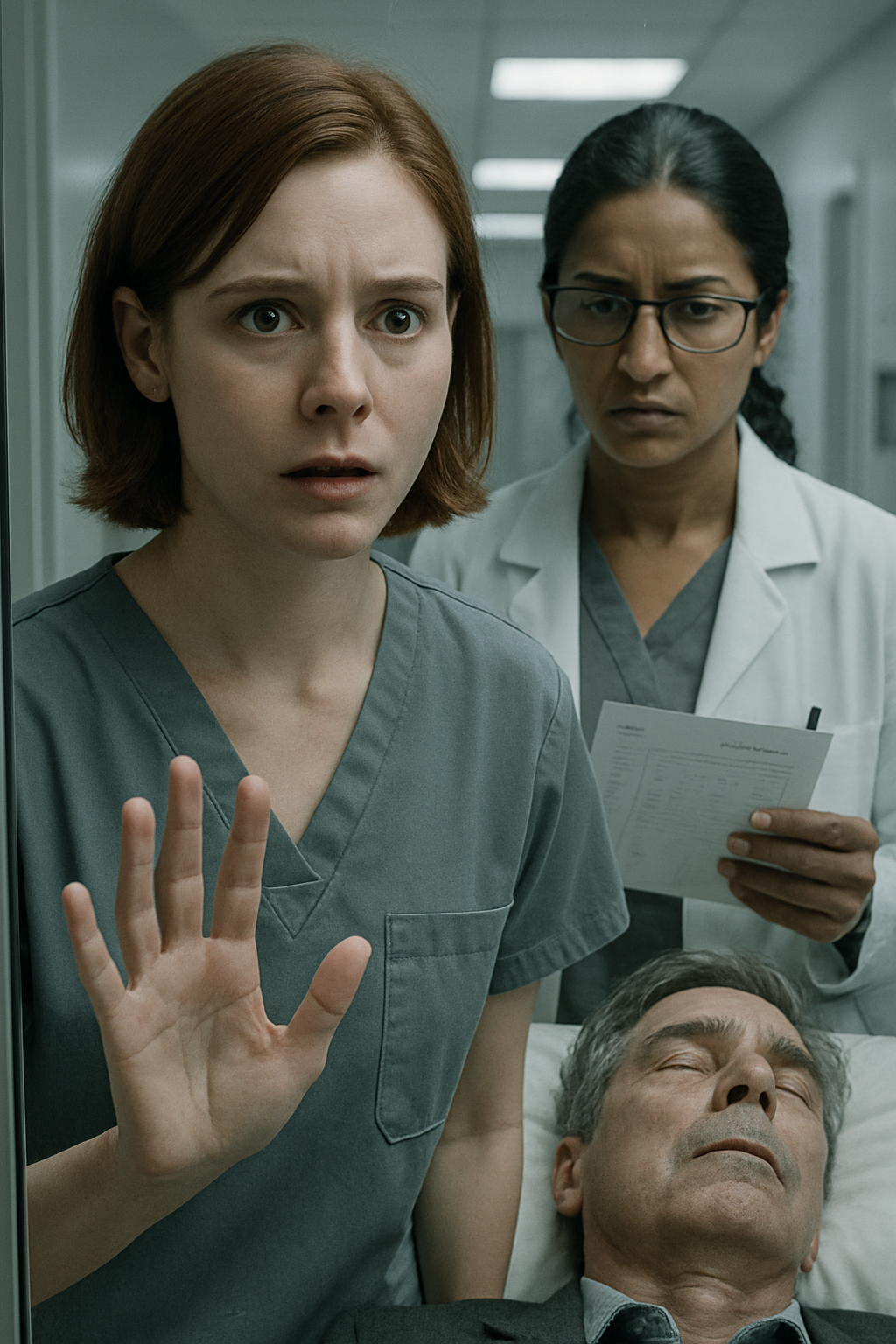
Dr. Priya Nair — forty-four, black hair in a tight braid that started at the nape of her neck and ended between her shoulder blades, white coat with a pen in every pocket, reading glasses pushed up on her forehead like a visor she kept forgetting to use — stopped in front of Mara's chair and looked at her in a way that doctors didn't usually look at donors.
Most doctors looked at donors the way people looked at vending machines. Useful, impersonal, briefly appreciated.
Dr. Nair was looking at her like a colleague about to deliver a result.
"We need to ask you something," Dr. Nair said. "And I need you to answer carefully."
Mara looked at the needle still in her arm. The bag was three-quarters full. She had good veins — another practical quality she had been quietly grateful for most of her adult life. "I'm a lab tech. I can take whatever you're about to say."
Dr. Nair did not waste time. "Do you have any biological family with the last name Ashby?"
The name landed strangely. Not loudly — the way a thing lands when it finds a groove it shouldn't fit into, the key-and-lock sensation of a word that opens something you didn't know was locked.
"No," Mara said. Then: "Why?"
"The patient we're treating for the highway collision — the AB-negative critical — his name is Walter Ashby." Dr. Nair held the clipboard level, reading from it without breaking eye contact. "His blood work came back twenty minutes ago. The compatibility profile between your blood and his is not simply a type match." A pause. "It's a familial pattern. Specific genetic markers. The kind of pattern we see in parents and children."
The bag on the IV stand was still filling. Mara watched it for a moment.
"You said you have no family named Ashby," Dr. Nair said. Not quite a statement. Not quite a question.
"My mother's name is Cole. It's always been Cole."
"And your father?"
The curtain between the donor area and the trauma bay had shifted slightly. Someone had moved it — or maybe the air conditioning had — and through the gap she could see more of the patient. Hands folded across a torn charcoal jacket, because someone on the trauma team had been careful enough to keep his upper body partially covered during the intake. Silver watch on the left wrist. A wedding ring on the fourth finger that caught the fluorescent light.
Silver-streaked dark hair against the white pillow.
A face she had never seen before in her life.
And yet.
The jaw. The particular angle of the forehead. The specific set of the nose — not aquiline, not sharp, just the specific shape she had been looking at in the mirror every morning since she was old enough to notice she didn't quite look like her mother.
"My father left before I was born," Mara said. Her voice came out flat. Professional. The voice she used in the lab when she was reading a result she didn't want to read out loud, when the number meant something and she had to say it anyway. "My mother never told me his last name. She only ever called him by his first name."
Dr. Nair waited.
"Walter," Mara said.
The nurse made a sound — half breath, half syllable — and stopped herself.
Dr. Nair did not react. That was how Mara knew it was confirmed. Good doctors only go completely still like that when they already know the answer and they're watching to see if you know it too.
"He's stable," Dr. Nair said, after a moment. "Your donation helped. He's unconscious and we expect he'll remain so for several more hours — significant head trauma, two fractured ribs, internal bruising. Nothing unsurvivable, but serious." She held the clipboard steady. "His emergency contact is listed as Susan Ashby. His wife. She's been notified. She's on her way."
Mara pulled the needle from her arm herself — carefully, precisely, the way she always did in the lab when the sample was her own, pressing the gauze square down with her thumb without flinching — and stood up.
"Can I see his intake form?" she asked.
"I can't give you his medical records without consent —"
"His date of birth. His home city." Mara kept her voice even. "That's all I'm asking."
Dr. Nair looked at her for a long moment — the assessing look of a physician weighing competing obligations and landing on the human one. Then she turned the clipboard around and held it so Mara could read it.
Mara read it.
Date of birth: March 9, 1968.
Home address: 14 Clearwater Drive, Hadfield, Connecticut.
She had heard that city name exactly once in her life. She had been eleven years old. She had found a box of her mother's old letters in the back of the linen closet while looking for extra pillowcases. She had read the return address on three of them — all the same, all from the same year, all from a Hadfield, Connecticut address — before her mother had come into the room and quietly closed the box and put it back where it belonged and never mentioned it again.
Mara had not mentioned it either. She had been a practical child.
She handed the clipboard back. Her hands were completely steady.
"Thank you," she said.
She walked to the restroom at the end of the corridor, locked the door behind her, sat down on the closed lid of the toilet in the harsh fluorescent light, and called her mother.
Ruth Cole picked up on the second ring, which meant she was awake, which meant she hadn't slept again.
She didn't sleep well anymore. She said it was her back. Mara had stopped pressing her on it three years ago, when she'd understood that the real reason was something her mother was never going to say out loud.
"Mara." Her mother's voice — warm, tired, with that specific texture of someone who had been guarding something alone for a very long time and had grown so used to the weight of it that she'd stopped noticing it was there.
"Mom." Mara kept her voice level. Steady. Lab-voice. "I need to ask you something and I need you to tell me the truth."
Silence.
Not the silence of someone thinking about what to say. The silence of someone who has been waiting for this particular silence.
"What city did you leave when you were twenty-two?" Mara asked.
A longer silence.
"Mara —"
"Mom."
The silence after that was different. It had weight. It had the specific gravity of thirty years of kept-quiet pressing down on a single breath.
"Hadfield," her mother said finally. Just the word. No explanation around it.
"And his last name."
"Mara, why are you asking me this at —" She checked herself. Mara could hear her checking herself. "Why are you asking me this right now?"
"His last name, Mom."
Ruth Cole was quiet for four full seconds. Mara counted them, the way she counted intervals in the lab. The way she counted anything she needed to stay steady through.
"Ashby," her mother said. And then, very quietly, the way someone says a name they have been not-saying for thirty years until not-saying it becomes its own kind of wound: "Walter Ashby."
Mara pressed her thumb flat against the cold tile wall.
"He's in the ER where I work," she said. "Highway collision. He's alive. He's unconscious. He's stable." She paused. "I just donated blood that saved his life. The blood type matched. The doctors flagged a familial marker in the compatibility profile. I saw his face."
Her mother said nothing for a long time.
"Mom."
"I know." Ruth's voice had gone very quiet. The quiet of someone sitting down without meaning to. "I know what you're about to ask."
"Did you ever tell him about me?"
"No."
The word came out clean. Final. Like she had been carrying it ready for exactly this conversation.
"Did he know you were pregnant when you left?"
"He didn't leave." Her mother's voice caught — almost imperceptibly, the way it always caught when she was about to say something she had said only to herself before. "I left. I left because I found out about the other woman. About Susan. He had been engaged to her for two years while we were together. Two years, Mara. I found the ring in his desk drawer on a Tuesday afternoon when I was looking for a pen. I was gone by Friday morning." A pause, long and textured. "When I found out I was pregnant — two weeks after I moved to Providence, before I had a job or a winter coat that fit — I decided he had no right to know. I decided that a man who could do what he did didn't deserve to be told."
Mara closed her eyes.
"You should have told me his last name," she said.
"I know."
"I've been working in the same hospital system as his attending physician for six years, Mom."
"I know."
"He has a wife. He almost certainly has children."
"I know." A breath. "I have thought about this. More than you know."
"And he is lying unconscious thirty feet from where I'm sitting right now."
Ruth Cole made a sound that was not quite crying and not quite not crying. The sound of thirty years exhaling.
"What are you going to do?" she asked.
Mara opened her eyes. Looked at the grey hospital tile. The same grey as her scrubs. The same grey as everything in this building, this night, this particular corridor of her life that she had apparently been walking toward for longer than she knew.
"I don't know yet," she said. "I'll call you later."
She hung up. Sat still for another moment — just the length of one deliberate breath. Then she washed her hands, straightened her collar, and walked back out into the hallway.
It was just past eleven when they moved Walter Ashby to a private room on the third floor.
Mara had gone back to the diagnostics lab, finished her shift notes, countersigned the overnight inventory, and clocked out. She put her coat on. She told herself she was going home.
She took the stairs to the third floor.
The corridor outside room 312 was quiet. The night nursing team was doing its rotation. The overhead lights were on their dimmed evening setting. Through the observation window in the hallway — standard clear glass, not one-way, the kind that existed for safety and not for privacy — she could see the man in the bed.
In the chaos of the trauma bay, she had only seen him through a curtain gap, at an angle, in the harsh overhead light of active emergency medicine. Here, in the softer ambient light of the private room, with the oxygen mask gone and only the IV line and the bandaging at his left temple and the quiet green trace of the cardiac monitor on the screen above him, he looked — ordinary. Expensive-ordinary. The way some men carry wealth so long and so unconsciously that it becomes structural — visible in the posture even when the posture is horizontal in a hospital gown, visible in the way the hands rest, in the particular ease of a man who has never had to hold himself tight against uncertainty.
She kept looking at the nose. She couldn't stop looking at the nose.
The door at the far end of the corridor swung open.
A woman came in first. Mid-fifties. Blonde-grey hair pulled back severely. A structured camel coat over dark trousers, the kind of coat that cost more than most people's monthly rent and was chosen to communicate that without advertising it. Moving with the controlled urgency of someone who had received terrible news and made a decision, somewhere between the car and the elevator, to manage it.
Behind her, a young man in his late twenties. Dark hair. Broad through the shoulders. Jaw set with the particular tightness of a man trying to hold his face together in a public place.
Mara stepped back from the window. Not far. Just enough to make it clear she had not been staring.
The woman — Susan Ashby; she matched the emergency contact completely — pushed through the door of room 312 without slowing. The young man paused in the doorway and said something briefly to the attending nurse, received a brief answer, then followed his mother inside.
Mara stood in the hallway and looked through the glass.
Susan went directly to her husband's side and took his hand in both of hers, the immediate and unthinking gesture of someone for whom that motion had become as automatic as breathing over many years of marriage. The young man stood at the foot of the bed — their son, unmistakably their son, Mara could see it in the line of the jaw and the set of the shoulders — and said something to his mother that made her shake her head once, firmly, the headshake of a woman refusing a particular kind of comfort.
They were a family.
A functional, frightened, clearly intact family gathered around a man they loved in the way families were entitled to love their center of gravity. They had no idea she existed. They had no idea that an AB-negative stranger one floor below had just learned, from a blood test, that she was the person who had kept their family intact tonight.
She was about to turn away.
Walter Ashby opened his eyes.
Not fully. Not dramatically. The slow, labored surfacing of someone coming out of heavy sedation — first the slitted awareness, then the blink, then the gradual assembly of focus. His wife leaned in immediately, squeezing his hand, saying his name. His son moved to the bedside.
And then — not with intention, not with effort, the way a thing happens below the level of will — he turned his head toward the window.
He looked directly at Mara.
His eyes were not yet fully focused. He was still too far inside the sedation for precise vision. But something resolved anyway — the way a camera autofocuses on the nearest point of contrast — and his brow moved. Not in confusion. Something older than confusion. Something that was not quite recognition and not quite not recognition. A man who had been carrying a shape in his mind for thirty years, and who had just seen something that matched it.
Mara held his gaze for three seconds.
One more than she'd intended.
Then she turned and walked away down the corridor, past the nursing desk, through the stairwell door, out into the parking garage.
She had decisions to make.
She needed to make them before his wife came back into the hallway.
She came back at 7 a.m.
Not during visiting hours. Before them, by forty-five minutes. The morning shift was mid-turnover, the corridors carrying that pre-dawn hospital quality she knew well from years of early starts — over-lit and under-populated, smelling of disinfectant and last night's coffee and the specific kind of quiet that only existed in places where urgency was always exactly one call away.
She had spent the night running the logic.
She could walk away. The blood had already done its work before she knew who it was going to. The practical mercy had already been given, without choosing to give it and without knowing to whom. Whatever debt existed between her and this stranger — and she was not certain that debt was a useful word for it, not certain that the architecture of what they were to each other could be mapped onto any familiar structure — it was not a debt that required more from her.
She could tell his wife. She could tell his son. She could walk to the third-floor nursing desk and hand over the blood test flag that Dr. Nair had already documented in the chart — it was already in the record, already a fact, just not yet a conversation — and let the information move the way information moved when it was let loose in a room with people who had been given no warning.
She had considered that option carefully, somewhere around two in the morning, sitting at her kitchen table with a cold cup of coffee. She had considered what Susan Ashby's face might do with the information. She had considered what the young man's face — the son she did not know the name of — might do. She had considered what it meant to hand someone a fact and let it take whatever shape the room made room for.
She had decided, somewhere around four, that she needed to hear it from Walter first.
Not for his sake. For hers. She needed it said out loud by the one person who owed it to her, in a room, with no witnesses, before anyone else got to shape the meaning of it.
Room 312.
She opened the door.
Walter Ashby was awake. Sitting up slightly, the IV still feeding into the back of his hand, the window behind him letting in the flat grey light of an overcast morning. The cardiac monitor traced its quiet green line. His wife and son had not yet arrived — visiting hours still forty minutes away.
He looked at her when the door opened.
He had been expecting her. She could tell immediately — not from any arrangement of expression that said so, but from the absence of surprise in his face. When a man who has just had a head trauma wakes to find a stranger in his hospital room and does not call for the nurse, he has been waiting.
His voice, when it came, was rough from the intubation — low and deliberate, the voice of a man who was choosing each word.
"I know who you are," he said.
Mara closed the door behind her. Pulled the chair from the corner of the room — the visitor's chair, institutional padding, slightly scuffed — and sat down at the side of his bed. Close enough to speak quietly. Not close enough to suggest anything other than this exact conversation.
"Tell me," she said.
He looked at the window. At his hands. At the IV line tracing into the back of his wrist. He was a man who calculated rooms — she could see that even now, even diminished and horizontal, the eyes that moved to the door and the edges of the space before they settled on her, the small invisible inventory of a man who was used to knowing where the exits were.
There were no useful exits from this particular room.
"Your mother's name is Ruth," he said.
"Yes."
"She left in October of 1996."
"She left because she found your engagement ring in your desk drawer," Mara said. "We can skip the passive construction."
He accepted that. His jaw moved slightly — not quite flinching, more the adjustment of a man recalibrating.
"I didn't know she was pregnant," he said. Not quickly — not defensively, which would have been worse. With the flat precision of a man who had rehearsed this sentence for thirty years in the event that he ever needed it, and who was discovering now that the rehearsal had never really been adequate. "She was gone before I knew. I looked for her — I looked for close to a year. She had changed her number, moved out of her apartment, and her sister — the only person in her family who knew me — refused to tell me where she was." He stopped. "After a year I stopped looking."
"And married Susan."
"We were already engaged when Ruth and I were together."
"I know," Mara said. "That's the part that mattered to her."
He closed his eyes for a moment.
"It was not a thing I'm proud of," he said.
"I'm not asking you to perform remorse for me. I'm asking you to tell me the truth."
He opened his eyes. "Yes. I was engaged to Susan. I had been for two years. Ruth didn't know. I kept telling myself I was going to end the engagement. I kept not doing it." He paused. "When Ruth disappeared I told myself she had found out and chosen to go without a confrontation. I told myself she hadn't wanted me to find her. It was — easier to believe that."
"More comfortable."
"Yes."
"Did you have children? With Susan?"
"One. A son. James. He was here last night."
Mara thought about the young man with the broad shoulders and the tight jaw. The one who had stood at the foot of the bed and argued quietly with his mother about something.
"He's younger than me."
"He's twenty-six."
Three years younger. She had three years on the legitimate child. She was not sure what to do with that arithmetic. She set it aside.
"You have money," she said. It wasn't a question. She had looked him up in the small hours on her phone — Walter Ashby, commercial real estate, Hartford and New Haven, board positions, a charitable foundation with Susan Ashby's name in the title.
"Yes."
"My mother worked two jobs until I was old enough to start paying half the bills. She worked as a medical transcriptionist during the day and cleaned offices three nights a week. She did that for eleven years."
He said nothing. There was nothing to say to that.
"I'm not here for money," Mara said. She kept her voice level — not cold, not warm, simply clear. "I want to be specific about that. I don't want your name. I don't want a share of your estate. I don't want an apology that costs you nothing. I have a life. I have a career. I'm a functioning adult who was raised by a woman who never once let me feel the absence of what she couldn't give me." She paused. "I came here because you looked at me through that window last night and you knew. And I needed that to happen in a room. Out loud. From you."
Walter Ashby looked at her for a long moment.
"You're my daughter," he said.
The words landed clean and strange, the way a diagnosis lands when you have already suspected it for days and the confirmation changes nothing about the fact and everything about its weight. Not warm. Not cold. Just — specific. Real in a way that the blood test had not quite been real, the way that only speech made things real.
"I know," Mara said.
"I'm sorry," he said. "I know that's insufficient."
"It is," she agreed. "But say it anyway."
"I'm sorry," he said again. More carefully. "I'm sorry for what Ruth went through. I'm sorry you grew up without a father, and that the reason you grew up without one was something I did." He paused. "I'm sorry I looked for a year and then decided the looking was enough."
Mara sat with that.
"Are you going to tell Susan?" he asked. Not with the edge of a man asking her to protect him — she listened carefully for that edge and it was not there. With the tone of a man genuinely uncertain, genuinely prepared for either answer.
"No," she said. "Not from me. Not today." She stood, pushed the chair back to the corner. "That's not forgiveness. It's not protection either. It's just — not my story to tell to your wife. It's yours. And my mother's. The two of you made a mess between you, and the two of you should figure out what to do with it." She moved toward the door. "If you want to tell her, that's your choice to make. If you want to reach out to me — actually reach out, not manage me from a polite distance — you can. I'm in the system. I work here three days a week."
She had her hand on the door.
"Mara."
She stopped. Turned back.
He looked at her with the expression of a man who has been holding a thing at arm's length for so long that the act of setting it down felt like letting a limb go.
"Thank you," he said. "For the blood."
She looked at him — this stranger with her jawline and her nose and thirty years of owed things standing between them like furniture in a room neither of them had furnished.
"I didn't do it for you," she said. "I didn't know it was you."
She opened the door.
She paused, half in and half out of the room. Not for effect. Because the thing she was about to say was true and she hadn't decided until just now that she wanted him to have it.
"But I would have anyway," she said.
She let the door close behind her.
She called her mother from the parking garage, standing between two cars in the flat morning light.
"I talked to him," she said.
Her mother was quiet on the other end.
"He said he didn't know. He said he looked for you."
"He did look," Ruth said softly. Not defending him — just acknowledging the fact of it, the way you acknowledged any fact you had been holding in cold storage for a long time. "For about a year. I saw him once, from a distance, on a street in Boston. I was with you — you were almost two. I turned around and walked the other way before he could see us." A pause. "I was too proud and too hurt and too afraid that if he found out about you he would find a way to take you from me. I know that doesn't make logical sense."
"It makes human sense," Mara said. "There's a difference."
Ruth exhaled. "What are you going to do now?"
Mara stood in the parking garage. Grey concrete. Grey sky through the open top level. Grey morning coming in around the edges of everything.
"Nothing dramatic," she said. "I'm going to go home. I'm going to sleep for a few hours. I'm going to come back tomorrow and do my job." She paused. "I told him he can reach out if he wants to. I told him it's his story to tell Susan. That's all I've got right now."
"That's more than he deserves."
"Probably," Mara agreed.
Her mother made a sound that was half-laugh, half-exhale — that particular sound that meant something had cracked just enough for the air to get in.
"You saved his life," Ruth said.
"I saved someone's life," Mara said. "I didn't know it was his life."
"Does that matter?"
Mara thought about it. The blood leaving her arm in the donor chair, before she knew. The impersonal, biological generosity of a body that matched another body without asking for context, without requiring the story first, without needing to know who the person was or whether they deserved the gift.
"No," she said. "I don't think it does."
She hung up. Walked to her car. Drove home through the grey morning with the heater on and the radio off.
In her apartment, she took a shower and stood in the steam for a long time. Made coffee. Sat at her kitchen table in the specific quiet of her own space, the space she had built for herself over years of practical choices and deliberate savings, the space that belonged to no one but her.
She had a father now. A living, breathing, silver-haired man in a hospital bed with her jawline and a wedding ring and a life she had not been any part of and a family that didn't know she existed. A man who had looked at her through glass at eleven o'clock at night and known her immediately, thirty years after the fact.
She didn't know what to do with that yet.
She was not certain that she needed to know yet.
The light came in through the kitchen window. Grey first, then, slowly, as the clouds shifted, something edging toward gold.
She drank her coffee.
She had time.
For the first time in this strange and impossible night, she had nothing but time.