PART 1
The intensive care hallway smelled of bleach, cold coffee, and fear.
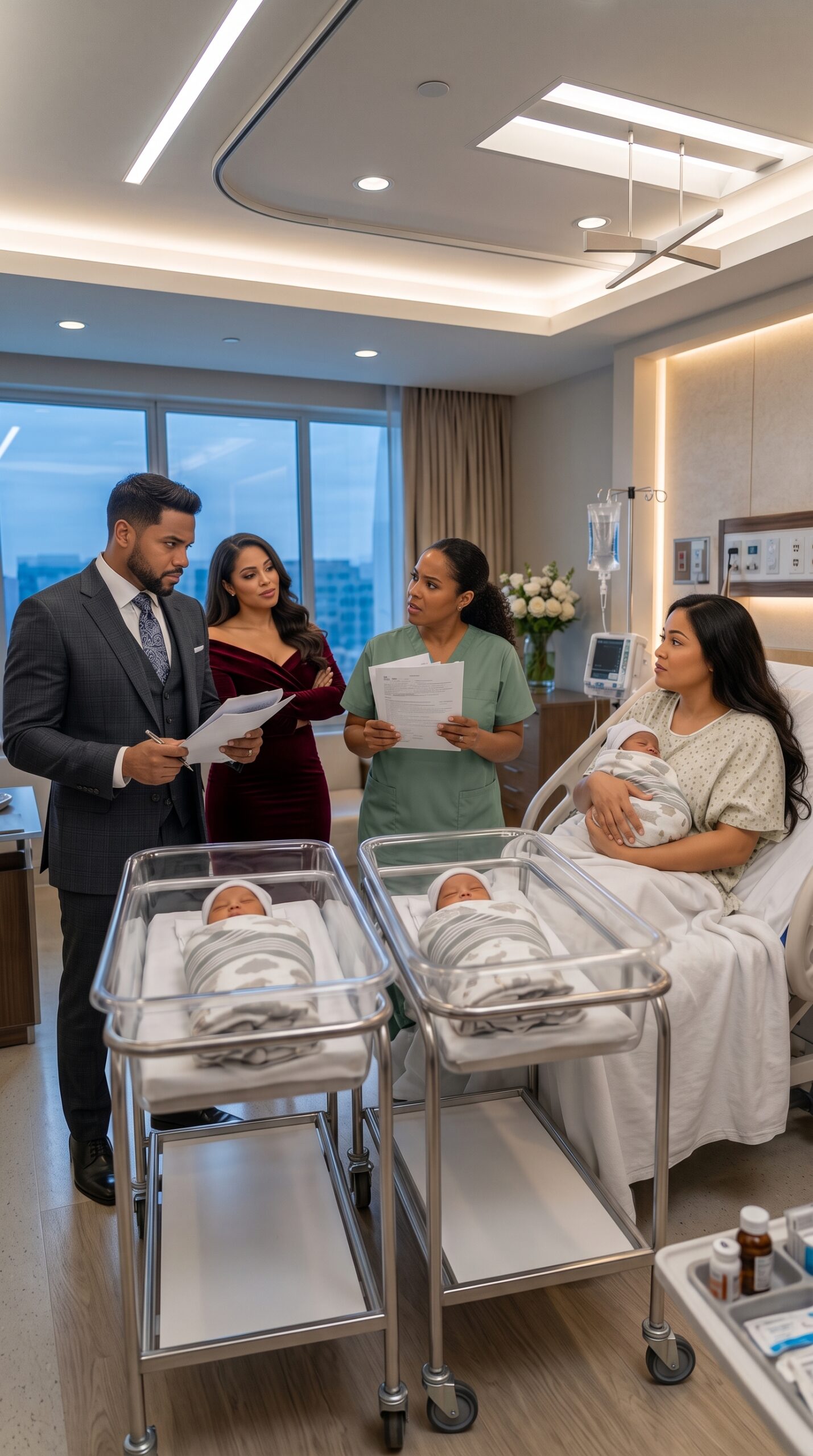
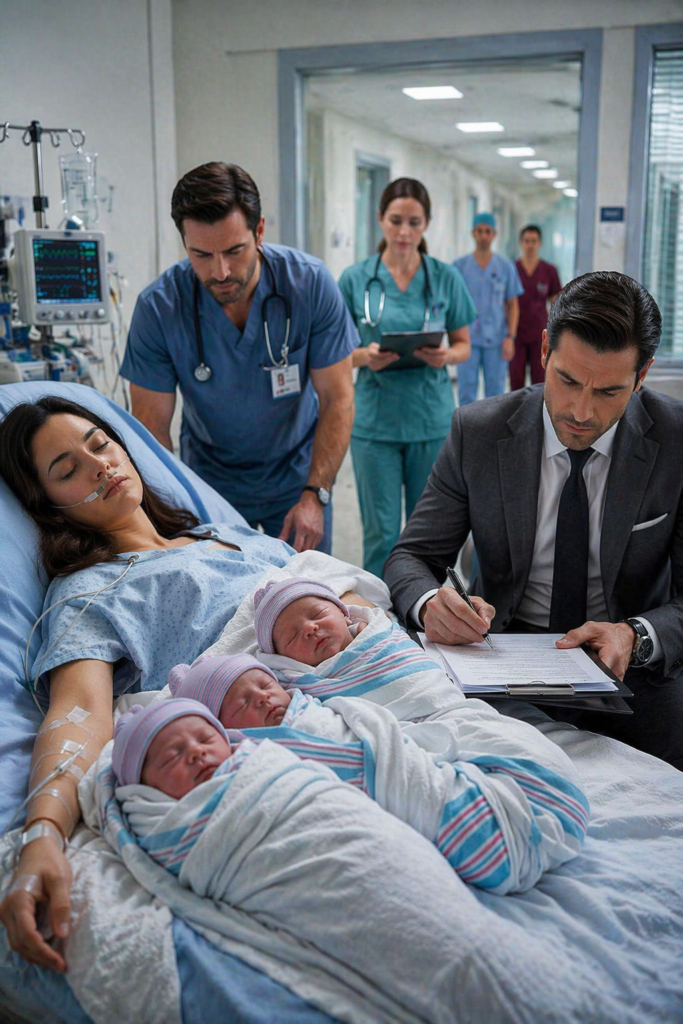
Behind white doors, six doctors fought against time to save Valeria Montes, a 33-year-old architect who had just given birth to triplets in an emergency cesarean.
The children breathed.
She could barely manage.
Her heart had stopped for four minutes.
A machine forced air into her lungs.
Another registered weak, uneven beats, as if her body still couldn’t decide whether to stay or go.
As nurses rushed with bags of blood and medication, outside stood her husband, Rafael Armenta Luján, heir to one of the most powerful construction companies in Monterrey.
He wore an immaculate gray suit, Italian shoes, and had the demeanor of someone waiting for a valet to bring around their car.
He wasn’t crying.
He wasn’t praying.
He wasn’t asking about his children.
He was simply checking his watch.
Beside him, a lawyer with a black portfolio held a thick folder.
“Mr. Armenta, with all due respect… your wife is in critical condition,” the lawyer said, lowering his voice. “Do you really want to sign this right now?”
Rafael didn’t even look towards the intensive care door.
“That’s precisely why, counselor. Before it gets any worse.”
The lawyer swallowed hard.
“This is an expedited divorce due to abandonment of cohabitation and property separation.”
“I know.”
“But she just gave birth to your children.”
Rafael raised his gaze, cold as marble.
“I didn’t come here for a morality lesson. I came to close a problem.”
The pen touched the paper.
A signature.
Another.
One more.
Each stroke felt like it cut something invisible.
Doctor Jimena Rivas emerged from intensive care with her mask hanging and eyes red from exhaustion.
“Mr. Armenta, your wife is still alive, but she’s very delicate. We need family authorization for an additional procedure. There could be kidney failure, internal bleeding…”
Rafael closed the folder.
“I’m no longer her immediate family.”
The doctor blinked.
“What did you say?”
He showed her the freshly signed documents.
“Two minutes ago, I stopped being her husband. Update the records.”
The lawyer turned pale.
A nurse crossed herself silently.
The doctor looked at him as if she had heard a blasphemy.
“Your three children are in neonatology. Do you want to see them?”
Rafael tucked the pen into his jacket.
“I’ll take care of that later.”
Then his phone vibrated.
A message from Mariana, the woman he had been hiding with in hotels in Polanco, appeared on the screen.
“Is it done?”
Rafael smiled faintly.
He replied:
“Yes. I’m free.”
The doctor caught a glimpse of the screen.
And in that moment, she understood she wasn’t facing a frightened husband.
She was facing a man who had been waiting for the exact moment his wife was most defenseless to erase her from his life.
Rafael walked toward the private elevator without looking back.
Valeria remained between life and death.
Her three babies cried in incubators.
And outside, the man who was supposed to protect them had just signed something far more serious than a divorce.
Unbeknownst to him, he had activated a hidden clause in the Armenta family trust.
A clause written in blood, shame, and resentment by his own grandfather.
Designed to destroy any heir capable of abandoning their family in a hospital bed.
PART 2
Valeria awoke three days later.
It wasn’t like in the novels, with soft music and someone holding her hand.
She woke with a dry throat, a stitched belly, a broken body, and a nurse telling her not to move because they had almost failed to bring her back.
The first thing she asked was about her children.
“They’re alive,” Doctor Jimena told her. “They’re tiny but strong.”
Valeria cried silently.
She wanted to get up.
She couldn’t.
She wanted to hold them.
Her arms trembled.
Then she asked to speak with Rafael.
The doctor lowered her gaze.
“Ma’am… there’s something you need to know.”
A hospital administrator entered with a tablet and a too-serious face.
“Your private insurance was suspended 48 hours ago.”
Valeria thought she had misheard.
“What do you mean, suspended?”
“There were also changes to your legal status. You no longer appear as Mr. Rafael Armenta’s dependent spouse.”
The room turned cold.
“Where is my husband?”
No one answered immediately.
The doctor pressed her lips together.
“He signed divorce papers while you were in intensive care.”
Valeria closed her eyes.
For a second, the physical pain didn’t matter.
The cesarean.
The blood.
The needles.
Everything shrank against that betrayal.
“And my children?” she whispered.
The administrator spoke carefully.
“Due to the sudden change in family status and the suspension of coverage, the hospital’s legal department requested an administrative review. It doesn’t mean you’ll lose them, but we need to regularize everything.”
Valeria felt the air being ripped from her.
Rafael hadn’t just abandoned her.
He had left three newborns in legal limbo to save himself trouble, money, and explanations.
That same afternoon, when she still couldn’t walk without help, a nurse lent her a cellphone.
Rafael’s name appeared on the screen.
Valeria answered.
“We need to talk,” he said.
Not a “how are you?”
Not a “did you see the babies?”
Not a “I’m sorry.”
Just that voice of a businessman used to giving orders.
“We have nothing to talk about,” she replied, hoarsely.
“Don’t make this harder. The situation’s gotten out of control.”
Valeria gripped the sheets.
“I died for four minutes, Rafael.”
“But you woke up.”
That phrase hit her harder than any scalpel.
“But you woke up? Is that really all you have to say?”
Rafael sighed.
“Multiple pregnancies are extremely costly. You were delicate. My mom was right: this was going to become a burden for everyone.”
Valeria froze.
There was the truth.
It wasn’t fear.
It wasn’t confusion.
It was contempt.
For seven years of marriage, Valeria had endured the words of Doña Leonor, Rafael’s mother.
“That girl isn’t our level.”
“A little architect from Guadalajara doesn’t join this family for free.”
“She’ll tie you down with kids.”
Rafael never defended her.
He simply said:
“You know my mom. Don’t pay her any mind.”
But he did pay her mind.
Months before the birth, Rafael started coming home late.
Smelling of women’s perfume.
With trips to Querétaro that didn’t appear on the company agenda.
With messages he deleted before going to the bathroom.
Valeria suspected Mariana Solís, an image consultant who had attached herself to the Armenta family like an elegant shadow.
But she had no proof.
Until Rafael made the mistake of talking too much.
“I need you to cooperate,” he said. “If you sign a confidentiality agreement, I can help you with some medical expenses.”
Valeria let out a dry laugh.
“Help me? I’m the mother of your three children.”
“Don’t start with that. There are lawyers.”
“Have you seen the children?”
Silence.
Valeria felt nauseous.
“You haven’t seen them.”
“I’ve been busy.”
“Signing my death, I suppose.”
Rafael hardened his voice.
“Watch how you talk. I can still make this worse for you.”
Valeria looked at the IV bag hanging next to her bed.
It hurt to breathe.
It hurt to exist.
But for the first time in years, she wasn’t afraid.
“You’ve already made it worse, Rafael. Now it’s my turn to survive.”
She hung up.
Twenty minutes later, an older man entered, dressed in a dark blue suit, with a wooden cane and intelligent eyes.
“Mrs. Valeria Montes.”
She recognized him from afar.
It was Don Ernesto Cárdenas, notary and historical advisor to the Armenta trust.
He had worked with Rafael’s grandfather since before the group built its first hotel in San Pedro.
“You shouldn’t be receiving visits,” the nurse said.
Don Ernesto showed an ID.
“This can’t wait.”
He sat next to her bed and opened a brown leather folder.
“Your husband just made the most expensive mistake of his life.”
Valeria looked at him, confused.
“What are you talking about?”
“About the Armenta Trust 1998.”
She furrowed her brow.
Rafael always spoke of that trust as if it were an eternal safe.
Stocks.
Land.
Hotels.
Investments.
The family’s real fortune.
“Rafael’s grandfather, Don Octavio Armenta, left a special clause,” Don Ernesto explained. “Almost no one mentions it because no one believed an heir would be foolish enough to activate it.”
Valeria struggled to breathe.
“What clause?”
The notary lowered his voice.
“Don Octavio lost his first wife to cancer. Not because she died, but because he abandoned her when she fell ill. Years later, he carried that guilt to his grave. That’s why he ordered that no Armenta could retain control of the trust if they legally or financially abandoned their spouse during serious illness, medical incapacity, high-risk pregnancy, or complicated childbirth.”
Valeria felt the monitor speeding up.
“Rafael signed the divorce while I was in intensive care.”
“Exactly.”
“And he took away my insurance.”
“That made everything worse.”
Don Ernesto placed a sheet in front of her.
“Since 9:14 this morning, Rafael Armenta has lost control of his shares, his corporate privileges, his business credit cards, and his vote on the board.”
Valeria couldn’t speak.
“There’s more,” he continued. “The clause also protects the children born during the medical event that caused the abandonment.”
“My babies…”
“Your three children are priority beneficiaries. And you, as the surviving mother and victim of abandonment, can be appointed provisional administrator until they turn 18.”
Valeria turned her face toward the window.
The city continued moving as if nothing had happened.
But within that room, Rafael’s world had just flipped.
Meanwhile, in his penthouse in Santa Fe, Rafael was pouring himself coffee when his black card was rejected for an online purchase.
Then another.
And another.
He called the bank in a fury.
“I’m Rafael Armenta Luján. Resolve this now.”
The executive responded with unbearable calm.
“Sir, your financial access has been suspended by order of the trust board.”
“What board? I am the president.”
“Used to be, sir.”
Rafael froze.
He opened his email.
“TEMPORARY REMOVAL OF FUNCTIONS.”
Another message.
“SUSPENSION OF ACCESS TO CORPORATE ACCOUNTS.”
Another.
“REVIEW OF FIDUCIARY CONDUCT FOR MEDICAL AND ECONOMIC ABANDONMENT.”
His phone rang.
It was Doña Leonor.
“What did you do, idiot?” she shouted as soon as he answered.
Rafael clenched his jaw.
“Mom, don’t start.”
“You activated your grandfather’s clause!”
“That doesn’t exist.”
“Of course it does. Your father hated it all his life, but he could never get rid of it.”
Rafael paced back and forth.
“I just signed a divorce.”
“When?”
He hesitated.
“While Valeria was in intensive care.”
Doña Leonor fell silent.
Then she spoke in a lower, more frightened voice.
“I told you to leave her, not to expose yourself as a monster.”
For the first time, Rafael felt fear.
Not guilt.
Fear.
Of losing money.
Of losing power.
Of losing the surname that always protected him.
He rushed to the trust offices in Lomas de Chapultepec.
Don Ernesto received him without standing up.
“I demand an explanation.”
“You already received it by email.”
Rafael slammed his hand on the desk.
“That fortune is mine.”
“No. You were merely its administrator.”
“I’m an Armenta.”
“Precisely, that’s why you were expected to have more decency.”
Rafael let out a nervous laugh.
“This is ridiculous. Valeria can’t manage an empire.”
Don Ernesto looked at him over his glasses.
“Maybe not. But she does know not to abandon three babies in incubators.”
The blow was clean.
Rafael didn’t respond.
Then the notary added:
“Furthermore, there is an internal investigation regarding personal expenses charged to the group’s accounts.”
Rafael turned pale.
“What expenses?”
Don Ernesto slid several invoices across the table.
Suites in Polanco.
Jewelry.
Trips to Los Cabos.
A monthly rent in Mariana Solís’s name.
“Your mistress wasn’t cheap either, Mr. Armenta.”
Rafael left there with a twisted expression.
That night, he tried calling Mariana.
She didn’t answer.
He texted her.
“I need to see you.”
She replied an hour later:
“My lawyer says it’s not in my best interest to get involved. What we had was a mistake.”
Rafael hurled the cellphone against the wall.
The next day, he arrived at the hospital without bodyguards.
The private parking lot didn’t recognize his license plate.
He had to walk in, sweaty, with a wrinkled shirt and a desperate look.
He found Valeria in neonatology.
She was in a wheelchair, weak but resolute, wearing a light gown and with her hair up.
A nurse was placing one of the babies on her chest.
“His name is Emiliano,” Valeria said softly.
Then she pointed to the other incubators.
“They are Nicolás and Mateo.”
Rafael stood in the doorway.
It was the first time he saw his children.
Three tiny bodies.
Three lives he had treated as administrative obstacles.
“Valeria…” he murmured.
She didn’t turn around immediately.
She kissed Emiliano’s forehead.
Only after did she look at him.
“Now you remember they exist?”
Rafael swallowed hard.
“I made a mistake.”
“No.”
Valeria’s voice came out calm.
That scared him more than a shout.
“A mistake is forgetting to buy diapers. A mistake is being late for an appointment. You signed my divorce while I was dead on a gurney.”
He took a step closer.
“I didn’t know you were going to wake up.”
The nurse lifted her gaze, horrified.
Valeria smiled with immense sadness.
“Thank you for making it clear.”
Rafael understood too late what he had just confessed.
“I didn’t mean to say that.”
“Yes, you did.”
Don Ernesto appeared behind him with two lawyers and a social worker.
“Mrs. Valeria, the board just voted.”
Rafael turned.
“They can’t do anything without me.”
Don Ernesto didn’t even look at him.
“By unanimous vote, Valeria Montes is appointed provisional administrator of the Armenta Trust on behalf of Emiliano, Nicolás, and Mateo Armenta Montes until they reach adulthood.”
Rafael felt the ground disappear beneath him.
“She’s going to manage my family?”
Valeria stroked her baby’s back.
“No, Rafael. I’m going to protect my children from your family.”
Doña Leonor arrived minutes later, wearing dark glasses and a pearl necklace.
She stormed in, furious.
“Valeria, this can be fixed. You’re not going to destroy my grandchildren’s surname.”
Valeria looked at her without resentment, but without fear.
“You yourself said I’m not of your level.”
Doña Leonor pressed her lips together.
“I was angry.”
“No. I was sure. And your son believed it.”
Rafael lowered his head.
His mother, for the first time, couldn’t defend him.
The social worker intervened.
“Mr. Armenta will need to apply for supervised visitation if he wishes to see the minors. For now, the medical and legal priority is the mother.”
Rafael opened his mouth.
Nothing came out.
He had money, but he could no longer buy the scene.
He had a surname, but he could no longer impose silence.
He had lawyers, but in front of everyone, he had left proof of what he was.
Valeria asked that her chair be moved closer to the three incubators.
She looked at her children one by one.
Then she looked at Rafael.
“When you signed those papers outside intensive care, you thought you were shedding a burden.”
He had red eyes.
“Valeria, please…”
“Don’t interrupt me.”
The hallway fell silent.
“You thought that if I died, you could start anew with your lover, your money, and your perfect life. But you didn’t count on something.”
“With what?” he whispered.
Valeria held Emiliano against her chest.
“With the fact that I survived.”
Rafael broke.
Not out of love.
Not yet.
Maybe never.
He broke because he understood that his punishment wouldn’t be a scene, nor a lawsuit, nor a headline on social media.
His punishment would be waking up every day knowing he had three children and a living wife, and still chose to lose them.
Months later, Valeria left the hospital walking slowly, with her three babies in small strollers and a legal escort from the trust.
The press waited outside because Rafael Armenta’s fall had already become a national scandal.
No one knew all the details.
It was only rumored that a millionaire had tried to divorce his wife while she lay dying.
Rafael appeared on the other side of the entrance.
Thinner.
Without a driver.
Without a luxury watch.
With a diaper bag in hand.
“Valeria,” he said. “I just wanted to help.”
She looked at him.
For a second, she almost felt pity.
Then she remembered the message.
“I’m free now.”
And the pity vanished.
“Helping doesn’t erase abandoning.”
Rafael lowered his gaze.
Valeria continued walking.
She didn’t need to shout.
She didn’t need to humiliate him.
The van’s door closed with a soft, definitive sound.
As the vehicle moved along Avenida Revolución, Valeria looked at her three sleeping children.
She had lost blood.
She had lost a marriage.
She had lost her innocence.
But she hadn’t lost her life.
And that was what Rafael never calculated.
That a woman he wanted to erase could come back stronger.
That a mother just out of intensive care could lift an empire if it was for her children.
And that there are men who don’t lose everything when the money runs out.
They lose everything the day they show that, having family, they preferred to be miserable.