The job was simple, the way all impossible things seem simple when you first begin.
Clean the rooms. Don't break anything. Don't ask questions.
Maya Chen had followed those three rules for nine years. She had cleaned every surface of the Caldwell estate so many times she could navigate it in total darkness — the master bathroom with its double marble sink, the library with its wall of leather-bound books no one ever opened, the four guest bedrooms kept perpetually made for visitors who never came, the kitchen where Mrs. Caldwell delivered instructions each morning with the precision of someone who had never needed to raise her voice.
She knew the house the way you know a person you've lived beside but were never properly introduced to. By their patterns. By what they kept. By what they threw away.
The receipt in the library trash was the first thing she had ever found in that house that she couldn't explain away.
She found it on a Tuesday morning in October when the cold had come overnight and the fog sat heavy in the grounds.
Victor Caldwell had left before six — she had heard the car when she arrived at half past. Diana Caldwell had a charity luncheon. Eleanor, their daughter, was in Singapore on a deal that had been running three months.
Maya was alone in the east wing with Petra, who preferred silence in the mornings, and old Mr. Brannagh, who could be found at this hour behind the greenhouse with his thermos of tea.
The east wing in the mornings had a quality she had come, over nine years, to value. The light came through the tall windows in long pale strips across the parquet floor. Everything was exactly where she had left it. Nothing had happened since she left and nothing would need undoing.
She was emptying the wastepaper basket beside the library desk at nine forty-two when she found it.
A receipt. Printed on thermal paper — the kind that stiffens at the fold lines and tears along the creases. Ripped into four pieces. Not carefully — not the deliberate shredding of someone who understood how to destroy a document — but the impatient tearing of someone who wanted it gone without thinking clearly about whether gone and destroyed were the same thing.
She registered it as rubbish. Dropped the pieces in the bin liner. Lifted the bag. Twisted the neck.
She picked up her supplies caddy and walked toward the next room.
She made it to the doorway before she stopped.
She stood there for a moment. Then she set the caddy down, went back to the bin liner, untied it, and took the pieces back out.
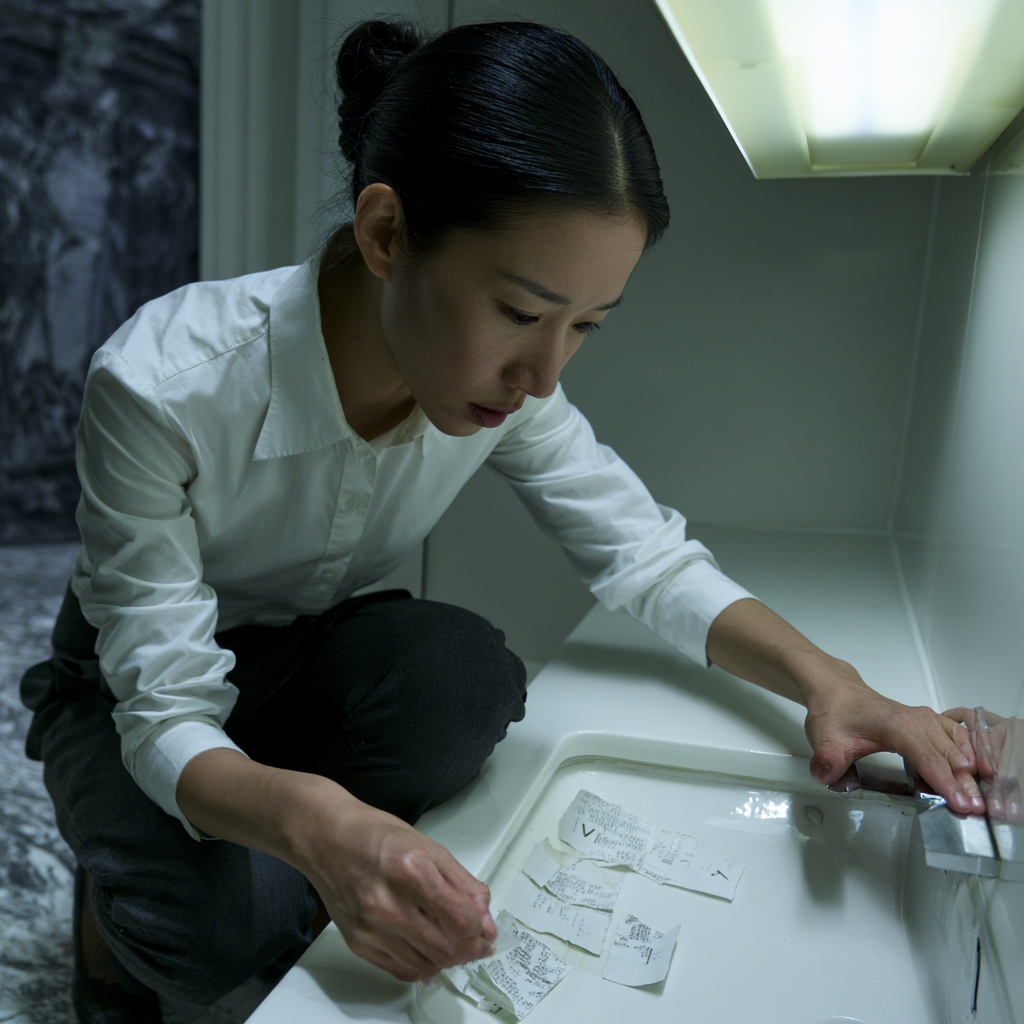
She carried them to the staff bathroom at the back of the house. She locked the door. She laid the four pieces on the edge of the ceramic sink — a sink she had scrubbed herself hundreds of times — and fitted them together with the same quiet care she gave to everything.
The logo at the top belonged to a private genetics laboratory. The service: DNA Relationship Testing. The date: six weeks ago. The client reference line had been torn away — she was missing that corner entirely. But the result section was intact.
RELATIONSHIP CONFIRMED: BIOLOGICAL PARENT-CHILD Match probability: 99.98% Subject identifier: VC-11
She read it.
She read it again.
She looked at herself in the mirror for a moment. Then she looked back down.
VC.
She stood in that bathroom for three full minutes — she knew because she watched the second hand of the wall clock — without moving.
Then she folded the pieces carefully, slipped them into the inside pocket of her uniform jacket, and went back to work.
She was twenty-nine years old and she had been adopted at three days old by a couple in the city — Alan and June Chen, a postal worker and a primary school teacher — who had told her when she was seven in the gentlest, most matter-of-fact way she would later understand had taken considerable thought and love.
'You were chosen,' June had said. 'There was a birth mother who couldn't keep you. That had nothing to do with whether you were wanted. You were very much wanted.'
Maya had accepted this with the equanimity of a seven-year-old whose world was primarily concerned with what was for dinner and whether the school library had the next book in her series. It hadn't shaken her. It had settled into her understanding of herself as one of several facts that were simply true: she was the daughter of Alan and June, she had been born to someone else, and her parents were the people who drove her to school and checked her homework.
She had not, for most of her life, felt any urgency about her biological origins. Her father had died four years ago, a slow illness that gave them time to say what needed saying. Her mother still called every Sunday evening, regular as tide. Maya's life was her own: a degree earned alongside this job through four years of evening lectures, a small flat she was genuinely proud of, a handful of real friendships.
She was not a woman who lived in the past.
But she was not entirely without questions. Medical forms demanded family histories she couldn't provide. There had been a moment, two years ago, at an airport mirror at an angle she wasn't accustomed to, when she had looked at herself and felt the question rise and sit in her chest before she set it down and caught her flight.
The question had always been there. She had learned to work around it. Now it had grown teeth.
She thought about Victor Caldwell's inexplicable warmth — nine years of it, quiet and consistent, never overstepping, simply there.
He had given her two weeks' leave without being asked when her father was in hospital for the last time. He had called on the Monday after — not Diana, not a message through Petra, but Victor himself — to ask how things were going in the careful way of someone who wanted to know but didn't want to intrude.
She had found out only later — through Petra, who had seen it in the household accounts and told her in the manner of someone passing on information they felt they had no right to keep — that Victor had paid a semester of her university fees in her third year, when she had been two weeks from withdrawing due to finances. She had told no one at work. He had simply done it.
He had never mentioned it. She had never found a way to bring it up.
She had put it down to his general decency. Victor Caldwell was a genuinely good man — she had observed this across nine years with the quiet confidence of someone in a position to observe it without illusion. He remembered the names of every tradesperson who came to the house. He asked Petra about her sister's health with what appeared to be actual interest. He was the kind of man who, when he saw something that needed doing, did it without waiting to be asked.
She had attributed his specific kindness to her as an extension of that general quality. She had been grateful and had moved on.
She was having difficulty moving on now.
At lunchtime she sat in the staff kitchen and searched the laboratory's name on her personal data connection — not the household WiFi.
Their website was clean, accredited, professional. Designed, she thought, for people doing something they hadn't told their families about. She read their FAQ:
What does a 99.98% match probability mean for parent-child relationships?
It means the relationship is confirmed. Standard forensic testing requires 99.5% for a positive determination. Our threshold of 99.98% represents the practical maximum given population variation. If your result shows this figure, the relationship exists.
She put her phone away. She drank her tea.
That afternoon she worked through the remainder of the east wing and the main staircase and did not allow herself anything impulsive.
At five forty-five she drove home.
At seven thirty, sitting at her kitchen table, she ordered a home DNA test kit that offered a twelve-day turnaround and discreet, unbranded packaging.
She pressed confirm before she could think about it long enough to stop.
She made herself eat dinner. She washed the plates. She went to bed.
She slept badly. In the morning, she went to work.
The test kit arrived the following day in a plain white envelope. She opened it at her kitchen table before leaving for the estate. Swabbed the inside of her cheek. Sealed the sample in the prepaid return envelope. Put it in her work bag.
She mailed it on her lunch break, walking three blocks to a postbox rather than using the collection tray at the estate.
She told no one. Not her mother, who called Sunday and heard Maya's voice and asked if everything was all right in the way that mothers ask when they already think something isn't. Maya said everything was fine. Her mother paused for a moment and then said she was making a vegetable soup and was Maya sure?
Maya was sure.
She worked for the next twelve days exactly as she had always worked — steady, thorough, invisible. She cleaned the library every Tuesday and Thursday and every time she emptied the wastepaper basket she thought: this is where it started. This is where the before ended.
Victor Caldwell was in the city most of the week. When he was home he was as he had always been: warm, briefly attentive, looking at her sometimes across a room with that particular expression she had spent nine years not thinking about.
She thought about it now.
She thought about it at the estate and at home and on the drive in between, the same question turning over and over: what did it mean to have worked in someone's house for nine years without knowing what you were to them?
And the harder question, the one she kept setting down and picking back up: what did it mean that he had been kind to her without knowing either?
On the twelfth day, at nine fourteen in the morning, an email arrived.
She was in the Caldwell kitchen. Petra was reading out the shopping list. The October sun was low and white through the kitchen windows.
Maya's phone buzzed.
Your DNA results are ready. Click to view.
Petra was still talking. Maya set her coffee mug on the counter.
'I'll be one minute,' she said.
She walked down the back hallway and into the staff bathroom and locked the door.
She sat on the edge of the tub. Her hands were steady. She opened the email.
She read it.
She read it again.
The result was: 49.8% shared genetic material. First-degree biological relative. The report noted in its standard clinical language that this level of correspondence was consistent with a parent-child or full-sibling relationship and inconsistent with any more distant connection.
First-degree.
She sat on the edge of that tub with her phone in both hands and the white October light coming through the frosted window and the sounds of the house continuing around her as they always had — Petra's footsteps in the kitchen, the distant sound of Mr. Brannagh starting the leaf blower on the far side of the grounds — and she understood that she had known, really, from the moment she had fitted those four torn pieces together on the edge of the sink.
She had known. She had needed the number to say it out loud.
She got up. She washed her face. She looked at herself in the mirror.
Then she went back to the kitchen, picked up her coffee mug, and waited for Petra to finish the shopping list.
She finished her shift. She drove home.
She sat at her kitchen table and looked at the results until it was dark.
Then she did the one thing she had not yet done: she checked the matching pool.
She had consented to be found when she had registered — a standard option she had clicked without thinking much about it. She checked now to see if anyone with her DNA overlap had also consented to contact.
There was a match.
Profile name withheld. Relationship: FIRST-DEGREE BIOLOGICAL RELATIVE. Consent to contact: YES.
Maya looked at that line for a long time.
Then she clicked REQUEST CONTACT and sat back and waited to see what would happen next.
She did not have to wait long.
She made the request at ten past nine.
She did not expect a response that night. The genetics service facilitated introductions on their own timeline; she had read the FAQ. The matched individual would be sent a notification, and whether they responded, and when, was entirely up to them.
She got into bed at eleven with the television on quietly in the background and the phone on the nightstand, face-up, the way she left it on nights she was expecting something. She told herself she was not expecting anything. She was being realistic. The match could choose not to respond. The match could take weeks. The match might not even be Victor Caldwell — might be a half-sibling she didn't know about, someone else entirely.
She fell asleep before midnight, which surprised her.
The notification came at seven twenty the next morning while she was making coffee. She read it standing at the kitchen counter with the coffee running behind her.
A first-degree match has accepted your contact request. Their details have been forwarded to your registered email address.
Her email showed a name she had not expected.
Not Victor Caldwell.
The name was Eleanor Caldwell.
She stood at the counter and looked at the name for a long time.
The coffee finished brewing. She didn't pour it.
Eleanor Caldwell was thirty years old. Eleanor Caldwell was Victor Caldwell's daughter. Eleanor Caldwell had been present, in the background of Maya's working life, for nine years.
Eleanor Caldwell was her half-sister.
Or she was — or Victor Caldwell was — and the specific mathematics of it hadn't fully assembled themselves yet. But a first-degree match meant one parent shared. And Eleanor's parent was Victor. And the receipt had said VC.
She poured her coffee. She sat at the table.
The attached contact details listed a mobile number. No message. No context. Just the number.
Maya looked at it for the better part of a minute.
Then she typed: This is Maya Chen. I understand you've accepted a contact request in relation to a DNA match. I'd like to speak with you when you're ready.
She hit send.
She drove to the Caldwell estate, parked in the staff lane, and walked in through the back entrance as she had every morning for nine years, and wondered whether Eleanor Caldwell would be at the main breakfast table this morning, and whether Eleanor Caldwell had known all along.
Eleanor Caldwell was not at breakfast.
She was in Singapore.
Maya cleaned the east wing and the library and the main staircase and the three downstairs hallways and did not check her phone.
At twelve-thirty she checked her phone.
Nothing.
At four fifteen, walking to the staff cloakroom to collect her bag, her phone buzzed.
This is Eleanor. I know. I've known for fourteen years. Can we meet in person? Not at the house.
Maya looked at the message.
She typed back: Yes. When and where?
Eleanor replied within thirty seconds. She was landing at the airport the next morning. She suggested a café, the name and address of a place Maya knew: a quiet corner spot two miles from the estate, the kind of place people went when they wanted to have a conversation no one would hear.
Maya accepted.
She drove home.
She sat at her kitchen table for a long time in the early dark.
She thought about nine years. About the library. About the receipt that had been ripped in four pieces and dropped in a bin liner as if it were nothing. She thought about the precise way Victor Caldwell had always said her name — the pause before it, the weight he gave to one syllable of her — and she wondered how much a person could know without knowing that they knew.
She ate dinner. She washed her plate. She set her alarm for an hour earlier than usual.
In the morning she drove, not to the estate, but to the café.
She arrived at the same time as Eleanor Caldwell.
They looked at each other across the entrance.
Neither of them smiled.
They went inside together, sat at the corner table, and for the first time in nine years of passing each other in the corridors of the same house, they were finally, genuinely, introduced.
The response arrived at seven twenty the following morning.
Maya was standing at her kitchen counter with the coffee running behind her when the email came through.
The name attached to the match was not Victor Caldwell.
It was Eleanor Caldwell.
She stood there for a long moment with the phone in her hand.
Eleanor Caldwell was thirty years old. She was Victor Caldwell's daughter. She was the woman Maya had passed in the corridors of the same house for nine years — occasionally in the same room, occasionally exchanging the kind of brief, courteous words that pass between the family of an employer and the people who work for them.
She was also, if the 49.8% was accurate, her half-sister.
Maya looked at the contact number attached to the match profile. It was a mobile number. No message. Just the number.
She typed: This is Maya Chen. I understand you've accepted a contact request in relation to a DNA match. I'd like to speak with you when you're ready.
She hit send.
Then she drove to the estate and cleaned the house.
Eleanor Caldwell called at four fifteen that afternoon, while Maya was walking to the staff cloakroom to collect her bag.
She answered on the second ring.
"Maya." Eleanor's voice was different from how she sounded in the house — less formal, more careful. Like someone stepping onto ice they had been watching for a long time. "This is Eleanor Caldwell."
"Yes," Maya said. She had walked to the far end of the back hallway, away from the kitchen, away from Petra. "I thought it might be."
A pause. "I've been waiting for this," Eleanor said. "For quite a long time."
Maya leaned against the hallway wall and said nothing. She waited.
"I'd like to meet in person," Eleanor said. "Not at the house. There's a café — do you know the Anchor on Holland Street?"
Maya knew it. Two miles from the estate. A quiet corner spot.
"I know it," she said.
"Are you free tomorrow morning?"
"Yes."
"Nine o'clock?"
"Nine o'clock," Maya said.
After she hung up she stood in the hallway for a moment. Through the kitchen doorway she could see the edge of the table where she ate lunch every day, the window above the sink where she had watched the seasons change nine times.
She walked out through the back entrance, got in her car, and drove home.
Eleanor Caldwell was already at the corner table when Maya arrived the next morning. She was wearing a navy coat. Both hands were wrapped around a coffee cup. She looked up when Maya walked in.
Something happened in her face — something that had been held a long time and was now, at the sight of Maya walking through that door, doing something more complicated than relief.
Maya sat down across from her.
They looked at each other.
"You look like him," Eleanor said at last. Her voice was quiet. "Around the eyes. I've thought so for years."
Maya did not know what to say to that. She said nothing.
Eleanor set her coffee down. "I need to tell you the whole thing before you say anything. Can you hear it first?"
"Yes," Maya said.
"I found out when I was sixteen. I was looking for a passport renewal form in my mother's desk — nothing dramatic, just paperwork — and I found a document from a private lawyer. A private adoption arrangement. My father's name wasn't on it." She paused. "My mother's was."
Maya's hands were still on the table.
"My mother was in a relationship before she met my father. It ended badly. When she found out she was pregnant — she wasn't certain who the father was. She had just agreed to marry my father. She decided the cleanest path was also, she told herself, the kindest. She arranged a private adoption through a lawyer's firm. Paid the fee herself." Eleanor looked at her steadily. "She told my father she'd had a miscarriage. He believed her. He has believed it for thirty years."
Maya said: "He doesn't know."
"He doesn't know," Eleanor confirmed. "Or he didn't. He had a DNA test done recently. I don't know exactly what he found or what he made of it, but — I think he was beginning to suspect something. Something old that he'd never been able to name."
The café was warm around them. Outside, a Tuesday morning was moving past the window the way Tuesday mornings did everywhere.
"The DNA test in the library trash," Maya said.
Eleanor looked at her. "You found it."
"Six weeks ago."
Something moved through Eleanor's expression. "He did the test and then — couldn't face the results. Tore them up." She shook her head slightly. "That's him. He knew and he didn't want to know."
"But he consented to contact in the matching pool," Maya said. "Before he destroyed the receipt."
"He consented when he registered," Eleanor said slowly. "He must have registered and then — changed his mind. Or been afraid." She looked at the coffee cup between her hands. "I submitted my sample eighteen months ago. I put myself in the matching pool and I've been waiting ever since. I knew your name before I heard from you this week. I found the adoption file when I was nineteen — I did my own research. I found your name, your approximate age, the city you were placed in." She looked up. "I just didn't know how to approach you."
"I work in your house," Maya said.
"Yes."
"We have passed each other in the hallway for nine years."
Eleanor closed her eyes briefly. "I know," she said. "I know. I thought — I told myself that if I just — made it easier for you to stay, somehow—" She stopped. "That's not a good reason. I know it isn't."
"What's the real reason?" Maya asked.
Eleanor looked at her directly. Her voice was steady. "Because I didn't know how to start. Because I was twenty and then twenty-five and then you'd been there so long that I thought: if I say something now, she'll know how long I've said nothing. And every year it got harder." She paused. "Until you found the receipt. Until you made the move. And then — I couldn't not answer."
Maya looked at the woman across from her.
Her half-sister.
The word sat strangely. It was true in the way facts were true — provable, specific — but the thing itself hadn't arrived yet. What she felt looking at Eleanor Caldwell was not kinship, not yet. It was something smaller and more careful. The beginning of a question that might, given time, become something.
"What about my birth mother?" Maya asked.
Eleanor reached into her bag and took out a manila envelope. She set it on the table.
"I found what I could," she said. "This was all I was able to locate."
Maya opened the envelope.
Inside was a copy of an adoption document. The kind prepared by a private lawyer's firm, formal and oddly clinical in the way legal documents about intimate things always were. Her birth date. The placement date. A line: Father: unknown to client. Biological mother requested complete anonymity. Father may not be aware of birth.
And beneath that, in a small archival sleeve: a photograph.
A young woman. Dark hair, somewhere between twenty and twenty-five in the photograph, sitting outside somewhere with good light — a garden, a terrace. The photograph was old enough that the colour had gone slightly warm around the edges. The woman was looking not at the camera but slightly off to the side, caught in a moment of thought, a small expression that wasn't quite a smile.
Maya looked at the photograph for a long time.
"She died eight years ago," Eleanor said quietly. "She was living in Toronto. She had a career, a good life. She never — to my knowledge she never went back to find you, but she didn't forget. I found a letter she had written and posted and never sent. It was in the records the lawyer's firm still had. She wrote it when you would have been about twelve." Eleanor paused. "I can get you a copy, if you want it."
"Yes," Maya said. "I want it."
"She didn't know who your father was," Eleanor said. "Or rather — she wasn't certain. There had been someone before my father. She named him in the letter. His initials."
Maya looked up from the photograph.
"VC," she said.
Eleanor looked at her for a moment.
"Yes," she said.
Maya drove back to the estate afterward and sat in the parked car for twenty minutes in the staff lane.
She looked at the house through the windscreen. The same east-wing windows she had looked through from the inside for nine years. The same gravel drive. The same old copper beech at the corner of the garden that Mr. Brannagh complained about every autumn because of the leaves.
She thought about the man inside that house who had — without knowing why — been kind to her for nine years. The tuition fee. The leave without asking. The particular pause before her name.
She thought about the birth mother she would never meet. The photograph in the archival sleeve. The letter written and never sent.
She thought about Eleanor Caldwell sitting across a café table with both hands on her coffee cup and the expression of someone who had been waiting fourteen years for a conversation.
She got out of the car.
She walked through the back entrance.
She went to work.
At five thirty Victor Caldwell came home.
She heard him come through the front door, heard his briefcase go down on the hall table, heard his footsteps cross to the study.
She went to the study door.
She knocked.
"Come in," he said.
She went in.
He was at his desk. Reading glasses pushed up into his silver hair. Papers in front of him. He looked up when she entered, and there was the look — that specific quality of attention, different from how he looked at anyone else in the house.
"Maya." The pause. "It's late."
"I know," she said. "I'm sorry to disturb you."
"You never disturb me." He said it simply, as fact. "What is it?"
She stood in the doorway for a moment.
She had planned something to say. Careful, measured words. A prepared approach that respected the size of what she was carrying.
What she said was: "I need to speak with you. Not the way I normally speak with you in this house." She gestured slightly — herself in the uniform she was still wearing, the door she was still standing in, the invisible line she had stood on the correct side of for nine years. "As something other than your employee."
Victor Caldwell set his papers down.
He looked at her for a long, careful moment.
"All right," he said at last. "Sit down."
She sat.
She took the envelope from her bag.
She set it on the desk between them.
"This is a DNA result," she said. "Mine. And I believe yours."
The study was very quiet.
The copper beech outside moved in the autumn wind.
Victor Caldwell looked at the envelope. He looked at Maya.
He did not say anything.
He reached out and picked it up.
He opened the envelope with the careful precision of a man who had learned, over a long life, that the most important moments were the ones you needed to give time to.
He took out the document. He read it.
He read it once. Then he read it again.
His expression, across the desk, was not what she had expected. She had expected some version of shock — the controlled version, the kind that manifests in very still faces and questions asked in carefully calibrated voices. She had worked for this family long enough to have seen Diana Caldwell manage difficult news in boardrooms and at dinner tables, and she had assumed, without ever consciously thinking it, that Victor would be the same: the well-practiced composure of people who had learned that showing nothing was its own kind of competence.
What she saw instead was something much harder to describe, and much more affecting.
He looked like a man who had been waiting to understand something for a very long time.
He set the document down. He took off his reading glasses. He looked at Maya.
"How long have you known?" he asked.
"Three days," she said. "Since I went to meet Eleanor."
"You've met Eleanor."
"Yesterday morning. She'd been in the matching pool. She found me."
He absorbed this. "And before Eleanor. You found the—"
"The receipt. In the library. Six weeks ago."
He was quiet for a moment. "I had the test done," he said, "and then I couldn't — I couldn't open the results. I left them on the desk for a week. Then I tore them up." He looked at his hands. "A lawyer told me eighteen months ago that there might be — that there was something in old records. A placement. He couldn't find a name. I had the test done because I thought I needed to know." He stopped. "And then I found I wasn't ready to know."
"You consented to the matching pool before you destroyed the receipt," Maya said.
"Yes. I registered. I consented. And then I — lost my nerve." He looked up. "My wife doesn't know."
"I know," Maya said. "Eleanor told me."
Something moved through his face at that. Something complicated and tired.
"Eleanor has known for fourteen years," Maya said.
He closed his eyes.
The copper beech outside moved in the dark.
Maya waited.
After a long moment he opened his eyes and looked at her across the desk, and he said something she hadn't prepared herself for.
"I've thought about you," he said quietly, "since your first week. There was something — something I couldn't name. I thought it was just—" He stopped. Started again. "I thought it was just that I admired you. Your quality. The way you worked." He looked at the document on the desk between them. "I paid for your university fees when you were in your third year. I found out you were about to withdraw. I didn't ask you. I just — did it. And I didn't tell you." A pause. "I've thought about why. I thought it was just my way. But I think — I think some part of me knew something without knowing what it knew."
Maya looked at him.
The man across the desk was her father. This specific, quietly decent, occasionally absent, imperfect man — who had paid for her education without saying so, who had given her leave when she needed it, who had said her name with a pause before it for nine years as if her name were something that mattered — was her father.
She had nine years of impressions of him. None of them had prepared her for this.
"Your wife," she said. "She needs to know."
"Yes," he said.
"This isn't something that gets kept."
"No," he said. "It isn't."
He looked at the document one more time. Then he looked at Maya.
"I'd like to ask you something," he said. "You don't have to answer."
"All right."
"Are you — is there anything you need from this? From me?"
She thought about it.
"I needed to know," she said. "I've always needed to know. That's all." She paused. "I don't want anything from the estate. I'm not here because of what you have. I want you to know that."
Something moved through his expression that was, she thought, relief — and also something else. Something that looked, quietly, like gratitude.
"I know that," he said. "I could see that. I could see that in your first week."
They sat there in the quiet study with the autumn dark outside and the house around them.
"What happens now?" Maya asked.
Victor Caldwell looked at his desk for a moment. Then he looked at her.
"Now," he said, "I go and find my wife. And you—" He paused. "I'd like you to come back. Tomorrow. Or the day after. When the immediate — when there's been time." He looked at her directly. "Not as my employee. As whatever this is."
Maya looked at him.
"Whatever this is," she said.
"Yes."
She nodded.
She stood. She picked up her bag. She walked to the door.
"Maya," he said.
She turned.
He was still sitting at his desk, the document in front of him, the reading glasses he'd taken off still in his hand. He looked, for the first time in nine years, uncertain — not the easy authority she had known, but something younger and less defended.
"Thank you," he said. "For not — for coming here."
She stood in the doorway for a moment.
"Nine years," she said. "I wasn't going to let it go for nothing."
And she went home.
Diana Caldwell came home at eight forty-three.
Maya heard the car on the gravel from the study. She was still in the chair across from Victor, who had not moved in twenty minutes except to fold the DNA document very carefully and set it back on the desk.
They both heard the front door.
Victor looked at her. "Stay," he said. It wasn't exactly a request and wasn't exactly an order. It was something more like asking from the part of a person that doesn't know how to pretend.
She stayed.
Diana came into the study two minutes later. She was still in her coat from whatever she had been doing that evening — a dinner, Maya thought, something social, the kind of thing Diana's calendar was full of. She had her handbag still over her arm. She looked at Victor. Then at Maya.
Her face went very still.
"Diana," Victor said. His voice had no heat in it. It was the very quiet voice of a man who has been sitting alone with something for twenty minutes and has decided what to do. "Sit down, please."
She sat.
What followed was not what Maya had expected.
She had prepared herself for noise. For the controlled version of a scene — the formal legal language, the careful management of narrative, the closing of doors before anything could be said in an unprotected space. She had worked for this family long enough to understand how they managed difficult things.
What happened instead was quieter and more honest and, in a way she hadn't expected, harder to watch.
Victor asked. Diana answered.
She had been young, she said. Twenty-three, twenty-four. A bad year she had mostly recovered from. The pregnancy was confirmed when she had already agreed to marry Victor. She wasn't certain of the timing, wasn't certain of the father. She had decided, she said — and her voice was steady throughout, which Maya thought was the hardest part to watch — that the cleanest thing was also the kindest.
"I arranged it privately," Diana said. "Through a lawyer's firm I had used for something else. I paid the fee. I moved forward. I told Victor I had miscarried."
"I believed you," Victor said.
"Yes."
"For thirty years."
"Yes."
"You let me grieve a child for thirty years," he said, "who was alive. Who was — who was in our house, Diana. For nine years, in our house."
"I didn't know she was in our house," Diana said. "Not at first. Not for the first month." She looked at her handbag in her lap. "When I found out — when Maya came to work for us — I recognised her from the placement document. She was twenty years old. And I—" She stopped.
"You what?" Victor asked.
Diana looked up.
"I thought the best thing I could do," she said, "was make it easier for her to stay. Easier to be near. I spoke to you about the pay, about the leave policy. I encouraged you to — I suggested keeping her on when she finished her degree." She paused. "I told myself it was what I could give, since I couldn't give her the other thing."
The room was very quiet.
"You could have told her," Victor said.
"I know."
"You could have told me."
"I know."
"Diana—"
"I know." Her voice was still steady. "I knew every day that I should. And every day I didn't, it became harder. And then she'd been here five years, and then seven, and then — I thought — I told myself she had a good life. She had everything she needed. I thought—" She stopped. Her composure held. Maya thought she had never seen anything quite like it — the total control of a woman who had decided, a very long time ago, that control was the price of what she had done. "I am sorry," Diana said finally. "I know that's not adequate."
She looked at Maya directly for the first time since she had walked in.
Her eyes were dry. Her posture was as it had always been.
But something was different in her face — something in the architecture of her usual expression had lost its structure, just slightly, the way a building looks different when one load-bearing element is no longer bearing the load.
Maya looked at Diana Caldwell.
She thought about nine years of instructions delivered at the kitchen table. The distant, efficient manner. The way Diana moved through the house as if everything in it — including the people who worked there — were elements of a design that she was responsible for managing correctly.
She thought about the semester at university. About Diana having quietly suggested keeping her on. About every year she had stayed, thinking it was the job and the pay and a sense of belonging she couldn't quite name, and now understanding that one piece of it had been someone else's way of keeping her close.
It was not forgiveness. But it was the beginning, maybe, of understanding what there was to forgive.
Eleanor arrived at nine fifteen.
She came in through the front door with her own key — she still had it from her last stay — and walked into the study and stopped when she saw all three of them there.
She looked at her mother. Then at her father. Then at Maya.
"It's done, then," she said.
"Yes," Victor said.
Eleanor sat down on the arm of the chair near the window — not fully in it, on the edge, the way she had sat on furniture in this house since she was a child, like someone not entirely sure they were allowed to be completely comfortable.
She looked at Maya. "Are you all right?"
"I don't know yet," Maya said. "I think so."
"That's the right answer," Eleanor said.
Victor asked Diana to leave the room. Diana went.
He sat across from Maya at the desk in the quiet of the study.
"I want to ask you something," he said. "And you don't owe me an answer."
Maya waited.
"Nine years," he said. "Knowing what you know now — are you angry?"
She thought about it.
She was twenty-nine years old. She had a degree she had earned. A life she had built. A mother who called every Sunday without fail. She was good at her work and knew it. She had, in this house, been seen — not fully, not in the way she now understood was possible, but seen in a way she had come to value without knowing exactly why.
"I don't know if angry is the right word," she said. "It's more like — I've been a piece of something for nine years without knowing I was in the picture. Now I can see it." She paused. "That's a lot to hold at once."
"Yes," he said. "It is."
"I'm not going to ask you for anything," she said. "I want you to know that clearly. I don't want the estate. I don't want legal recognition or money or any of that. That's not what I came here for."
He looked at her for a long time.
"You have her way of saying what she means," he said quietly. "Your — the woman in the photograph. I don't mean Diana. The woman Eleanor found."
"I know who you mean," Maya said.
"She was extraordinary." He looked at his desk. "I've thought about her over the years. I didn't know she was gone."
"She had a good life," Maya said. "Eleanor did her research."
He nodded. "I'm glad."
They sat in the quiet study for a while. Outside, the copper beech moved in the dark.
"What would you like?" he asked at last. "From this. From — whatever this becomes."
She thought about it honestly.
"I'd like to know you," she said. "Whatever that looks like. I don't need it to look like anything specific. I'd just like the option."
He looked at her.
"That's not very much to ask," he said.
"No," she said. "It isn't."
Diana Caldwell asked for a separation two weeks later.
She moved to the city apartment. Victor stayed at the estate. Eleanor came home more often — which felt, to Maya, like something that had been waiting for permission.
Maya gave her notice on a Friday.
Victor asked her not to go. Not in the way of an employer asking an employee to stay on — in a different way entirely. "There's no reason for you to leave unless you want to," he said. "You have as much right to be here as anyone."
She thought about it for a week.
She handed back her keys and cleared her locker on a Friday afternoon.
She came back the following Sunday for dinner.
Not as staff.
The table was set for three — Victor, Eleanor, Maya. The good china. Candles. The particular quiet of a house that has had something difficult pass through it and is now, cautiously, beginning again.
Victor looked at her across the table. "You'll have to tell me what you've been doing for nine years," he said. "I know the work. I don't know the rest."
"That could take a while," Maya said.
"We have time," Eleanor said. She said it with the particular firmness of someone who has spent a long time being glad of something that has finally arrived and intends to make use of every bit of it.
Maya looked at the two of them. These people who had been the background of her adult life and were now, improbably, its foreground.
She picked up her fork.
"Ask me whatever you want," she said.
For the first time in nine years she sat down to dinner in that house as someone who was invited to stay.
After dinner she helped carry the plates to the kitchen.
It was an automatic motion — nine years of habit — and she almost stopped herself, almost redirected it, and then thought: no. This is still a house. Carrying plates to the kitchen is still just carrying plates to the kitchen.
Eleanor appeared at her elbow with the wine glasses. "You don't have to do that."
"I know," Maya said. "I'm doing it anyway."
Eleanor looked at her for a moment. "This is going to take some getting used to," she said.
"Yes," Maya said. "For everyone."
They stood at the kitchen sink, side by side, rinsing plates the way people rinse plates after dinner in houses where the work gets done together. The kitchen Maya had eaten a hundred lunches in. The window above the sink where she had watched nine years of seasons turn.
"She left a letter," Eleanor said. "Your birth mother. She wrote it when you were twelve and she never sent it. I told you I'd get you a copy. I'll get it this week."
"Thank you," Maya said.
"I found a few photographs too," Eleanor said. "More than the one I showed you. From different years. I'll bring them."
They finished the dishes in silence.
Not an uncomfortable silence. The silence of two people who have a great deal to say to each other and have understood, without discussing it, that they have time.
On the way home Maya pulled over on the road a mile from the estate and sat with the engine running for a while.
She thought about her mother — June, who called every Sunday, who had loved her without reservation from three days old, who had sat beside her father's hospital bed four years ago and held his hand and said everything that needed to be said, and who still made vegetable soup on Sunday afternoons even though there was only one person to eat it.
She had not told her mother any of this. She had not known how to begin.
She picked up her phone.
It was ten past ten. Her mother was almost certainly awake — Sunday was Sunday but Saturday nights were different.
She called.
Her mother answered on the second ring.
"Sweetheart. It's late."
"I know," Maya said. "I know it is. I just — I wanted to hear your voice."
A pause. Her mother's voice, when it came back, was the voice of a woman who had known her child for twenty-nine years and could hear in four words that something had shifted.
"Are you all right?"
"Yes," Maya said. "I am. I just have something to tell you. Not tonight — not on the phone. Can I come this week? This week sometime?"
"Any time," her mother said. "Any time at all. Thursday? I'll make the soup."
"Thursday," Maya said. "Yes."
She hung up.
She sat with the engine running in the dark, the road ahead of her empty, the lights of the city a faint glow on the horizon.
She thought about the photograph in the archival sleeve. The young woman looking off to the side, caught mid-thought. She thought about a letter written to a twelve-year-old girl and never sent, sitting in a lawyer's filing cabinet for seventeen years.
She thought about the man at the head of the dinner table who had said her name with a pause before it for nine years without knowing why.
She thought about Eleanor at the kitchen sink, side by side, rinsing plates.
She put the car in gear.
She drove home.
She was twenty-nine years old and she was not the person who had arrived at the Caldwell estate nine years ago — not in any way that mattered. But she understood something now that she had not understood that morning: that a life can hold more than one true thing at once, that a family can be made and found and remade, and that the things you didn't know you were looking for are sometimes the ones that find you first.
She parked outside her flat. She sat for a moment.
Then she went inside.
She made a cup of tea.
She read the birth mother's letter, which Eleanor had sent as a scanned PDF while they were doing the dishes, quietly, without making anything of it.
She read it twice.
She did not cry. But she sat at her kitchen table for a long time with the tea going cold and the document on the screen and the October dark outside the window, and she was — she thought, carefully, trying to find the right word for it — glad.
She was glad she had opened the bin liner.
She was glad she had fitted the pieces together.
She was glad she had pressed confirm.
She was at work on Monday morning at the usual time.
She walked in through the back entrance — habit — and went to the staff cloakroom, and then stopped.
The key in her pocket was no longer a work key. She had given it back on Friday. She had let herself in this morning because the back door was unlocked, because it always was in the mornings when Mr. Brannagh came in at seven.
She stood in the cloakroom for a moment.
Then she went to the kitchen, made herself a cup of tea, and sat at the kitchen table and waited.
Victor Caldwell came down at eight fifteen, earlier than usual. He stopped when he saw her at the table.
"You came back," he said.
"I said I would."
He sat down across from her at the kitchen table — not at the head of the table, not in the place that was his by habit and inheritance, but across from her, like a person sitting down to talk to another person.
"I spoke to my lawyers yesterday," he said. "About the formal aspects. I'm not going to push anything on you that you haven't asked for. But I wanted you to know that the option is there. Whatever you want to be acknowledged — legally, on paper, for practical purposes — I'll make it happen if you decide you want it."
"I know," Maya said.
"You don't have to decide now."
"I know that too."
He looked at her. "What would you like to do today?" he said.
It was such a specific question. So different from nine years of implicit assumption — she was here to work, the work was obvious, the work was already known.
"I don't know," she said. "What does a person do when they find out this sort of thing and then come back the Monday after?"
He thought about it seriously. "I think," he said slowly, "they have another cup of tea. And then they figure out what happens next."
Maya looked at him.
She stood up, turned to the kettle, and put it on.
It was a Monday morning in October. The October light was coming through the kitchen windows in the particular way she had watched it come through for nine years. Mr. Brannagh was already on the grounds. Petra would be in at nine.
She made two cups of tea and sat back down.
They sat at the kitchen table together as the house woke up around them, and talked — not about the DNA test or the lawyers or what came next, but about ordinary things, the way you do when you are still figuring out the shape of something new.
Outside, the copper beech dropped its leaves in the thin October sun.
Inside, for the first time, the house felt like it might, eventually, be hers as well.