The phone rang at 6:47 in the morning.
Ruth Santos had already been awake for an hour. That was her habit — up before the buses ran, coffee made, uniform pressed, bag by the door. Fifty-four years old and still running on the schedule she had set herself at twenty-three, when she had first learned that the only things she could count on were the things she arranged herself.
She did not know yet that it was the last Tuesday she would arrive at the Langley house as an employee.
She did not know yet that everything was about to change.
She just knew the 7:15 bus, the twelve-minute walk from the stop on Fairview, and the spare key that Mr. Langley had pressed into her palm nine years ago with both hands wrapped around hers, the way old men do when they mean something more than what they are saying.
The Langley house sat at the end of a long driveway lined with plane trees that were older than the house itself. It was the kind of house that had been built when money meant stone and silence — three storeys, ivy on the east wall, a garden that Ruth kept trimmed to an inch of perfection every other Friday. From the outside it looked like the kind of place where nothing could go wrong.
Ruth had learned otherwise.
She unlocked the front door at 7:28. The alarm did not chirp.
That was the first thing wrong.
Mr. Langley always set the alarm at night — not because he was afraid, he had told her once, but because the sound of it disarming in the morning gave him something to do. "Old men need small rituals," he had said, pushing his reading glasses up to his forehead the way he always did when he was thinking out loud. "Otherwise the day has no edge to it."
The alarm was already disarmed. Or it had never been set.
Ruth set her bag on the hall table. She called out, the way she always did: "Mr. Langley? It's Ruth."
Silence.
She was not worried. Not yet. He was seventy-one and he slept poorly, and sometimes he simply forgot the alarm. She had learned not to catastrophize the small departures from routine — there had been too many of them over nine years, and most of them meant nothing.
She hung her coat. She went to the kitchen to begin the coffee.
The kitchen was untouched. His glass from last night was still on the counter, half-filled with water. His book was open on the kitchen table, a Post-it marking a page — she recognized the title, something about the geology of the Scottish Highlands that he had been working through for three weeks. His reading glasses were not on the table beside the book.
They were on his forehead. Which meant he had fallen asleep reading, the way he sometimes did in his study armchair, and had simply not made it to bed.
She went to the study.
The door was half-open.
She pushed it the rest of the way.
Edward Langley was at his desk.
He was seated upright in his leather chair, his head tilted slightly to the left, his right hand still loosely holding a pen. His reading glasses were pushed up on his forehead. He was wearing his navy cardigan — the one he wore every morning, the one she had mended twice at the left elbow because he refused to replace it.
He looked, for one brief and terrible moment, like a man who had simply paused mid-thought.
Then Ruth saw the stillness of his chest. The particular colour of his face. The pen on the desk — not writing, just resting there, held by fingers that had stopped.
She crossed the room in three steps.
She pressed two fingers to the side of his neck the way she had been taught in a first aid course twenty years ago. His skin was cool. Not cold — not the cold of winter — but the cool of a fire that had been out for some hours.
She stood there for a moment. Just a moment. She let herself have that moment.
Then she took out her phone and called 999.
While she waited for the ambulance, she stood in the doorway of the study. She did not go back inside — she did not want to disturb anything, in case they needed the room undisturbed, and she was not sure she could look at him again just yet.
But from the doorway she could see the desk.
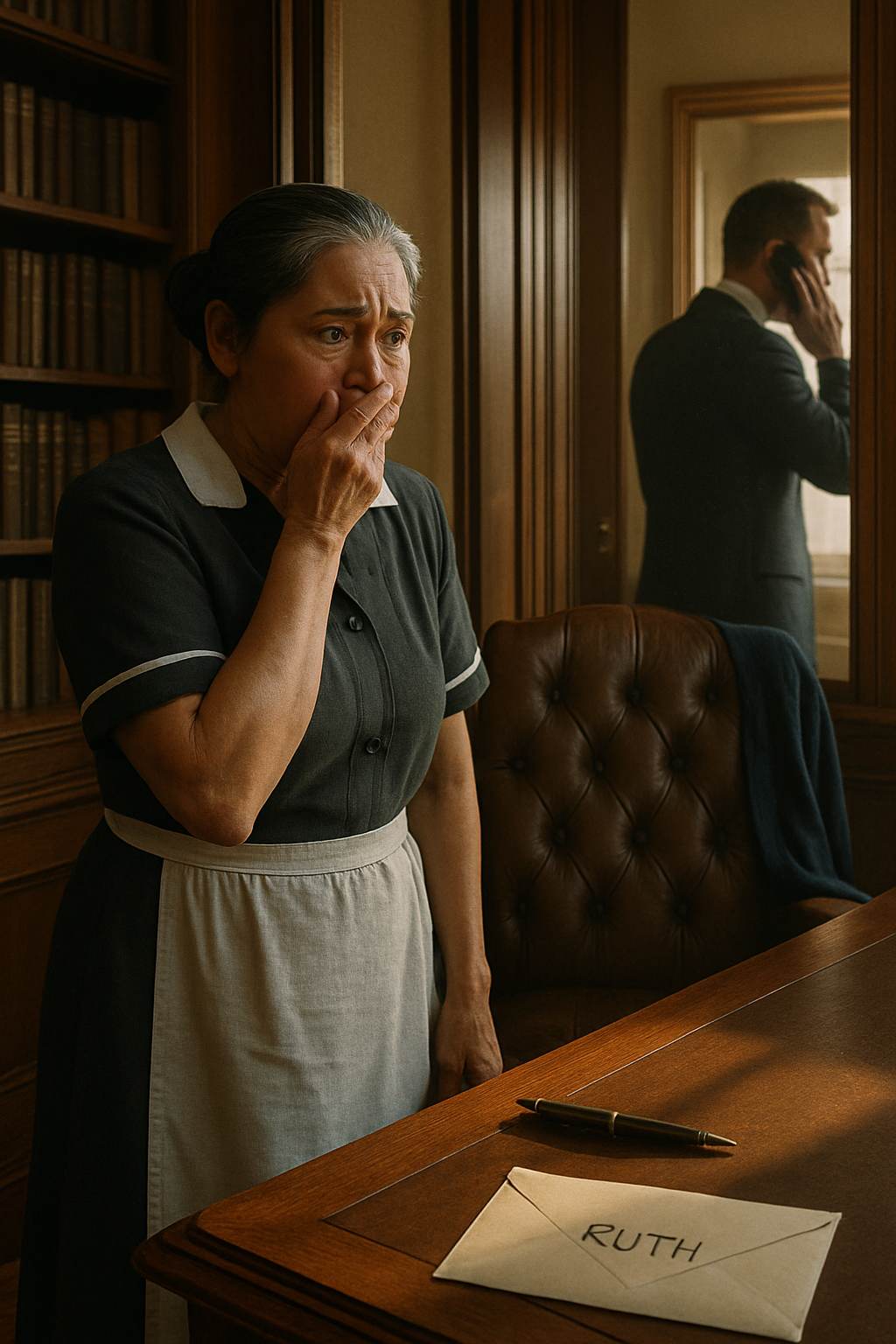
And on the corner of the desk, placed with deliberate care, was an envelope.
It was a good cream-coloured envelope, the kind he used for personal correspondence. Her name was written on it in his handwriting — the careful, slightly forward-slanting script she knew from nine years of notes left on the kitchen counter, grocery lists pinned to the fridge, the occasional card on her birthday and at Christmas.
RUTH.
Not Ms. Santos. Not Ruth Santos. Just Ruth, in letters that looked like he had pressed down harder than usual, like he wanted to make sure.
She did not go back in to get it.
She stood in the doorway and looked at it and listened to the sound of the plane trees in the wind outside and waited for the sirens.
The paramedics came at 7:51. They were kind and efficient and they confirmed what she already knew. The lead paramedic — a young woman with her hair in a tight braid — asked Ruth several questions in a gentle, practiced tone, and Ruth answered each one clearly and completely, because that was what she did. She was not hysterical. She was not numb. She was present, the way you have to be when you are the only adult in a room where something important has just happened.
The young paramedic asked if there was family to contact.
"He has two children," Ruth said. "Victor and Helen. I can find their numbers."
"Are you family?"
Ruth considered the question for a moment longer than she probably should have.
"No," she said. "I'm his housekeeper."
The paramedic nodded and made a note, and something in the way she did it — something ordinary and final, the stroke of a pen reducing Ruth to a category — made Ruth breathe a little more carefully through her nose.
She found Victor's number in the small leather address book Mr. Langley kept in the top right drawer of the hall table. She called him. He answered on the fourth ring, his voice the particular aggressive blankness of a man interrupted mid-task.
She told him what had happened. She was clear and concise.
There was a pause.
"Right," Victor said. "We'll be there in an hour."
He did not ask if she was all right.
She went back to the study after the paramedics had done what they needed to do. The envelope was still there.
She picked it up. She held it.
She put it in the inside pocket of her coat.
She did not open it. Not yet. She wasn't sure why — some instinct that told her this was not the right moment, that whatever he had written required more stillness than she currently had access to.
Victor arrived at 9:14. Helen at 9:31.
Victor came in like a man arriving at a business meeting that had been called without sufficient notice — dark suit, expensive haircut, phone already in hand before he was through the door. He was forty-five and looked it, in the way that certain kinds of men look their age in their jaw and their eyes even when the rest of them is well maintained.
He looked at Ruth standing in the hall.
"You found him?" he said.
"Yes," Ruth said. "I'm sorry for your loss, Victor."
He nodded, already moving toward the study. "Is the study accessible?"
"The paramedics have finished. Yes."
He went past her without another word.
Helen arrived seventeen minutes later, highlighted blonde hair immaculate, pearl earrings, the kind of composure that required visible effort to sustain. She looked at Ruth with the particular expression Ruth had learned to recognize over nine years — not unkind, exactly, but faintly absent, as if Ruth occupied a category of person that Helen's social architecture did not require her to fully register.
"Ruth," Helen said. "Thank you for calling."
"I'm very sorry," Ruth said.
"Yes." Helen pressed her lips together. "Where is he?"
"His study. Victor is there."
Helen went. Ruth stayed in the hall.
She could hear them, faintly — not words, just the register of voices. Victor's clipped, managerial. Helen's slightly higher, slightly tighter. The sounds of people working out who was in charge.
Ruth went to the kitchen and made tea.
She had made tea in this kitchen approximately nine hundred and thirty-six times. She knew where everything was without looking. She knew that the kettle needed two minutes after it clicked off or the tea steeped bitter, and that Mr. Langley took his with a half-teaspoon of sugar but always claimed not to, so she had simply added it quietly for nine years without comment.
She stood at the kitchen window with her own mug and looked at the garden.
The apple tree in the far corner needed pruning. She had been planning to do it Friday.
She didn't know, standing there, whether she would be doing it Friday. She didn't know, standing there, what came next for her at all.
At 10:23, Victor's phone rang.
Ruth heard it from the hall — she had brought their tea through and set it on the table in the study, and was leaving when it rang. She paused outside the door, not eavesdropping, just paused.
"Langley," Victor said, the way he always answered his phone.
A pause.
"Yes, that's correct." Another pause, longer. "I — who?" His voice shifted. "Why?" A beat. "Right now?" His tone had changed completely — the efficient blankness gone, replaced by something sharper, something that had edges on it. "I'll call you back."
Ruth walked away from the doorway.
Two minutes later, Victor appeared in the hall.
He was looking at her differently.
Not unkindly — that wasn't quite it. More the way a man looks when he has just learned that something he assumed was furniture has been watching him the entire time.
"That was my father's solicitor," he said.
Ruth said nothing. She waited.
"He needs to speak with both of us." Victor's jaw was very slightly tight. "You and me. Together."
"All right," Ruth said.
"Did my father speak to you about his estate?"
Ruth met his eyes. "No," she said.
It was the truth. Edward had never once spoken to her about money or property or what would happen when he was gone. They had spoken about his health — she had driven him to appointments and knew the medications in his bathroom cabinet — and they had spoken about the garden, and about books, and about the particular difficulty of getting older in a house that had been built for a larger life. But he had never mentioned his will.
Victor studied her for a moment. Then he turned and went back toward the study.
Ruth put her hands in her coat pockets. Her left hand found the envelope.
She held it there, unopened, and waited.
The solicitor's name was Mr. Okafor. He arrived at eleven in a charcoal suit and a manner of such meticulous professionalism that Ruth suspected it was doing a great deal of work to keep the room's temperature stable.
He set up at the dining room table. Victor sat at one end, Helen beside him, both of them with the slightly compressed look of people who have been managing logistics all morning and are now required to sit still. Ruth sat across from them, her coat folded over the back of the chair, the envelope safe in its inner pocket.
Mr. Okafor opened his folder.
"Mr. Edward James Langley," he began, "last amended his will fourteen months ago. I witnessed the amendment myself. He was of sound mind and clear intention." He let that sentence settle before continuing. "The estate, in its entirety, is straightforward in some respects and — I suspect — surprising in others."
Helen leaned forward slightly. Victor's hands were flat on the table.
"The investment portfolio and cash holdings," Mr. Okafor continued, "are divided equally between Victor and Helen Langley. The value at last assessment was approximately four point two million pounds."
Victor exhaled. Helen's shoulders dropped a fraction.
Mr. Okafor turned a page.
"The property known as Langley House — including all contents, the grounds, and any associated structures — is bequeathed, in full, to Ruth Emiliana Santos."
The room went very still.
Ruth heard the words. She heard them clearly, individually, in order. She understood each one. She sat completely still, her hands folded on the table in front of her, and she kept her face quiet.
Victor made a sound that was not a word.
Helen said, slowly: "I'm sorry — what?"
"The property," Mr. Okafor said, without changing his tone, "is bequeathed in full to Ms. Santos."
"That's —" Victor stopped. He started again. "That's the primary asset. That house is worth —"
"One point eight million, as of last valuation," Mr. Okafor said. "Yes."
"She's the housekeeper," Helen said, and the word came out with more force than she'd probably intended, sharp at the edges, and she heard it herself and pressed her lips together.
"She is named as the beneficiary," Mr. Okafor said. "Mr. Langley left a letter of explanation, to be read in private by Ms. Santos. He also left a letter for both of you, which I have here." He produced a second envelope from his folder. "He anticipated questions."
Victor's chair scraped back. Not dramatically — just a few inches, a physical expression of the need for space. "I'm going to contest this," he said. "This isn't — he wasn't — fourteen months ago his cognition was —"
"I conducted the capacity assessment myself," Mr. Okafor said. "He was fully competent. The amendment is legally sound."
"He left her the house." Victor's voice was flat in the way that very controlled anger sounds flat. "He left her the house. We haven't lived here in twenty years, and he left it to the woman who cleaned it."
Ruth looked at him. She did not look away.
"She wasn't just cleaning it," she said.
It was the first time she had spoken since Mr. Okafor began.
Victor looked at her as if she had said something in a language he didn't speak.
"He was living in it," Ruth said. "Every day. He was living in it and I was the only other person who was here."
Helen made a sound — small, caught in her throat. Her eyes were bright. She was about to cry, Ruth could see, the kind of crying that is more about being in front of a camera than about grief, but perhaps that wasn't entirely fair. People cried for complicated reasons.
"I'd like to read my letter in private," Ruth said to Mr. Okafor.
"Of course." He gathered his papers. "I'll step out."
Victor stood. "This isn't over," he said.
"I understand," Ruth said.
He left the room. Helen followed, one hand pressed to her mouth, pearl earrings catching the midday light.
Mr. Okafor set the envelope on the table in front of Ruth — a different envelope, this one bearing her name in Mr. Langley's handwriting, from the folder — and then quietly withdrew.
Ruth was alone in the dining room.
She had two envelopes now. The one from the desk, which she had carried in her coat pocket for four hours. And this one, which the solicitor had brought.
She opened the solicitor's envelope first.
Dear Ruth,
By the time you read this, I will have thoroughly inconvenienced everyone in my vicinity, which was not entirely unintentional.
I am leaving you the house because you are the only person I know who has genuinely lived in it. I don't mean that as a slight against my children — it is simply a fact. Victor and Helen have their own lives, their own homes, and I have spent years being grateful for that, even when it was lonely. Especially when it was lonely.
You have been here. Every Tuesday and every Friday and every other day I called you for something I could not fix myself. You know where the leak in the second bathroom comes from. You know the apple tree needs to be cut back in January or it goes wrong by April. You know that the alarm code is my wife's birthday, which I have never changed because I am a sentimental old man who should have spoken more honestly to the people he loved.
My children are provided for. I have thought about this carefully.
I am leaving you the house because houses should belong to people who know them. And because you have given me nine years of your life, quietly, without complaint, and never once made me feel like a burden or a duty or an inconvenience. That is rarer than I can tell you.
There is something else. The second letter — the one you have been carrying in your coat all morning (I knew you would find it on the desk and I knew you would not open it there, because you are more patient than I have ever been) — that one is different. That one is for you alone. Read it when you're ready. Take your time.
I am sorry for the inconvenience with Victor.
You were more than a housekeeper. I hope you knew.
Edward
Ruth set the letter down.
She sat for a very long time in the dining room. She could hear Victor's voice somewhere in the house — on the phone, probably, the particular staccato of a man mobilizing resources. She could hear Helen in the sitting room, doing the quieter version of the same thing.
She reached into her coat pocket.
She took out the other envelope.
The one he had written himself, in the last hours of his life, that he had placed on the corner of his desk where she would find it.
She opened it.
Ruth —
I'm writing this at half past midnight. I can't sleep, which is not unusual, and I've been sitting here thinking about things I should have said.
I want to tell you about Margaret.
My wife. You know the broad strokes — she died twenty-three years ago. Cancer, quickly. The children were teenagers. I did a poor job of it, the grief. I went somewhere interior that I couldn't find my way back out of, and by the time I tried, Victor and Helen had built their lives around the fact of my absence. I don't blame them for the distance. I created it.
What I have never told anyone — not my children, not Mr. Okafor, not anyone — is why I never sold this house.
Margaret loved this house. Not because it was valuable, but because she said it had good light. She said that in a specific way that meant something to her about a place being alive, the way she was alive. She died in the small bedroom at the top of the stairs with the east-facing window, and for a long time after I couldn't sleep there. I slept in the study. Sat at this desk. Wrote letters I never sent.
Nine years ago — the Tuesday you first came — I had been alone in this house for fourteen years. I had let the garden go. I had let several things go. You rang the bell and you had a reference from the Cavendish family and you shook my hand and looked me directly in the eye and said, "I understand you need reliable help."
I did not know then how true that was.
You did not treat me like a problem to be managed. You did not treat me the way the care agencies sent people who looked at me with practiced patience. You treated me like a man who lived in a house, and you helped me live in it.
I noticed you, Ruth. All nine years, I noticed.
The way you prune the apple tree — you talk to it, I've seen you, you think no one is watching. The way you know without being told when I need quiet and when I need someone to make a noise in the kitchen so I know there is another person in the world. The way you left a book on the kitchen table once — a novel, nothing I would normally read — with a Post-it that just said "try it" and nothing else, and I tried it, and it was the best thing I read in five years.
I am not a man who has expressed himself clearly to the people he loved. I am aware of this failing.
But I want you to know, in whatever time you have remaining that will be shaped by this house and this letter and the rather spectacular chaos I am about to create at the reading of my will: you mattered. You matter. Not because of what you did — though you did everything — but because of who you were while you were doing it.
The house has good light.
I hope you will let it have good light again.
Edward
Ruth sat in the dining room for a long time after that.
Victor knocked on the door at some point. She said: "Please give me a few minutes." He withdrew.
She read the letter again. And then a third time.
Outside, through the window, she could see the plane trees at the end of the driveway. The garden. The apple tree in the far corner, bare-branched still with spring not quite arrived.
She thought about what he had written. About Margaret, and the east-facing bedroom, and the fourteen years alone before she'd rung that bell.
She thought about her own life — the flat in Barton Road, the two rooms she had lived in for eleven years, the bus schedule she knew by heart. She thought about her daughter in Bristol, who called on Sundays and had been asking for two years when Ruth was going to stop working for other people and start doing something for herself.
She had always had an answer to that question that was really an avoidance of the question.
She thought about the house and its good light.
She folded both letters carefully and put them back in their envelopes. She put them in her coat pocket, with the deliberateness of someone filing something she will need to find again.
Then she went out of the dining room and found Victor in the hall.
He was on his phone. He looked at her and ended the call with a short, clipped sentence.
"I've spoken to my solicitor," he said.
"I know," Ruth said. "You should do what you need to do."
"This isn't personal."
"I know that too."
Victor looked at her for a moment — really looked at her, possibly for the first time in nine years. There was something in his expression that was not quite guilt and not quite respect and might have been the beginning of either one.
"Did he tell you he was going to do this?" Victor asked.
"No," Ruth said. "He didn't."
"Then why —" He stopped. Tried again. "Why you?"
Ruth considered the question honestly.
"Because I was here," she said. "And because I saw him. I think that's all. I don't think it needed to be more than that."
Victor's jaw was still tight. But he nodded, once, the way a man nods when he has received an answer he wasn't expecting and hasn't decided yet what to do with it.
She did not move into the house immediately.
There were legal processes — Victor's initial challenge, which Mr. Okafor handled with quiet and thorough efficiency. There were weeks of paperwork and phone calls and one brief, awful meeting in a solicitor's office where Victor sat across from Ruth and his lawyer argued about capacity assessments and undue influence, and Ruth sat in her practical dark clothes with her hands folded and answered every question clearly and simply, and thought about a letter that spoke of good light.
The challenge failed. The will held.
On the day the transfer was finalized, Ruth drove herself to the house — she had bought a car, a sensible second-hand one, with a portion of the financial gift that Mr. Okafor had quietly informed her about: Edward had also left her a sum in addition to the house, held in a separate account he hadn't mentioned in the will reading because he had wanted her to have the house conversation first.
She parked on the driveway. She sat for a moment.
Then she rang the bell.
She didn't use the key. Not this time.
She stood on the step and heard the silence inside, and then she unlocked the door and walked into the hall.
It smelled like polished wood and old books and the particular cleanness she had maintained herself for nine years.
She did not feel like a housekeeper.
She did not feel like a beneficiary.
She walked through the hall, into the kitchen, and then through the garden door and out into the yard.
She stood under the apple tree.
It needed pruning — she had known it would, she had seen it from the window when she'd sat in the dining room on that first terrible morning. The branches were going wrong the way branches do when they're left too long without attention.
She stood under it for a long time. She looked up through its tangled branches at the pale spring sky.
Then she went inside and made tea.
She stood at the kitchen window with her mug and looked at the garden and thought: this is what he meant. This is what he wanted.
Not charity. Not rescue. An acknowledgement.
She had given nine years to a house that was not hers. He had found a way to give it back.
Outside, the plane trees moved in the wind. The apple tree stood in the far corner, crooked and winter-bare, waiting.
She set down her mug.
She went to find the pruning shears.
She had work to do.
And for the first time in nine years, it was her own.
Victor Langley filed a second legal challenge eighteen months later. It also failed. He and his sister have not spoken to Ruth since.
Ruth Santos lives at Langley House. She converted the east-facing bedroom into a study. The window catches the morning light.
She talks to the apple tree. She's aware this is something people do.
Edward Langley was right about the light.