# She Carried His Baby For Nine Months and Signed Away Her Rights. Twelve Years Later, His Wife Placed a Job Ad. She Needed a Nanny.
## Part One: The Ad
The listing was on three different platforms by Thursday morning.
Seeking experienced nanny for 12-year-old girl. Live-in preferred but not required. Duties include school transport, homework assistance, meal preparation, weekend availability. Competitive compensation. References required. Ashworth household, Greenwich, CT.
Maya Chen read it twice on her phone, standing in her kitchen with a cup of coffee she'd let go cold. The kitchen was small. The window looked out onto a fire escape and the brick wall of the building next door. She had $214 in checking and $800 in savings and her rent was due in eleven days.
She'd been a teaching assistant for four years until the school cut the program. She'd done tutoring after that, three families, good money for a while — until one of the mothers decided Maya was too close to the father, which wasn't true, but it was enough. She'd lost two of the three families in a week.
The third family had moved to Portland.
She sent her resume that afternoon.
She had good references. She was patient. She liked children. She was good at homework. These were all true things. She listed them plainly.
She got a response within two hours.
Mrs. Ashworth will see you Friday at 10 a.m. Please come to 14 Whitmore Lane. Dress professionally. Plan for approximately one hour.
She wrote back: Thank you. I'll be there.
She didn't look up the address. She had no particular reason to.
## Part Two: The Door
Friday morning she took the train to Greenwich and then a car from the station.
It was early June, the kind of morning where the light came in sideways and everything looked a little more significant than it was. She wore the navy cardigan over a white blouse, her good jeans, low heels she kept for interviews. She had her portfolio in a leather folder her mother had given her. She looked at her hands on her lap during the car ride and noticed they were cold already.
They always were. She'd stopped apologizing for it.
The car turned onto a long road lined with old maples. The houses here sat back from the street behind hedges and iron gates, the kind of houses that didn't need to announce themselves. Maya watched them pass and felt the familiar low-grade distance she always felt in spaces like this — not bitterness exactly, more like standing outside a window at night, seeing the warm room inside.
When the car stopped she looked at the house.
It was large and white, Georgian style, black shutters, a brass knocker on the front door shaped like a lion. Gravel driveway. A garden along the front that was professionally maintained, nothing wild, everything with intention.
She had a strange feeling.
She paid the driver and got out. The gravel was very quiet under her heels. She walked to the front door.
The feeling didn't go away.
She had been here before.
She stood at the door for a moment with her hand near the knocker and tried to place it. The layout of the drive. The angle of the windows. The way the maple tree at the left edge of the lawn threw a long shadow across the gravel in the morning light.
Thirteen years ago. Almost fourteen.
She had come to meet them. She had sat in a room — a study, or a sitting room, she hadn't known the difference then — and they had explained what they wanted. A young couple. He had been polished and a little distant. She had been warmer than she expected, not cold yet, or maybe not cold in the way she would become.
Maya pressed her lips together. She was not going to turn around. She needed this job.
She used the knocker.
## Part Three: The Interview
The woman who opened the door was not who she'd expected.
Diana Ashworth was forty-four, platinum blonde hair cut sharp at the jaw, wearing cream trousers and a silk blouse the color of pale water. She looked like a room that had been decorated by someone with very expensive taste and no warmth at all. Her smile was controlled and immediate and told Maya nothing about what was behind it.
"Ms. Chen," she said. "Come in."
Maya stepped inside.
The foyer was marble, pale grey. A console table with a vase of white flowers. A staircase curving up to the right. The house smelled of something clean and expensive — a candle, maybe, or just money.
Diana led her down a hallway to what was clearly a formal sitting room kept for exactly this kind of meeting. Two chairs, a low table. A tray with coffee and glasses of water. Diana sat across from Maya and crossed her ankles and opened the folder that was already waiting on the table beside her — Maya's resume, printed out.
"Tell me about your most recent position," Diana said.
Maya told her. She kept it clean, professional. The teaching assistant work. The tutoring. Her background in child development, the two courses she'd taken at the community college, the CPR certification she renewed every two years. She was precise and calm. Her hands were in her lap.
Diana listened with the particular quality of attention that wasn't really attention — it was evaluation. She was deciding, not listening.
"The family you tutored most recently," Diana said. "The Holloways. Why did that end?"
"They relocated," Maya said. It was true. It was also the one that didn't hurt to explain.
"And before them?"
A pause Maya kept to a length that communicated nothing. "It wasn't the right fit."
Diana made a small sound. Not skeptical, exactly. Just noting it.
"We need someone consistent," Diana said. "Lily is twelve. She's in the middle of a difficult patch — academically, socially. She doesn't respond well to people who aren't steady."
"I understand."
"She can be quite sharp. Children that age often are. Some caregivers find it difficult."
"I've worked with a range of temperaments," Maya said. "I find that directness in children usually means something real is happening underneath. I'd rather deal with that than the alternative."
Diana looked at her for a moment. Something shifted in her expression — barely, just a fraction — and then the controlled smile returned.
"You'd be driving her to school Monday through Friday," Diana said. "We have a car for you. Some afternoons she has activities — fencing, currently, though that may change. Weekends are more variable. My husband and I travel occasionally for work."
"How often?"
"Often enough that we need someone reliable." She paused. "Live-in isn't required, but there's a suite on the third floor. The stipend would be higher if you chose that arrangement."
Maya thought of the $214 in checking.
"I'd be open to that," she said.
Diana nodded. She reached for her coffee cup. "I'd like you to meet Lily before we make any decisions. She's upstairs. I'll have her come down."
She stood. She left the room.
Maya sat alone for two minutes. She looked at the white flowers on the console in the hall, visible through the doorway. She looked at her hands.
She breathed.
She had carried a child here. She had given birth to a child who lived in this house. She had signed papers in a lawyer's office and deposited a check and driven herself home and she had not let herself think about it for twelve years, and she was not going to start now.
She was here for a job.
That was all this was.
## Part Four: Lily
The girl came down the stairs like she was deciding whether to bother.
She was twelve, which Maya knew, but seeing it was different. Knowing an age is a number. Seeing the number is a person.
Lily Ashworth was tall for her age, with Richard's build — long-limbed, a little angular. Her hair was straight and very dark, falling past her shoulders. Her eyes were darker than either of her parents' eyes. She was wearing school clothes still, or maybe she'd just chosen them that way — a navy sweater, dark jeans. She stopped at the bottom of the stairs and looked at Maya with the kind of direct, uncurated assessment that adults spend years learning to disguise.
"You're the nanny," Lily said.
"I'm interviewing to be the nanny," Maya said.
Lily tilted her head. "There's a difference?"
"There's still a difference."
Something in the girl's mouth moved — almost a smile, not quite. She came into the sitting room and sat down in the chair her mother had vacated. Diana stood at the doorway but didn't come back in, which Maya noticed.
"Do you like kids?" Lily asked.
"Yes."
"That's what everyone says."
"I know," Maya said. "It's still true."
Lily looked at her. "My last nanny quit after three months. Before her, one lasted six weeks. Before her, my parents just used a service and there were a lot of different people."
"That sounds unsettling."
"It was fine." But the word fine in the way she said it meant something other than fine. Maya had heard that particular usage of fine from enough children to know.
"What made them leave?" Maya asked.
A pause. Lily glanced toward the doorway where Diana was standing. Diana's expression didn't change.
"They found other things to do," Lily said.
"That happens," Maya said. And then, quietly enough that it was slightly between them: "Did you like any of them?"
Lily considered this seriously. "The one who lasted six weeks. She taught me how to make gyoza. She was Japanese."
"What happened with her?"
"She left." A beat. "I think my mom and she didn't get along."
Maya nodded. She didn't pursue it.
Lily looked at her hands — Maya's hands, which were resting on the leather portfolio in her lap — and then back up. "Your hands are cold," she said. "Aren't they?"
Maya blinked. "How do you know that?"
"You're holding them a certain way. Like you're trying not to let them touch anything cold."
Maya looked down at her own hands. The girl was right. She hadn't realized she was doing it.
"Yes," she said. "They're always cold."
Lily nodded, as though this confirmed something. She stood up. "I have homework," she said. She looked at Maya one more time — direct, measuring, something behind her eyes that Maya couldn't name. "I hope you take the job."
She left the room.
Maya sat with the absence of her.
Diana came back in. "Well," she said, and her smile was doing something complicated. "She likes you. That's rare."
"She seems like a perceptive child," Maya said carefully.
"She is." Diana sat down, very straight. "Almost inconveniently so." She looked at Maya over her coffee cup. "Can you start Monday?"
## Part Five: Richard
She didn't meet him until Sunday evening.
Diana had called Saturday to say Maya could move in Sunday, the suite was ready, they'd be home by six. Maya packed two bags and took the train back to Greenwich and arrived at four, let in by a housekeeper named Berta who showed her the third-floor suite without ceremony.
The suite was larger than her apartment. White walls, a double bed, a small sitting area, a bathroom she didn't look at too carefully because she would think about the $800 she had in savings and feel something embarrassing.
She unpacked. She sat by the window and watched the garden below.
The Ashworths arrived at six-twelve. She heard the car, then voices in the foyer, then Lily's feet on the stairs going up quickly without stopping. Then the house went quiet for a while.
At six-forty there was a knock at her door.
She opened it.
Richard Ashworth was forty-seven. Light brown hair going grey at the temples, a good suit jacket over an open collar. Expensive watch on his left wrist. He was the kind of man who had learned to move through rooms as though they were his, and he did it without thinking anymore, which is the most thorough kind of ownership. He looked at Maya and for exactly one second she saw something move behind his face — not recognition, or not only that, but something older than recognition, some knowledge that lives below the level of thought.
Then it was gone.
"Ms. Chen," he said. "I'm Richard. I wanted to introduce myself." He put out his hand.
She shook it. His hand was warm. Hers was not.
"Mr. Ashworth," she said.
"Richard is fine." He kept his voice pleasant, neutral, the voice of a man accustomed to transactions that required civility. "I hope the room is comfortable. Diana said you'd be starting with Lily in the morning."
"That's right. School pickup and then I understand she has a fencing lesson at four."
"That's right." He nodded. He was looking at her, but not in the way a man looks at a woman — in the way a man looks at something he is trying to place in a category that will let him stop thinking about it. "You were a teaching assistant, I read."
"For four years. Before that, some tutoring and childcare work."
"Lily's bright. She gets bored easily." He paused. "She responds well to people who take her seriously."
"Diana mentioned that."
"Good." Another pause. Longer than it needed to be. "Well. Welcome to the house."
"Thank you."
He left. She listened to his footsteps down the stairs.
She closed the door and sat down on the edge of the bed and looked at the floor for a long time.
He didn't remember her.
Of course he didn't. He had met her twice, thirteen years ago. She had been twenty-three. She had changed. He would have moved through the whole arrangement the same way he moved through rooms: purposefully, without particular attachment to the texture of what was happening. She had been a solution to a problem. Solutions didn't have faces you kept.
She told herself this was fine.
She almost believed it.
## Part Six: The First Week
The mornings were easy. Lily was ready on time, ate breakfast without being asked twice, got in the car without theater. She was quieter in the morning than she'd been during the interview — a different kind of quiet, less guarded, more internal. Maya drove, Lily looked out the window, sometimes she asked questions.
"What's the worst job you ever had?"
"Gift-wrapping at a department store during Christmas. My wrists hurt for two weeks."
"Did you quit?"
"It was seasonal. It ended."
Lily considered this. "That's not the same as quitting."
"No," Maya agreed. "It's not."
Afternoons were the harder part.
Not Lily — Lily was fine in the afternoons, easier with homework than the school had suggested, sharp at math in a way that surprised Maya until she remembered it shouldn't. She had good spatial intuition. She thought in systems.
The hard part was Diana.
Diana was in the house most afternoons. She worked — something in finance, consulting, Maya didn't ask — but she worked from a home office on the second floor, and she emerged with a frequency that didn't seem accidental. She would appear in the kitchen doorway while Maya and Lily were doing homework at the table. She would observe for a moment, say something neutral, and leave. She would ask Maya questions in a tone that was just barely not an accusation:
I noticed you changed the afterschool snack arrangement. Was there a reason?
Lily mentioned you talked about your previous jobs on the way to school. I'd prefer she not be burdened with other people's professional histories.
You left the car in a different spot last night. Is that going to be consistent?
Maya answered everything calmly. She did not take any of it personally, or she took all of it personally in a way she processed privately and presented nothing.
Lily watched these exchanges with the particular stillness of a child who has learned that watching carefully is the safest form of participation.
On Wednesday of the first week, Maya was in the kitchen making tea when Lily came in after her fencing lesson, still in the jacket, hair damp from exertion.
"She does that to everyone," Lily said, without preamble.
Maya didn't ask who. "I know."
"It's not about you."
"I know that too."
Lily got a glass of water and leaned against the counter. "She did it to Mrs. Patterson — that was the first nanny after the service. Mrs. Patterson left a note on the kitchen table that said I have decided this position is not conducive to my professional integrity and Diana taped it to the refrigerator and left it there for a week. Like a trophy."
Maya looked at her. "That's a difficult way to grow up."
Lily shrugged. It was a very specific kind of shrug — the gesture of someone who has already integrated something painful and is presenting you with the scar, not the wound. "She's not a bad person. She's just territorial."
"That's a generous read."
"I've had twelve years to work on it."
Maya was quiet. She drank her tea. Outside the kitchen window the garden was in its long evening light, the kind of light that made the June grass look almost gold.
"Do you have kids?" Lily asked.
The question landed the way it always landed — not hard, exactly, but precisely. Like a tap on a door you'd spent years learning to walk past without looking at.
"No," Maya said.
Lily nodded. She didn't push it.
Maya was grateful.
## Part Seven: What Diana Knows
She found out on Thursday of the second week.
She was coming down the back stairs with a load of Lily's laundry — Lily had asked her, which was the only reason she was doing it, it hadn't been assigned — when she heard Diana's voice from the study below. The door was not quite closed. She wasn't listening; she was stopping because she didn't want to interrupt.
Diana was on the phone.
"— I'm telling you it's her. I know it's been years but I have good memory for faces, Peter, I don't — yes, I know. I know what it was." A pause. "The agreement covered everything. That doesn't mean I'm comfortable with her standing in my kitchen." Another pause, longer. Her voice dropped but didn't disappear. "He hasn't said anything. He doesn't remember her or he's pretending he doesn't. Either way — no, I'm not going to do anything yet. She's good with Lily. Lily actually — yes, that's the problem."
Maya stood very still on the stairs.
"I'll handle it," Diana said. "I always handle things. That's not going to change."
The sound of the phone being set down.
Maya waited thirty seconds and then continued down the stairs. She walked through the kitchen with the laundry basket. She loaded the wash. She stood over the machine and listened to the water fill.
Diana knew.
Had known, perhaps since the interview. That controlled smile, the evaluation behind the eyes that wasn't just an employer evaluating a candidate. Diana had hired her anyway. Or Diana had hired her because. Maya couldn't tell which, and she understood that not being able to tell which was itself a kind of information.
She thought: I should leave.
She thought: I have $214 in checking.
She thought about Lily saying I hope you take the job at the bottom of the stairs, with that particular directness, as if she already knew what Maya didn't know yet.
She started the wash.
## Part Eight: Richard Remembers
It was Friday, late, past ten.
Lily was in bed. Diana had gone to a dinner. Maya was in the kitchen with a book she wasn't reading when she heard the front door and then Richard's jacket being hung in the front hall and then silence.
Then footsteps toward the kitchen.
He came in looking the way men in expensive suits look at ten-thirty on Fridays when they are carrying something they have been carrying for a long time and haven't put down — tired, but also braced, like he was prepared for the tiredness not to lift.
He opened the refrigerator. He stood in front of it.
"Long day," he said, without turning around.
"It seems like it," she said.
He took out a bottle of water. He closed the refrigerator and turned and leaned against the counter and looked at her and this time he did not look away quickly.
"How long have you known?" he said.
His voice was very quiet. Not an accusation. A question that had been waiting.
Maya set down her book. "Since I drove up and saw the house."
"Before the interview."
"Yes."
"And you stayed."
It wasn't a question. She answered it anyway. "I needed the job."
He nodded slowly. He looked at the water bottle in his hands. "I recognized you on Sunday. When we met. I just — I didn't know what to do with it. So I didn't do anything. I've gotten good at that."
"I know."
A silence that went on long enough to have weight.
"She doesn't know," he said. "Lily doesn't know anything. She thinks — Diana couldn't have children. We told her she was adopted from an agency."
"I know."
"Does that — " He stopped. Started again. "The agreement — "
"I'm not here about the agreement," Maya said. Her voice was even. She had rehearsed being even. "I'm not here to disrupt anything. I'm here because I was good at the job when Diana interviewed me and I'm still good at the job. That's all."
He looked at her for a long time.
"She's a good person," he said, and it took her a moment to understand he meant Lily. "She's — whatever you did, whatever we did, she came out — " His voice broke very slightly. Just at the edge. "She's a good person."
"I can see that," Maya said.
He nodded. He left.
She sat alone in the kitchen for a long time. The house around her was very quiet.
She was not going to cry. She had gotten very good at not doing that too.
## Part Nine: The Questions Lily Asks
Three weeks in, Lily started asking questions.
Not the interview questions — those had been performance, testing. These were different. These came sideways, in the car or over homework, as if Lily had been sitting with them for days and they finally got heavy enough to speak.
"Do you think genes matter more than how you're raised? Like for personality?"
Maya kept her eyes on the road. "I think both matter. I think genes give you a shape. How you're raised tells you whether to be ashamed of it."
Lily was quiet for a moment. "My dad says he was very shy when he was young. But I'm not shy. I don't know where that comes from."
"Sometimes traits skip," Maya said. "Sometimes they come from somewhere else."
"Where?"
"I don't know. People are more complicated than straight lines."
Lily looked out the window. "Do you think biological parents matter? Like if someone was adopted?"
Maya's hands tightened slightly on the wheel. She relaxed them. "I think they matter in some ways. But they're not the whole story. The people who are actually there — who make dinner and drive to fencing and argue about homework — they're real too."
"That sounds like a diplomatic answer."
"It is. It's also true."
Another silence.
"My hands are cold too," Lily said. Not looking at Maya. Just saying it. "Always. My mom says it's a circulation thing. My dad says he doesn't know where it comes from. Neither of them have that."
Maya said nothing.
Lily turned and looked at her.
Maya looked at the road.
"Okay," Lily said, finally, quietly. And looked away again.
They drove the rest of the way in a silence that had become something else — not comfortable, not uncomfortable, but aware. Charged. Two people who knew something was true and had agreed, without saying so, not to name it yet.
## Part Ten: Diana Makes Her Move
It came on a Tuesday, three and a half weeks in.
Diana called Maya into the sitting room — the same room as the interview, which Maya suspected was deliberate — and sat across from her with the same perfect posture and offered her coffee, which Maya declined.
"You're very good with Lily," Diana said. "She's responded well. Better than she has to anyone in years."
"Thank you," Maya said.
"Which makes this more difficult." Diana kept her eyes on Maya's. Her smile was gone. What was underneath it was colder but somehow more honest. "I know who you are. I've known since the interview."
Maya didn't move. "I know."
Diana's mouth tightened at the edges. She hadn't expected that. "You know."
"I heard you on the phone. Two weeks ago."
A pause. Something rearranged itself behind Diana's face. "Then you understand why I need you to leave."
"I understand why you want that," Maya said. "I'm not sure you need it."
"She's my daughter."
"Yes."
"Legally, morally, in every way that matters — "
"I know that," Maya said. Her voice was still even. She was working to keep it there. "I signed papers. I have never once attempted to contact anyone in this house. I applied for a job online and I came to an interview and I was offered a position and I took it. I'm not here to take anything from you. I don't want to take anything from you."
"Then what do you want?"
Maya looked at her. Just looked at her, for a moment, and let herself have that.
"She asked me if I have children," Maya said. "Two weeks ago. In the kitchen. I said no. That was the honest answer and I meant it. And I'm going to keep giving that answer for as long as I'm in this house because it is the answer that is true and good for her and true and good for you and I'm not going to change it."
Diana was silent.
"But if you fire me," Maya continued, quietly, "she will know that something is wrong. Children Lily's age know when adults are hiding something. She already knows. She doesn't know what, but she's circling. If I disappear suddenly she'll circle harder. And she'll find something eventually, because she's very sharp, and when she does she'll be doing it without me there."
Silence.
Diana stood. She walked to the window. She stood with her back to Maya for almost thirty seconds.
"You're using her against me," she said. Her voice was controlled but barely.
"No. I'm telling you what's true." Maya stood up too. "I'm going to go help her with her history project now. Unless you're telling me not to."
A long pause.
"Go," Diana said.
Maya left.
## Part Eleven: The Photo
It was a Saturday in early July, the kind of warm day that makes you believe everything is fine.
Diana was at a charity luncheon. Richard was on a golf course. Lily and Maya had spent the morning making Japanese breakfast — tamago, rice, miso from a kit Lily had ordered online, a small act of independence that made her more satisfied than any other meal they'd made.
After lunch Lily went to her dad's study to use the printer. It was allowed; she did it regularly. Maya was on the couch with her book.
Fifteen minutes passed.
Then Lily appeared in the doorway of the sitting room, and the look on her face made Maya's book go very still in her hands.
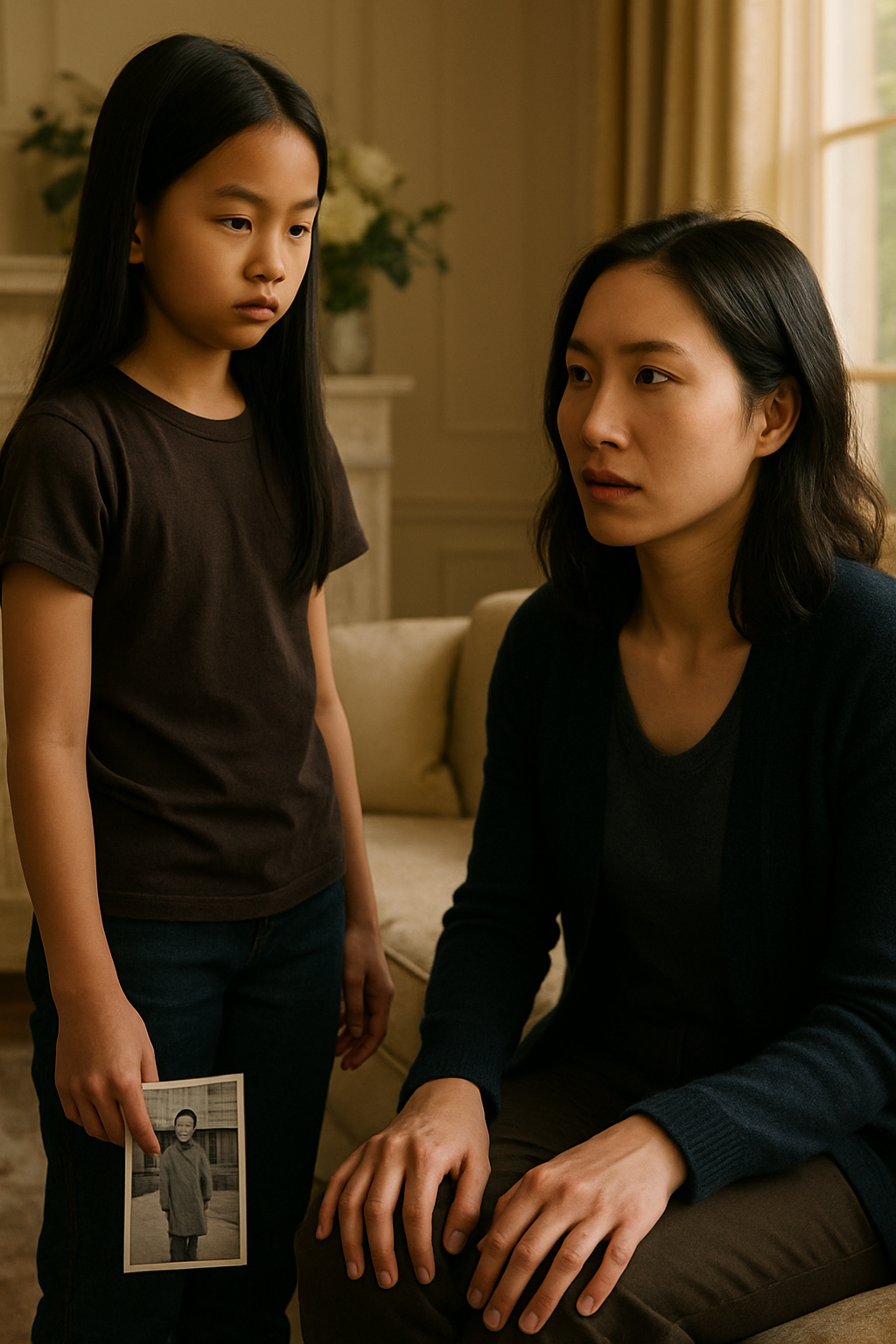
She was holding a photograph.
It was small, printed on regular paper from a long time ago, a little faded. Lily held it at her side and looked at Maya with an expression that was twelve years old and also somehow very old, the kind of old that comes not from time but from having just understood something you could not un-understand.
"Maya," she said.
"Yes."
"This was in my dad's study. In the back of a filing drawer. I wasn't looking for it. I knocked it out reaching for the stapler."
"Okay."
Lily crossed the room and held out the photo.
Maya took it.
It was her. Twenty-three years old, standing in front of a hospital building she had not been back to since. She was wearing a grey coat. Her hair was shorter. She looked directly at the camera with the expression of someone who is trying to look like they are fine and almost managing it. It was summer in the photo — no, autumn, the trees behind her were turning — and she was seven months along, though you couldn't tell from the angle.
Richard had taken it at a check-in appointment. She remembered that day. She remembered the light.
She did not remember him taking the photo. He must have done it without her knowing.
She looked at the photo for a long time.
Then she looked up at Lily.
Lily was standing very still, her hands at her sides, her dark eyes — Maya's eyes, the exact same darkness — fixed on Maya's face. Her expression was not angry. It was not even hurt. It was the expression of a person who has been waiting for the answer to a question they didn't know how to ask, and the answer just walked into the room.
"I have cold hands," Lily said.
"Yes," Maya said.
"Like you."
"Yes."
A silence that held the whole house inside it.
"Did they know you were — " She stopped. Started again, more carefully. "Did you know who you were coming to work for?"
"I found out when I got to the door," Maya said. "And I needed the job. That's the truth."
"But you stayed."
Maya looked at her. This girl who had come out of her body twelve years ago and who had grown into someone with straight dark hair and cold hands and a directness that cut right through. Who asked questions that were sharper than a twelve-year-old should be able to ask because she had been preparing for something, in some way, all her life, without knowing what.
"Yes," Maya said. "I stayed."
Lily sat down on the couch next to her — not close, but not far — and looked at the photograph that Maya was still holding.
"Are you going to tell me?" she said.
Maya looked at the photo. She looked at the girl.
She thought about Diana's face at the window. Richard's voice in the kitchen, she's a good person. The agreement she had signed in a lawyer's office when she was twenty-three and broke and not ready and had believed, really believed, that you could hand something over cleanly.
"I'll tell you whatever you want to know," Maya said. "But not today. Not without your parents here."
Lily thought about this. "That's fair," she said finally.
"It has to be their choice too. What to tell you and how."
"They won't tell me."
"Maybe not. But they should have the chance."
Lily was quiet for a long moment. Outside, the summer garden was very bright. Somewhere across the house a clock ticked.
"Will you stay?" Lily asked. Her voice was even. She was working to keep it there — Maya recognized that now, recognized where it came from, the particular effort of holding steady when your chest is doing something unsteady. "Whatever happens. Will you stay?"
Maya looked at her.
She thought: I don't know.
She thought: I can't promise you.
She thought: I stayed when I should have left. I stayed through Diana and Richard and that phone call and the sitting room and three and a half weeks of pretending I was only a nanny.
"I don't know what's going to happen next," she said honestly. "But I'm not going anywhere today."
Lily nodded.
She took the photograph gently from Maya's hands and held it in her own — her cold hands — and looked at it for a long time.
The clock ticked.
The garden was gold in the afternoon light.
Neither of them spoke.
They didn't need to.
End of Part One.