Eleanor Voss kept a diary.
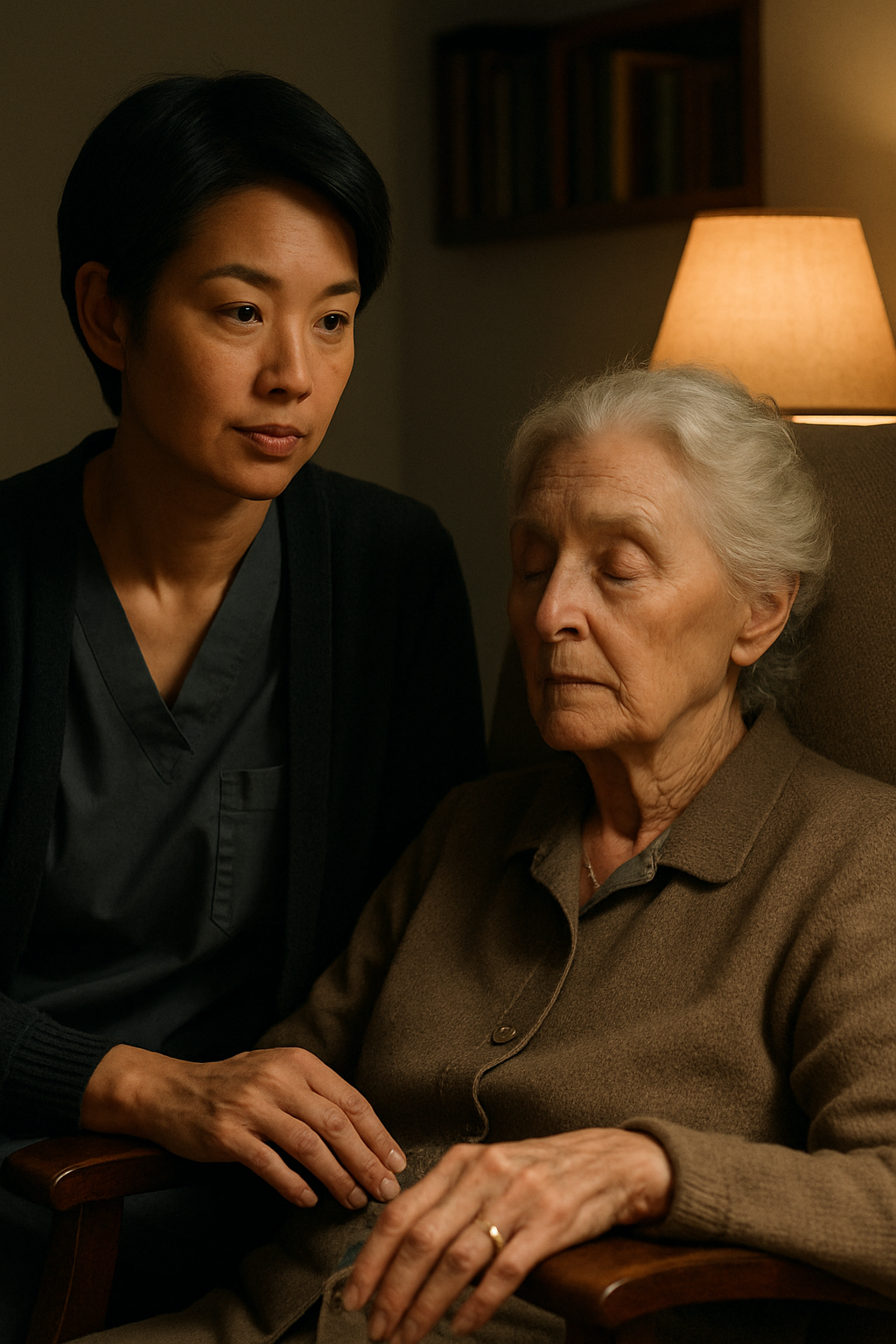
She had kept one since 1975, a habit from a women's college that had never left her. One entry a day, sometimes short, sometimes long, always dated. She had forty-seven journals on the shelf in her bedroom. She had told Grace about them in the third week, which was the third week Grace had come, which was the third week Eleanor had decided Grace was worth telling things to.
"They're not private," Eleanor said. "Not anymore. I'm eighty-two. There's no point in privacy when you're eighty-two. Privacy is for people who have futures."
"You have a future," Grace said.
Eleanor looked at her. "I have time left. That's different from a future."
Grace thought about this.
"Fair enough," she said.
Eleanor had smiled then — the quick, unexpected smile that always appeared when Grace said something honest rather than kind. She had learned, in five years, that Eleanor Voss valued honesty over kindness, which was the most useful thing she had learned about her.
Grace had come to Eleanor through an agency.
She had been a ward nurse for fourteen years, then a community palliative care nurse for three, and when the agency listed Eleanor Voss she had read the file and thought: this is the kind of person you work for.
Not because the money was good. The money was adequate.
Because the file said: sharp mind, organized, keeps her own records, has opinions. Because there was a note from the previous carer — who had left to move cities, not because of Eleanor — that said: she is demanding and funny and she will remember your name correctly the first time and never forget it.
Grace had taken the job.
She had been right.
Eleanor was demanding in the way of people who know exactly what they need and have given up being apologetic about it. She was funny in the way of people who have outlived most of their contemporaries and have therefore run out of patience for social pretense. She was sharp — her memory, her observation, her particular way of looking at you when you said something she found intellectually inconsistent.
And she kept her records.
Not just the diaries — she kept a medical log (temperature, medications, meals, notable events), a household log (which utilities came when, who had repaired what), and a third log that Grace didn't discover until the fourth month.
This one was simply labeled: Daniel.
Daniel Voss came four times a year.
He was a good son, in the way that the phrase covers a lot of distance. He called twice a week. He handled the finances. He made sure the house was maintained and the heating worked and there was someone — Grace — to deal with the things that required presence.
He came at Christmas and Easter and in summer and in September, which was Eleanor's birthday month. Each visit lasted three to four days.
He was not unkind.
He was not particularly curious.
He sat with his mother at the kitchen table and talked about his work and his children — two teenagers, busy lives — and he took notes when she mentioned things that needed doing and he emailed Grace with requests and he left on schedule.
Eleanor watched him.
Grace watched Eleanor watch him.
In year two, Eleanor said to Grace: "He's a good man. He loves me. He just doesn't know me very well anymore. We've been conducting a relationship by phone for about twenty years and we haven't noticed what we've lost."
"Do you want to tell him that?" Grace asked.
"I've been writing it down," Eleanor said. "That's good enough for now."
The will was read on a Friday in October.
Eleanor had died on a Tuesday, in the morning, with Grace beside her and the morning light coming through the window they had always left open a crack. It was a good death, which is a real category. Grace had seen enough of the other kind to know.
Daniel arrived on Wednesday. He moved through the house the way he always moved — slightly too quickly, slightly too purposeful. He was kind to Grace. He said the right things. He called the right people.
On Friday he sat in a solicitor's office with Cynthia and the solicitor opened the will.
Eleanor Voss had left the family home to Grace Park.
Daniel was left the investment portfolio, the savings, and all personal effects. The total value was significant — Eleanor had been careful with money. The house was also significant in value, but it was a different category of thing: it was the house Daniel had grown up in, the house his own children had come to in summers.
He had assumed it would come to him.
The solicitor read the clause: "To Grace Yunjin Park, who was present when others were absent, I leave the house at 14 Arbour Lane, in gratitude and in acknowledgment of what presence means."
Cynthia put her hand on Daniel's arm.
Daniel said: "Is that — is that the whole provision? There's nothing else for the house?"
"That is the complete provision," the solicitor said.
Daniel looked at Grace.
Grace said nothing.
She had not known. She wanted to say that clearly, but this did not feel like the moment for it.
She sat with her hands in her lap and waited for what came next.
Daniel came to her at the house that afternoon.
She was packing Eleanor's room — with care, the way she would have done it regardless, the way Eleanor would have wanted it done — folding things into boxes, keeping the diaries together, keeping the medical logs together. She heard Daniel come upstairs and stop in the doorway.
"I want to talk to you," he said.
"Of course," Grace said. She set down the scarf she'd been folding.
He came into the room. He stood near the window where his mother used to sit.
"I'm going to be honest with you," he said. "I don't know if this was my mother's decision or something that developed as she became more dependent. I need to understand the context."
"What would help you understand it?" Grace asked.
"Was there a conversation? Did she discuss this with you? Did you—" He stopped. He was trying to be careful, which she appreciated. "Did you encourage it?"
"No," Grace said. "I didn't know. I've been caring for people in this capacity for eight years. It's not — it wouldn't have been professional, and it wouldn't have been right. I didn't know."
Daniel looked at her.
"She didn't mention it to you at all?"
"She mentioned the diaries," Grace said. "She said they weren't private. She said I was welcome to read them after she was gone, if I wanted to understand her better." A pause. "I think that was its own kind of communication."
The diaries were in the shelf in the bedroom.
Grace had not read them. She had looked at them every day for five years, but they were Eleanor's, and Eleanor had said after, and this was after, but the house was full of grief and it hadn't been the right time yet.
Daniel read them.
He took the stack from year one — this year, the year Grace had joined — and sat in his mother's chair by the window and he read.
He was there for two hours.
Grace made tea and left it on the table beside him and went to continue packing.
When he came to find her, he had the diary in his hand.
"Can I read you something?" he said.
She sat down on the edge of the bed.
He opened the diary to October, a year ago. He read: "Grace stayed until two in the morning on Thursday when I had the breathing trouble. She had a day shift the next morning. She did not mention this. She sat in the chair by the bed and read until I fell asleep and was there when I woke up. I did not tell her to stay. She simply stayed. I have been thinking about this all day. About what presence means and who provides it. Daniel would have come if I had called. But I didn't call. I have always been careful about calling Daniel. He has so much going on. I wonder sometimes if that carefulness is something I should examine."
Daniel closed the diary.
Grace looked at the carpet.
"There are entries for every week of five years," he said. "Every missed call. Every visit." A pause. "Every time she didn't call me because she was being careful."
"She wasn't angry at you," Grace said.
"I know. That's almost worse."
"She understood you. She loved you. She also saw you clearly."
He sat in the chair by the window. Not his mother's chair — the other one, the one Grace usually sat in.
"There's an entry from three years ago," he said. "She writes about what she wants to happen to the house. She says she's been thinking about it and she wants it to go to the person who has actually been in it. That she's going to talk to the solicitor."
"I didn't know," Grace said again.
"I know you didn't," Daniel said. He looked at the diary. "She was very clear about that, too. She writes: Grace does not know about this and I am not going to tell her because that would change the nature of the care. I want her to be here because she chooses to be here, not because she has something to gain from it."
Grace looked at the window.
"I'm going to contest the will," Daniel said. "I want to be honest about that."
"I understand."
"I have lawyers. I have grounds — undue influence, capacity. I'm going to try."
"I understand," Grace said again.
He looked at her. "I'm also going to read the rest of the diaries first."
He read them all.
Three weeks. He stayed at the house — Cynthia went home to their children, but Daniel stayed — and he worked in the mornings and read in the afternoons and came down for dinner, which Grace made because she was still living in the house's annexed flat while the legal situation was unresolved.
They ate dinner together most nights.
Not because either of them had planned this, but because the house was full of Eleanor and it made sense to not be alone in it.
He told Grace things about his mother — things from the years before Grace, from his childhood, from the years when Eleanor had been the formidable center of everything.
Grace told him things from the five years she'd been there — the stories Eleanor had told her, the opinions, the sharp observations, the way she had catalogued the things around her.
On the nineteenth day, he came down to dinner and said: "I'm withdrawing the contest."
Grace set down her fork.
"She knew what she was doing," he said. "The diaries are twenty years of a woman who knew exactly what she was doing. There's no argument for incapacity." He looked at his plate. "And the undue influence argument — I had a lawyer look at the specific entries around the will decision. She was more clearly herself when she made this decision than at any other point in the year."
"Daniel—"
"I should have been here more," he said. "That's the honest truth. She loved me, but I wasn't here, and someone else was, and she left the house to the person who was present." He looked up. "I don't think she was wrong."
Grace was quiet for a long time.
"What do you want to do with it?" he asked.
"I haven't decided," she said. "I think — I'd like to keep living here. For a while. If that's all right."
"It's yours," he said. "Whatever you do with it is yours."
Outside, the October garden was the particular quiet of late autumn — things put to rest, things waiting.
Eleanor would have had an entry for it.
Grace made a note to start keeping a diary.
Grace kept the house.
She did not do anything grand with it. She moved from the annexed flat into the main house in November, which meant moving into the large bedroom where Eleanor had slept, which she did with the particular care of someone handling a thing that belongs to more than one story.
She kept the diaries on the shelf where Eleanor had always kept them.
She did not read all of them — that felt like too much, like entering a room you've been invited to but should still move through carefully. She read the years she'd been there. She read the years Eleanor wrote about her. She read the entry from the night she'd stayed until two in the morning for the breathing trouble, and the one from three years ago when Eleanor had gone to the solicitor and decided.
She understood, reading them, that Eleanor had been paying attention to her from the first week.
This was not unsettling. It was, in its way, a very Eleanor thing to do.
Daniel came back in December with his family — his two teenagers and Cynthia, who was warmer now, who had done some adjusting in the weeks between October and December and arrived at a version of the situation she could live with.
They stayed for four days. They ate at the kitchen table where Eleanor had always eaten. The teenagers — a boy and a girl, both tall, both more like Daniel than like Eleanor — were polite in the way of young people who are not sure what the rules are and have decided polite is safest.
On the second day, Daniel's daughter, Mia, found the shelf of diaries.
"Are these Grandma's?" she asked.
"Yes," Grace said.
"Can I—"
"Ask your father," Grace said. "They're the family's."
Daniel said yes. Mia read for two hours on the sofa.
At dinner she said: "She wrote about all of us. Me and Oscar. Every visit." She looked at her father. "She wrote about when you called and when you didn't."
Daniel looked at his plate.
"I know," he said.
"She wasn't angry," Mia said. "She kept saying that. She said she understood. But she also said—" She stopped. "She said she used to wait for the phone to ring."
Nobody said anything.
"I'm going to call more," Mia said. She was seventeen. She said it with the particular directness of seventeen, when decisions still feel like things you can simply make. "I know Grandma's gone. But I'm going to call more, in general. Just — more."
Oscar looked at his sister. Then at his father.
"Yeah," he said. "Same."
Daniel nodded once. He didn't say anything.
Grace got up to bring the bread.
She got a letter from Eleanor's solicitor in January.
A separate matter, not related to the house — there was a codicil that had been held back pending the contest resolution. Eleanor had established a small fund for Grace's continuing education, "because Grace has mentioned wanting to study end-of-life care properly, and because people who are good at important work should be supported in being better at it."
Grace sat with the letter for a while.
She had mentioned this — once, to Eleanor, in the second year. They had been talking about a documentary Eleanor had watched about hospice work, and Grace had said, casually: "I've thought about going back to study. Proper palliative training. I never got the formal qualification."
Eleanor had said: "You should."
Grace had said: "Maybe someday."
Eleanor had said nothing further.
She had apparently written it down.
She started the qualification in February.
Two evenings a week, a mix of online and placement. It was harder than she expected and also exactly as interesting as she had hoped, and she came home from the placement days tired in the good way, which is different from the depleted way.
The house was quiet in the evenings in the particular way of a house that holds one person comfortably.
She had the garden to think about in spring. She had Eleanor's rosebushes, which needed attention, and the herb bed she had planted in the third year that had survived two winters on its own. She had the kitchen with the good light in the mornings.
She had the diaries on the shelf.
One evening she sat down and opened the earliest one she hadn't read — not Eleanor's, not from the years of their time together, but one from 1992, when Eleanor was in her forties and Daniel was a child and the house was full of the particular noise of a different kind of life.
Eleanor's handwriting, steady and clear: "There is a difference between presence and attendance. One can attend something and be entirely absent from it. I want to practice presence. I want to be in the room I'm actually in."
Grace closed the diary.
She looked at the house around her — the good light, the quiet, the shelf of forty-seven journals.
She picked up her own new notebook — plain cover, she'd bought it in February — and she wrote the date.
Then she thought for a moment.
Then she wrote: Eleanor was right about this, as about most things.
She wrote until the room went dark.