She hadn't wanted to come.
That was the first thing Laura told herself when she pulled into the hotel car park and sat in the car for four minutes longer than necessary, adjusting her lip gloss in the rear-view mirror and telling herself she looked fine. She did look fine. She knew she looked fine. That wasn't the problem.
The problem was that she was thirty-eight years old and had spent two decades building a life — a good life, a real one — and somehow the idea of walking into a room full of people who had known her at seventeen still had the power to make her palms damp.
She got out of the car.
The reunion was held in the ballroom of the Alderton Park Hotel, a function venue that had been chosen by whoever organised these things because it was equidistant between the school — now converted into luxury flats — and the motorway junction that most people would use to escape. Laura had contributed forty pounds to the venue cost. She had not helped organise. She had assumed this would be apparent to no one; it was, in fact, apparent to Karen Price the moment Laura walked through the door.
"LAURA. Oh my God."
Karen was the same. Twenty years hadn't touched her in any way that mattered — she was still loud, still immediately physical, still wearing too much of a perfume that she'd probably been wearing since Year 10. She crossed the room in a way that suggested the room was hers to cross, which in this context it essentially was, and grabbed Laura's arms above the elbow.
"You look amazing," Karen said, in a tone that meant: you look fine, I'm being generous.
"You too," Laura said, which was also true.
They did the circulation. That was what Laura had come for — the obligation of it, the ability to say she'd been, the confirmation that she had in fact survived school and come out the other side and built something. She shook hands and kissed cheeks and heard about children and mortgages and career pivots and a surprising number of people who had moved abroad. She drank a glass of wine that was not good enough for the price of the hotel. She laughed at the right moments.
She was, she told herself, fine.
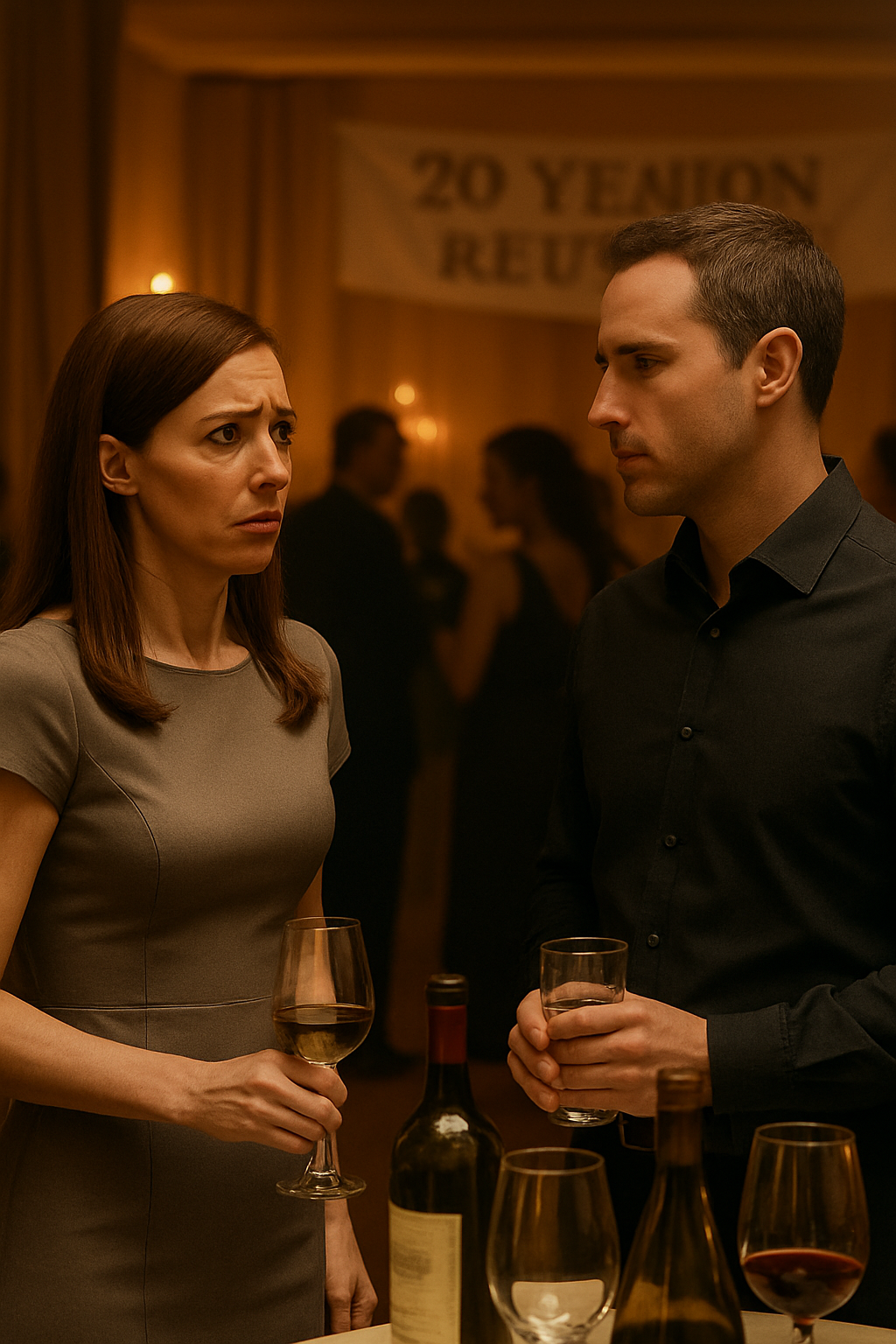
The room was warm and loud and smelled of cut flowers and event catering. A banner on the far wall read ST. CATHERINE'S — CLASS OF 2006 — 20 YEARS. Someone had decorated with photos printed from what must have been the school's archive: group shots, sports days, a blurry school play. Laura walked past them without looking closely. She had no interest in seeing herself at seventeen.
She was at the drinks table, refilling her wine — still not good enough — when Karen appeared at her elbow with the particular energy of someone making an introduction.
"Laura, this is — God, you two must know each other, you were the same year —"
Laura turned.
The man standing beside Karen was tall. Close-cropped dark hair going grey at the temples, a dark shirt with no tie, the kind of stillness that either comes from being very relaxed or from spending a long time learning not to show anything. He had calm eyes. Not handsome in a way that stopped you — handsome in the way you notice afterwards, when you've already been looking at him for a moment longer than you meant to.
She didn't recognise his face.
"Hi," he said. "Daniel Farrow."
The room didn't stop. The noise continued. Karen was already half-turning towards something else, already distracted by someone calling her name from across the room. The string quartet — there was a string quartet, which Laura had found absurd when she saw it on the invitation — was working through something from the nineties.
None of that changed.
Laura's hand went out, automatic, and she shook his hand. Her grip was fine. Her face, she was certain, was fine. Twenty years of knowing how she presented, and she did not let anything show.
"Laura," she said. "West. Harrison, when we were at school."
"I remember," he said.
Those two words. She replayed them immediately — once, then again — looking for the tone in them. There was no tone. He was simply confirming a fact.
Karen patted them both on the arms as though she had performed a service. "Lovely," she said, to no one in particular, and then she was gone, swallowed by the room, and Laura was standing at the drinks table with Daniel Farrow.
She said the first thing that came.
"I'm sorry — I don't — I wouldn't have placed you."
"That's all right," he said. "People change."
"Twenty years."
"Twenty years," he agreed.
He picked up a glass of water from the table. Not wine. He turned it in his hand once and didn't drink it immediately, and Laura had the sense — difficult to name — that he was waiting for something. Not impatiently. He simply seemed to have time.
"Did you stay local?" she asked.
"No. London, mostly. Some time in Edinburgh."
"What do you do?"
"Law," he said. "Commercial litigation, mostly. And you?"
"Marketing. I run a consultancy — brand strategy, mostly mid-sized firms."
"Do you enjoy it?"
The question surprised her slightly. Not the question itself — it was a normal question — but the way he asked it. Like it mattered to him whether she did.
"I do, actually," she said. "I built it myself, which helps."
"That's important," he said. "Having built something."
She looked at him again. Trying to find Year 12 in his face. She had a memory of someone — smaller, she thought, though everyone was smaller at seventeen — someone who sat near the back in English. Quiet. There had been a scholarship, she recalled now — one of those external awards, something competitive, something his parents had been proud of. She remembered hearing about it in that way you heard about things at school, as information that attached itself to people and defined them before they had a chance to define themselves.
She didn't remember much else.
She told herself she didn't remember much else.
"It's strange, isn't it?" he said. "Seeing people after this long. You forget how much you've actually changed."
"And how much you haven't," Laura said.
He smiled at that. It was not unkind. It was not warm, exactly. It was the smile of someone who found something genuinely interesting and was letting her see that he did.
"I wanted to come," he said. "I wasn't sure I would. But I thought — it seemed worthwhile. To see everyone."
"To see how people turned out."
"Something like that."
He looked at her with those calm eyes, and Laura had the distinct and difficult sensation — the kind you notice in the chest before the brain has named it — that she was being studied. Not aggressively. Not even consciously, perhaps. But that he had already known, before Karen introduced them, exactly who she was.
"I just wanted to meet you as an adult," he said.
Not to meet people. To meet you.
Laura looked at him.
His expression didn't change. He was still just standing there, the glass of water in his hand, in the warm ballroom light, with the string quartet playing something she almost recognised. He was not angry. He was not threatening. He was simply — there. Exactly where he had said he would be, which was nowhere and everywhere at once.
She was the first one to look away.
She excused herself to the bathroom.
She didn't actually need the bathroom. She stood at the sink for a moment with the tap running and looked at her face in the mirror and told herself she was being ridiculous. She was thirty-eight years old. She had built a successful business. She had a good marriage and a mortgage she was aggressively paying down and a daughter who was clever and strange and going to be fine. She had made, in any measurable sense, a good life.
She told herself all of this.
Then she turned off the tap and thought about Year 12.
It had been March.
The specific month mattered because it was close to the deadline for the scholarship applications — the Alderton Foundation Award, she remembered now, the thing Daniel had applied for and been likely to receive. Competitive, regional, the kind of thing that would have changed the shape of a life if you came from a family where the shape of your life needed changing.
She had been at school late that afternoon. Some rehearsal, something — drama club, she thought, though she'd quit halfway through that year. She was in the sixth form corridor and the door to Mr. Patterson's office was open and she heard voices.
She hadn't meant to listen. That was what she'd told herself then, and it was almost true. She'd slowed down because she recognised a voice — not Daniel's — and in the way of seventeen-year-olds she had leaned slightly towards the gap in the door before she'd decided whether she was going to or not.
It was Max Reid's voice. Max had been in their year. Loud, easy, comfortable in his own skin in the way that boys from certain kinds of families were — the kind of family that had never had to be worried about, which meant he never was. He was talking to someone Laura couldn't see, and what he was saying was — she'd stood in the corridor and worked out, slowly, what he was saying about.
He was talking about Daniel.
What he was saying wasn't true. Laura had known that even then. She had known Max well enough to know that he said things because he could, because he found it amusing, because the discomfort of others was interesting to him in the way that things are interesting to people who have never had real consequences. What he was saying — that Daniel had been seen with something he shouldn't have had, had done something he hadn't done — was not true in any way that would hold up if anyone looked.
She had told herself, walking home that evening, that it wasn't her business.
She had told herself that for three days.
On the fourth day she had been called into Mrs. Flynn's office — the Head of Sixth Form — for something routine and unrelated, and at the end of it, she didn't know why, she still didn't fully know why, she had mentioned what she'd heard.
Not maliciously. She had not gone in with a plan. She had just — let it out.
Mrs. Flynn had thanked her. Had said she'd look into it. Had told Laura she'd done the right thing.
The inquiry had taken nine days.
Laura had not been interviewed again. She had not been asked to clarify or confirm. She had simply been a girl who had passed something along, and whatever machinery the school had set in motion, it had moved without her.
Daniel had been expelled three weeks before the scholarship deadline.
She had heard about it the way you heard about things at school: in pieces, through people, the information arriving pre-digested and already shaped. He had been expelled for what was described, in the terms the school used for these things, as a conduct issue. The scholarship had gone to someone else. She couldn't remember who.
She had told herself, at the time, that she'd done the right thing. That she'd passed along something true — she had heard Max say it, that was true — and that it wasn't her fault if the school had acted disproportionately. That she hadn't known they would.
She had told herself this for quite a long time.
She had mostly stopped thinking about it.
She came back out of the bathroom.
Daniel was still at the drinks table. He had not moved to talk to anyone else, which she registered without knowing what to do with. He looked up when she approached — not as though he'd been waiting, just as though he noticed — and Laura, who had spent twenty years building a life in which she was in control of the information she chose to share and with whom, said:
"We should probably —" and then didn't finish.
"Talk?" he said.
"I was going to say mingle."
"Of course." He didn't move. "How is your daughter?"
She went still.
It was involuntary, the stillness — the kind that comes from the body processing something before the mind does. She looked at him and tried to find the expression that matched the question, and what she found was the same expression he'd had all evening: calm, unhurried, looking at her as though this were a perfectly ordinary thing to ask.
"I — how do you know I have a daughter?"
"LinkedIn," he said. "You mention her occasionally. It came up."
It was a reasonable answer. It was completely reasonable. People looked each other up; that was what reunions were, effectively — everyone showing up already pre-researched. She had looked up three or four people herself on the train.
She had not looked up Daniel Farrow.
"She's eleven," Laura said. "She's good. She's — she likes reading."
"What does she read?"
"Everything. She's going through a stage of historical fiction at the moment. Lots of Hilary Mantel."
"Ambitious," he said.
"She's an ambitious person."
"That must be something, watching that."
Laura nodded. Something in the conversation had become slightly unsteady under her feet — not vertiginous, not dramatic, just the specific wrongness of ground that looks level but isn't. She said: "She terrifies me a bit, honestly."
"I imagine," he said, "that's what they're supposed to do."
She looked at him for a moment. "Do you have children?"
"No."
He said it without any of the usual register — no hint of whether this was a choice or a grief or something in between. Just: no.
"Do you still —" She stopped.
"Do I still what?"
She had been going to ask if he still thought about school. She did not ask that. She said: "Do you still live in London?"
"I'm based in London, yes. Holborn, mostly."
"That's convenient for the courts."
"Very convenient," he said.
She wanted him to move on. She wanted Karen to come back and attach herself to them and pull the conversation into something safer. She wanted the string quartet to stop playing the song they were playing, which she had now identified as "Wonderful Tonight" and which seemed, under the circumstances, specifically unkind.
"I thought about you," she said. She had not meant to say it. She said it anyway, because the alternative was to keep standing here knowing something he also knew and not naming it, and she was thirty-eight and she had built something and she had not built it by avoiding things.
He looked at her.
"Did you," he said.
Not a question. An acknowledgement.
"Not — not often," she said. "But — yes. Sometimes."
He nodded slowly. He set the glass of water down on the table and straightened up slightly, and for a moment she thought he was going to walk away, which would have been fine, which would have been the most sensible thing either of them could do. Instead he said:
"I thought about you, too."
"I'm sorry," she said. The words came out before she'd decided to say them, which meant they were real — the kind of sorry that hadn't been prepared, that had no strategy attached to it.
He looked at her with those eyes, and the expression on his face was not forgiveness and it was not anger and it was not the performance of either. It was something more difficult than both. It was a man who had had twenty years to arrive at a conclusion and had arrived at it without her help.
"I know," he said.
He reached into the inside pocket of his jacket and produced a card — a small white rectangle, the kind printed on heavy stock — and placed it on the drinks table in front of her. Not in her hand. On the table, as if setting down a document.
"I think you know how to reach me," he said, "if you ever want to."
He straightened. He looked at the room once — the banner, the photographs, the people they had both once been seventeen with — and then he looked at her once more, with that expression that was neither forgiveness nor its absence.
"It was good to meet you properly," he said.
And then he walked away.
Laura picked up the card.
It was heavy in a way that small things are not supposed to be. She turned it over once, which told her nothing new, and then she turned it back and read it again and it said what it had said the first time.
FARROW & ASSOCIATES LLP Solicitors — Commercial Litigation Daniel Farrow — Partner
His name was on the door.
Not as an associate. Not as a junior. His name was first, which meant it was his firm, or at least that he had a claim to it equal to any other person in the building with their name above the entrance. She stood with the card in her hand and did the arithmetic that she'd been avoiding for twenty years: he had lost the scholarship, he had lost whatever the scholarship would have led to, and then he had gone and found his way to the same destination by a different, longer route, and the extra years it had cost him were visible in his face in the grey at his temples and the particular quality of his calm.
The card was cream. The font was clean. The address was Holborn, as he'd said.
She thought about her daughter reading Hilary Mantel.
She thought about the word ambitious.
She thought about a closed door in a sixth form corridor and a voice she'd stopped to listen to and three days of telling herself it wasn't her business and the fourth day when she'd walked into Mrs. Flynn's office for a routine meeting and had opened her mouth.
She had told herself she hadn't known what would happen. That was true. She had not known. But she had known — she had known even then, at seventeen, with the specific and uncomfortable honesty of seventeen — that she had not passed the information along because she thought it was right. She had passed it along because Max Reid was easy and popular and Daniel Farrow was neither, and because the information had been in her possession and possessing it had been a kind of currency she hadn't known she'd wanted to spend until the moment she did.
She had told herself other things for twenty years. They had been easier to live with.
The string quartet had moved on to something else. She couldn't identify it. Karen was somewhere behind her, she could hear her laugh, and the room was doing what rooms like this do at the midpoint of the evening — loosening, getting louder, the drinks starting to do their work on people who'd been careful for the first hour.
Laura looked at the card in her hand.
His name. His firm. His address.
He had not asked her for anything. He had not accused her of anything. He had stood in a hotel ballroom and asked pleasant, specific questions and placed a card on a table and walked away, and the most terrifying thing he had done — the thing she would think about tonight and in the days after tonight and in the months after that — was that he had been exactly right about everything.
He had known who she was.
He had known what she'd done.
He had known for twenty years.
And he had made a partner's name at a law firm in Holborn, which meant that whatever she had cost him, it had not been the future. It had been a version of the future. And the version he had ended up with still had his name on a door, and she was standing in a hotel ballroom holding his card with cold hands and a glass of not-good-enough wine and the particular feeling — the feeling she had spent twenty years not feeling — of being seen.
Not punished. Not accused.
Seen.
She put the card in her bag.
She did not throw it away, which told her something about herself she had to sit with.
She went to find Karen, who was wonderful and oblivious and would talk for twenty minutes about someone else entirely, and Laura would listen and nod and say the right things and present exactly as well as she always did, because she had always known how she presented and tonight was no different from any other night.
Except that it was.
Except that it was entirely different, and she had known it would be from the moment he said his name, and she had come anyway, and she did not know, standing in the ballroom of the Alderton Park Hotel with his card in her bag and the string quartet playing something she couldn't place, whether that had taken courage or something else entirely.
She found Karen.
She stayed for another forty minutes.
She drove home in the dark, both hands on the wheel, and did not think about the card in her bag.
She did not think about it at all.
That was what she told herself.