PART 1
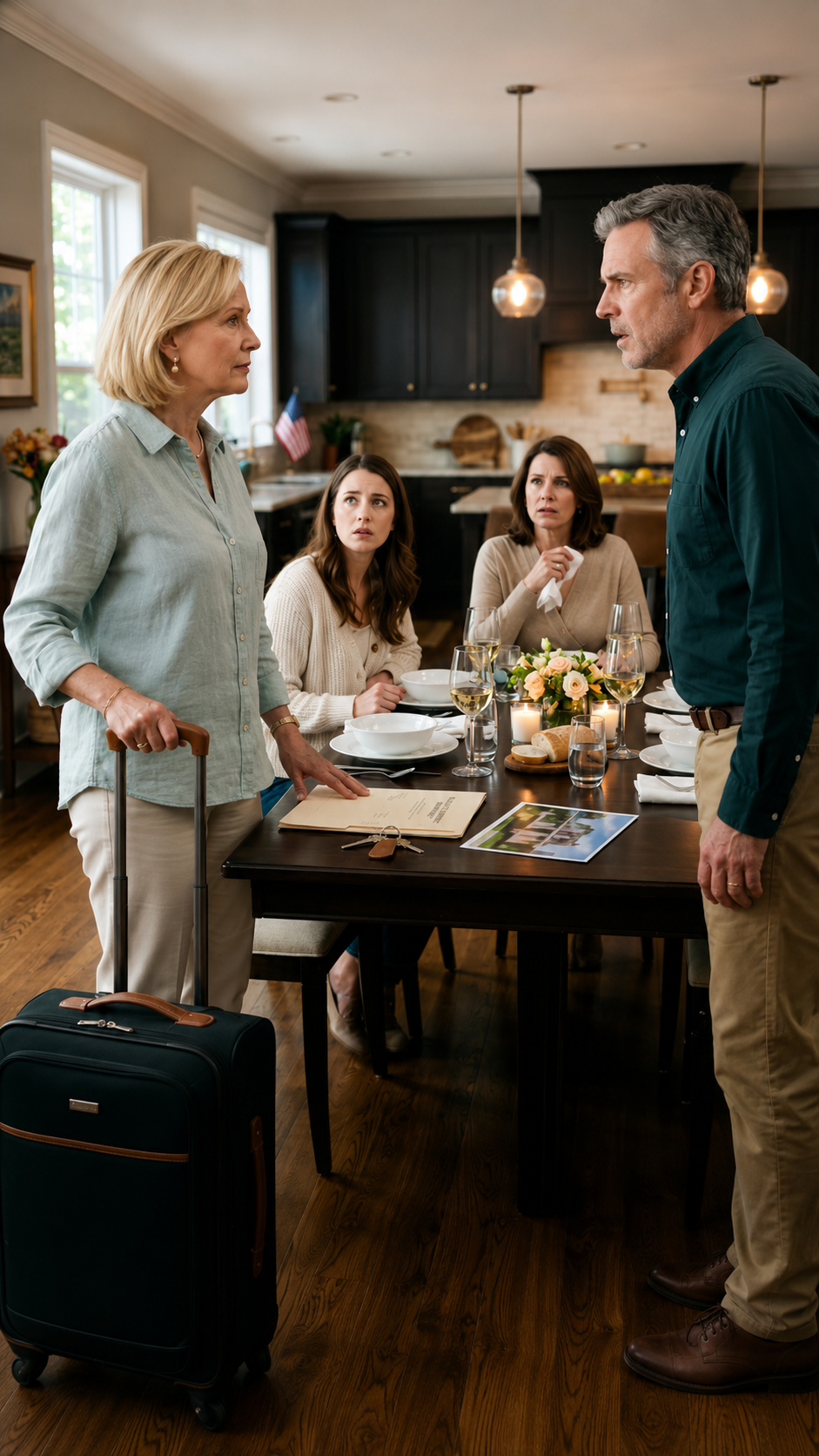
—Mom, if you make me go back to Julián, I might as well die here.
Mariana said this at 1:07 AM, sprawled out in front of her mother’s house, on a quiet street in Coyoacán.
Her blouse was torn, dried blood caked on the sleeve, her lip split, and one hand cradled her belly as if she were protecting the last thing she had left.
Lucía opened the door, thinking the rain was beating against the gate.
But it wasn’t the rain.
It was her 28-year-old daughter, curled on the floor, trembling like a small child.
—Don’t make me go back to him, Mom —Mariana pleaded, clutching her robe—. Please, don’t make me go back.
Lucía felt her body grow cold.
For months, she had suspected something was wrong.
Mariana no longer came on Sundays for sweet bread. She didn’t answer messages. She didn’t laugh like she used to.
Every time Lucía asked about Julián, Mariana repeated strange phrases, as if they were rehearsed:
—He only cares about me.
—His mom wants to teach me how to be a better wife.
—You’re exaggerating, Mom.
That night, seeing her daughter broken at the entrance, Lucía understood that Mariana didn’t live in an elegant home.
She lived in a cage with a marble dining room.
She called an ambulance and covered her with a blanket.
—Who did this to you, my girl?
Mariana closed her eyes.
—They said no one would believe me.
—Who?
The young woman swallowed hard but couldn’t hold back the tears.
—Julián… his mom… Rodrigo… everyone.
Julián Salvatierra was her husband.
Owner of a luxury real estate firm in Polanco, son of a family featured in social magazines, one of those guys who barely smile because they think the world owes them obedience.
His mother, Elvira, was worse.
A pearl-clad woman, Sunday mass-goer, and venomous in her speech.
Since Mariana married Julián, Elvira treated her like a poor girl who had gotten lucky.
At the private hospital in Tlalpan, doctors cleaned Mariana’s wounds.
Lucía stood by the gurney, her hair wet from the rain and her eyes filled with rage, when Julián appeared in the hallway.
He looked impeccable.
Black coat, expensive watch, fine perfume.
As if nothing had happened.
—My wife is very emotional —he told the nurse—. She fell down the stairs. She’s pregnant and lately makes up stories.
Pregnant.
Lucía turned to Mariana.
Her daughter’s face shattered.
Behind Julián, Elvira walked in, wiping fake tears with a silk handkerchief.
—Poor thing —she said—. Pregnancy made her unstable. In our family, we just didn’t know what to do with her.
Then the doctor arrived.
She held a folder in her hands and a seriousness that silenced the whole room.
—Mrs. Mariana —she said carefully—, I’m very sorry to inform you that the baby didn’t survive.
Mariana’s scream wasn’t a normal cry.
It was a broken, deep sound, as if life had been ripped from her insides.
Julián lowered his gaze.
But Lucía caught a glimpse.
A tiny flash.
Relief.
Elvira leaned closer to her and whispered with a cold smile:
—Take your daughter home, Lucía. Teach her not to ruin decent families.
For years, the Salvatierra family had called her “the lady from the bakery,” as if selling conchas, gelatins, and three-milk cakes made her foolish.
What they didn’t know was that before opening her business, Lucía had worked for 22 years as a forensic auditor for the Attorney General’s Office.
She had tracked stolen money, fake signatures, ghost companies, and manipulated inheritances.
She could smell a lie even if it was drenched in Chanel.
Julián placed a hand on Mariana’s shoulder.
—Let’s go home, love. Your mom doesn’t understand.
Lucía stepped in the way.
—No.
Julián smiled.
—Excuse me?
She stared at him, unblinking.
—You touched my daughter once. Now I’m going to touch everything you have.
Elvira let out a soft laugh.
Julián leaned toward Mariana and said something that made her tremble:
—Sign what I asked, and this won’t get worse.
Lucía didn’t know what papers they were.
She didn’t know that the baby’s death hid a much larger plan.
But that early morning, she understood that the Salvatierra family had just committed the worst mistake of their lives.
PART 2
Security removed Julián from the hallway when he tried to drag Mariana away by force.
—She’s my wife —he shouted, adjusting his coat—. The law is on my side.
Elvira walked behind him, unruffled.
—You have no idea who you’re messing with, Lucía.
That was her first mistake.
Because before dawn, Lucía was already in deep.
While Mariana slept sedated, Lucía didn’t call the neighbors to cry nor light candles hoping for a miracle.
She opened an old laptop she kept in a metal box, pulled out a black notebook, and began working like she did in her Attorney General days.
She requested a copy of the medical report.
Requested photographs of every bruise.
Stored Mariana’s torn clothes in a clean bag.
Reviewed her daughter’s phone, downloaded messages, audios, locations, and emails.
By noon, the dining table no longer looked like a dining table.
It looked like an investigation office.
Mariana woke up in her mother’s room, pale, with swollen eyes and a broken voice.
—Mom… they didn’t just hit me.
Lucía sat next to her.
—Tell me everything, sweetheart.
Mariana breathed as if every word burned.
—Elvira gave me teas. She said they were for nausea. If I didn’t take them, Julián got angry. Then I felt dizzy, my head hurt, I couldn’t think straight. They said I was losing my mind.
Lucía clenched her jaw.
—Since when?
—Since I told them I was pregnant.
Mariana covered her face.
—Last night, I heard them in the office. Elvira said they couldn’t wait any longer. That if the baby was born, everything would get complicated.
—What would get complicated?
Mariana looked out the window, as if she still feared someone was listening.
—The land in Valle de Bravo.
Lucía closed her eyes.
Everything began to fit together in a horrible way.
Ernesto, Mariana’s father, had left a plot of land by the lake in a family trust.
It wasn’t just any land.
A developer had been trying to buy that area for years to build a luxury housing development.
The most important clause stated that when Mariana had a child, she would assume total control of the trust.
But if Mariana died or was declared legally incapacitated, the temporary administration would pass to her husband.
To Julián.
Mariana began to cry.
—they wanted to make me seem crazy, mom. They didn’t just want to take my baby. They wanted to take my voice.
Lucía felt such rage that she had to stay still to avoid breaking something.
This wasn’t a couple’s argument.
It wasn’t an intrusive mother-in-law.
It wasn’t a fall down the stairs.
It was a plan.
A plan to break Mariana, to lock her under a false diagnosis and take the last gift from her father.
But the Salvatierra family didn’t know something.
Ernesto had been so cautious that he even kept copies of supermarket receipts.
After a cousin tried to steal documents from him, he left a secret rule in the trust.
Every legal inquiry, every attempted modification, and every access request was automatically sent to the email of the alternate trustee.
Lucía.
She opened a folder she had been ignoring for months, thinking it was bank notices.
There it all was.
Emails supposedly sent by Mariana.
Forged signatures.
Questions about mental incapacity.
Drafts to transfer usage rights.
Consultations about marital property management.
Lucía printed each page.
Then she called Patricia Vázquez, a commander in the Attorney General’s Office and an old acquaintance.
Years ago, Lucía had helped her imprison a corrupt treasurer.
—Lucía —Patricia said when she answered—, tell me this isn’t personal.
—It’s personal —Lucía replied—. But the evidence is clean.
By 4 PM, they had more.
A pharmacy camera showed Elvira buying dangerous herbal mixtures.
Rodrigo, Julián’s brother, had searches on his phone like: “how to request guardianship for a wife’s mental crisis.”
The family lawyer had prepared an urgent document claiming that Mariana was violent, delusional, and a risk to herself.
They planned to present it that very night.
Then a message arrived on Mariana’s phone.
“Come home before 8 or I’ll report your mother for kidnapping. Bring your ID. You’re going to sign.”
Mariana went pale.
Lucía took the phone and wrote:
“I’m coming. Have the papers ready.”
Julián replied with a smiling emoji.
He still thought he was winning.
He didn’t know that on the other side of the screen, his cage was closing.
They arrived at the Salvatierra mansion at 7:40 PM.
The house was in Lomas de Chapultepec, behind black gates, perfect bougainvillea, and cameras pointed at everything except the truth.
Mariana sat in the backseat of a car with no visible plates, wrapped in her mother’s gray coat.
Her hands were cold.
But they no longer trembled.
Across the street, two discreet patrol cars waited with their lights off.
Commander Patricia checked her watch.
—No one enters alone —she told Lucía—. If they threaten, we intervene. If they confess, better.
Mariana took a deep breath.
—I want to say it myself.
Lucía looked at her.
For the first time in a long while, her daughter didn’t seem to be asking for permission to exist.
They entered.
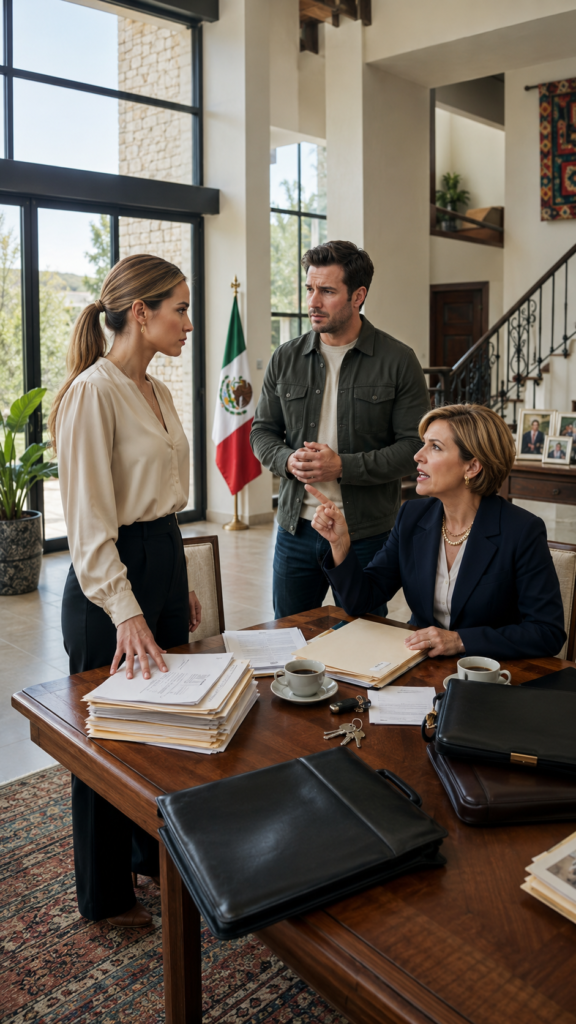
Elvira had prepared tea in the main room, as if this were a family gathering and not a crime scene with a fine tablecloth.
There were porcelain cups, almond cookies, and a huge vase.
All elegant.
All fake.
Julián stood by the fireplace with Rodrigo.
The family lawyer, Licenciado Cárdenas, and Dr. Montes, the same one mentioned in the draft of the legal petition, were also there.
—Finally —said Julián—. My confused wife has returned to where she belongs.
Mariana shuddered.
Lucía squeezed her hand.
—She’s not confused —she said—. She’s documented.
Elvira let out a soft laugh.
—Oh, Lucía, don’t make a scene. You bake cakes. This is a matter for serious families.
Lucía opened her bag and pulled out a thick folder.
—Yes, I bake cakes. And before that, I built files that sent men with watches more expensive than your son’s to prison.
The room changed temperature.
Julián stopped smiling.
Lucía placed the folder on the table.
—False requests to the trust. Forged signatures. Threatening messages. Photographs of injuries. Medical reports. Pharmacy video. Drafts of an illegal guardianship. And a preliminary toxicological test.
Elvira looked at the papers as if she had seen a viper.
The lawyer stepped back.
—I wasn’t informed of any possible crimes.
—How convenient —said Commander Patricia, entering with two agents.
Julián lost color.
—This is absurd. Mariana is unstable. We all know that here.
Mariana stood up.
Her voice came out low but firm.
—I’m not crazy, Julián. You isolated me, checked my calls, made me believe no one would help me. Your mom gave me teas that made me sick. Rodrigo checked my emails. Your lawyer prepared papers to take away my rights. And you…
She brought her hand to her belly.
Silence fell heavy.
—You knew I could lose the baby.
Julián gritted his teeth.
—Don’t say nonsense.
Mariana lifted her head.
—I lost my child because of you.
Elvira stood up abruptly.
—Watch what you say, girl.
Then Julián made the mistake of men used to commanding.
He mistook silence for fear.
—That baby was a problem —he spat.
No one breathed.
A body camera blinked red.
The lawyer closed his eyes as if he could already hear his career breaking.
Elvira whispered:
—Julián, shut up.
But arrogance, once lit, doesn’t know how to extinguish itself.
—What did you want me to do? Wait until it was born and that property was out of our reach? That land was going to be a luxury development. We had investors. We had permits lined up. And she got sentimental.
Mariana recoiled as if each word were another slap.
Lucía walked toward him.
—It wasn’t just land. It was the last gift from her father.
Julián glared at her with hatred.
—Your husband is dead.
—Yes —Lucía replied—. But he was smarter than all of you living.
The commander raised her hand.
—Julián Salvatierra, you are under arrest for domestic violence, threats, fraud, forgery, and conspiracy. The investigation will determine additional charges related to the loss of the pregnancy.
Rodrigo began to cry before they put him in handcuffs.
—I just did what Julián asked.
Elvira tried to call someone.
—I know judges. This is going to fall apart.
Patricia took the phone from her.
—Then call them from the Public Prosecutor’s Office.
Dr. Montes remained seated, sweating in front of an untouched cup of tea.
Later, it was revealed that he had accepted to sign a false report in exchange for a contract with a clinic linked to the Salvatierra family.
The lawyer Cárdenas cooperated that same night to save himself.
He handed over emails, recordings of meetings, and the complete draft of the lawsuit dated before the attack.
Thus, the case ceased to be “a wife against her husband” and became a web of violence, property fraud, and corruption.
In the following weeks, the Salvatierra mask shattered in public.
Julián’s real estate firm was investigated for operations with front men.
His accounts were frozen.
Elvira, who boasted donations at charity events, had to explain false foundations and made-up invoices.
Rodrigo handed over passwords.
The doctor lost his license.
The Valle de Bravo trust was protected by a court order.
But nothing brought back the baby.
That was the hardest truth.
Justice can make noise when it arrives, but the pain remains sitting for a while in the living room, breathing alongside the family.
Mariana took months to return to sleep.
She attended therapy, went to hearings, and slowly learned to stop apologizing for things she hadn’t done.
Some mornings she cried at the sight of baby clothes in a store.
Others, she got so angry that she walked until her legs hurt.
Lucía never told her, “it’s over.”
Because it wasn’t over.
It had only stopped destroying her every day.
Six months later, mother and daughter returned to the Valle de Bravo plot.
The lake was still, golden in the dawn.
Ernesto’s old shed had been rebuilt with light wood, large windows, and a simple terrace facing the water.
At the entrance, several workers were placing a new sign.
“Casa Raíz: a refuge for women who don’t have to return to fear.”
The project would be financed with part of the recovered assets and compensation ordered by the judge in the civil process.
It wasn’t revenge.
It was something better.
It was turning a trap into a way out.
Mariana wore a light blue dress.
Her hair was loose, and a small scar adorned her lip.
She no longer hid it.
—Do you think Dad would be proud? —she asked.
Lucía looked at the lake.
She thought of Ernesto, his obsession with keeping copies, his usual phrase: “A family isn’t protected with speeches; it’s protected with timely decisions.”
—Your dad would say you came home wounded —she replied—, but you didn’t come back defeated.
Mariana smiled with tears in her eyes.
Then she walked to the sign and ran her fingers over the freshly painted letters.
—For a long time, I thought coming back to you was failing —she said—. As if asking for help made me less strong.
Lucía shook her head.
—No, sweetheart.
Mariana took a deep breath.
—Coming back was what saved me.
That day, when they opened the doors of the refuge, the first woman to enter had a sleeping child in her arms and a black bag with clothes.
Mariana welcomed her without asking why she hadn’t left sooner.
Without judging her.
Without demanding explanations.
She simply said:
—You’re safe now.
Lucía watched her from the patio, with her heart both tight and full.
At 1:07 that morning, Mariana had fallen at her doorstep covered in blood, pleading not to return to hell.
One year later, at that same exact minute, she lit the first light of Casa Raíz.
And Lucía understood something that no elegant last name, no mansion, and no monster disguised as a husband could ever erase:
Sometimes a woman returns home broken, not to hide, but to remember who she was before they tried to extinguish her.