PART 1
—Change the code before she leaves the hospital. Make her understand this house is not a refuge for useless women.
Mariana didn’t hear that phrase when Teresa, her mother-in-law, said it over the phone in the kitchen of the Del Valle apartment. She understood it three days later, standing in front of the door, her cesarean wound burning like fire and her newborn baby sleeping against her chest.
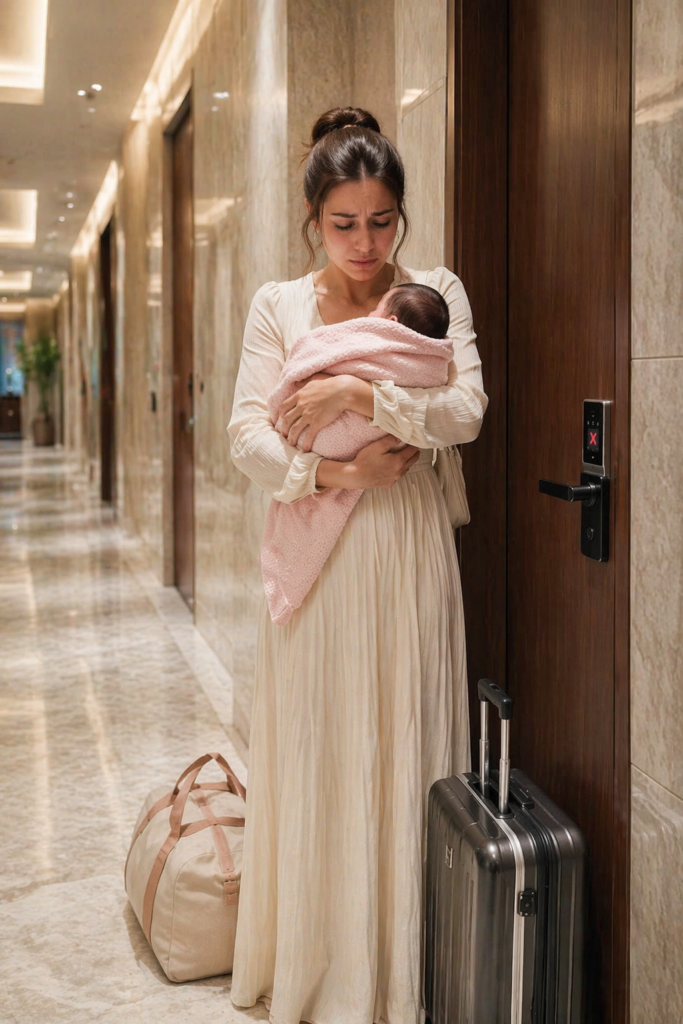
She came from the hospital exhausted, pale, hair tied back in a messy bun, with a diaper bag hanging from her shoulder. In the taxi, as they crossed the Viaducto under a heavy sun, she whispered to her son:
—We’re almost home, my love. Your dad must be waiting for us.
But when she entered the smart lock code, the screen lit up red.
Error.
Mariana frowned. She thought her fingers trembled from exhaustion. She tried again.
Error.
On the third try, she felt something break inside her.
She pulled out her cellphone and called Rodrigo. Voicemail. She sent messages. Nothing. She called Teresa, her mother-in-law, who answered on the fifth attempt, annoyed.
—What do you want, Mariana?
—I’m outside the apartment. The code doesn’t work. I just came out of the hospital with Santiago.
There was a brief silence.
—Well, find a way to solve it. You always say you’re very independent, right?
—Where is Rodrigo?
—I’m not his secretary.
And she hung up.
Santiago started to cry. Mariana pressed him to her chest, trying to calm him, but she was trembling too. The diaper bag slipped from her shoulder and fell onto the hallway floor.
Then, the door to the neighboring apartment opened.
Doña Lucha, a retired lady who always brought her gelatin when she saw her pregnant, peeked her head out.
—Oh, honey, you’re back! I’m so glad you’re okay. I thought you’d stay with your mom.
Mariana looked up.
—Why did you think that?
Doña Lucha paled.
—It’s just that yesterday I saw your husband leave with his mom and sister. They had huge suitcases. They were all so happy. They said they were going to Cancun, that they needed a break.
Mariana felt the hallway stretch, grow colder, more cruel.
Rodrigo had gone to Cancun with his mother and sister while she was just out of surgery, with a three-day-old baby. And before leaving, he changed the code.
Under the doormat, she found an old bank card and a note written in marker:
“Learn to respect my son’s house.”
She didn’t scream. She didn’t kick the door. She didn’t beg.
She slowly sat on the floor, hugged Santiago, and let a single tear fall. Then she wiped her face with her sleeve.
She called her mother.
—Mom, come get me. Rodrigo left me outside with the baby.
Carmen didn’t ask anything.
—Don’t move. Your dad and I are on our way.
That night, at her parents’ house in Coyoacán, Mariana opened the safe her dad had kept since before her wedding.
There it was, the deed.
The apartment wasn’t Rodrigo’s.
It never was.
Her parents had given it to Mariana before the marriage, when she still believed that getting married meant having a family, not losing her own.
At dawn, with Santiago sleeping on a blue blanket, Mariana called Licenciado Barrera.
—I want a divorce. I want to protect my son. And I want to sell my apartment.
As Rodrigo uploaded photos from the beach with a piña colada in hand, Mariana signed documents, canceled access, blocked cards, and prepared something he could never imagine.
Because when Rodrigo returned with his suitcases full of shopping, he wouldn’t find his wife crying behind the door.
He would find a stranger opening “his” house.
PART 2
Rodrigo returned five days later, sunburned, wearing sunglasses, with two new suitcases and a smile of a man used to getting his way.
Teresa walked behind him carrying designer bags. His daughter, Fernanda, was recording stories to show off bracelets, sandals, and expensive perfumes.
—Nothing like traveling with the family that knows how to behave —said Teresa, looking at the cellphone camera—. Some women think they’re queens after giving birth.
Fernanda giggled.
—Surely Mariana has understood. A little scare should bring her down a notch.
Rodrigo said nothing. He just smiled. In his head, Mariana would be at her in-laws' house, crying, waiting for him to forgive her. Maybe she would even apologize for being “cold” during the pregnancy.
But when he arrived at the building, something bothered him.
His parking spot was taken by a gray truck he didn’t recognize.
—Who the hell is this guy? —he muttered.
Furious, he stormed up to the eighth floor. Teresa followed, ready to make a scene. When they reached the apartment, Rodrigo saw that the lock was different. It was new, metallic, shiny.
He entered the code.
Error.
He tried another.
Error.
Teresa pushed her son aside.
—Get out of the way.
She banged on the door with her ring-covered hand.
—Mariana! Open up right now! This house belongs to my son!
The door opened.
A man in his fifties, dressed in a white shirt and dress pants, with a calm expression, appeared before them.
—Can I help you?
Teresa almost lunged at him.
—Who are you and what are you doing in my son's house?
The man raised an eyebrow.
—I bought this property in front of a notary four days ago.
Rodrigo stood frozen.
—No. Impossible. This apartment is mine.
—According to the deed, it belonged to Mrs. Mariana Ríos. Now it’s mine. If you don’t leave, I’ll call security.
Rodrigo awkwardly pulled out his cellphone. As he turned it on, dozens of notifications flooded in. Among them was a message from Mariana.
“The apartment was sold. The divorce proceedings are underway. Don’t look for me. The real trial is just beginning.”
Teresa glanced over and began to scream.
—Thief! Gold digger! She stole our house!
The new owner shut the door without arguing. Minutes later, security arrived. Then a patrol car.
Rodrigo tried to play the victim.
—My wife left me on the street.
The police officer reviewed documents, spoke with the administration, and made it clear:
—You are not listed as the owner or an authorized resident. You need to leave.
That night they ended up in a cheap hotel near Tlalpan. Fernanda refused to take them in.
—I can’t let you into my apartment. Iván is coming tomorrow, and my wedding is in two months. Don’t ruin my life.
Teresa insulted her, but Fernanda left in a taxi with her bags.
The next day, Rodrigo hired a lawyer and filed a lawsuit against Mariana. He wanted half the apartment, damages for emotional distress, and compensation because, according to him, she had “left him homeless.”
When Mariana received the notification, she was breastfeeding Santiago in her parents’ living room. She read the papers and let out a dry laugh.
—Emotional distress? He left me with a newborn in a hallway.
Licenciado Barrera calmly reviewed everything.
—They won’t take the apartment from you. It was a separate property, acquired before the marriage by donation from your parents. But we found something more delicate.
Mariana looked up.
—What thing?
The lawyer placed bank statements on the table.
—While you were hospitalized, Rodrigo withdrew 380,000 pesos from the joint account.
Carmen put her hand to her chest.
—For what?
—That’s what we’re going to prove.
A week later, the private investigator delivered the report. Transfers, payments, ATM footage. Everything led to Fernanda.
The money wasn’t for the baby. It wasn’t for medicine. It wasn’t for rent or food.
Fernanda had used it to pay for her wedding venue, the down payment on a truck, and part of the remodeling of her apartment in Narvarte.
Mariana looked at the evidence without crying.
—I want everyone in court to know.
The hearing was fifteen days later. Rodrigo arrived in a blue suit with a martyr’s face. Teresa was on his arm, dressed in black, as if they were going to a funeral she had caused herself. Fernanda sat in the back, made up, anxious, checking her cellphone every ten seconds.
Mariana entered wearing a beige dress, her hair up, her face tired but resolute. She didn’t bring Santiago. Her parents were watching him outside in the car, to keep him from breathing the filth of this war.
Rodrigo declared first.
—I worked for that home. My wife acted with hatred. She took my house and manipulated everything because she was resentful.
Teresa went up next.
—Mariana was never a good wife. My son put up with her too long. She got pregnant and became unbearable. We just wanted her to learn to appreciate what she had.
Some of Rodrigo’s relatives nodded from the benches.
Then Licenciado Barrera stood up.
—Your Honor, we present a public deed, a donation contract, and notarial records. The apartment was acquired by Mrs. Mariana Ríos before the marriage. Mr. Rodrigo Salazar didn’t contribute a single peso for its purchase.
Silence fell heavily.
Teresa stopped waving the handkerchief she held.
—Additionally —the lawyer continued— we present screenshots, access logs, and neighbor testimonies. Mr. Salazar changed the lock code while his wife was hospitalized after a cesarean. He then left on vacation with his mother and sister, abandoning a newly operated woman with a three-day-old baby.
Rodrigo swallowed hard.
—She could have gone to her parents.
Mariana closed her eyes for a second. That phrase confirmed everything. Rodrigo felt no shame. He felt annoyance because he had been caught.
The judge looked at him seriously.
—Do you acknowledge changing the code?
Rodrigo hesitated.
—It was a family decision.
—Family? —the judge asked—. Did it include your wife?
Rodrigo didn’t answer.
The lawyer opened another folder.
—We also present evidence of fund withdrawals from the joint account. While Mrs. Ríos was hospitalized, Mr. Salazar transferred 380,000 pesos to his sister, Fernanda Salazar.
Fernanda turned pale.
—That has nothing to do with this.
—It does —the lawyer said—. The money was used to cover personal expenses for Miss Salazar.
The screen displayed invoices: event venue, flowers, banquet deposit, down payment on a white truck, new furniture.
At that moment, Iván, Fernanda’s fiancé, walked in. She jumped up.
—Iván, my love, this isn’t what it looks like.
He didn’t approach.
He declared in a low voice:
—Fernanda told me that money was a gift from her grandmother. I didn’t know it came from Rodrigo and Mariana’s account. I certainly didn’t know you took it while she was in the hospital with a newborn.
Fernanda began to cry.
—Rodrigo gave it to me. I didn’t steal anything.
Iván looked at her for the first time.
—You were going to marry me using money stolen from a new mother. Seriously, I don’t know who you are.
—Don’t do this to me —she pleaded.
—You did this all by yourself.
Teresa tried to stand up but nearly fell. Rodrigo buried his face in his hands. The room filled with murmurs.
The judge banged the gavel.
—Order.
The ruling was clear. The apartment belonged solely to Mariana. Rodrigo had no right to claim it. His request for emotional damages was dismissed. An investigation was ordered into the misuse of the joint account funds, and Rodrigo had to return the corresponding amount, cover legal expenses, and comply with protective measures.
Temporary custody of Santiago was awarded to Mariana.
She didn’t smile. She didn’t celebrate. She just breathed as if someone had finally lifted a stone from her chest.
Outside the courthouse, Carmen waited for her with Santiago in her arms. Mariana took her baby and kissed him on the forehead.
—Did we win? —her mother asked.
Mariana looked toward the door, where Rodrigo was arguing with Teresa, and Fernanda was crying because Iván had just canceled the wedding.
—I don’t know if ‘win’ is the word, Mom. But no one is going to close the door on us anymore.
The following months were tough. Rodrigo appealed and lost. Then he started posting indirect insults on social media, calling Mariana self-interested, manipulative, and a bad mother. The lawyer responded with a defamation action.
Teresa ended up living with Fernanda in a small apartment, blaming Mariana for everything. Fernanda sold the truck to pay off wedding debts that never happened. Rodrigo rented a room at a friend’s house, and every time he called to ask about Santiago, Mariana only responded through lawyers.
It wasn’t revenge. It was peace.
One afternoon, while sorting through boxes at her parents’ house, Mariana found an old college notebook. She had studied industrial design before getting married, before dimming herself to fit into a family that never wanted her.
Among yellowed pages, she found sketches for baby accessories: baby carriers, lightweight strollers, nursing pillows. On one page, she had written:
“Design can also care.”
Mariana cried in silence.
The next day, she took Santiago to a baby product expo at the Citibanamex Center. She walked among booths observing flaws she had never noticed before: hard clasps, uncomfortable fabrics, heavy strollers for broken sidewalks.
She pulled out a pen and began to draw on a brochure.
—Mariana Ríos?
She looked up. It was Diego Arriaga, a former classmate from college. He now ran a Mexican company called Nido Claro that specialized in maternity products.
—Did you do this just now? —he asked.
Mariana tried to hide the paper.
—They’re just ideas.
Diego took it gently.
—No. This solves real problems.
They had coffee. Mariana told him the essentials: the cesarean, the locked door, the trial, the fear. Diego listened without interrupting.
—I’m building an innovation team —he said at the end—. I need someone who can design like a professional and like a mom. I want you to lead it.
Mariana nearly laughed.
—I can barely sleep.
—Precisely because of that, you know what moms need that no one listens to.
She accepted weeks later, with Santiago asleep in her arms and her parents promising support. At first, it was difficult. In meetings, several executives treated her like she was just “the mom with pretty ideas.”
But Mariana didn’t let them. She interviewed women in clinics, parks, and daycare centers. She tested fabrics, calculated costs, corrected molds, and returned with data.
Her first product, a baby carrier called Raíz, went viral. Moms from Guadalajara, Puebla, Monterrey, and Mérida uploaded videos saying someone had finally thought of them.
A year later, Mariana received a national innovation award in Polanco. She stepped onto the stage in a simple dress, her voice shaking.
—Some time ago, I sat in a hallway with my newborn, unable to enter my own home. I thought they had taken everything from me. But my son taught me that a woman doesn’t break when left alone. Sometimes, that’s when she starts to rebuild herself.
The audience stood up.
A reporter later asked:
—Was your success a revenge against your ex-husband?
Mariana smiled calmly.
—No. Revenge still depends on those who hurt you. I no longer depend on them.
Diego waited for her at the back. For months, he had accompanied her without invading her space. He played with Santiago, brought her coffee when she worked late, and never tried to save her, because he understood she was already saving herself.
Over time, the affection grew quietly.
One night, in a quiet fonda in Roma Sur, Diego took her hand.
—Mariana, I don’t want to erase your story. I want to walk with you knowing all that you carried.
She looked down.
—I’m scared.
—Then we’ll walk slowly.
Months later, Santiago took his first steps in the garden of Carmen’s house. He walked toward Mariana, wobbling, laughing, with his arms open.
She welcomed him, crying.
In that moment, she understood that no ruling, no sold apartment, no foreign surname was worth more than that laughter.
Years later, Mariana bought a small house in Coyoacán with a patio, bougainvilleas, and a blue wooden door. It didn’t have a smart lock. It had a regular key, one that made noise when turned.
On moving day, Diego carried boxes, Santiago ran around the patio, and Carmen placed a pot near the entrance.
Mariana stood looking at the door.
She remembered the cold hallway. The cesarean. The cry of her baby. The cruel note under the doormat. Teresa’s voice calling her a thief.
Then she looked at her son laughing in the sun.
—Mom, is this our house? —Santiago asked.
Mariana knelt in front of him.
—Yes, my love. And here no one will leave you outside.
Soon after, news spread through acquaintances: Rodrigo had lost his job due to repossessions. Teresa no longer flaunted trips or bags. Fernanda remained alone, still blaming everyone but herself.
Mariana felt no joy. Nor pity. She just closed the message and continued preparing dinner.
Because she understood something many people don’t grasp until they hit rock bottom: justice is not always about seeing those who hurt you fall.
Sometimes justice is waking up one day, opening your own door, hearing your child’s laughter inside, and realizing you no longer need anyone to apologize to live in peace.
Rodrigo thought changing a code could erase a wife.
Teresa thought humiliating a newly postpartum mother would make her small.
But Mariana discovered that a home is not a deed, nor a lock, nor a surname.
A home is the place where, after all the pain, someone waits for you with love.
And where you never have to beg to enter again.