PART 1
The day Sofía turned 16, the house in Lomas de Chapultepec was cleaner than ever, yet emptier than a hospital at dawn.
There were no balloons.
No cake.
Not a single voice saying "happy birthday."
Just a yellow note stuck to the steel refrigerator, written in her stepmother's perfect handwriting:
"Stay out of sight, phenomenon. Don’t embarrass us."
Sofía stared at those words, dressed in her school uniform with a poorly made braid because that morning no one had asked her if she needed help.
In the living room, the white flowers remained fresh.
The driver had taken her dad, her stepmother, and her two step-siblings to the Imperial Reforma Hotel, where they would celebrate the closing of the largest contract in Industrias Montenegro with a Spanish medical group.
The party was for investors, politicians, entrepreneurs, and journalists.
Alejandro Montenegro's only blood daughter was not invited.
To them, Sofía was strange.
Too quiet.
Too thin.
Too much like her dead mother.
Claudia, her stepmother, said Sofía had a "tragic look" and gave off bad vibes in family photos.
Her step-siblings, Iván and Renata, called her "the ghost" because she always appeared in the corners of the house, asking for nothing, bothering no one.
But that day she did expect something.
Even if just a call.
Even if just a message.
Even if her dad remembered that 16 years ago, in a hospital in Santa Fe, her mother had died hours after bringing her into the world.
Sofía went up to her room and pulled from a shoebox the only letter she had left from Mariana Robles, her mother.
The letter smelled of old paper and lavender.
"When you turn 16, my girl, ask for what belongs to you. Don’t believe everything they’ve told you. Your grandfather left something for you. And if anyone ever makes you feel invisible, look for Elisa Valdés."
Sofía had read those lines so many times she almost knew them by heart.
But she had never dared to ask.
Her dad always became stern when someone mentioned Mariana.
"Your mother was complicated," he would say.
And Claudia would add:
"That’s why this house needs peace."
At 6:43 p.m., Sofía saw on Instagram a story from Renata.
Her family was toasting in a huge hall with golden chandeliers.
Alejandro was smiling next to Claudia, Iván was raising a glass, and Renata wrote over the video:
"Today we celebrate the true pride of the family."
Sofía turned off her phone.
She went down to the kitchen for a glass of water, but she saw the note again.
"Phenomenon."
The word burned more than any slap.
At exactly 7 p.m., the doorbell rang.
Sofía jumped, startled because no one entered that house without permission.
When she opened the door, she saw a woman in her 50s, elegant, with her hair pulled back, wearing a gray suit and holding a black folder against her chest.
Her eyes misted as soon as she saw her.
"Sofía Montenegro Robles?"
Sofía nodded.
The woman swallowed hard.
"My name is Elisa Valdés. I was your mother’s best friend."
Sofía felt the floor shift beneath her.
Elisa handed her some documents with family court stamps.
"Your dad signed away your guardianship today. Legally, for the last 18 minutes, I am your representative."
Sofía didn’t understand.
"What?"
Elisa glanced at the note stuck to the refrigerator, then back at her.
"Your dad just gave you away, honey. And he doesn’t know that by doing so, he handed you the key to everything he’s been robbing from you for 12 years."
PART 2
Sofía didn’t cry at that moment.
She stood still, her hand pressed against the door, as if her body had forgotten how to breathe.
Elisa walked in without asking for permission, ripped the note from the refrigerator, and tucked it into a transparent bag.
"This is useful too," she said.
"Useful for what?"
"To prove the treatment they gave you."
Sofía looked at the papers.
There was her father’s signature.
Alejandro Montenegro.
The man who rarely hugged her but still signed her school bills and authorized her medical appointments.
He had renounced her like canceling a membership.
The document stated that Sofía presented "emotional instability," that her presence affected family harmony, and that Elisa Valdés accepted to take on guardianship for "humanitarian reasons."
"I didn’t know anything," Sofía murmured.
"That’s why I came today," Elisa replied. "Your mom asked me that if Alejandro tried to get rid of you before or right when you turned 16, I would show up."
Sofía clutched Mariana’s letter against her chest.
"Why at 16?"
Elisa opened the black folder.
Inside was a copy of a will, old photographs, and papers with the logos of Industrias Montenegro.
"Because your grandfather, Don Julián Robles, wasn’t just your dad’s first partner. He was the one who invested the initial capital to start the company."
Sofía furrowed her brow.
She had heard a different story her whole life.
That Alejandro built the company all on his own.
That Mariana had been a problematic wife.
That the Robles had only brought debts, drama, and shame.
Elisa placed a photograph on the table.
In the picture was a young Mariana, wearing a white construction helmet, next to an older man with a mustache and Alejandro, much thinner, smiling in front of a warehouse in Naucalpan.
"Your grandfather sold three lots to invest in the first plant," Elisa explained. "And your mom handled the accounting for the first few years. Without them, your dad wouldn’t have had an office."
Sofía sat down because her legs trembled.
"So why didn’t anyone tell me?"
"Because in 2014, when your mom discovered Alejandro was moving money from the company to personal accounts, she started gathering evidence. A week before she died, she sent me copies of everything."
Sofía felt a chill.
"They told me she died from a complication."
"That was true," Elisa said carefully. "But it’s also true that she died knowing your dad was stealing what your grandfather had left protected for you."
Elisa pulled out another document.
"This is Don Julián Robles' will. It states that 51% of the shares of the Robles-Montenegro part would pass to his only legitimate granddaughter upon turning 16, as long as her legal guardian requested recognition within the first 30 days."
Sofía looked at the date.
Her birthday.
That day.
"My dad was my guardian."
"Exactly. As long as he was your guardian, he could not claim anything. He could let the 30 days pass and keep everything. But by renouncing your guardianship today, he made me your legal representative."
Elisa looked at her with a mix of sadness and fury.
"And I will claim it."
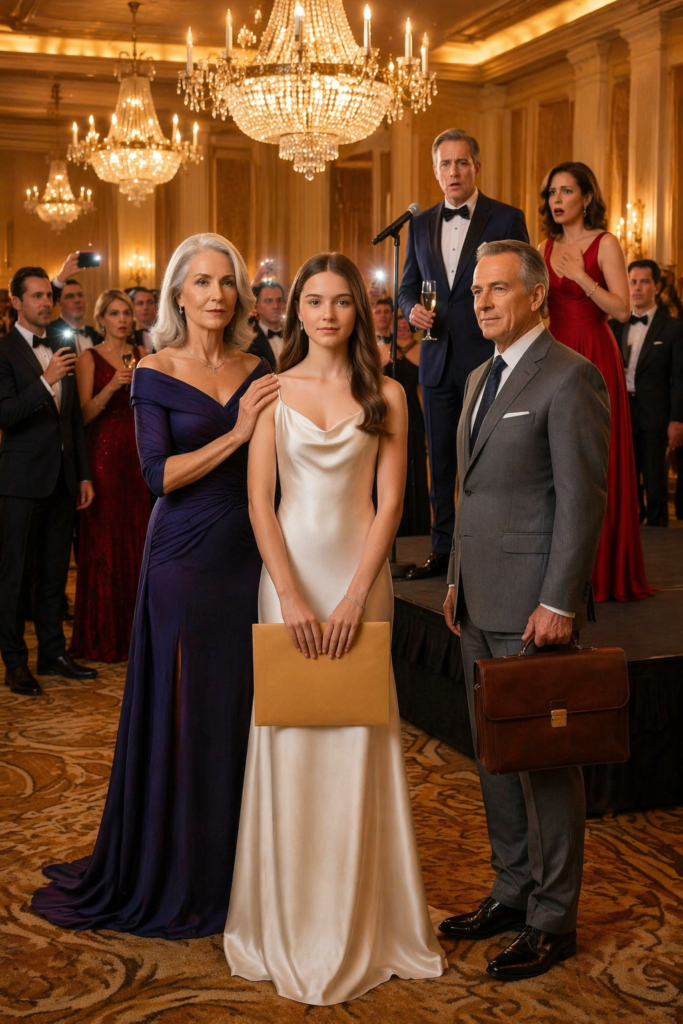
Meanwhile, at the Imperial Reforma Hotel, Alejandro Montenegro raised a glass in front of 200 guests.
The main hall was filled with cameras, expensive floral arrangements, and tables covered in ivory tablecloths.
On a giant screen, it read:
"Industrias Montenegro: new era of medical expansion."
Claudia smiled like a soap opera queen.
Iván practiced his heir speech.
Renata kept posting stories.
No one mentioned Sofía.
At 8:12 p.m., Alejandro took the stage.
"Tonight, we’re not just closing an 80 million dollar contract," he said. "We’re also celebrating the strength of a united family."
The applause was thunderous.
Claudia placed a hand on her heart.
"My wife and my children have been my driving force," Alejandro continued. "Iván, Renata, thank you for always being by my side."
From the back of the hall, Sofía heard those words wearing her mother’s navy blue dress.
It was a bit long for her.
Elisa had helped her adjust it with a pin before leaving the house.
"Your mom wore it when she defended an audit for investors for the first time," she had said.
Sofía didn’t want to go to the hotel.
It terrified her.
But Elisa took her hand and said:
"They made you invisible in private. The truth has to enter in public."
Beside her walked Rodrigo Ibarra, a retired notary public of 72 who had worked with Don Julián Robles.
The man moved slowly, with a cane and a leather folder.
When Alejandro saw Sofía at the entrance of the hall, his smile shattered.
Claudia turned pale.
Iván cursed under his breath.
Renata lowered her phone.
Alejandro left the microphone at the podium and walked toward them with his jaw clenched.
"What are you doing here?"
Sofía didn’t answer.
Elisa did.
"We came to correct a theft."
Claudia rushed over, her silver dress brushing the floor.
"This girl is having a crisis. She has always been unstable. Get her out before she ruins the night."
Sofía felt all eyes on her.
Businessmen.
Partners.
Reporters.
Waiters.
People who knew nothing of her life but were already starting to judge her.
Alejandro lowered his voice.
"I told you to stay at home."
Sofía pulled out the yellow note from the transparent bag and held it up.
"In the house where they left this for me?"
A murmur swept through the hall.
A journalist pointed her camera at the note.
Claudia tried to snatch it away, but Elisa stepped in.
"Don’t touch it."
"You have no right to be here," Alejandro said.
Elisa smiled without joy.
"Since 7 p.m., I do have a right. You gave it to me yourself."
Alejandro understood too late.
His eyes darted to the black folder.
Then to Sofía.
Then to the notary.
Rodrigo Ibarra requested the microphone.
No one gave it to him.
Then Elisa climbed the stage, took the microphone from the podium, and spoke with a calmness that chilled the hall.
"My name is Elisa Valdés. I am a family lawyer and the legal guardian of Sofía Montenegro Robles since today, by renunciation signed by Mr. Alejandro Montenegro."
The hall erupted in murmurs.
Iván looked at his father as if he had heard wrong.
"You gave her away?" he whispered.
Claudia squeezed Alejandro’s arm.
"Do something."
But Alejandro didn’t move.
Elisa continued.
"We bring here notary Rodrigo Ibarra, who safeguarded a certified copy of Don Julián Robles' will, a publicly unrecognized founding partner of Industrias Montenegro."
Rodrigo climbed the stage with difficulty.
He opened his folder.
His voice was old, but firm.
"The will was signed on December 15, 2010, and ratified before public faith on January 20, 2011. Clause 9 states that 51% of the shares corresponding to the Robles-Montenegro capital would be transferred to his only granddaughter, Sofía Montenegro Robles, upon turning 16."
The giant screen continued displaying the company logo.
But no one was looking at the logo anymore.
Everyone was looking at Sofía.
Rodrigo raised his gaze.
"This transfer had to be requested by her legal guardian. Starting tonight, Licenciada Elisa Valdés fulfills that function by Mr. Montenegro’s own decision."
The representative of the Spanish medical group stood up.
"Mr. Montenegro, the contract is paused until the ownership of the shares is clarified."
Alejandro opened his mouth.
"This is manipulation. It’s a family matter."
The Spaniard didn’t blink.
"When it affects the control of a company, it stops being family."
That was the first public blow.
The contract Alejandro had boasted about for six months was frozen in front of everyone.
Claudia climbed onto the stage uninvited.
"This is ridiculous," she said, with a nervous laugh. "Sofía can’t even take care of herself. Her mother couldn’t either. Mariana Robles was a poor wretch who trapped Alejandro with a sick daughter."
Sofía felt something inside her break.
But she didn’t shatter.
She stepped closer to the microphone.
"Don’t talk about my mom."
Claudia raised her chin.
"Your mom destroyed this family."
Sofía looked at the guests.
Then at the camera of the journalist.
Then at her dad.
"My mom didn’t destroy anything. Mariana Robles found out that Alejandro Montenegro was diverting money from the company to personal accounts. That’s why they erased her from history. That’s why they erased me."
Alejandro stepped forward.
"Shut up."
"No."
The word came out small but firm.
Elisa pulled out a printed sheet.
"This email was sent from Alejandro Montenegro’s personal account to his tax advisor on June 2, 2026."
Elisa read:
"We need to resolve Sofía’s situation before her birthday. If she stays under my guardianship, we won’t claim the Robles clause. But if someone external represents her, the risk is enormous."
The silence fell heavy.
It wasn’t gossip.
It wasn’t a tantrum.
It was a confession written in office language.
Claudia whispered:
"Say it’s false."
Alejandro didn’t say it.
Because he couldn’t.
And that lack of response hurt more than any scream.
The guests began to step away.
First the prudent businessmen.
Then the partners.
Then the board members who suddenly needed to call their lawyers.
Renata stopped recording.
Iván stepped down from the stage.
The hall that was supposed to crown Alejandro Montenegro as untouchable became a showcase of shame.
Sofía took the microphone with both hands.
Her fingers trembled.
Her voice did not.
"My name is Sofía Montenegro Robles. I am the daughter of Mariana Robles and the granddaughter of Julián Robles. For years, I was told I was a burden, a disgrace, a shadow that needed to hide."
She looked at her dad.
"Today they left me alone on my 16th birthday with a note that said phenomenon. Today they signed to remove me from their lives."
She took a deep breath.
"But I didn’t come to destroy a company. I came to say that the truth also has the right to enter through the front door."
Someone started to clap.
Then another person joined in.
Not everyone did.
But enough did for Alejandro to understand that power had shifted.
Hours later, in a private room at the hotel, Elisa, Rodrigo, and Sofía reviewed the documents.
The company would remain under fiduciary supervision while the commercial court formally recognized the share transfer.
Until Sofía turned 18, Elisa would act on her behalf.
"But you will be present," Elisa said. "You’re young, not useless."
Sofía lowered her gaze.
No one had ever spoken to her like that.
That night she didn’t return to the mansion in Lomas.
She went to Elisa’s apartment in Condesa.
It wasn’t huge.
It had plants, books, a small kitchen, and the smell of cinnamon.
Elisa opened a room with light-colored walls.
"Your mom stayed here when we studied together. I kept some things, in case one day you came."
On the bed was a blue quilt.
On the desk, a photo of Mariana laughing with Elisa in Coyoacán.
Sofía touched the image carefully.
For the first time in a long time, she cried without hiding.
She didn’t cry for the note.
She didn’t cry for the party.
She cried because someone had left a door open for her for 12 years.
The next morning, financial portals published the news.
"Industrias Montenegro Gala Ends in Scandal: Hidden Will Emerges and CEO's Daughter Claims Majority Shares."
The photos went viral.
Alejandro with a gray face.
Claudia trying to smile.
Iván walking away.
And Sofía, standing there, in her mother’s blue dress, looking braver than she felt.
The medical contract was paused.
The shares dropped.
The board called an urgent meeting.
Within a week, Alejandro was temporarily removed.
In a month, the temporary became permanent.
The internal audit found irregular transfers, payments to shell companies, and movements that matched the evidence Mariana had saved before she died.
The cruelest twist was discovering that Claudia did know everything.
Not only had she pushed Alejandro to resign his guardianship over Sofía.
She had also written the note on the refrigerator to provoke the girl into staying home and seeking no help.
But she hadn’t counted on Mariana’s letter.
She hadn’t counted on Elisa.
And above all, she hadn’t counted on her own humiliation being the emotional proof everyone would remember.
Renata wrote three days later.
"I didn’t know about the will. Sorry for calling you ghost."
Sofía read the message several times.
She didn’t reply.
Not out of revenge.
But because an apology opens a door, but it doesn’t build a bridge.
Iván never sought to talk to her.
And Sofía accepted that faster than she expected.
Alejandro called two weeks later.
"Sofía, you’re still my daughter," he said with a tired voice. "Blood doesn’t erase with documents."
For a second, the girl still living inside her wanted to believe him.
Then she remembered the refrigerator.
The note.
The family photos where they cropped her out.
The silent birthdays.
"You’re not calling because you regret it," Sofía said. "You’re calling because you lost."
Alejandro fell silent.
"If the will hadn’t appeared, you would still be saying I was a disgrace."
He tried to say her name.
She hung up.
Her hands trembled.
But she didn’t cry.
That too was a kind of victory.
On January 16, 2027, Sofía woke up in Elisa’s apartment to the smell of sweet bread.
The table had two plates, purple flowers, and a small cake with 17 candles.
Elisa smiled.
"Happy birthday, my girl."
There were no cameras.
No businessmen.
No speeches.
Just someone who loved her without asking her to hide.
The gift was a silver bracelet from Mariana, repaired and cleaned, with a new pendant shaped like a key.
On the back, the date of her 16th birthday was engraved.
"The day everything changed," Elisa said.
Sofía held it against her chest.
"The day I stopped being invisible."
This time she didn’t make a wish.
She no longer needed the false love from a family that only wanted her when it was convenient.
She had the truth.
She had her mother’s legacy.
She had a home where her name wasn’t a nuisance.
And she had something that Alejandro Montenegro could never buy with millions:
A life that finally belonged to her.