PART 1
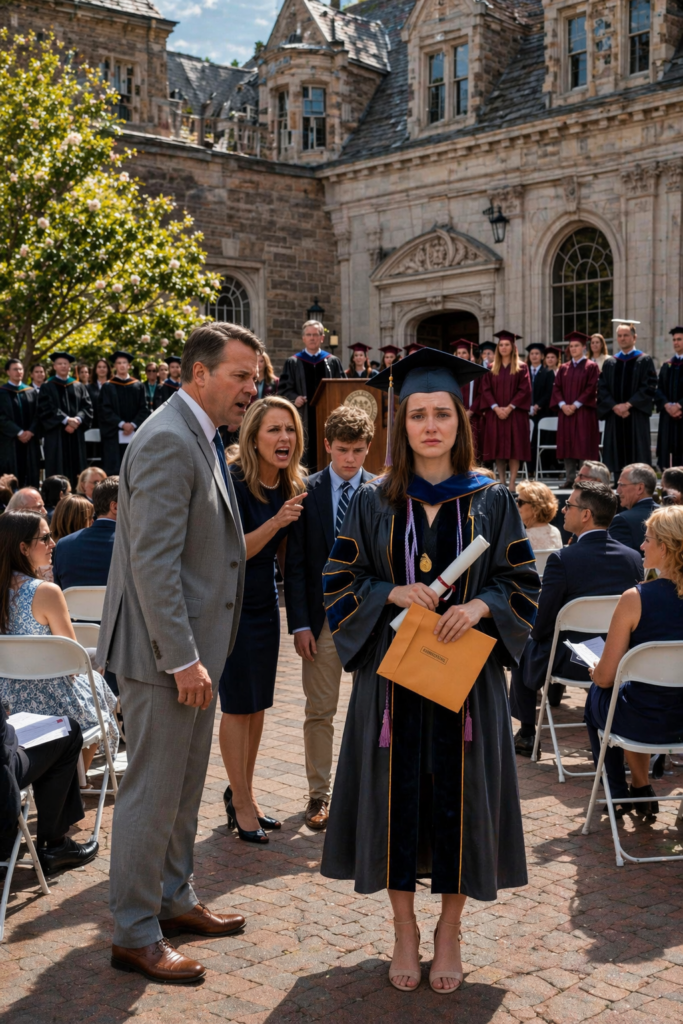
The slap echoed louder than the applause.
Camila’s black cap flew off in front of the entire expanse of the Universidad Autónoma de Guadalajara and landed beside the floral arrangement her best friend had brought her. For a few seconds, no one spoke. Not the teachers, not the photographers, not the families who had just shouted her name with excitement.
Her father, Ernesto Robles, stood with his hand raised.
—You have no right to stand there as if you were someone important —he said, his face flushed with rage—. That degree doesn’t erase the shame you’ve brought us.
Camila felt her cheek burning. The gown weighed on her like it was soaked. At her feet, the diploma remained inside its blue folder, just handed over, still with the golden ribbon intact.
Her mother, Beatriz, pushed through the crowd, her eyes filled with fury.
—A failed graduate! —she shouted—. That’s what you are! An ungrateful person who thinks she’s special because she got a piece of paper!
Some ladies crossed themselves. A child began to cry. The master of ceremonies lowered the microphone, unsure of what to do.
Camila didn’t cry.
Not because it didn’t hurt. It hurt like hell. It hurt her face, it hurt her chest, it hurt to hear her own parents insult her in front of classmates who had seen her arrive sleep-deprived, dark-eyed, with cold coffee in hand and notebooks filled with notes.
But Camila had prepared for this moment for 4 years.
Not for the slap. Not for the public humiliation. But for the day when her parents could no longer hide what they had done behind phrases like “it’s a family matter” or “blood should be respected.”
For 4 years, Ernesto and Beatriz told everyone that Camila had dropped out of school.
That she had run off with a boyfriend. That she was going down the wrong path. That she didn’t want to study. That they, poor sacrificial parents, had done everything for her and she had repaid them with ingratitude.
The truth was different.
Camila had obtained a 60% scholarship. To pay the rest, she worked at a stationery store in the mornings, gave extra classes in the afternoons, and waited tables at a café near Chapultepec on weekends.
She slept 3 or 4 hours. She ate half sandwiches to make them last 2 days. She had sold her good cellphone and used an old one with a cracked screen for almost a year.
And still, she graduated with honors.
When they announced her name, many stood and applauded.
The only one who didn’t applaud was her younger brother, Iván.
Iván stood behind their parents, in an expensive suit, a new watch, and shiny shoes. He was the pride of the household, even though he had dropped out of 2 degrees, ruined a motorcycle business, and lost money in sports betting that everyone pretended not to see.
Camila was told there was no money.
Iván had everything paid for.
Camila bent down, picked up her cap, and brushed the dust from the edge. Then she took her diploma with a calmness that made her mother nervous.
—You’re right about one thing —she said, looking at her parents—. Everyone should hear the truth.
Beatriz paled.
—Camila, don’t you dare.
But Camila was already walking toward the podium.
The rector, Dr. Quiroga, held the microphone with a look of not knowing whether to stop the ceremony or call security.
Camila pulled out a thick yellow envelope from her folder, sealed with tape.
—Dr. Quiroga —she said into the microphone—, I need to publicly denounce the people who used my name, forged my signature, and left me in debt for over 480,000 pesos while saying I was a freeloader.
Ernesto shouted from the crowd:
—Shut up, damn it!
But the microphone was already on.
PART 2
The silence that fell over the expanse was heavier than the slap.
Camila held the envelope with both hands, not because she was nervous, but because inside it held 4 years of proof: account statements, screenshots of messages, contracts, credit applications, forged signatures, and deposits that never reached her hands.
The rector approached slowly.
—Miss Robles, are you sure about what you’re saying?
—Yes, doctor —she replied—. And this time I won’t fix it “at home.”
The phrase hit Beatriz directly.
—Don’t believe her —the mother shouted, raising her voice—. My daughter has always been dramatic. Since she was a child, she makes scenes to get everyone’s attention. She must be upset because we didn’t throw her a party.
Several people murmured. Some phones were already recording.
Camila turned to her.
—Did I also make up the 3 student loans that appear with my CURP? Did I also invent that my signature was copied from my scholarship application? Did I also invent that the money went into an account in Dad’s name and then was transferred to Iván’s business?
Beatriz’s face changed.
She no longer seemed an offended mother. She looked like a woman who had been exposed.
Ernesto stepped toward the podium.
—This is a family problem. No one has to get involved.
A university guard stopped him with his arm.
—Sir, you cannot go up there.
—I'm her father!
Camila looked at him with cold sadness.
—And that’s why you thought you could steal from me without consequences.
The rector took the envelope. He opened it in front of 2 academic coordinators and a university lawyer who approached as soon as she heard the word “credits.” Camila recognized her: it was Licenciada Montserrat, the only adult who believed her when she came crying to her office 6 months earlier.
Montserrat didn’t look surprised. She looked ready.
—Doctor —the lawyer said—, the university was already aware of this case. The student has provided sufficient documents to formally request a review from the financial institutions.
A louder murmur swept through the crowd.
Camila took a deep breath.
—When I entered the program, my parents said they couldn’t help me. I accepted that. I never asked them for anything. I worked, saved, fell behind, paid late fees, sold things. But in the third semester, they denied me a procedure because I appeared with educational debts that I never applied for.
Mariana, her best friend, was among the graduates with tears in her eyes.
Camila continued.
—I went to the bank. They told me the loans were signed by me. I checked the contracts and saw my name, my CURP, my address, and a signature that looked like mine, but wasn’t mine. Then I found emails sent from my dad’s computer and proof of deposits into a family account.
Iván lowered his gaze.
Until that moment, he hadn’t said anything. He just fidgeted with his watch, nervous, as if he could hide behind his sleeve.
—That money —Camila said, pointing at him— ended up paying the rent for the shop where you set up your motorcycle workshop. It also paid for merchandise, tools, and even your truck.
Iván’s head shot up.
—Don’t drag my name into this.
—Your name is already in the deposits.
Grandma Consuelo, Ernesto’s mother, stood up from a chair in the front row. She had arrived with a bouquet of sunflowers for Camila, but Ernesto took it from her upon entering and told her not to make a scene, that Camila “didn’t deserve flowers.”
The woman walked slowly until she stood in front of her son.
—Ernesto —she said with a broken voice—, you swore to me that Camila had dropped out of school.
Ernesto clenched his jaw.
—Mom, you don’t understand.
—I understand perfectly —she replied—. You asked me for money to “rescue the girl” and you gave it to Iván.
Camila felt the air choke her.
That wasn’t in her documents.
—What money? —she asked.
Grandma Consuelo looked at her with a guilt that seemed to have been carried for years.
—I gave your father 90,000 pesos. He said he needed it to pay for a clinic because you were into drugs and didn’t want help. I... I believed him.
Camila closed her eyes.
For years, she had wondered why her grandmother stopped calling her. She thought she hated her too. She thought the whole family had discarded her without asking.
But no. They had also robbed her of the chance to defend herself.
Beatriz approached the podium, now with fake tears on her face.
—Daughter, please. Think about your brother. Iván was going through a rough patch. You’ve always been stronger. You could get through this on your own.
Those words hurt more than the slap.
Because they weren’t an apology.
They were a confession.
Camila looked at her mother as if she were seeing her for the first time.
—Then you did know.
Beatriz fell silent.
The silence was enough.
Iván, desperate, let out a nervous laugh.
—Oh, come on. Don’t make such a scene. In the end, everyone in the family knew Vale was the one who could handle everything. I was doing poorly, what did you want me to do?
Mariana shouted from below:
—Get a job, dude!
Several students applauded involuntarily. Others let out a “seriously, how low can you go?”
Iván turned red.
—Shut up, you’re not even family.
Camila lifted the microphone again.
—That’s exactly what’s the saddest part. The people who weren’t my family fed me when I had nothing. They loaned me notes when I worked double shifts. They accompanied me to the bank when my hands were shaking. My family, on the other hand, used my name to borrow money and then called me a failure.
The rector looked at security.
—Please, close the main entrance. The municipal police are on their way.
Ernesto exploded.
—You’re not going to report your parents on your graduation day!
Camila looked at him with her cheek still red.
—You hit me on my graduation day.
That phrase left Ernesto speechless.
The ceremony never resumed in the same way. The other graduates were moved to the auditorium. Families passed through murmurs, some outraged, others recording, others pretending they hadn’t seen anything because in Mexico, there are still people who believe dirty laundry should be washed at home, even when that laundry is full of abuse.
Camila stayed in an administrative room with the rector, Licenciada Montserrat, and 2 police officers. Beatriz cried in a chair, but kept repeating:
—My son is not to blame. My son is not to blame.
No one asked about Camila.
Ernesto tried to say that she had verbally authorized everything. That since she lived at home back then, it was normal for the documents to be there. That a signature could look similar. That maybe Camila didn’t remember.
But Montserrat placed on the table the evidence that changed everything.
It was a video from a security camera at the stationery store where Camila worked. On the exact date she supposedly signed the largest loan, Camila was attending customers at 11:18 in the morning.
The signature had been put in a bank branch at 11:20.
—Unless Miss Robles can be in two places at the same time —Montserrat said—, that signature was forged.
Iván began to sweat.
Then the second blow came.
The police reviewed messages previously delivered by Camila. In one, Beatriz was writing to Ernesto:
“As long as Camila doesn’t check Buró, there’s no problem. She doesn’t even know how that works.”
In another, Iván asked:
“Did the money for Cami’s school come through? The supplier is pressuring me.”
And Ernesto replied:
“Yes, but shut up. Your sister must not find out.”
Camila read those screenshots without crying.
Not because it didn’t hurt anymore, but because she finally understood that her pain had a name. It wasn’t exaggeration. It wasn’t drama. It wasn’t ingratitude.
It was betrayal.
The investigation continued for weeks. The graduation video went viral on Facebook. Some defended Camila. Others said exposing parents was a sin, that a daughter should forgive, that a slap didn’t justify destroying a family.
Camila didn’t respond to comments.
She had more important things to do.
With the university’s help, she managed to suspend the charges while the loans were reviewed. Later, a judge determined that the signatures did not belong to her. The institutions canceled the debt in her name and initiated proceedings against those responsible.
Ernesto and Beatriz accepted a settlement to pay restitution and face lesser charges for forgery and fraud, avoiding a heavier sentence. Iván had to sell the truck, close the shop, and return part of the money he received.
For the first time, the favorite son had to answer for something.
The family split in two.
Some uncles called Camila brave. Others sent her messages saying she had gone too far, that it wasn’t necessary to take her parents to court, that “family comes first.”
Camila replied only once:
—Family also steals. Family also lies. Family also destroys when everyone stays silent.
Then she stopped responding.
Grandma Consuelo was the only one who came to her rented room with a shopping bag, a new bouquet of sunflowers, and swollen eyes.
—I’m sorry, my girl —she said—. I should have looked for you. I should have asked you.
Camila didn’t hug her immediately. She needed time. But she opened the door.
Sometimes healing doesn’t start with forgiveness.
Sometimes it starts with letting in only those willing to acknowledge the harm.
Months later, Camila found a job at an accounting firm near Providencia. She rented a small apartment, with white walls, a folding table, 2 chairs, and a used coffee maker that made too much noise in the mornings.
To anyone, it was little.
For her, it was peace.
The day she received her framed diploma, there was no party. No mariachi, no balloons, no family food. Only Mariana, her grandmother, and 2 classmates arrived with sweet bread and coffee.
Camila hung her diploma over her desk.
Below, she taped a photo taken seconds after the slap. In the picture, her cheek was red, the gown wrinkled, and the diploma pressed against her chest. Her eyes were filled with tears, but her back remained straight.
Mariana asked her why she wanted to keep such a harsh photo.
Camila replied:
—Because that day they wanted everyone to see me destroyed. And it ended up being the day I stopped hiding.
One night, Ernesto wrote to her from another number:
“One day you’re going to regret ending this family.”
Camila looked at the message for a while. Then she turned to see her diploma, her desk, her open window, and the life she was building without asking for permission.
She replied:
“I didn’t end the family. I just stopped paying the price for their lies.”
Then she blocked the number.
On that graduation day, her parents wanted to turn her into a public disgrace. They wanted everyone to remember Camila as the ungrateful daughter, the failure in a gown, the girl who didn’t deserve to be on stage.
But they ended up showing who they really were.
And Camila understood something that many people take a lifetime to accept: honoring family doesn’t mean keeping quiet when they destroy you. Sometimes, honoring your name means being the first to tell the truth, even when everyone else prefers to keep living the lie.