PART 1
"Your mom's hurting herself, Alejandro. She really doesn't know what she's doing anymore."
That's what Mariana said in front of three neighbors, with one hand over her chest and tears in her eyes, though Alejandro knew they were fake.
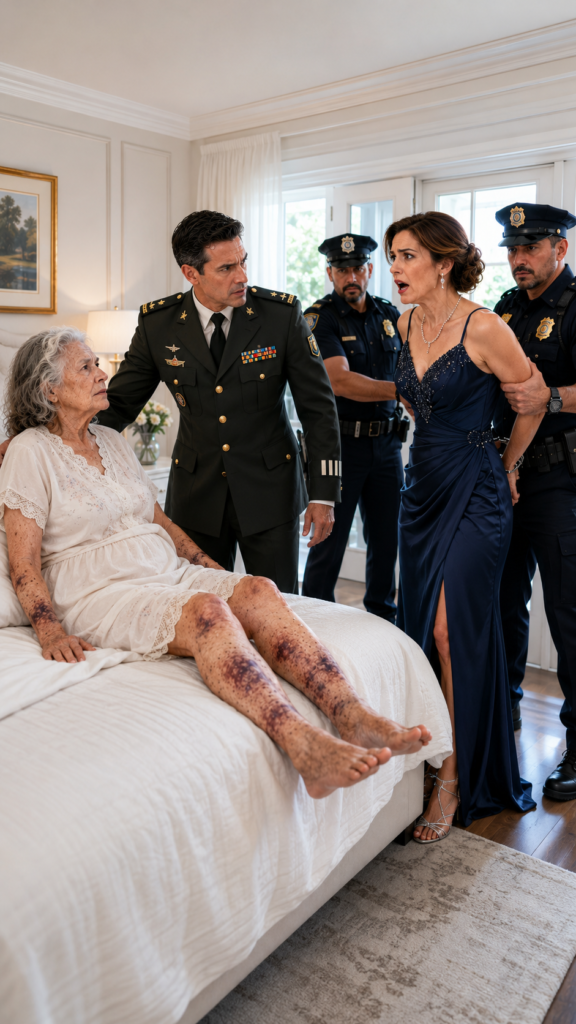
Captain Alejandro Vargas had just gotten out of a taxi in Juriquilla, Querétaro, after 21 days on a mission. He was exhausted, his clothes reeking of road and gunpowder, dreaming of hugging his mother and eating the green enchiladas she always made for him.
But he didn't find food.
He found a house that was too clean.
A porch full of nosy people.
And a muffled scream behind a closed door on the second floor.
"Alejandro! Son, please!"
The voice was his mother, Doña Teresa.
Alejandro looked up.
Mariana immediately approached him, perfumed and polished, in her cream-colored dress and that decent woman smile she loved to show in public.
"Honey, don't be scared. Your mom is worse. She's disoriented, she screams, she breaks things. The doctor says it could be advanced dementia."
Doña Carmen, the neighbor, nodded sympathetically.
"Oh, captain, your wife has suffered so much taking care of her."
Alejandro didn't reply.
In the army, he'd learned that the most dangerous enemy wasn't the one who shouted, but the one who smiled too much.
So he hugged Mariana.
Kissed her forehead.
And said calmly:
"Thank you for taking care of her."
Mariana breathed a sigh of relief, as if she'd already won.
When the neighbors left, Alejandro went up to the second floor. Mariana tried to stop him.
"Don't go in now. Your mom gets aggressive."
"I just want to see her."
"Alejandro, please. Trust me."
He looked at her intently.
"Of course, I trust you."
But he went downstairs without arguing.
He waited until Mariana went to take a shower. Then he went straight to the closet, looked for the red box where she kept her jewelry, and found a key taped under an earring case.
He went back upstairs.
Opened the door.
The room smelled of confinement, old medicine, and fear.
Doña Teresa was sitting on the floor, wearing the same blouse she'd had on during their video call four days ago. Her lips were dry, a glass of warm water by her side, and dark bruises around her wrists.
But her eyes weren't lost.
They were alive.
"I'm not crazy," she whispered.
Alejandro felt his chest break.
"I know, Mom."
She tried to stand up but heard footsteps in the hallway. She immediately lowered her gaze and put on a vacant expression, as if she'd been practicing how to survive for weeks.
"Not yet," she murmured. "She checks everything."
Alejandro understood.
He closed the door from the outside, hating himself for doing it.
That night, Mariana served mole, red rice, and wine, as if they were celebrating his return. She then put a folder on the table.
"Tomorrow, the doctor will assess your mom. If she confirms incapacity, you sign this power of attorney, and I can sell her downtown house to pay for a decent residence."
Alejandro flipped through the papers.
There were studies, medical letters, suspicious signatures, and a pending bank application for 1,480,000 pesos.
"Is there already a buyer?" he asked.
Mariana barely smiled.
"A great opportunity, love. Don't be sentimental. That old house is worth more dead than alive."
That phrase told him everything.
At midnight, Alejandro checked the cameras.
Mariana had deleted three months.
But she forgot to delete the cloud.
He also found emails from his mother diverted to Mariana's personal email, password changes, an alert in the Public Registry, and messages with a real estate agent named Ricardo Saldaña.
Before dawn, Alejandro returned to Doña Teresa's room.
"Mom, tomorrow I need you to act confused."
She looked at her bruised wrists.
Then lifted her face with a coldness he'd never seen in her.
"How confused, son?"
Alejandro realized that Mariana had no idea who she'd provoked.
No one could believe what was about to happen…
PART 2
At 7:30 in the morning, Doña Teresa went down to the kitchen wearing a blue robe and her hair carefully combed. Alejandro had passed it to her through the window before sunrise, along with a phone hidden in a bread bag.
Mariana was making coffee.
Seeing her, she smiled with that fake sweetness she used when there were witnesses.
"Good morning, Teresita. How did you wake up?"
Doña Teresa stared at the refrigerator for several seconds.
Then she asked:
"Do the buses to Celaya leave from here?"
Mariana let out a theatrical sigh.
"See, Alejandro? This is every day. Your mom can't tell a kitchen from a bus terminal anymore."
Alejandro looked down at his cup.
"We have to be patient."
Doña Teresa picked up the sugar bowl and let it fall.
The crash shattered the house's tranquility.
Mariana reacted without thinking. She grabbed her wrist so hard the old woman winced in pain.
"Enough playing the victim," she said through clenched teeth. "You're not going to ruin this for me, old lady."
Alejandro didn't move.
Under the table, a recorder kept running.
"Mariana," he said calmly. "Let her go. She might get hurt."
She let go abruptly.
"See? That's why she needs professional help. You'll understand today."
The assessment was at 9:00 in a private office in the Álamos neighborhood, with Dr. Laura Cárdenas, a specialist in seniors.
Mariana arrived impeccable, wearing pearls, low heels, and a thick folder clutched to her chest. She looked like a sacrificial daughter-in-law.
"Doctor, I have everything here," she said as soon as she entered. "Behavior reports, episodes of aggression, escape attempts, forgetfulness, disorientation…"
Alejandro let her talk.
Then he placed a USB drive and a black folder on the desk.
"I brought something too."
Mariana's smile faltered for one second.
The doctor opened the folder.
First, she saw photographs of Doña Teresa's wrists.
Then, a locksmith's report confirming the room's lock had been modified to open only from the outside.
Next, the deleted access records from the cameras.
The transfer application for 1,480,000 pesos.
The diverted emails.
The signature comparisons.
The movement alert regarding the downtown house.
And the messages between Mariana and Ricardo Saldaña.
The doctor picked up the phone.
"Rosa, please close the consultation area entrance. No one is leaving yet."
Mariana let out a nervous laugh.
"Excuse me? Doctor, this is ridiculous. My husband is tired, traumatized by his work. He doesn't understand what I've been through."
Doña Teresa lifted her gaze.
"Today is Thursday, September 14th. I'm in Querétaro, at Dr. Laura Cárdenas' office. My full name is Teresa Morales widow of Vargas. I'm 68 years old. I take losartan in the morning and calcium at night. My house is on Madero Street, number 47. My accounts are with Banorte and BBVA. And no, doctor, I don't have dementia."
Mariana turned pale.
"She memorized that!"
The doctor asked her to be quiet.
For 40 minutes, she evaluated Doña Teresa. She asked her to recall words, draw a clock, repeat numbers backward, explain recent news, mention family dates, and describe how she managed her money.
Doña Teresa answered everything.
She even corrected the doctor when she misstated the year her husband died.
"My husband died five years ago," she said. "And before he left, he installed a hidden camera because he said in Mexico, even good people need evidence when bad people smile nicely."
Alejandro plugged in the USB drive.
The screen showed the house's hallway.
The image wasn't perfect, but it was enough.
You could see Mariana entering the room, taking Doña Teresa's phone, and putting it in her purse.
"You're not calling anyone," it was heard. "Alejandro is far away. And when he returns, I'll have already explained to him that you're losing your mind."
In another video, Mariana pushed her toward the room.
"You're hurting me," Doña Teresa said.
"It'll hurt more when they institutionalize you," Mariana responded.
The doctor clenched her jaw.
Mariana stood up.
"That's edited!"
Alejandro placed his phone on the desk and played the kitchen audio.
"No one will believe a confused old lady. I've already told everyone you scream, make things up, and hurt yourself. Tomorrow, a doctor will put it in writing."
Mariana stopped breathing for a moment.
Then she tried to change her tone.
"Alejandro, honey, I was tired. Your mom provoked me. You were never there. I carried everything."
"You didn't carry her," he said. "You locked her up."
The doctor looked at Mariana.
"Why was a lucid adult without a phone, without keys, and without the ability to open from the inside?"
Mariana didn't answer.
"Why was there an attempt to transfer 1,480,000 pesos from her accounts?"
Silence.
"And why does a real estate developer appear talking about selling the house for 4 million when it's worth over 10?"
Mariana looked at Alejandro with hatred.
"You spied on me."
"No," he replied. "I protected my mother."
At that moment, a side door opened.
Two agents from the Prosecutor's Office entered.
One showed his ID.
"Mariana Ríos Santillán, you are under arrest for your probable involvement in elder abuse, illegal deprivation of liberty, document forgery, and attempted property fraud."
Mariana stepped back.
"You can't do this to me. I'm his wife!"
Alejandro didn't move.
"And she's my mother."
"Ricardo pressured me!"
"You also kissed him in the kitchen."
That phrase shattered her more than the handcuffs.
Doña Teresa closed her eyes. Not out of weakness, but out of pain. Because knowing someone wanted to take your house was one thing, but accepting that person had dined with you, received your affection, and still dared to call you "mom" was another.
While Mariana was being led away, Ricardo Saldaña arrived at the Public Registry with sunglasses and a notarial folder.
He didn't get to deliver the papers.
Two other agents were waiting for him.
They arrested him with the fake contract in hand. When they checked his folder, they found files on two more seniors, houses sold below value, and dubious diagnoses.
Doña Teresa's case wasn't isolated.
It was a business.
Dr. Cárdenas signed a definitive report: Teresa Morales was lucid, competent, and capable of managing her life and assets. She also recommended immediate protective measures and psychological attention for trauma.
That same day, a judge froze the accounts, suspended the notarial powers, and blocked any movement on the house.
The doctor who signed notes without examining Doña Teresa was called to testify.
The notary too.
Alejandro didn't feel joy.
He felt tired.
As if he'd returned from one war only to discover another within his own home.
When they returned to Juriquilla, the neighbors were on the street.
Doña Carmen was crying.
"Doña Tere, forgive me. Mariana told us you made things up, that you screamed, that you hurt yourself…"
Doña Teresa looked at her without anger.
"Next time you hear an older person asking for help, don't ask the one with the key. Ask the one who's locked up."
Doña Carmen lowered her head.
That phrase spread through the neighborhood faster than any gossip.
In the weeks that followed, everyone began to remember things. That Mariana turned up the music when Doña Teresa screamed. That she wouldn't let her receive visitors. That she always answered her phone. That she said, "old age is like that" when someone noticed bruises.
Everyone had memories when it was safe to have them.
Months later, Mariana accepted responsibility. She was sentenced for elder abuse, illegal deprivation of liberty, forgery, and attempted fraud. She also received a restraining order and lost any marital rights.
Ricardo Saldaña received a harsher sentence, as his network involved more families.
The divorce was swift.
Mariana lost the house, the money, the reputation, and the image of a perfect woman she'd so carefully maintained.
But, according to a cousin of hers, what hurt her most was that no one believed her tears anymore.
Eight months later, the room where Doña Teresa had been locked up was transformed.
The walls were painted light blue. There were new curtains, a comfortable chair, old novels, a warm lamp, and a phone on the table.
The lock had been removed.
Alejandro installed a new door that opened from both sides.
In the yard, they burned the old mattress, damaged clothes, and broken lock. There were no speeches. Just fire, silence, and a woman regaining her breath.
Doña Teresa watched the flames.
"A house needs to breathe too," she said.
Alejandro requested an extension of his leave but still slept little. He checked windows, cameras, doors. He woke up at any noise.
One morning, Doña Teresa served him coffee from a pot and sweet bread.
"Son, you can live again."
"I can't leave you alone."
"You're not leaving me alone. You're leaving me free."
Alejandro swallowed hard.
"I failed, Mom."
She took his hand.
"No. You arrived."
"But late."
"In time. Those who arrive late are the ones who hear and do nothing."
Weeks later, Alejandro received orders to return. It was Doña Teresa who packed his bag. She put in socks, a notebook, a wooden rosary, and a bag of walnut cookies.
"So you don't eat just junk," she said.
Alejandro smiled.
"Yes, Sergeant."
She raised an eyebrow.
"Captain, don't get confused. I'm in charge here."
Before leaving, Alejandro found her in the kitchen making lemon pie. Light streamed cleanly through the window. In the hallway, a new camera blinked discreetly.
Not to monitor her.
To protect her.
"Still confused, Mom?" he asked, trying to joke.
Doña Teresa tasted the filling with a spoon.
"Very."
"Oh, really?"
"Yes. Every day, I forget why I was ever afraid of that woman."
Alejandro laughed, but his eyes filled with tears.
Doña Teresa served him coffee.
"Go in peace, son. This house no longer has doors locked from the outside."
He hugged her long.
Not as a captain.
Not as an investigator.
As a son.
And as the taxi drove away, Doña Teresa stepped onto the porch with her cup in hand.
Doña Carmen, from the sidewalk, raised her hand shyly.
"Good morning, Doña Tere."
She answered with a serene smile.
"Good morning."
The house was still hers.
Her memory too.
And for the first time in many months, when she closed the door, it didn't sound like a prison.
It sounded like peace.