PART 1
—Sign the house, Natalia, or your grandmother will end up in a nursing home where no one will ever ask about her again.
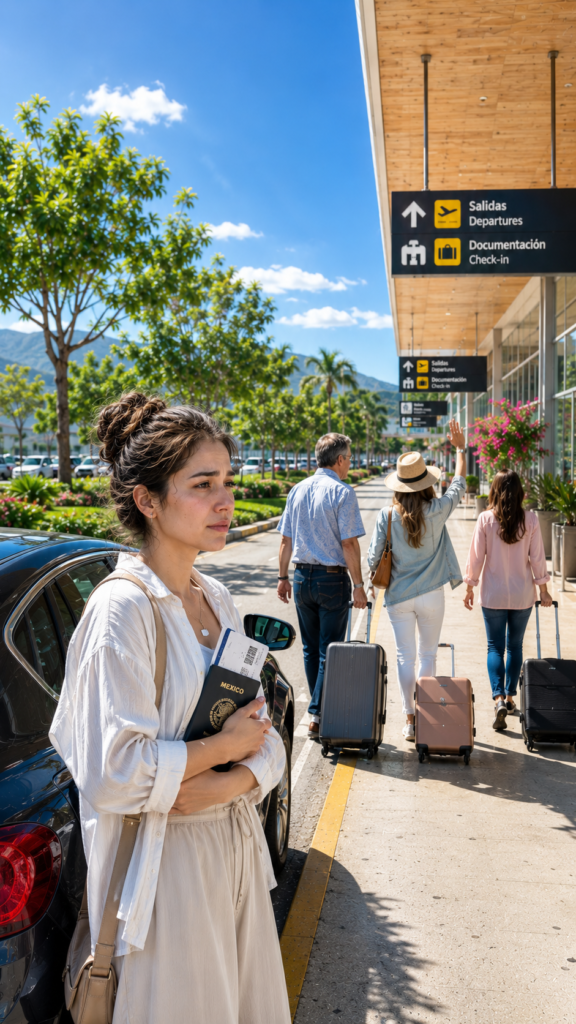
That was the first thing Mireya said when Natalia Robles crossed the gate of the old family home in San Ángel, still holding her suitcase in one hand and her wrinkled Navy uniform from the flight.
There was no hug.
No condolences.
Not even a pretty lie.
Just Mireya, standing under the sun in the yard, wearing dark glasses, red nails, and a white dress too expensive for a woman claiming to be in mourning.
A black bow hung on the front door.
Perfect.
Clean.
So well arranged it looked like magazine decor, no sign of pain.
Natalia felt something freeze in her chest.
She had been in training in Veracruz for six months, and during all that time, she asked about her dad almost daily. Mireya always replied the same way:
“Javier is tired.”
“Your dad doesn’t want to worry you.”
“Your grandmother Carmen is very much out of her mind.”
But upon arriving, don Roque, the caretaker who had been at the house for over ten years, opened the door with swollen eyes.
—Lieutenant… your dad passed away three months ago.
Natalia didn’t understand at first.
Three months.
Ninety days of false messages.
Ninety days of fabricated silence.
Ninety days during which she kept writing: “Tell my dad I’ll be back soon.”
Then she heard a moan in the side yard.
She walked quickly, her heart pounding against her ribs, and there she saw her.
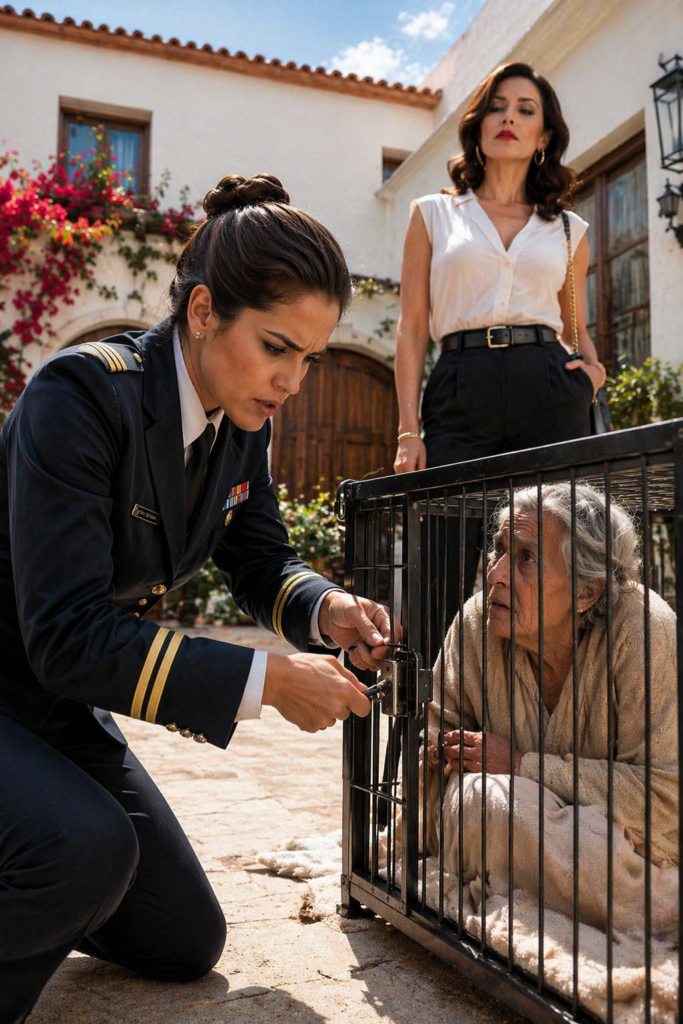
Her grandmother Carmen was locked inside a metal dog cage, sitting on a dirty blanket, her wrists marked, her lips cracked.
Beside her was a plate of cold rice.
Too far away to reach it.
A bowl of water was overturned on the floor.
Natalia stood frozen.
The woman who taught her to grind salsa in a molcajete, who slipped sweet bread into her backpack when she went to elementary school, who called her “my steel girl” every time she saw her in uniform, was there, treated like an animal.
—She became aggressive —Mireya said, not removing her glasses—. Your dad knew it was necessary.
The grandmother barely lifted her head.
—Naty… you’re back.
That was enough.
Natalia didn’t scream.
Didn’t cry.
She didn’t give Mireya the satisfaction of seeing her break.
She simply extended her hand.
—Give me the key.
Mireya smiled.
—This house is mine. Your dad left everything in my name. You don’t come here to give orders.
Natalia looked at the cage.
Then looked at her grandmother.
After that, she placed her boot against the lock and pulled with all her might.
The metal resisted twice.
On the third, it snapped.
She pulled her grandmother into her arms and felt how little she weighed. Too little. As if those three months had also stolen her bones.
—Don’t leave me again —Carmen whispered.
—Never again —Natalia replied.
Don Roque called the family doctor. Lupita, the lifelong maid, appeared crying from the kitchen with a blanket.
Natalia pulled out her phone and took pictures.
The cage.
The lock.
The plate far away.
The marks on the wrists.
The perfect black bow.
Mireya began to get nervous.
—You don’t know what happened here. Your dad signed papers. There are documents.
Natalia entered the study.
The drawers were empty.
The safe was open.
The family photos had disappeared.
On the desk were new contracts, all in Mireya’s name.
Then grandmother Carmen, trembling under the blanket, unpicked the edge of her robe.
A small key fell into Natalia’s hand.
Above, in the guest room, something heavy scraped the floor.
And when Natalia turned, Mireya no longer smiled.
PART 2
Natalia held the key between her fingers and looked toward the stairs.
Mireya immediately stepped in front of her.
—That room doesn’t open.
Her voice came out dry, but her hands betrayed her. They trembled as if the key were a gun pointing straight at the truth.
—Then there is something in there —Natalia said.
Don Roque climbed behind her. Lupita stayed with doña Carmen in the living room, holding her as if every movement could shatter her.
Mireya tried to grab Natalia's arm.
—Your father didn’t want you to see this.
Natalia shook free without violence, but with a firmness that made it clear she wasn’t going to ask for permission.
—My father taught me to distrust those who hide papers and lock up old ladies.
The key fit perfectly in the lock.
The room smelled of dampness, bleach, and confinement.
In the middle was Javier Robles’ military trunk, the one Natalia had known since she was a child. Inside, her dad kept medals, letters, photographs of his first wife, and documents he never left in plain sight.
The trunk had fresh scratches around it.
Someone had tried to move it minutes ago.
On the carpet were broken frames, medical receipts, bank statements, and a yellow envelope with Javier’s handwriting.
Natalia picked it up.
It said:
“If Mireya says your grandmother lost her mind, check everything before signing.”
Doña Carmen, from the doorway, let out a small sob.
It wasn’t fear.
It was relief.
As if she had waited months for someone to find those words.
Inside the trunk appeared the missing folder.
There was also an old cell phone with a cracked screen. Don Roque carefully took it and, when he pressed a button, the screen lit up.
It had a paused recording.
Date: March 14.
Time: 1:43 a.m.
Mireya jumped down two steps.
—Don’t play that.
Natalia didn’t look at her.
She pressed play.
The image was dark, but the yard was distinguishable.
Javier Robles appeared standing, thinner, with a robe over his shoulders. His breathing sounded tired, but his voice still had strength.
—Mireya, my mother is not crazy. And I’m not going to sign anything against Natalia.
The camera shook a little.
Doña Carmen appeared in a corner, sitting, with a cup in her hands.
Mireya entered the frame dressed in black.
Not in mourning.
As if she had already rehearsed the role of widow.
—Your daughter is far away —she said—. Your mother can’t defend herself. You’re sick. Really, Javier, stop playing the hero.
Natalia squeezed the phone until her knuckles turned white.
In the video, her dad took a step.
—If Natalia comes back, she is going to find the letter.
Mireya laughed.
—Then let’s hope she doesn’t come back in time.
The recording cut off.
No one spoke.
The silence weighed more than any scream.
Natalia opened the folder with trembling hands.
Inside was the original will. There was also a revocation of powers, a medical report confirming that doña Carmen was lucid, copies of deeds, blocked bank transactions, and a letter addressed to Natalia.
She read it while standing.
“My Naty:
If you’re reading this, it’s because I didn’t manage to tell you.
Your grandmother is not sick.
Mireya wants to isolate her to take the house, my accounts, and everything we built.
Don’t sign any documents dated after March 14.
Don’t think I handed everything over willingly.
Don’t leave your grandmother alone.
And, above all, don’t let anyone make you believe you arrived too late.
Your dad.”
Natalia closed her eyes.
For the first time since she crossed the gate, the pain hit her fully.
She hadn’t been able to say goodbye.
Hadn’t received a call.
Hadn’t heard her father’s last voice due to a carefully planned lie.
Mireya stepped toward the folder.
—That’s worthless. Javier was medicated. He said nothing but nonsense.
Doña Carmen lifted her face.
—My son was clearer than you, you wretched woman.
Mireya turned with rage.
—You shut up, meddling old hag.
That was her mistake.
The first without a mask.
Don Roque intervened.
—Don’t speak to her like that again.
—You work for me.
He looked at the broken cage in the yard, then at the letter.
—Not anymore, ma’am.
At that moment, the doorbell rang.
Lupita had called Dr. Serrano, but don Roque had also called a patrol and lawyer Ibarra, the one Javier had fired “out of nowhere” weeks before he died.
When the doctor examined doña Carmen, his face hardened.
—She has dehydration, pressure sores on her wrists, and clear signs of abandonment.
Mireya crossed her arms.
—Doctor, you know she has episodes.
The doctor looked at her with a cold calm.
—You told me two months ago that doña Carmen was in a private residence in Cuernavaca.
Lupita covered her mouth.
Don Roque murmured:
—She never left here.
Doña Carmen lowered her gaze.
—I was hidden when people came. First in the service room. Then in the yard. When I screamed, they said I was crazy.
The lawyer looked over the papers on the desk.
It took less than 15 minutes for him to turn pale.
—Natalia, these documents are not just irregular.
—What are they? —she asked.
He lifted a sheet.
—Some have your dad's signature dated five days after his death.
Mireya spoke quickly.
—Notary errors.
—Errors with the signature of a dead man —the lawyer replied.
One of the officers asked to secure the documents. The other went down to the yard to photograph the cage.
Then Natalia’s phone vibrated.
An unknown number.
The message read:
“Don’t let Mireya into the laundry room. Everything that’s missing is there.”
Natalia looked up.
Mireya was already looking toward the service hallway.
Too fast.
Too guilty.
—Don Roque —Natalia said—, don’t take your eyes off her.
Mireya let out a fake laugh.
—This is starting to feel like a cheap novel.
—No —Natalia replied—. Novels at least warn you that they’re lies.
The laundry room was at the back, next to the rear exit. It smelled of bleach. Too much bleach.
There was a washer, dryer, shelves with fabric softeners, and an old cabinet where Natalia’s mom kept embroidered tablecloths.
At first glance, there was nothing.
Until doña Carmen spoke from the living room:
—The floor, dear.
Natalia bent down.
A tile under the shelf had dust accumulated on the edges, as if it had been lifted and put back down incorrectly.
The officer asked that no one touch anything.
With gloves, he removed the piece.
Underneath was a sealed bag with tape.
Inside they found a USB drive, copies of IDs, sheets filled with forged signatures, bank statements, a visible prescription bottle, and a small notebook.
The lawyer opened the notebook.
The first page read:
“Notary Salcedo — 250,000.”
“Geriatric report — urgent.”
“Block calls from Natalia.”
“Convince neighbors: Carmen aggressive.”
“Rush signature before return.”
Natalia felt disgust.
Not from surprise.
But from precision.
Everything was planned.
Her mission.
The isolation.
The perfect mourning.
The false messages.
The cage.
Even the neighbors had been part of it without knowing, quietly repeating that “poor doña Carmen, she was no longer well.”
—Who sent the message? —the lawyer asked.
Lupita raised her hand in fear.
—I did.
Mireya looked at her as if she wanted to erase her.
—You, ungrateful piece of trash.
The officer stepped forward.
—Be careful with what you say, ma’am.
Lupita was crying, but this time she didn’t lower her head.
—I saw when she hid the bag. She took my phone and threatened to accuse me of theft. She said no one would believe a maid against the widow of don Javier.
Doña Carmen extended her hand.
Lupita ran to her and knelt down.
—I’m sorry. I should have spoken up sooner.
The grandmother stroked her hair.
—Fear also locks people in, Lupita. But today you opened a door.
Natalia couldn’t take it anymore.
She sat on the edge of the couch with her father’s letter on her lap. The house was filled with police, papers, voices, and cell phone cameras of neighbors peeking through the windows.
But she only felt a void.
Her dad wasn’t going to come down the stairs.
Wasn’t going to say “my captain,” even though she corrected him for the thousandth time that that wasn’t her rank.
Wasn’t going to make coffee to talk until dawn.
The truth had come, yes.
But it didn’t bring him back.
Mireya was arrested that same afternoon to testify. Notary Salcedo was summoned. The accounts were frozen. The transfers were suspended. The original will was presented to the judge.
The USB drive sank her.
In a recording, Mireya said they had to “rush everything before the military returns.”
In another, she ordered that doña Carmen be denied water until she accepted to say that Natalia was “ambitious.”
In another, Javier Robles repeated weakly:
—I’m not going to sign against my daughter.
Natalia couldn’t listen to that part the first time.
Not the second.
The third time, yes.
Because she understood that justice needs not only evidence.
It also needs the courage to look at what hurts.
Doña Carmen spent 12 days recovering. When she returned home, there was no cage in the yard. Natalia had delivered it as evidence, along with the photos and the broken lock.
She changed the locks.
Returned the family photos to the foyer.
Took down the perfect black bow and put up a picture of her dad laughing with a cup of coffee, disheveled, with doña Carmen beside him and Natalia in the middle wearing an old Navy t-shirt.
That was the real house.
Not Mireya’s.
One afternoon, while going through papers in the kitchen, doña Carmen said to her:
—Don’t carry that, dear.
Natalia didn’t ask what.
She already knew.
—I arrived late, grandmother.
The old woman took her hand.
—No. You arrived when there was still a door left to open.
Natalia looked toward the empty yard.
No cage.
No plate far away.
No water denied.
Only the bougainvilleas her mom had planted years ago, blooming as if nothing could overcome them.
That night she read her father’s letter again.
“Don’t let anyone make you believe you arrived too late.”
She folded it carefully and put it away.
Then she understood something that many neighbors learned too late:
A house doesn’t belong to whoever manages to put their name on a piece of paper.
It belongs to the one who stays when the truth weighs heavy.
It belongs to the one who opens the door.
And, above all, it belongs to the one who doesn’t leave their loved ones locked away while others pretend not to see.