PART 1
When Camila Robles inserted the key into the door of her new home, she didn’t feel excitement.
She felt fear.
The lock turned differently, as if someone else had used it too many times. And before she fully opened the door, she froze: the welcome mat was no longer hers.
In its place was a cheap plastic one that read: “Happy Children Live Here.”
Camila was 35 years old, had no children, and this house in Querétaro was the first thing that truly belonged to her after twelve years working as a marketing manager for a tech company.
She had bought it with her savings, sleepless nights, bonuses, and lost Sundays in front of a laptop.
It wasn’t a mansion, but to her, it was a castle: three bedrooms, a living room filled with natural light, a spacious kitchen, and a patio where she imagined putting bougainvilleas.
Six months earlier, the company had sent her to Singapore for an international project. It was the opportunity that could lead her to regional management.
The only loose end was the house.
As a precaution, she had left a key with her mother, Doña Elena.
“Just for emergencies,” Camila had told her.
Her mother smiled with that sweetness that often seemed like affection, but was many times control.
“Of course, dear. You work peacefully. We’re here to support you.”
Camila wanted to believe her.
For the first few months, everything was fine. Until a message changed everything.
“Your sister got divorced again. She’s in a bad place.”
Her sister’s name was Mariana. She was 37 years old, had three small children, and was pregnant with a fourth. She had always lived amidst fights, dramas, urgencies, and phrases like: “No one understands me.”
Camila replied cautiously:
“How difficult. I hope she’s okay.”
But a week later, Doña Elena called her without asking for permission.
“I lent your house to Mariana for a little while. Poor thing, she had nowhere to go.”
Camila was left speechless in her apartment in Singapore.
“My house? Mom, what do you mean, my house?”
“Well, yes, dear. You’re not even here. Besides, she’s your sister. Don’t be so harsh.”
Camila argued. She pleaded. Explained that it wasn’t a matter of money, but of respect.
Her mother only released her usual phrase:
“Don’t be selfish. Family comes first.”
From that day on, Camila began to sleep poorly.
Two days later, her neighbor Lupita sent her a video.
In front of her house was a moving truck, two workers unloading cribs, bunk beds, mattresses, boxes of toys, and cans of paint.
Lupita wrote:
“Hey, Cami… are you remodeling?”
Camila felt her heart drop.
She called her mother.
“What are they doing in my house?”
Doña Elena sighed, annoyed.
“Oh, Camila, don’t exaggerate. Mariana needs space for the children. They’re just adapting the rooms.”
“Adapting which rooms?”
“Why, all of them. The master bedroom will be for the baby. It looked too cold.”
Camila didn’t scream.
She fell silent because the anger was so great it closed her throat.
That very night, she bought the first flight back to Mexico.
When she arrived, the exhaustion from the trip didn’t matter. She got out of the taxi in front of her house with a suitcase and the feeling that something had broken forever.
She opened the door.
The smell hit her first: diapers, spoiled food, sour milk, and damp clothes.
Where her clean living room had once been, with the gray sofa she had chosen with pride, now sat a stained brown chair, toys scattered everywhere, and crayons marking the walls.
Camila walked down the hallway with trembling hands.
The room that was supposed to be her office had bunk beds.
The guest room had a crib and clothes thrown about.
And when she opened her master bedroom, she felt the air leave her lungs.
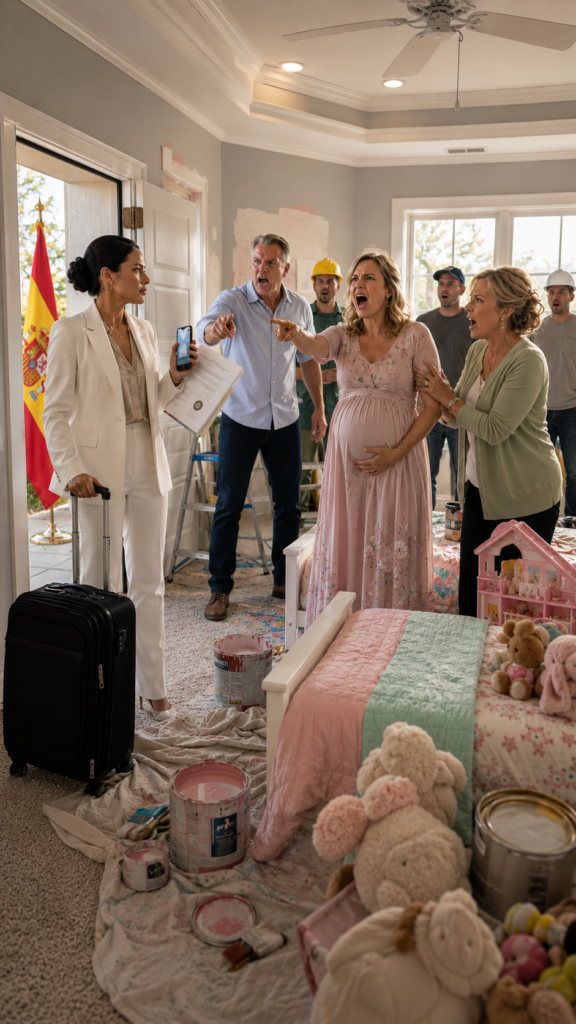
The walls were painted a garish Mexican pink. Her bed was gone. Her dresser, too. They had hung star mobiles from the ceiling and placed a toddler bed shaped like a car.
In the midst of it all, Mariana appeared, carrying a child in her arms.
She looked at her without guilt.
“Oh, you’re back.”
Camila could barely talk.
“What did you do with my things?”
Mariana shrugged.
“I took them out. Honestly, they were pretty mediocre. Besides, you can buy more.”
Camila took a step back.
And then Mariana smiled as if the house were already hers.
“Mom said you weren’t going to make a fuss. After all, you weren’t using it.”
PART 2
Camila left the house before she lost control.
Not because she didn’t want to confront Mariana, but because she understood something terrible: if she screamed, her family would use that scream to label her as crazy.
She drove straight to her parents’ house, in a quiet neighborhood in Querétaro where everyone knew everyone, and appearances weighed more than the truth.
Her father, Don Ernesto, opened the door.
Upon seeing her, he lowered his gaze.
Doña Elena appeared behind him with a false smile.
“Cami! What a surprise, dear. Why didn’t you call?”
Camila didn’t greet her.
“Why did you give my key to Mariana?”
Her mother made a face of annoyance.
“Oh, not this again.”
“She threw out my furniture. Painted my room. Moved her children into my house.”
“They're your nephews.”
“It’s my house.”
Doña Elena let out a dry laugh.
“Please, Camila. You’ve always been the strong one. Mariana is pregnant, divorced, and has three kids. Did you want to see her on the street?”
Camila looked at her father.
“Did you know?”
Don Ernesto adjusted his glasses, uncomfortable.
“Your mother thought it was best.”
“Best for whom?”
No one answered.
Doña Elena hardened her voice.
“Don’t be selfish. The furniture is just stuff. Family is not.”
Camila felt something inside her dim.
She didn’t cry.
She simply said:
“Then you chose.”
That night, she slept in a cheap hotel near the highway. On the hard bed, with the noise of trucks passing by, she opened her phone and reviewed the old photos of her house.
Every corner was documented: living room, dining room, bedrooms, lamps, paintings, rugs, even the plants.
She had taken them out of pride.
Now they would be evidence.
The next morning, she went to the Public Prosecutor’s Office.
She brought deeds, receipts, identification, property tax payments, and photographs.
But the agent who attended her gave her the tired look of someone who doesn’t want to get involved in family problems.
“Miss, if your mother gave your sister the key, this could be seen as a civil matter.”
“My mother isn’t the owner.”
“I understand, but we can’t just evict her. You need a process.”
Camila left, furious, but not defeated.
That afternoon, she sought out a lawyer recommended by a coworker: Licenciada Rebeca Salgado, a specialist in property conflicts.
Rebeca listened to everything without interrupting.
When Camila finished, Rebeca simply said:
“Your family thinks that because they’re family, there are no consequences. We’re going to show them that there are.”
Camila breathed for the first time in days.
The lawyer explained that they needed clean evidence: the previous state, current state, damages, unauthorized occupation, and messages where Mariana or Doña Elena acknowledged what happened.
“Can you enter your house without it becoming a circus?”
Camila shook her head.
“Then we will do it intelligently.”
Rebeca proposed saying that the bank needed an appraisal for refinancing.
An appraiser would enter, but in reality, he would be a private expert authorized to photograph each room.
Camila agreed.
She called Mariana.
“People from the bank will come on Thursday at 10 to check the house.”
Mariana scoffed.
“Such a drag. My kids have school.”
“It’s my house. You have to allow access.”
“You’re going to start again, aren’t you?”
“No. I’ve already started.”
On Thursday, Camila arrived with a man named Víctor, a folder in hand, a camera slung around his neck, and the face of someone doing a boring task.
Mariana opened the door with a dismissive gesture.
“Come in quickly.”
Víctor recorded everything.
The scratched walls. The alien couch. The damaged doors. The broken closet. The poorly installed electrical outlets. The missing furniture. The pink bedroom that had once been Camila’s refuge.
Mariana didn’t understand that every second of video was burying her.
She even took the liberty to boast.
“Honestly, it looked better this way. Before, it looked like a lonely woman’s house.”
Camila didn’t respond.
She just let the expert record.
That same day, Rebeca sent a formal notice: Mariana had to vacate the house and respond for damages.
Camila’s phone exploded.
Her mother called 18 times.
Mariana left crying voice messages.
“How can you do this to me? I’m pregnant. My kids love you. You’re a disgrace.”
Don Ernesto sent a message:
“Please, don’t make this bigger.”
Camila forwarded everything to the lawyer.
Rebeca replied:
“Perfect. Let them keep talking.”
Five days later, Mariana refused to leave.
Then Rebeca requested a court order for eviction due to unauthorized occupation and damages to the property.
When the judge saw the deeds, the before-and-after photos, the videos of the aftermath, and the audio of Mariana admitting she had thrown things away, they didn’t need much more.
The order was issued.
The day an official posted the notice on the door, Lupita sent Camila another message:
“Your sister is screaming on the sidewalk. She says you’re leaving her without a home.”
Camila felt a knot in her stomach.
She didn’t enjoy this.
But she also wasn’t going to save someone who had destroyed her peace.
That night, Doña Elena arrived at the hotel unannounced.
Her eyes were red, but her voice was still commanding.
“Withdraw the lawsuit.”
Camila looked at her from the door.
“No.”
“Mariana has no money.”
“Then she shouldn’t have thrown my things away.”
“She’s pregnant.”
“And I’m the owner.”
Doña Elena pressed her lips together.
“You’re going to be left all alone, Camila. No one wants a cold woman.”
That phrase hurt.
But it no longer controlled her.
Camila replied:
“I was much more alone when my own mother handed over my house.”
Doña Elena wanted to say something, but couldn’t.
For the first time, she didn’t have a ready phrase.
Two weeks later, Mariana moved out.
She didn’t leave the house clean. She left it as if a hurricane had passed: trash in black bags, rotten food in the fridge, scratches on the floor, stains on the walls, broken toys, and a note stuck to the door of the master bedroom.
“Enjoy your empty palace.”
Camila read it without expression.
Then she took a photo.
Another piece of evidence.
In the following days, she hired painters, carpenters, electricians, and a deep cleaning service.
The final bill was brutal.
Between lost furniture, repairs, painting, flooring, locks, cleaning, electrical damages, and replacements, the amount exceeded 420,000 pesos.
Rebeca prepared the civil lawsuit.
When Doña Elena found out about the amount, she called crying.
“Camila, for God’s sake. This is going to sink us.”
Camila stood still.
“Us?”
“Your sister can’t pay. Your father and I are going to have to help her.”
“You started this.”
“I just wanted to help.”
“No, Mom. Helping with someone else’s things isn’t helping. It’s abusing.”
The lawsuit progressed.
Mariana tried to play the victim on social media. She posted a photo of her kids with the phrase:
“When your own family abandons you in the hardest moment.”
The post filled with comments from people supporting her.
Until Lupita, the neighbor, uploaded three photos: the moving truck, the paint cans going in, and the note stuck to the door.
She didn’t write much.
She simply put:
“The house wasn’t hers.”
The gossip exploded.
Neighbors, cousins, family friends, and even an aunt from Guadalajara began to ask questions.
Doña Elena, obsessed with appearances, called Camila furiously.
“Look what you’ve caused!”
Camila responded calmly:
“I didn’t cause it. I documented it.”
That’s when the twist came that finally broke the family.
During the legal review, Rebeca discovered that Mariana hadn’t just thrown out furniture.
She had sold several items.
The gray sofa, the walnut table, two lamps, the mattress, and some chairs appeared in Facebook Marketplace posts made from a friend’s account.
Camila felt disgusted.
This wasn’t need.
This was looting.
When Rebeca presented that, Mariana stopped crying and began to plead.
Her lawyer requested a settlement.
Camila agreed, but with conditions.
Mariana had to pay the total in installments. If she missed a single payment, the full amount was demanded. And Doña Elena along with Don Ernesto would sign as guarantors.
Doña Elena initially refused.
“Do you want to seize your parents’ assets?”
Camila looked at her without blinking.
“No. I want them to be accountable for what they allowed.”
They signed.
Not because they were remorseful, but because they didn’t want a public trial or more shame.
Camila slowly recovered her home.
She had the walls painted a warm white. Threw away the stained curtains. Changed all the locks. Installed cameras. Bought new furniture, different from the previous ones, because she no longer wanted to reconstruct the house they had taken from her.
She wanted to build one where no one could enter without permission again.
She never gave a key to anyone.
Not to her mom.
Not to her dad.
Not to a neighbor.
Every month, the deposit arrived with the concept: “House Restoration.”
At first, Camila felt a pang in her chest when she saw it. Later, she just felt calm.
A year passed.
Mariana never missed a payment, not out of responsibility, but because her parents were legally bound.
Doña Elena stopped organizing family meals. Don Ernesto aged suddenly. Mariana moved to a small apartment and continued saying that Camila “ruined her life.”
But Camila no longer argued.
One afternoon, sitting in her patio with the bougainvilleas finally blooming, she received a message from her father.
“I hope you’re well.”
There was no apology.
There was no acknowledgment.
Just that cowardly phrase from someone wanting peace without repairing the damage.
Camila looked at the message, turned off the screen, and went back to watering her plants.
Because she understood something that many people learn too late:
The family that only wants you when you let them use you isn’t asking for love.
They’re asking for permission to keep breaking you.
And this time, Camila didn’t give it.