PART 1
—Take your kids to your mom’s house. Sofía can’t sleep and has an exam for UNAM tomorrow.
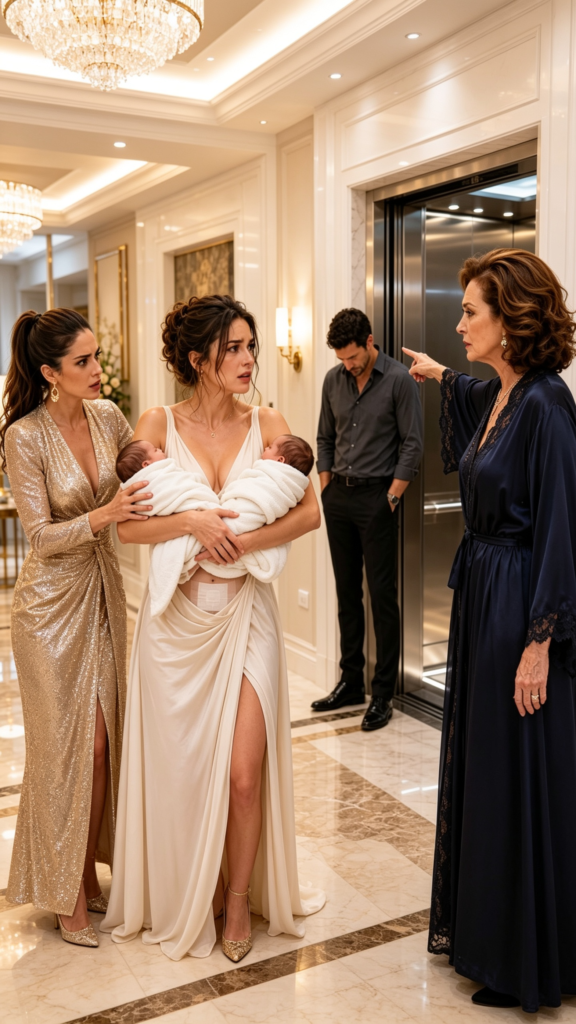
Doña Carmen said this at 2:17 AM, standing in the doorway of the room, her silk robe billowing, her expression one of annoyance as if the cries of two newborns were nothing but poor manners.
Mariana had just been home from the hospital for five days.
At 29 years old, with a still-open C-section, a back aching, her breasts sore, and two tiny twins crying out of hunger, cold, or simply because they had just arrived in a world where no one had asked permission for them to exist.
Mateo and Diego were small, restless, clinging to her chest like two frightened little birds.
She called them “my little bean” and “my peanut,” because she still couldn’t believe those two little bodies were hers.
They lived in an apartment in the Narvarte neighborhood of Mexico City.
From the outside, it looked like a perfect life: large windows, an elegant living room, marble in the kitchen, expensive paintings, and a silent elevator that smelled of fine perfume.
But inside, Mariana felt like she was breathing on borrowed time.
The apartment belonged to Rodrigo, her husband, or at least that’s what Doña Carmen always reminded her when she wanted to remind her of her place.
What she never mentioned was that Mariana had contributed money for three years: mortgage payments, furniture, hospital bills, diapers, doctor visits, tests, and even part of the down payment.
That dawn, Diego was crying desperately.
Mariana tried to get out of bed, pressing her hand against her belly to dull the burning sensation from her wound.
Rodrigo opened his eyes, confused.
—Mom, Mariana is delicate —he murmured.
Doña Carmen looked at him like he was a useless child.
—You go back to sleep. You have work tomorrow. She’s in her postpartum period; that’s what being home is for.
That’s what being home is for.
Mariana felt that phrase crash down on her like a bucket of ice water.
She wasn’t a wife.
She wasn’t a newly operated mother.
She was a nuisance with two crying babies.
The next morning, Sofía, Rodrigo’s younger sister, appeared in the dining room with dark circles under her eyes, a biology notebook, and a guilty look.
She was 18 and had been preparing for her medical entrance exam for months.
—I couldn’t study at all —she said quietly—. The babies cried all night.
Mariana stepped out of the room with Mateo clinging to her chest and Diego asleep in a blue blanket.
—I’m sorry, Sofía. I’m really trying to keep them quiet.
The girl lowered her gaze.
But Doña Carmen slammed her cup on the table.
—And what good is your apology? Is the exam going to give her points because you’re tired?
Mariana swallowed hard.
—I just gave birth five days ago.
—I gave birth twice and didn’t make such a drama —Doña Carmen replied—. So here’s what you’re going to do. You’re going to take your kids to Toluca, to your mother. When Sofía finishes her exam, you’ll come back.
Mariana’s mother lived alone, suffering from high blood pressure, in a small house where barely two beds and a table fit.
Mariana couldn’t drive.
She couldn’t lift anything.
She couldn’t even walk straight without feeling like her body was splitting in half.
She looked at Rodrigo.
—Are you hearing what your mom is saying?
He ran a hand through his hair.
—Mariana, it will only be for a few weeks. Mom is nervous about Sofía.
Mariana let out a bitter laugh.
—And who are you nervous for? Your sister or your newly operated wife and your newborns?
Rodrigo didn’t answer.
That silence hurt more than the screams.
Mariana went back into the room, stuffed hospital papers, provisional birth certificates, her ID, bank statements, receipts, and proof of all the transfers she had made over the years into a bag.
Then she called Valeria, her best friend.
—Come get me, please. I can’t carry both kids by myself.
Valeria only asked:
—Are they kicking you out?
Mariana couldn’t answer.
Half an hour later, Valeria arrived at the Narvarte apartment.
Seeing her pale, hunched, with the babies wrapped up and the diaper bag thrown on the floor, her eyes filled with rage.
—No way. She had her belly opened five days ago. And they’re kicking her out?
Doña Carmen lifted her chin.
—No one is kicking her out. I’m just asking her to be considerate with this family.
—Family would mean taking care of her —Valeria shot back—, not throwing her out on the street with two newborns.
Mariana picked up Mateo.
Valeria picked up Diego.
Before stepping into the elevator, Mariana looked at Rodrigo one last time.
She waited for a phrase.
Just one.
“My wife isn’t leaving.”
But Rodrigo lowered his head.
The doors closed in front of him.
And Mariana understood that her marriage wasn’t shattered by the cruelty of her mother-in-law but by the cowardice of the man who vowed to protect her.
What no one knew was that while she left with her twins and an open wound, the darkest secret of that family was about to emerge from a debt that Rodrigo never dared to confess.
PART 2
Valeria’s apartment in the Doctores neighborhood was small, with a double bed, a folding table, and a refrigerator that made noise like an old truck.
But when Mariana set foot inside, she felt more peace than in that elegant apartment where she had been treated like an inconvenience.
Valeria laid the twins on a clean mattress.
—Lie down already. You look as pale as paper.
Mariana tried to smile.
—If I faint, Doña Carmen will say I’m exaggerating.
Valeria didn’t laugh.
—A woman who just gave birth should be drinking broth, not running away with her kids, dude.
That same afternoon, Licenciada Rebeca Robles, a lawyer friend of Valeria’s, arrived.
She was about 45, with thin glasses and a voice so calm that it commanded more respect than any shout.
Mariana put a blue folder on the table.
There were the hospital receipts, monthly transfers to Rodrigo, payments for furniture, deposits for the mortgage, and bank statements.
Rebeca reviewed everything in silence.
—Mariana, here are enough proofs that you contributed to the family assets. Even if the apartment is in Rodrigo’s name, they can’t erase you as if you never existed.
Mariana finally breathed for the first time in hours.
But Rebeca frowned.
—There’s something else.
She turned her laptop.
—The apartment was used as collateral for a private loan of 1 million 200 thousand pesos. And here appears a signed authorization with your supposed signature.
Mariana felt the blood drain from her face.
—I never signed that.
—I know —Rebeca said—. This signature doesn’t match your documents. This looks like forgery.
Mariana shot up, and the wound pulled painfully.
She had to clutch her belly to keep from collapsing.
Rodrigo had put their children’s roof at risk while she was pregnant.
She called him.
He answered after many rings.
—Mariana, are the kids okay?
—Did you use the apartment as collateral for a loan?
On the other end, there was silence.
And that silence was worse than a confession.
—Rodrigo.
—I was going to fix it —he murmured.
—Fix what?
Rebeca gestured for the speakerphone.
Rodrigo breathed heavily.
—I invested in some land near Querétaro. A friend told me it was a sure thing. I wanted to buy a bigger house before the kids were born.
Valeria let out a dry laugh.
—Oh, of course. The classic hero risking everyone’s house and then says it was for love.
Rodrigo continued, sinking deeper.
—It went wrong. My partner disappeared. I took out another loan to cover the interests. Then another. I couldn’t stop it anymore.
—How much do you owe? —Mariana asked.
He didn’t answer.
Rebeca checked another sheet.
—The total debt exceeds 2 million 600 thousand pesos.
Mariana looked at her children asleep half a meter away.
Mateo was moving his little mouth as if searching for milk.
Diego was breathing softly, innocently.
They had no idea that their father had gambled their future on a ludicrous business.
At that moment, Rodrigo’s phone rang.
It was Doña Carmen.
Mariana insisted he answered on speaker.
—Where are you? —she said—. Don’t let Mariana do her theater. Women who just gave birth get sensitive. Say some nice words and she’ll be fine.
—Carmen, I’m listening —Mariana said.
There was an uncomfortable silence.
Then Doña Carmen changed her tone.
—Mariana, couple problems shouldn’t be aired. If Rodrigo made mistakes, you as his wife must support him.
—Supporting him doesn’t mean letting my signature be forged and being pushed off the cliff with my children.
She hung up.
The next morning, Rebeca called early.
—I found a repeated name in Rodrigo’s transfers: Abril Salgado. In 6 months, he sent her almost 240 thousand pesos.
Mariana felt a stab in her chest.
A woman.
A debt.
Another lie.
When she called Rodrigo to ask who Abril was, he fell silent again.
—It’s not what you think.
—You don’t even know what I’m thinking.
Hours later, Abril called Mariana.
She spoke fearfully.
—I’m not your husband’s mistress, ma’am. I work in a financial institution. I processed part of his loans.
—So why did he send you money?
—Commissions, urgent payments, interests. But there’s someone behind those contracts. Don Arturo Salvatierra. He bought the most significant debt.
—And what does he want?
Abril lowered her voice.
—He doesn’t just want to collect. He asked a lot about Doña Carmen. A lot.
Mariana felt a chill.
Before hanging up, Abril said something that left her breathless:
—That man knows a secret your family has been hiding for over 30 years.
That night, Mariana ran a fever.
First came the chills.
Then a hard, hot, painful chest.
Valeria, who was a nurse, checked her and was alarmed.
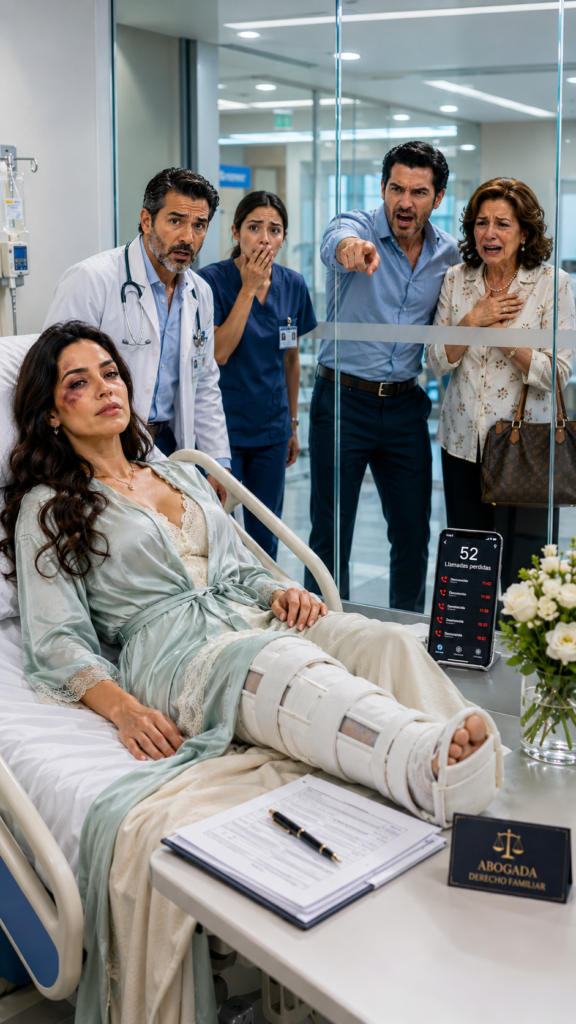
—You have the beginnings of mastitis. And Diego is jaundiced. We need to go to the hospital.
It was 5 AM when they arrived at the emergency room.
Mariana was treated for the fever, and Diego was kept under the lamp for a few hours due to jaundice.
As she watched her baby under that blue light, Mariana felt herself breaking.
She hadn’t even been a week into motherhood and was already fighting against a cruel mother-in-law, a lying husband, a million-dollar debt, and a secret she didn’t even understand.
Rodrigo arrived midmorning.
He had a few days’ stubble and sunken eyes.
—How are they?
—Diego is in phototherapy. Mateo is sleeping. I have a fever.
—I’m sorry.
Mariana looked at him without blinking.
—Don’t use that word if you’re still hiding things.
Before he could respond, two men in suits appeared in the hallway.
One pulled out a folder.
—Mr. Rodrigo Méndez. Today is the deadline to respond to the debt. If there’s no agreement, we will initiate proceedings regarding the Narvarte apartment.
Rodrigo turned pale.
Then Doña Carmen arrived with sweet bread and coffee.
Seeing the men, she became furious.
—What’s going on here? Mariana, did you call them? Do you still want to humiliate us in a hospital?
Mariana, feverish and in a wrinkled gown, spoke without trembling.
—What humiliates isn’t telling the truth. What humiliates is that your son pledged my children’s roof while you were kicking me out for crying.
Doña Carmen opened her mouth but couldn’t respond.
Later, when they discharged Diego, she tried to touch him.
—He looks just like Rodrigo as a baby —she whispered—. My grandsons.
Mariana hugged him tighter.
—Don’t touch him without washing your hands.
—I’m his grandmother.
—And I’m his mother.
Doña Carmen hardened her gaze.
—Think about it, Mariana. You’re sick, you don’t have a stable home, and Rodrigo is in debt. It’s best if the children stay with me for a while. I can raise them.
Valeria nearly exploded.
Rodrigo lifted his head.
—Mom, no.
But Mariana spoke first.
—Yesterday my children were a nuisance to Sofía. Today, because they’re boys, they’re family treasures. No, Carmen. My children aren’t trophies, nor hostages, nor a surname in diapers.
At the end of the hallway stood Sofía.
She had heard everything.
She carried a backpack and a thermos of broth for Mariana.
—Mom —she said with a broken voice—, stop using my exam as an excuse.
Doña Carmen turned.
—What did you say?
Sofía was crying.
—I never asked you to kick Mariana out. If I fail, it will be my responsibility. But I don’t want to enter UNAM knowing that a freshly operated woman was thrown out because of me.
The hallway fell silent.
For the first time, Doña Carmen found no defense.
Then her cell phone rang.
She answered with a trembling hand.
A man’s voice came through loud:
—Carmen, they came to measure the house in Puebla. They say it’s changed owners. What did you do?
Sofía went pale.
—Dad’s house?
Rodrigo closed his eyes.
Mariana understood that the misfortune was greater.
The truth came out the next day, in Rebeca’s office.
Doña Carmen, cornered by her children, confessed that she had sold the house in Puebla eight months earlier for 1 million 600 thousand pesos to cover part of Rodrigo’s debts.
It was the house her deceased husband had left to Sofía.
The house with the bougainvilleas in the patio.
The house where they set up their father’s altar every Day of the Dead.
Sofía broke down in tears.
—You promised me we would go after my exam.
—I didn’t want to distract you.
—You took my dad’s house to cover Rodrigo’s lies!
Rodrigo couldn’t defend himself.
Then Rebeca placed another folder on the table.
—The main creditor requested to be present.
The door opened.
Arturo Salvatierra entered, a 62-year-old man, tall, in a gray suit, with a weary gaze.
He didn’t look like a collector.
He looked like someone who had been waiting for this moment for too long.
Doña Carmen stood as if she had seen a ghost.
—Arturo…
Sofía looked at her mother.
—Do you know him?
Arturo left a manila envelope on the table.
—The question isn’t if you know me. The question is how long you were planning to keep hiding the truth.
Doña Carmen began to tremble.
Rodrigo tensed.
—If you’re here for money, speak clearly.
Arturo looked at him with a rare sadness.
—You think it’s all about money because no one taught you to face the truth.
The silence became unbearable.
Doña Carmen covered her face.
—Don’t do this here.
—You should have done it thirty years ago.
Sofía held onto the chair.
—Mom, what’s happening?
Doña Carmen cried.
Not like when she manipulated.
She cried like someone who finally runs out of hiding places.
—Rodrigo… your dad, the one who raised you, was not your biological father.
Rodrigo froze.
—What?
—He knew and loved you as his own. But your real father is Arturo.
The air cut off.
Arturo didn’t lower his gaze.
—I found out two years ago. I saw you at a construction event, and you looked too much like me when I was young. Then I confirmed the truth and discovered your debts.
Rodrigo clenched his fists.
—So you bought my debt to pressure us?
—I bought the most dangerous part so that it wouldn’t fall into worse hands —Arturo said—. And yes, I pressured. Because if I didn’t, you would keep lying, Carmen would keep hiding, and Mariana would end up paying with her children for a debt that didn’t belong to her.
Abril arrived later, summoned by Rebeca, and confirmed that she was not Rodrigo’s mistress.
That took away a suspicion from Mariana, but not the pain.
She looked at her husband.
—You weren’t unfaithful with a woman. You were unfaithful with your lies. You let me give birth, you let me walk out with our children into the street, and still, you expected me to understand.
Rodrigo cried without being able to say anything.
Arturo coughed heavily.
Abril rushed to him.
—Uncle, tell them.
He raised his hand.
—I have terminal liver cancer.
Doña Carmen let out a moan.
—You came back because you’re dying.
—I came back because I don’t want to leave another generation buried under secrets.
Days later, in an oncology hospital, Arturo requested everyone to be present.
Rebeca read the agreements.
Rodrigo would legally acknowledge Mariana’s contributions to the apartment: 600 thousand pesos as a down payment and over 900 thousand in documented payments.
He would hand over all debt documents.
If the apartment was sold, Mariana and the twins’ share would be protected in separate accounts.
Then Arturo announced something nobody expected.
—I established a trust for Mateo and Diego. It will only be for health, education, and basic needs. No adult will be able to touch that money.
Mariana opposed.
—I don’t want my children used to clean up guilt.
Arturo smiled weakly.
—That’s why I did it this way. It’s not a reward. It’s a shield.
Then he looked at Rodrigo.
—You are their father, but not the owner of their future.
After that, he looked at Doña Carmen.
—And you learn this before it’s too late: grandchildren aren’t born to save a family’s pride.
Doña Carmen didn’t respond.
She only asked permission to hold Diego.
—Can I?
Mariana was surprised to hear that word from her lips.
—Wash your hands first.
She did so without arguing.
Two months later, Arturo died.
Before leaving, Rodrigo managed to say “dad.”
No one knew if that healed anything, but in Arturo’s eyes, there was a peace that no amount of money could buy.
The Narvarte apartment was sold.
Part of it paid off the debt.
Another part was protected for Mariana and her children.
No one ever said she left empty-handed again.
Rodrigo rented a room near Mariana’s new apartment.
He didn’t go back to her.
Every afternoon he came, washed bottles, bathed the children, and sent her his bank statements without her asking.
—I want you to know everything —he said—. I don’t want you to live guessing anymore.
Mariana didn’t promise forgiveness.
Doña Carmen also changed.
Before visiting the twins, she would call.
—Mariana, can I stop by for a bit? If you can’t, it’s no problem.
The first time, Mariana thought she was dreaming.
Sofía did enter UNAM, but not for Medicine.
She chose Literature.
When she told Mariana, she cried hugging her.
—I learned that there are tests that don’t come on paper —she said—. Mine was speaking up when something is unjust.
A year later, Mateo and Diego took their first steps in a small rented apartment with a simple kitchen and a balcony where the sun came in.
There was no marble.
There were no expensive furniture.
But no one shouted.
No one decided for Mariana.
No one touched her children as if they were family property.
On New Year’s Eve, Rodrigo arrived with a folder.
It was a divorce request signed by him.
—If you want to end everything, I won’t stop you. I don’t want you to stay out of pity or for the kids.
Mariana looked at the papers.
Then she looked at her children fighting over a plastic truck.
—Rodrigo, I no longer need your promises. I need your actions. At the first lie, no matter how small, I’m leaving forever without a word.
He nodded with red eyes.
—I understand.
Mariana left the folder on the table.
It wasn’t a perfect ending.
Nor was it the easy forgiveness some expect to sleep soundly.
It was something harder: a life rebuilt with boundaries, truth, and memory.
Because a house isn’t held up by expensive walls or proud surnames.
It’s held up by respect.
And when a mother learns to defend her children, no mother-in-law, husband, debt, or secret can ever throw her back into the street.