PART 1
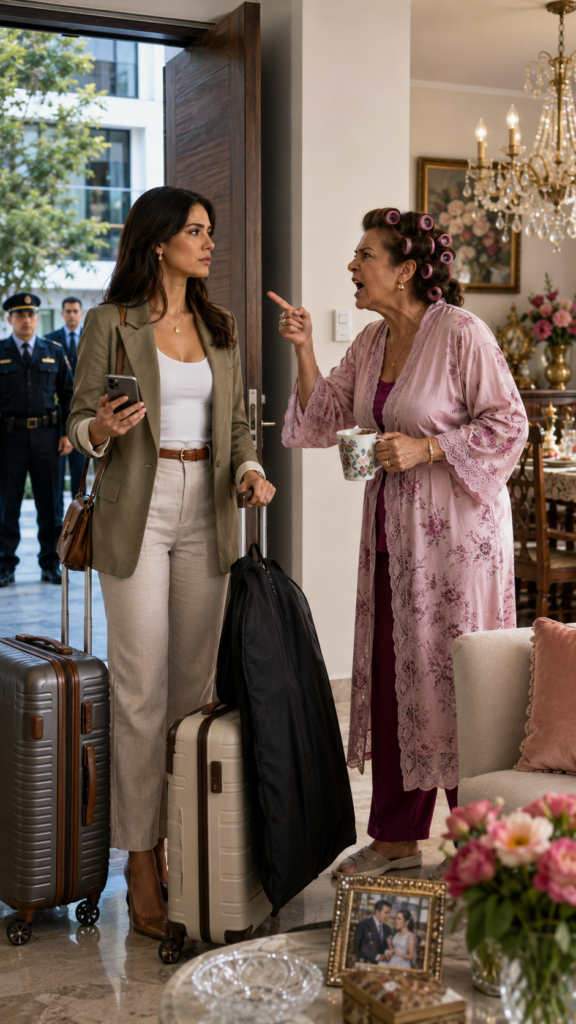
When Mariana Cruz returned to her apartment in the Narvarte neighborhood after six weeks of caring for her sick sister in Querétaro, she found her mother-in-law standing at the door as if she owned the place.
Doña Teresa wore a floral robe, new slippers, and a clay mug that Mariana had bought in Oaxaca with her first big paycheck.
—What are you doing here?—the woman shouted, crossing her arms—. This apartment is no longer yours. My son bought it for me. So grab your junk and get out.
Mariana stood there, two suitcases in hand.
She didn’t shout.
She didn’t cry.
She just looked around.
Her photos were gone from the walls. Her cushions had disappeared. The blanket woven by her mother was tossed in a corner, as if it were an old rag.
In the living room were candles, fake flowers, and a hideous painting that read: “In this house, the family rules.”
Iván’s family, of course.
Not Mariana’s.
Apartment 8-C had been hers long before she got married. She had bought it with her savings, with bonuses from her job as an administrative manager, and with years of depriving herself of vacations, expensive clothes, and weekend outings.
Iván Robles, her husband, had never put a single peso towards the down payment.
But during their marriage, he always said the same:
—Don't be dramatic, Mariana. What’s yours is mine too. That’s what being married is for, right?
Mariana had stopped arguing with him months ago.
Because Iván had a knack for making her feel guilty. He never yelled too much. He never broke things. He just looked at her as if she were overreacting, cold, or ungrateful.
And then there was Doña Teresa.
A woman with a loud voice, a venomous tongue, and an impressive ability to play the victim whenever someone set a boundary.
—My son told me everything—her mother-in-law continued—. That you were going to stay in Querétaro with your sister. That this place would be better used with me. You didn’t even give him children, honey. Why do you need so much space?
Mariana clenched her jaw.
That blow hurt.
Because Doña Teresa knew that Mariana had lost a pregnancy the previous year.
And yet she wielded it as a weapon.
—I’m going to call security—Mariana said, her voice low.
Doña Teresa laughed.
—Call whoever you want, trash. Let's see who really owns this place.
Mariana pulled out her phone.
She dialed the building’s security and requested that they send up the administrator.
Doña Teresa stopped laughing.
Just for a second.
But that second was enough for Mariana to understand something: her mother-in-law was not sure she was right. She was just used to winning through outrage.
Minutes later, two guards knocked on the door.
The administrator asked for identification and the deed.
Mariana opened her digital folder, showed the documents, and pointed at Doña Teresa.
—This woman entered my property without permission and is threatening me.
The mother-in-law began to scream.
She said Iván was the owner, that Mariana was crazy, that this house belonged to the Robles family.
But when they asked for papers, she had nothing.
No deed.
No contract.
No permission.
Just arrogance.
They dragged her into the hallway amid insults, floral robe, and a shame that couldn’t fit on her face.
Before leaving, Doña Teresa managed to say:
—My son is coming, and he will put you in your place.
Mariana closed the door.
She took a deep breath.
Then she saw Iván's desk open.
There was a yellow folder with her full name written on the cover.
And when she opened it, she found something that froze her blood.
PART 2
The folder read: “Mariana Cruz Ramírez / Apartment 8-C”.
Inside were copies of her INE, her CURP, the deed, and several property tax receipts.
Mariana immediately recognized the INE.
It was the same one she had “lost” seven months ago.
She recalled Iván helping her search for it all over the house. They checked bags, drawers, the car, even the laundry basket.
—You probably dropped it at some coffee shop, love—he had said, with perfect calm.
Mariana believed him.
Now she understood that he had had it the whole time.
Beneath the documents was a credit application.
Requested amount: 2,600,000 pesos.
Collateral: apartment 8-C, Narvarte neighborhood.
Holder: Mariana Cruz Ramírez.
And at the end, a signature.
Her signature.
But it wasn’t hers.
It was a clumsy, shaky imitation, as if someone had practiced many times and still couldn’t copy it well.
Mariana felt nauseous.
Not from fear.
From disgust.
She kept looking.
There were printed emails between Iván and a financial advisor.
In one, Iván asked if they could proceed because “the owner was out of town for a family matter.”
In another, the advisor replied that to formalize the process, physical presence, validated signature, and biometric review were needed.
The last email was dated three days earlier.
Iván wrote:
“My wife comes back this weekend. If she doesn’t cooperate, we’ll look for another option. It’s urgent to close before it complicates.”
Mariana read that phrase several times.
“If she doesn’t cooperate.”
As if she were an obstacle.
As if her house, her effort, and her name were pieces of a plan that others had the right to move.
In the same folder was a rental contract.
The apartment was advertised as “furnished, ready for executives, excellent location, monthly rent of 42,000 pesos.”
Lessor: Iván Robles Medina.
Not Mariana.
Iván.
There were photos of the living room, the bedroom, the kitchen, and the study. In one, Mariana’s dress was clearly hanging on a chair. In another, her computer was on the desk.
They took photos of her life while she was caring for her sister in a hospital.
As if Mariana no longer existed.
As if she were just a nuisance.
At the end of the folder, she found a handwritten note by Doña Teresa.
“When Mariana stays longer with her sister, we’ll move her things to a storage unit. If she complains, Iván will say he paid for repairs. She always lets herself be convinced. Besides, no one believes a woman when she gets hysterical.”
Mariana closed her eyes.
There lay the complete truth.
It wasn’t an impulse.
It wasn’t a misunderstanding.
It wasn’t an intrusive mother-in-law who got too excited.
It was a plan.
Iván wanted to use the apartment to cover a debt, rent it out without permission, and, if he could, turn Mariana into the crazy one of the story.
Her phone vibrated.
Iván: “My mom told me what you did. I’m coming over. Don’t do anything stupid.”
Mariana looked at the message and let out a dry laugh.
The stupidity had already been his.
She took photos of each document.
She recorded a video showing the folder, the dates, the emails, the fake signature, and the rental contract.
Then she called Paulina, her best friend from university.
Paulina wasn’t just a lawyer.
She was one of those women who weren’t scared by yelling, but were by paperwork.
—Pau, I need you to come—Mariana said.
—Did Iván do something to you?
—I don’t even know how to call it yet. But he tried to use my apartment without my permission.
Mariana sent the photos.
Paulina took almost a minute to respond.
—Don’t touch anything more than necessary. Keep the originals. Upload them to the cloud. Email them to me. And don’t be alone with him.
Mariana obeyed.
Then she called the building administrator.
She requested to block Iván and Doña Teresa’s access cards. She also asked to keep the video footage from the last eight weeks.
The administrator, who had seen enough drama in the hallway, didn’t argue.
—With the deed in your name, we’ll proceed today, Mrs. Cruz.
Mariana hung up.
She looked at the living room.
Everything smelled of cheap perfume, reheated coffee, and a breach of trust.
Then she pulled out three black bags.
She stuffed in Doña Teresa’s robe.
The slippers.
The candles.
The ridiculous cushions.
The gossip magazines.
The dishes that weren’t hers.
Then she moved on to Iván’s things: shirts, shoes, a leather jacket, cords, loose papers, and a speaker he always left on at full volume.
She wasn’t destroying anything.
She was cleaning.
Because sometimes a home isn’t reclaimed with keys.
It's reclaimed by removing everything someone put there to mark territory.
At 9:26 PM, Iván arrived.
The guard notified her through the intercom.
—Mrs. Cruz, Mr. Iván is downstairs. He says he lives here and demands to come up.
—He can come up—Mariana replied—. But accompanied by security.
When Iván entered, he wore the face of a tired man, as if he were the victim.
His shirt was wrinkled, his hair damp, and he had a rehearsed expression of concern.
—What show are you putting on, Mariana?—he said, looking at the guards—. Did you really need an audience?
—It’s not an audience. They’re witnesses.
Iván looked at the black bags by the door.
His face changed.
—Where are my things?
—Right there.
—You put them in garbage bags?
—It was the most appropriate container.
Iván clenched his teeth.
—My mom got upset, yes. But you went too far. You left her outside like a criminal.
—She entered a property that isn’t hers, threatened me, and called me trash.
—She’s my mother.
—And this is my apartment.
Iván let out a bitter laugh.
—Always with this. “My apartment, my money, my work.” That’s why we don’t work, Mariana. You never knew how to share.
She looked at him with a calmness that unsettled him.
—Is sharing forging my signature?
Silence fell heavy.
Iván blinked.
—What are you talking about?
Mariana placed a copy of the credit application on the table.
He didn’t touch it.
He just stared at it.
And on his face appeared something she had never seen: fear.
—That’s not what it looks like—he murmured.
—It has my name, my documents, my forged signature, and my apartment as collateral.
—I was going to explain.
—Before or after renting it for 42,000 pesos?
Iván fell silent.
The guards exchanged glances.
Mariana also pulled out the rental contract.
—Was that executive already on his way? Or were you first going to send my things to a storage unit like your mom wrote?
Iván jerked his head up.
—Did you check my papers?
—They were on my desk, inside my house, using my stolen documents.
—I didn’t steal them.
—Then tell me how my INE ended up there.
Iván opened his mouth.
Nothing came out.
Because that was the difference between manipulating and responding.
Manipulating he did perfectly.
Responding, not so much.
—I’m in debt—he finally said, lowering his voice—. The business went wrong. I owe money. A lot of money.
—How much?
Iván rubbed his face.
—Almost 1,900,000 pesos.
Mariana felt the ground shift beneath her.
Not because she cared about the debt.
But because he had slept by her side, dined with her, talked about vacations, smiled in front of her family… while planning to drag her down to save himself.
—And you thought to pay with my house?
—I thought I could resolve it for us.
—Don’t say “us.” You were already selling my peace without asking me.
—You never understand anything!—Iván exploded—. Always with your independence, your pride, your “I can do it alone.” What did you want? For me to let myself fall?
Mariana didn’t raise her voice.
That drove him even crazier.
—I wanted you to be honest.
At that moment, there was a knock at the door.
It was Paulina.
She entered with a folder under her arm, a firm gaze, and zero desire to negotiate with a manipulator.
—Good evening. I’m Paulina Aguilar, Mariana Cruz’s attorney.
Iván let out a nervous laugh.
—Attorney? How ridiculous. This is a couple's dispute.
Paulina placed the folder on the table.
—No. A couple’s dispute is arguing over who washes the dishes. This could be signature forgery, attempted fraud, misuse of personal documents, and unauthorized occupation of property.
Iván paled.
—You can’t prove anything.
Paulina smiled slightly.
—The bank has already been notified to block any transactions related to this apartment. We also requested to preserve the emails, access logs, and documents sent by you.
Iván looked at Mariana.
Now he really seemed frozen.
—Did you do that?
—Yes.
—Mariana, think carefully. If you report me, my life is over.
She felt a small, ancient pain.
The same pain that made her doubt before.
But this time she didn’t open the door.
—My life could have ended because of your debts, Iván. Only you didn’t care.
Her phone began to ring.
It was Doña Teresa.
Iván hesitated but answered.
His mother’s voice came out loud, shrill, furious.
—Son, these lowlifes won’t let me up! Tell them that woman took my things like I was trash!
Mariana grabbed one of the black bags.
She stepped close enough for her to hear her.
—Doña Teresa, you called me trash inside my own house. So I did the right thing: I took out the trash.
There was a delicious silence.
Then a choked scream.
—Ungrateful!
—No. Owner.
Mariana hung up.
Iván looked at her as if he didn’t recognize her.
And perhaps it was true.
Because the woman in front of him was no longer the one who begged for forgiveness to avoid conflicts.
She was no longer the one who lowered her voice to avoid discomfort.
She was no longer the one who believed that loving meant enduring.
Paulina requested that Iván sign an inventory of his belongings.
He initially refused.
Then he saw the guards, saw the hallway cameras, and understood that the show was over.
He signed.
One by one, the bags left the apartment.
Shirts.
Shoes.
Personal documents.
Cords.
A watch.
A laptop.
And a box of memories that Mariana didn’t want to open because she had seen enough.
Before leaving, Iván paused at the door.
—Are you really going to destroy our marriage over some papers?
Mariana looked at him without hatred.
That was the saddest part.
She didn’t even have enough rage left to give him.
—No, Iván. You destroyed it when you thought my name was a tool and my house an emergency exit for your mistakes.
He looked down.
For the first time, he had no response.
In the following weeks, the truth stopped depending on who screamed louder.
It became evidence.
The administration delivered videos showing Doña Teresa entering with suitcases, Iván carrying boxes, and a man taking photographs of the apartment.
There was also a recording where Iván opened Mariana’s mailbox and took out bank correspondence in her name.
The bank confirmed that they had received incomplete documents to start a credit process.
The financial advisor stated that Iván insisted on moving quickly.
When Doña Teresa was summoned, she said it had all been “a family misunderstanding.”
But in the recovered messages, it became clear that she knew too much.
“Hurry before she comes back.”
“If she gets intense, tell her you paid for repairs.”
“Don’t hesitate, son. That woman thinks too highly of herself.”
Mariana read those messages only once.
Then she let Paulina do her job.
She didn’t need to hold venom in her chest.
With the evidence, she filed a complaint and initiated a divorce process.
Iván tried to call her 18 times in two days.
First, he said he loved her.
Then that he was desperate.
Later, that his mother had pressured him.
In the end, he sent a short message:
“I’m sorry. I was afraid of losing everything.”
Mariana didn’t respond.
Because she had understood something: some apologies come too late, not because they lack words, but because the damage has already exceeded the pain.
Three months later, her sister came to visit her again.
She arrived with sweet bread, flowers, and a new jade plant.
—So this house can breathe beautifully again—she said.
Mariana placed the plant by the balcony.
The previous one, the one Doña Teresa had left to dry in the sun, seemed dead. But one morning it began to sprout a green leaf.
Small.
Stubborn.
Alive.
Mariana watched it for a long time.
And smiled.
That day she hung her photos again.
Bought new cushions.
Threw out the painting that said “In this house, the family rules” and put up a simple one with a phrase written by her sister:
“In this house, no one needs to ask permission to exist.”
When night fell, Mariana locked the door.
She didn’t feel alone.
She felt at peace.
Because a home isn’t where you’re tolerated.
It’s not where someone uses your love to take away what’s yours.
It’s not where you’re called overdramatic when you defend your boundaries.
A home is the place where your name matters.
Where your voice is valued.
Where taking out the trash doesn’t always mean filling a bag.
Sometimes it means removing those who mistook your kindness for weakness.
And Mariana, the woman they called trash, ended up understanding something many should learn before giving their opinions:
The true family isn’t the one that invades your home.
It’s the one that respects the door.