PART 1
—Your mom is in the hospital, and you’re on vacation like it’s nothing... seriously, Mariana, you’re a disgrace.
Diego spoke on the phone in that tone he used to belittle her. Mariana sat on a bench facing the sea in Puerto Morelos, while her six-year-old daughter, Sofía, built sandcastles with a pink bucket.
Years ago, that phrase would have shattered her.
She would have dashed to the airport, dragging luggage, child, guilt, and fear. She would have returned to the house in Colonia Portales to care for Doña Elvira, her mother-in-law, even though that woman had never treated her like family.
But that afternoon, Mariana took a deep breath, watched her daughter laugh, and replied calmly:
—If your mom is sick, take her to the hospital yourself. She’s your mom, not my boss.
There was a heavy silence on the other end.
—What did you say?
—What you heard.
For nine years, Mariana had lived as if she needed permission just to exist. Before marrying, she worked proofreading books for a small publisher in Coyoacán. She loved reading, had friends, dreams, and even plans to pursue a master’s degree.
But when Sofía was born, Diego convinced her to quit “just for a while.”
That while became a cage.
Diego earned 75,000 pesos a month as the commercial director of a tech company, but every payday, he left her with just 1,800 pesos.
—Make that stretch. I’m not going to finance your whims.
With that money, Mariana bought food, soap, medicine, school supplies, gas, and even Doña Elvira’s whims, who lived three streets away and would show up unannounced to check the fridge.
—Beans again? Poor my son, married to a useless woman.
Diego never defended her. On the contrary.
—My mom is right. You don’t contribute anything.
The night everything changed was their ninth anniversary. Mariana prepared pozole, bought sweet corn bread, and set flowers on the table. Diego arrived drunk, saw the dinner, and burst out laughing.
—Is this your big surprise?
He threw the plate to the floor. Sofía came out of her room crying.
—Dad, don’t yell anymore.
That night, Mariana understood that her daughter was learning to be afraid in her own home.
The next day, she sought out Héctor, a lawyer who had been her classmate in college. He listened without interruption.
—Don’t leave without proof —he said—. We need recordings, accounts, threats, economic violence. Everything.
Mariana complied.
For two weeks, she recorded conversations, took pictures of receipts, saved messages, and retrieved emails where Diego called her a freeloader. She also discovered something strange: Doña Elvira claimed to be unwell, but a neighbor sent her a video of Doña Elvira dancing danzón in the park.
Then came the final act.
Doña Elvira called, crying:
—I fell. I fractured my hip. Come take care of me. My son works, you do nothing.
Mariana didn’t go.
She bought two tickets to Cancún with savings she’d accumulated proofreading theses at night. Before leaving, she hid a recorder behind the vase in the living room.
That night, from the hotel, she opened the app.
First, she heard Doña Elvira’s voice, mocking:
—My nephew’s little doctor got me the excuse. With this, Mariana will come crawling back.
Then Diego’s voice:
—And if she doesn’t come back, we’ll take Sofía. I’ll tell the judge she’s crazy, and that’s it.
Mariana froze in front of her phone.
She couldn’t believe what was about to unfold next…
PART 2
Mariana listened to the audio four times. Not because she doubted, but because a part of her needed to understand how far someone who claimed to love her could go.
Diego hadn’t just humiliated her. He had planned to use Sofía as a weapon.
That night, she didn’t cry out loud. She cried silently, sitting on the bathroom floor of the hotel, so her daughter wouldn’t wake. Then she sent everything to Héctor.
The response came in twelve minutes:
“This is very serious. But check the other file. There’s something worse.”
It was a bank statement.
Mariana opened the PDF and felt her stomach clench. For thirty months, Diego had transferred 35,000 pesos monthly to Doña Elvira.
1,050,000 pesos.
While Mariana stretched 3,600 pesos a month to feed Sofía. While she begged for credit at the pharmacy. While she wore the same worn-out shoes to school meetings.
The transfers were labeled: “family support.”
Mariana squeezed her phone in anger.
The next day, Doña Elvira sent her a photo from bed, covered with a blanket and a huge cast on her leg.
—Sweetheart, come back. It hurts so bad. I can’t even move.
Mariana enlarged the image.
In the mirror behind the bed, Doña Elvira was perfectly made up, with her foot out of the cast, red-painted nails, and an open bag of chips on the table.
Mariana called her.
—Doña Elvira, next time, hide the mirror better.
The mother-in-law fell silent.
—Ungrateful. I always knew you were a bad woman.
—No, ma’am. I’m a tired woman.
Five minutes later, Diego called.
—What did you do to my mom? You made her worse.
—Your mom is so sick she even had time to paint her nails.
—I’m going to sue you. I’m going to take Sofía from you.
Mariana activated the recorder.
—Repeat that, Diego.
He didn’t notice the trap.
—I’m going to take her from you. Money can fix everything. You don’t have a job, you don’t have a house, you have nothing.
—I have your audios.
The silence was immediate.
—What audios?
—The ones of your mom confessing the fake cast. Yours talking about taking my daughter. And I also have the transfers for 1,050,000 pesos.
Diego gasped.
—Who gave you that?
—The question isn’t who gave it to me. The question is how you’re going to explain that you left us without food while gifting half your salary to your mom.
For the first time in years, Diego didn’t shout.
Hours later, he called again, but with a broken voice.
—Mariana, I need you to help me.
She almost laughed.
—How funny. Now you need something from the useless one.
Diego confessed that his uncle Rogelio, Doña Elvira’s brother, was suing him over a promissory note for 900,000 pesos. According to him, Doña Elvira had asked him to sign it to invest in some land in Hidalgo.
—My mom told me she would pay him with the money I sent her —Diego said—, but apparently, she didn’t give him anything.
Mariana closed her eyes.
There it was, the twist she hadn’t expected.
Doña Elvira hadn’t just faked being sick. She had also used her own son as a cash machine, as a shield, and as a useful fool.
—I need your savings —Diego said—. It’s 180,000 pesos, right? Lend it to me.
Mariana looked at Sofía sleeping with a plush axolotl in her arms.
—That money is to start over with my daughter.
—She’s my daughter too.
—Then start by not threatening her.
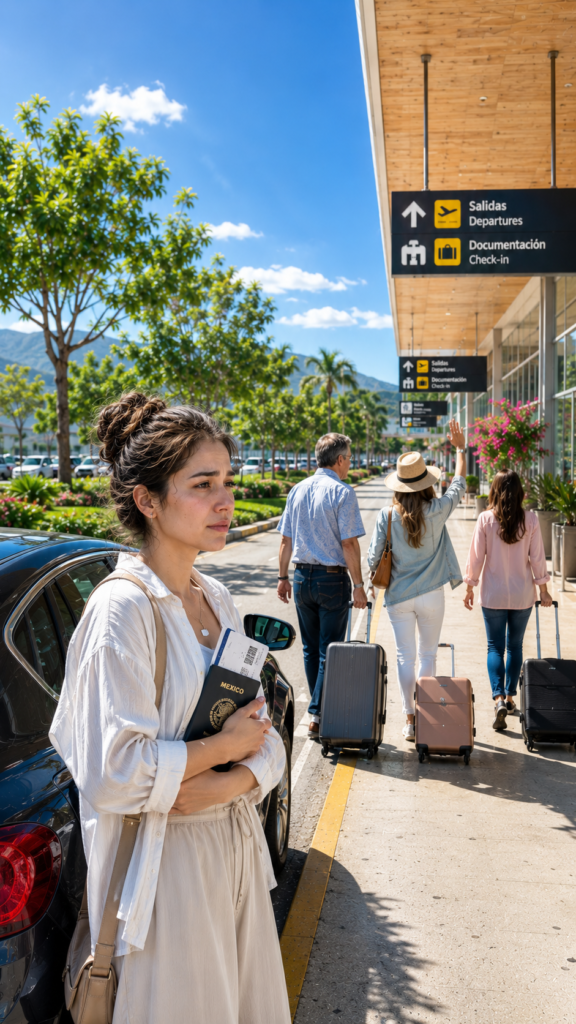
Two days later, Mariana returned to Mexico City. Héctor advised her not to go alone, but Diego showed up before she could leave the terminal.
He looked disheveled, with a wrinkled shirt and red eyes. He stepped in front of her suitcase and grabbed her wrist.
—You give me that money or you won’t see Sofía again.
Several people turned to look.
Sofía hid behind her mother.
Mariana didn’t shout. She didn’t cry. She simply took out her phone, turned up the volume, and played the audio.
Diego’s voice filled the hallway:
—If Mariana doesn’t come back, we’ll take Sofía. I’ll tell the judge she’s crazy, and that’s it.
Diego turned pale.
A security guard approached.
—Sir, let go of the lady.
Mariana paused the audio and looked him directly in the eye.
—Touch me again, and this goes to the Public Ministry today.
Diego released her wrist as if it burned.
—Mariana, please...
—Don’t say please to me. Say it to your daughter, who just heard you.
Sofía looked at her dad with wide, fearful eyes. That was the hardest blow. There was no insult, no threat, no act that hurt more than seeing a little girl understand who her father truly was.
Mariana took her suitcase and walked away.
That night, she stayed with Sofía in a friend’s apartment in Narvarte. It was small, with an uncomfortable sofa bed and a kitchen where barely two people could fit. But no one shouted. No one threw plates. No one called her useless.
The next day, Héctor filed for divorce, provisional custody, child support, and protective measures. He also requested an investigation into the transfers made to Doña Elvira during the marriage.
Doña Elvira exploded.
She sent audios, messages, and even notes with neighbors.
—That woman destroyed my family. She wants to leave my son on the street.
But Héctor obtained something that changed everything.
A neighbor of Doña Elvira, fed up with her scandals, delivered a video recorded from her window. In the footage, Rogelio was seen arguing with her in the garage.
—Elvira, that’s enough. Diego sent you over 1,000,000, and you only gave me 200,000. I made up the promissory note to pressure him, but you pocketed the money.
Doña Elvira responded furiously:
—That money is mine. I gave birth to Diego. Mariana deserves nothing. Let that old woman sell her savings if she wants to save him.
When Diego saw the video in Héctor’s office, he collapsed into a chair.
—My mom… robbed me?
Mariana didn’t feel pity. She felt a dry, old sadness, like dust.
—No, Diego. You robbed us first—Sofía and me. She just did to you what you did to me.
At the family hearing, Diego tried to play the victim.
—I was manipulated by my mother.
The judge looked at him sternly.
—You are an adult. You chose to threaten your daughter’s mother.
Héctor presented the audios, the bank statements, the pictures of the fake cast, and Rogelio’s video. The judge granted provisional custody to Mariana, supervised visits for Diego, immediate support payments, and a prohibition from approaching without permission.
Then came the settlement.
Diego was to return 525,000 pesos corresponding to half the misappropriated funds during the marriage. Since he couldn’t pay it, he agreed to have a plot of land purchased by Doña Elvira in Pachuca seized.
When Doña Elvira heard that, she screamed in the courtroom:
—Not my land! They’re mine!
The judge banged the gavel.
—Ma’am, be silent or I will remove you from the courtroom.
Doña Elvira trembled. She no longer appeared as the powerful mother-in-law who entered Mariana’s home checking pots and drawers. She looked like a woman desperate not to lose what she had gained at another’s expense.
Rogelio also fell. The promissory note turned out to be false in several parts, and the Public Ministry opened an investigation for procedural fraud. Diego lost his job when his company received a copy of the irregular movements he had made to cover family debts.
Months later, Mariana returned to work as an editor. She didn’t start in a fancy office. She began at home, proofreading manuscripts while Sofía did homework at the table. Then a publisher in Polanco hired her with a fixed salary.
She used the first payment to rent a simple apartment near División del Norte. She bought a round table, two chairs, a bed for Sofía, and a lavender plant for the window.
The first night, they had noodle soup and quesadillas for dinner. Sofía looked around and said:
—It feels peaceful here, Mom.
Mariana smiled.
—Because here, no one scares us.
Later, the partial deposit from Diego arrived. It wasn’t enough to erase nine years of humiliation, but it was a sign. A small repair. A proof that what they had lived through wasn’t imagination, exaggeration, or drama.
Doña Elvira had to sell one of her plots. Diego continued to see Sofía only in a supervised center. Rogelio faced charges. And Mariana, for the first time in a long time, walked down the street without anxiously checking her phone.
Sometimes people said:
—How strong to leave your husband like that.
But no one saw how strong it had been to stay for so many years.
No one saw the nights counting coins, the tears swallowed in front of a little girl, the broken dishes, the insults disguised as jokes, the mother-in-law pretending to be sick to enslave her, and a husband using custody as a threat.
Mariana didn’t become cold.
She became free.
And when a woman who has lost her fear decides to defend her daughter, neither a false mother-in-law, nor a cowardly husband, nor an entire family playing dirty can ever bring her to her knees again.