PART 1
At 6:12 in the morning, someone pounded on the door so hard that the entrance windows trembled as if they were about to shatter.
Valeria Montes didn’t move right away.
She continued sitting in her father’s kitchen, in the Del Valle neighborhood, staring at a mug of coffee that had long since grown cold. The house still smelled of funeral flowers, extinguished wax, and stored clothing.
Don Rogelio Montes had been buried just four days ago.
For 37 years, he had built, brick by brick, a chain of hardware stores in Mexico City. He wasn’t rich by luck. He was rich because he opened stores before dawn, carried bags with his own hands, and never spent a peso he couldn’t justify.
Valeria was his only daughter.
And also the only person who had been with him when the illness closed his throat and robbed him of his strength.
Her husband, Esteban Salcedo, was hardly ever around.
He always had a meeting.
He always had something pending.
He always had to help Bruno, his younger brother, the family’s eternal problem.
The knocking sounded again.
Before Valeria could get up, the door swung open.
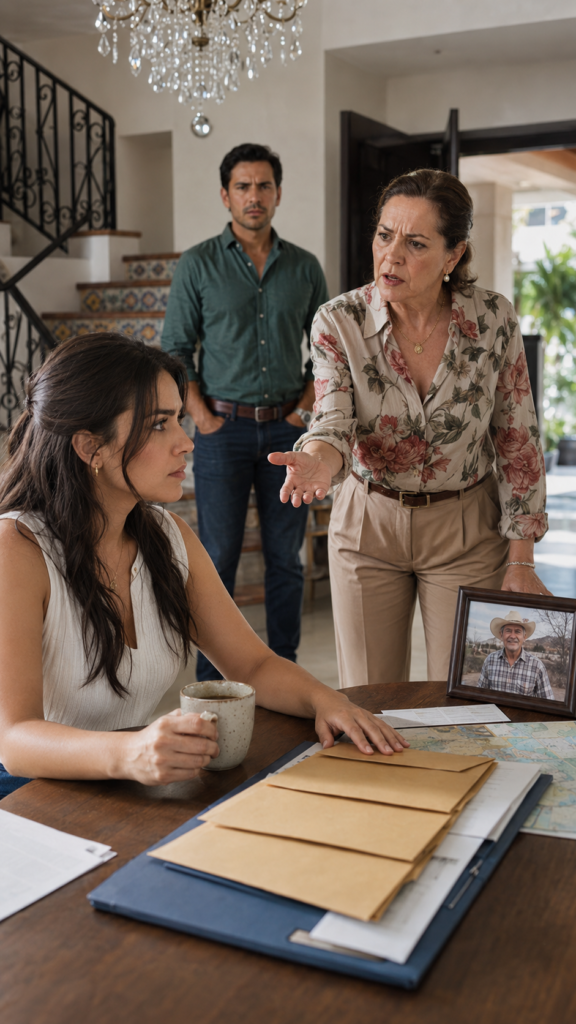
Doña Graciela, her mother-in-law, stormed in, wrapped in a black coat, wearing dark glasses, and clutching an expensive handbag. Behind her came Esteban, disheveled, serious, with the face of someone who already knew what was about to happen.
Valeria felt her stomach sink.
“Where’s the money?” Doña Graciela asked without greeting.
Valeria stared at her in silence.
“What money?”
Doña Graciela let out a dry laugh.
“Oh, don’t start with your little acts. We know the sale of your father’s warehouse closed yesterday. It’s 140 million pesos. Bruno needs that money today.”
The word “needs” fell like a stone.
Bruno.
Doña Graciela’s youngest son.
The one who had bankrupted two restaurants, sold a truck that he hadn’t even finished paying for, and lost fortunes in underground betting. The same one who always swore it was “the last time.”
Esteban stepped forward.
“Vale, please, listen to her.”
She looked at him in disbelief.
“You brought her here?”
He didn’t answer.
And that silence hurt more than any scream.
Doña Graciela removed her glasses.
“She wasn’t brought here. She came to do the right thing. You’re her wife. In a decent family, when there’s money, we help.”
Valeria placed her hands on the table.
“That money is my father’s.”
“Your father is dead,” Doña Graciela replied coldly. “The living are the ones with problems.”
Esteban said nothing.
He didn’t defend her.
He didn’t demand respect.
Valeria recalled the nights in the hospital, the signatures before a notary, the medications, the receipts, the tears swallowed alone while Esteban was in Cancun helping Bruno with another debt.
Then she opened a gray folder.
Doña Graciela smiled, thinking she had finally won.
But Valeria pulled out three sealed envelopes, placed them in front of them, and said with a calm that chilled the kitchen:
“Good thing you arrived early.”
Esteban furrowed his brow.
“What does that mean?”
Valeria pushed the first envelope toward him.
“That you still have time to find out everything before my lawyer arrives at 9:00.”
PART 2
Esteban clumsily took the envelope.
His fingers trembled, even though he tried to hide it. He ripped it open and pulled out several sheets with notarized seals. As soon as he read the heading, his face drained of color.
ABSOLUTE SEPARATION OF ASSETS AGREEMENT AND WAIVER OF RIGHTS TO PRESENT OR FUTURE INHERITANCES.
Doña Graciela snatched it from his hands.
She read two lines and let out a nervous laugh.
“That’s worthless. They’re married. A piece of paper isn’t worth more than a marriage.”
Valeria held her gaze.
“That paper is signed by Esteban, by me, by two witnesses, ratified before a notary, and registered before the wedding.”
Esteban gulped.
Suddenly, he remembered that afternoon.
The notary’s office in Roma.
Valeria had told him her father wanted to protect the family’s assets. He had laughed, signed quickly, and even joked that she was too distrustful.
He never read it in full.
He never cared.
Because at that moment, he didn’t think he would ever need to claim anything.
“But that was before,” he mumbled. “We’re married now.”
“No,” Valeria replied. “We are two people married under separation of assets. And you knew that.”
Doña Graciela pounded the table.
“Oh, please! Don’t come at me with technicalities. We’re talking about family here. Bruno could lose everything.”
Valeria stared at her unblinkingly.
“Bruno has lost everything many times. The difference is that now he wants to lose mine too.”
The mother-in-law tightened her jaw.
“You’re selfish. My son married you, was with you, endured your sadness, your silence, your dramas with your father…”
Esteban lowered his gaze.
Valeria felt a pang in her chest.
“My dramas?”
Her voice came out low but firm.
“My father was dying.”
Doña Graciela didn’t back down.
“And my son Bruno is sinking too. We all have problems, dear.”
“Don’t call me dear.”
The kitchen fell into silence.
It was the first time Valeria had taken that word from her mouth.
Then she opened the second envelope.
She pulled out a thick document, with a blue cover and the seal of the public notary 18.
“This is my father’s will.”
Esteban raised his head.
Doña Graciela tried to regain her composure.
“And what of it? If he left you everything, all the more reason to share.”
Valeria turned a page and read aloud:
“I declare my daughter Valeria Montes Rivas as the universal heir. No spouse, in-law, third party, indirect creditor, or person related to the Salcedo family may dispose of, claim, condition, or pressure for the inherited goods herein.”
Doña Graciela stopped moving.
Valeria continued:
“In case of economic pressure, emotional manipulation, intimidation, threats, or attempts at appropriation, I instruct my executor and legal representative to initiate civil and criminal actions immediately.”
Esteban opened his mouth but found no words.
Valeria turned another page.
“And here comes something you might actually be interested in.”
Her voice cracked just slightly, but she didn’t stop.
“I hereby certify that my daughter Valeria informed me in life about comments made by her mother-in-law, Doña Graciela Salcedo, and by her brother-in-law Bruno Salcedo, related to economic expectations regarding my estate.”
Doña Graciela went pale.
“That’s a lie.”
“No,” Valeria said. “My father listened more than you thought.”
She remembered a Christmas dinner.
Don Rogelio still walked without a cane. He had brought romeritos, cod, and an expensive bottle of tequila to toast. Bruno, half-drunk, asked how much the Iztapalapa warehouse was worth.
Doña Graciela laughed and said:
“Well, when Don Rogelio is gone, my Esteban will get a little pinch, right?”
Everyone laughed.
Except for Don Rogelio.
He only looked at Valeria.
That night, before sleeping, he told her:
“Sweetheart, there are people who don’t see people. They see properties.”
Valeria never forgot that phrase.
Doña Graciela tried to walk toward the folder.
“Your father had no right to include us in his will.”
“My father had the right to protect what he built,” Valeria replied. “Especially from people who waited for his death to come and collect.”
Esteban closed his eyes.
That hit him directly.
But the worst was yet to come.
Valeria opened the third envelope.
Inside were screenshots, audio transcripts, account statements, proof of rejected transfers, and credit applications.
The air shifted.
Esteban recognized some messages.
His face betrayed him.
“Eight months ago,” Valeria began, “Bruno asked me for 50,000 pesos. He said it was to save a payroll.”
She flipped a page.
“Then he asked for 120,000 to pay a supplier.”
Another page.
“Then 300,000 because, according to him, some partners were threatening him.”
Doña Graciela raised her voice.
“Because it was true!”
Valeria cut her off.
“No. It was a lie. They weren’t suppliers. They were bets.”
Esteban opened his eyes wide.
“What?”
Valeria pulled out a copy of bank movements.
“My lawyer traced the payments. Bruno didn’t owe for restaurants. He owed for online betting, private loans, and promissory notes signed with absurd interests.”
Doña Graciela pressed her lips together.
“He was desperate.”
“No. He was used to you cleaning up his life.”
The phrase hit hard.
Esteban rubbed his face.
Valeria looked at him.
“When I refused, he sought you out. And you began to pressure me.”
She read a message:
“Baby, don’t be so harsh, he’s my brother.”
Another:
“If your dad has so much, I don’t understand why it hurts you to help.”
Another:
“My mom says a wife who loves sacrifices for the family.”
Esteban barely whispered:
“I didn’t mean to pressure you.”
“But you did.”
Valeria held up the phone.
“And not just you.”
She opened an audio transcript.
Doña Graciela's voice appeared in writing, word for word.
“Valeria better understand that that money also belongs to Esteban. If not, we’re going to have to make her see reason.”
Doña Graciela lost the strength in her gaze.
“That was a figure of speech.”
“It was a threat,” Valeria replied.
Then she pulled out the last sheet from the envelope.
This one would really change everything.
“Bruno used my name as collateral in four private finance companies.”
Esteban jumped up.
“What did you say?”
Valeria placed the applications in front of him.
On each one appeared the name of Bruno Salcedo.
And in each, it declared that Valeria Montes would receive 140 million pesos, money that would serve as family collateral to cover debts.
But there was something worse.
On two documents appeared a forged signature of Valeria.
And alongside, as a validation contact, was Esteban’s number.
Valeria looked at him in pain.
“Are you going to say you didn’t know?”
Esteban took the papers.
He read them over and over.
“I… I just confirmed that you were my wife. Bruno told me it was a formality, really. He said nothing would happen.”
Valeria let out a sad laugh.
“You always say the same thing when Bruno destroys something.”
Doña Graciela intervened between them.
“My Bruno isn’t a criminal!”
At that moment, the doorbell rang.
It was exactly 9:00.
Valeria walked to the door.
Licenciada Mireya Aranda entered, a lawyer in her fifties, impeccable, in a light suit, with a black folder so thick it seemed heavier than all the lies in that house.
“Good morning, Valeria.”
“Good morning, licenciada.”
The lawyer looked at Esteban and Doña Graciela.
“I suppose you are Mr. Esteban Salcedo and Mrs. Graciela Salcedo.”
Neither replied.
The lawyer placed the folder on the table.
“Perfect. That saves us time.”
Doña Graciela tried to regain her domineering tone.
“You have no right to meddle in family matters.”
Mireya smiled slightly.
“When a family uses mourning, marriage, and forged documents to attempt to appropriate 140 million pesos, it ceases to be a family matter.”
Esteban sat down slowly.
The lawyer opened the folder.
“Over the last three weeks, messages, audios, financial applications, calls, and constant pressures have been certified. Everything has been reviewed by a computer expert.”
Doña Graciela breathed heavily.
“That doesn’t prove anything.”
Mireya pulled out a stamped document.
“Proves enough to present a complaint for attempted fraud, forgery, economic pressure, and moral damage.”
Esteban lifted his gaze.
“Present?”
Valeria replied:
“Presented. An hour ago.”
The silence was brutal.
Doña Graciela grabbed the back of a chair.
“You can’t do that to Bruno. He’s family.”
Valeria approached slowly.
“My father was also family. And you just said he’s dead, as if his entire life were an open drawer for you to reach into.”
Doña Graciela didn’t respond.
For the first time, she had no prepared phrase.
Mireya pulled out another folder.
“Additionally, there’s an additional instruction from the will.”
Esteban looked at her, confused.
“What?”
The lawyer read:
“If my daughter Valeria is subjected to pressure by her spouse or in-laws to hand over part of her inheritance, 30% of the liquid resources will be immediately transferred to a trust for legal defense and support for women victims of property abuse.”
Doña Graciela opened her mouth.
“What?”
Valeria lowered her gaze.
“My father wanted that if someone tried to use me, that money would serve to protect other women as well.”
The blow was double.
Not only would they not touch the inheritance.
Their attempt had activated a clause that removed a portion of the money from any argument and converted it into legal support for women going through something similar.
Esteban then understood that Don Rogelio hadn’t left papers.
He had left a wall.
“Valeria… forgive me,” he said, voice broken. “I didn’t want to lose you.”
She looked at him, tears held back.
“You didn’t lose me today.”
She paused.
“You lost me the day I chose my father’s coffin alone while you were with Bruno in Guadalajara negotiating a betting debt.”
Esteban covered his face.
It was true.
He had said he had an urgent meeting.
Valeria continued:
“You lost me when I cried in the hospital and you asked me to understand that your brother was also ‘going through something.’”
Doña Graciela tried to approach.
“Valeria, daughter…”
Valeria raised her hand.
“Don’t call me daughter. A mother doesn’t come demanding money on the table where a photo of a dead person still stands.”
The mother-in-law stopped.
Mireya pulled out one last package.
“The divorce documents are also ready.”
Esteban stood up.
“Divorce? Just like that?”
Valeria took the pen.
“It wasn’t just like that. It was months of loneliness, lies, and messages where I was made to feel guilty for caring for what my father worked for his entire life.”
She signed.
The ink fell on the paper like a door closing.
Just then, the doorbell rang again.
Two agents from the Investigation Police entered with a judicial officer.
“We’re here to notify Mr. Bruno Salcedo about an investigation related to forgery and financial fraud.”
Doña Graciela slumped into a chair.
Esteban said nothing.
In less than three hours, they had arrived believing they would take millions.
But they would leave with complaints, divorce, and the shame of having been discovered.
Valeria took her father’s photo.
She hugged it to her chest.
For the first time since the funeral, she felt she could breathe.
Don Rogelio was no longer there to open the door, make coffee, or say, “Sweetheart, don’t let them push you around.”
But he had done something bigger.
He had protected her even after death.
Before leaving, Esteban looked at her with tear-filled eyes.
“Is there nothing I can do?”
Valeria took a few seconds to respond.
“Yes. Learn that a wife is not a wallet. And that family is not measured by who demands more from you, but by who takes care of you when you have nothing to offer.”
The door closed behind them.
The house fell silent again.
But this time, the silence didn’t weigh the same.
It was a clean silence.
A silence of justice.
And while outside Doña Graciela cried for the son she always defended, even if he destroyed everyone, Valeria understood her father’s final lesson:
There are inheritances that are not protected by ambition.
They are protected because they represent a lifetime of sacrifices.
And no one, not even in the name of family, has the right to turn a dead person’s effort into the prize of an irresponsible one.
That’s why many people would debate this story.
Some would say Valeria was cruel.
Others would say she did the right thing.
But those who had ever been used by an estranged family would know the truth:
Sometimes, keeping safe seems like selfishness… until you understand it was the only way to survive.