PART 1
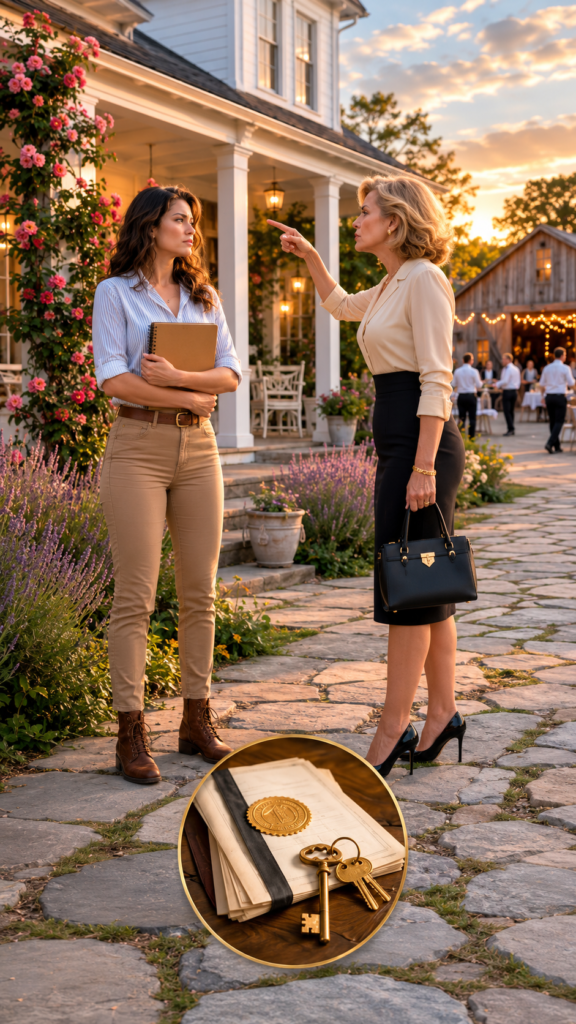
When Doña Beatriz stepped out of her white truck at the entrance of the refuge, Mariana thought she would finally hear a word of pride.
The carved wooden gate stood open, bougainvilleas cascaded over the restored adobe walls, and in the distance, the old barn shimmered with warm lights because there was a wedding that afternoon.
But her mother looked at nothing with tenderness.
She took off her dark glasses, surveyed the estate as if calculating the price of someone else's jewel, and uttered the phrase that froze her daughter’s blood.
—You have 72 hours to hand this property over to your brother.
Mariana thought she had heard wrong.
—Hand it over?
—Yes. No selling, no arguing, no drama. Raúl will manage it from now on.
A few meters away, some guests strolled through the lavender courtyard with earthen coffee mugs. In the kitchen, the chef checked the wedding menu. On the terrace, a couple from Monterrey was taking photos of the pond that used to be pure mud.
All of that existed because Mariana had spent three years sleeping among dust, humidity, and debts.
The estate was now called Refuge Sauce Luna, but before it was nothing but a ruin on the outskirts of Valle de Bravo.
When Don Julián died, the will had been “very fair,” according to Doña Beatriz.
Raúl got the luxury apartment in Polanco, with a private elevator, Italian marble, and a view of Reforma.
Mariana was left with a decaying mansion, with sagging ceilings, rusty pipes, scorpions in the rooms, and 12 abandoned hectares.
Raúl had mocked her.
—It suits you perfectly, sister. You’ve always liked broken things.
Mariana didn’t respond because grief had left her mute. Besides, no one remembered that she was an architect.
No one knew that years before, her father had taken her to walk through those lands and had asked her:
—If one day this were yours, what would you do here?
She had imagined rooms, gardens, pottery workshops, dinners under trees, and a place where people could breathe without hurry.
So she took the ruin and turned it into a destination.
She sold her car, took out loans, learned about municipal permits, argued with builders, carried bags, cut her hands removing glass, and cried many nights with instant soup in a windowless kitchen.
But she did it.
The main house became six suites. The barn, an event hall with original beams. The dry orchard, a garden for dinners. The old chicken coop, a glass studio for workshops.
And when the refuge began to fill up, her family came back.
Not to hug her.
To claim.
—Don’t be selfish, Mariana —her mother said—. This property has always belonged to the family.
Mariana clenched her fists.
—It was also part of the family when it was falling apart, Mom. And no one wanted it.
The next day, Raúl arrived in a black pickup, smiling as if he were there to pick up keys.
But upon seeing the sign at the entrance, his smile faded.
Refuge Sauce Luna — Founder: Mariana Rivas. Private property. Unauthorized administrative access prohibited.
Raúl looked at the suites, the garden, the flower-filled hall, and then at his sister.
—You have 71 hours, Mariana —he said quietly—. After that, we’re not going to ask nicely.
PART 2
Mariana didn’t move.
Inside, she felt the same cold she had felt the first night she slept in that house, when rain poured through the roof and she placed buckets around the inflatable mattress.
But this time, she wasn’t alone.
Behind her, Rosa, the cleaning lady, stopped arranging cushions. Don Chava, the gardener, lowered the hose. Lupita, the event coordinator, emerged from the barn with a folder in hand.
They had all heard.
Raúl smiled as he noticed the staff.
—Don’t make a circus. This is a family matter.
Mariana took a deep breath.
—My team is family too. They built this with me when you wouldn't even answer the phone.
Raúl let out a dry laugh.
—Oh, please. Don’t play the martyr. You played your cards well. You got the property cheap, fixed it up, and now you want to keep it all.
—I kept what Dad left me.
—Dad didn’t know what he was doing.
That phrase hurt more than the threat.
Because Don Julián did know.
He had been quiet, hard at times, but never foolish. He had seen in Mariana something her own mother never wanted to see: patience, vision, and a stubbornness capable of turning ruins into home.
Doña Beatriz appeared behind Raúl with a brown folder.
—We’ve already talked to a lawyer. We can contest the will.
Mariana looked at the folder.
—The will is three years old. It’s signed, registered, and executed.
—We can also prove that you influenced your father —said Doña Beatriz—. You were always glued to him in his last months.
Mariana felt her blood rush to her face.
—I accompanied him to chemotherapy, Mom. You said it gave you anxiety to enter the hospital. Raúl said he had meetings.
The silence weighed heavily.
A group of guests walked by and noticed the tension. Mariana made a discreet gesture to Lupita to guide them toward the garden.
She wasn’t going to let her mother and brother ruin a wedding out of greed.
—Leave —said Mariana—. I have an event today.
Raúl stepped closer.
—You have 71 hours to think. Because believe me, sister, this can get ugly.
Mariana didn’t back down.
—Worse than sleeping six months without heating in this house, I don’t think so, dude.
Raúl glared at her with hatred.
Doña Beatriz let out a dramatic sigh.
—Look at how you talk to your brother. That’s why no one can stand you, Mariana. Always so resentful.
—I’m not resentful. I’m tired.
They left, but the threat lingered.
That night, after the newlyweds danced under the barn lights and the guests applauded among candles and mezcal, Mariana locked herself in the office.
She pulled out all the deeds, permits, contracts, account statements, and invoices.
She had everything in order.
Or so she thought.
At 2 a.m., she found something odd in an old copy of the will.
There was an additional sheet she had never seen before.
It wasn’t in the file the family lawyer had handed over, but it was in a box of personal documents from her father, which Mariana had barely had time to sort.
The sheet bore Don Julián’s signature and a handwritten note.
“Mariana must receive the entire estate, not as a punishment, but because she is the only one who will understand what this place can be. Raúl already received his part in life. Beatriz knows.”
Mariana stood frozen.
Raúl already received his part in life.
What did her dad mean?
The next day, she sought out Don Ernesto, her father’s former accountant, a 68-year-old man living in Toluca who always sent her messages at Christmas.
When he arrived at the refuge, Don Ernesto carried a blue folder and a guilty look.
—Your dad asked me to keep this in case one day your mom or your brother tried to take the estate from you.
Mariana felt the ground shift beneath her.
—So he knew?
Don Ernesto lowered his gaze.
—He knew perfectly well who he was dealing with.
Inside the folder were transfers, purchase contracts, and promissory notes.
For five years before he died, Don Julián had paid off Raúl’s enormous debts: gambling, credit cards, a failed restaurant business in Santa Fe, and even an accident caused by drunk driving.
The total amount exceeded 9 million.
Moreover, the Polanco apartment hadn’t been a simple inheritance. Don Julián had bought it in Raúl’s name before he died, but in the will, he wrote it down so there would be no claims.
—Your mom signed as a witness to several documents —said Don Ernesto—. She knew Raúl had already received much more than you.
Mariana felt like vomiting.
It wasn’t just ambition.
It was a lie.
The whole speech about “family” was a smokescreen to hide that Raúl had eaten up her inheritance years before.
That same afternoon, Mariana called Licenciada Valeria Montiel, a lawyer from Toluca who had handled the refuge’s permits.
Valeria reviewed everything for hours.
—They can’t take the property from you —she said in the end—. But they can make noise, invent breach of trust, manipulation, defame you online. And if your brother is desperate, he might try something worse.
The warning came too late.
The next morning, Refuge Sauce Luna woke up with the front door forced open.
They hadn’t stolen televisions or money.
They had broken into the office.
The drawers were open, papers scattered, the computer disconnected.
And on the wall, written in black spray paint, was a phrase:
“Return what is not yours.”
Lupita crossed herself.
—Oh, Mariana… this is getting heavy.
Mariana called the municipal police. Then she called the lawyer. Then she reviewed the cameras.
In one recording, a black truck could be seen entering through the service road at 3:17 a.m.
The driver’s face wasn’t visible, but there was one absurd detail.
A keychain hanging from the rearview mirror.
The same leather keychain with initials R.R. that Mariana had given to Raúl for his 30th birthday.
The police took note, but Mariana knew her brother would deny everything.
And he did.
At 11, Raúl showed up with his mother and a notary who looked uncomfortable.
—What a coincidence about the robbery —Raúl said, looking at the stained wall—. Maybe it’s a sign that this place is too big for you now.
Mariana didn’t respond.
Valeria, the lawyer, stepped out of the office with a tablet.
—Mr. Raúl Rivas, before we continue, I suggest you listen to this.
Raúl tensed.
On the screen appeared an audio recovered from an internal camera he didn’t know existed.
His voice sounded clear.
—Don’t break everything, idiot. Just look for the blue folder. If Mariana has those papers, we’re in deep trouble.
Doña Beatriz paled.
The notary stepped back.
Raúl tried to snatch the tablet, but Don Chava stepped in front of him.
—Don’t you dare, kid.
—This is illegal —shouted Raúl—. You’re recording me without permission!
Valeria raised an eyebrow.
—The camera is inside private property with visible notice at the entrance. The illegal act is forcing your way into an office.
Mariana looked at her mother.
She expected shame, an apology, even a crack.
But Doña Beatriz pressed her lips together and said the unforgivable.
—We did it out of necessity. Raúl has debts. You don’t have children. You don’t need that much.
Mariana felt something break forever.
She didn’t scream.
She didn’t cry.
She just asked:
—So I matter less because I don’t have children?
Doña Beatriz didn’t answer.
Raúl exploded.
—Enough! Dad always preferred you. Always the smart girl, the architect, the saint Mariana. I’m his son too.
Mariana looked at him with old sadness.
—And that’s why he paid off debts for you, bought you an apartment, and saved you from prison. What more did you want?
Raúl froze.
The phrase fell like a stone.
Doña Beatriz turned to the notary, desperate.
—That has nothing to do with this.
But Valeria already had certified copies of everything.
The promissory notes. The transfers. The handwritten letter from Don Julián. The documents signed by Beatriz. The video of the break-in. The audio.
The police returned to the refuge that same afternoon.
Raúl was summoned to testify. Doña Beatriz too.
The news spread quickly among cousins, uncles, and acquaintances. As always happens in Mexican families, everyone had an opinion even though no one had lifted a single brick.
Some said Mariana was cruel for reporting her own brother.
Others said that finally someone had set limits.
An aunt wrote to her:
“Your mom is old. Don’t make her suffer.”
Mariana replied just once:
“My mom had three years to visit me when I was suffering. She never came.”
Then she blocked half the family.
On the day the 72 hours were up, Mariana was in the central courtyard of the refuge.
There was no threat.
No handover.
There was a small wedding of 40 people, marigold flowers, freshly baked bread, and soft music by the willow her father loved so much.
At sunset, Doña Beatriz arrived alone.
Without perfect makeup. Without dark glasses. Without a folder.
Mariana asked Lupita not to let her into the guest area, but agreed to speak with her at the entrance.
—Raúl is in bad shape —her mother said.
—Raúl committed a crime.
—He’s your brother.
—I’m your daughter too.
Doña Beatriz swallowed hard.
For the first time, she seemed to hear that phrase.
—I didn’t know how to see you, Mariana.
Mariana looked at the illuminated estate, the walls she had sanded herself, the windows she chose one by one, the path where she broke her hands carrying stones.
—No, Mom. You did know. You just chose to look the other way.
Doña Beatriz cried silently.
—Your dad wanted this place to belong to everyone.
Mariana shook her head slowly.
—No. Dad wanted this place to live. And it lived because I stayed when everyone else left.
She pulled out a copy of the handwritten letter and handed it to her.
Doña Beatriz read it with trembling hands.
When she reached the phrase “Beatriz knows,” she covered her mouth.
Mariana didn’t need more confessions.
She already had the truth.
Months later, Raúl accepted a plea deal to avoid prison but had to pay damages, return documents, and stay away from the refuge.
Doña Beatriz lost something harder to recover than money: her daughter’s trust.
Mariana didn’t close Refuge Sauce Luna.
On the contrary.
She opened a scholarship for women who wanted to learn restoration, gardening, and small business management. She named it the Julián Rivas Scholarship, because her father’s legacy wasn’t a property.
It was the faith he had placed in her when no one else did.
Sometimes, guests asked about the willow by the pond.
Mariana smiled and said that tree had survived droughts, abandonment, and storms.
She never mentioned that she had too.
Because in Mexico, everyone knows a family where the favored child is forgiven everything, and the strong daughter is demanded even for what she built with her own hands.
And that’s why Mariana’s story hurt so much.
Because it wasn’t just about an estate.
It was about that question many dare not ask aloud:
How many times does family call “selfishness” the simple act of refusing to be destroyed?