PART 1
The first time her baby cried, Rogelio smiled as if that wail was a trophy.
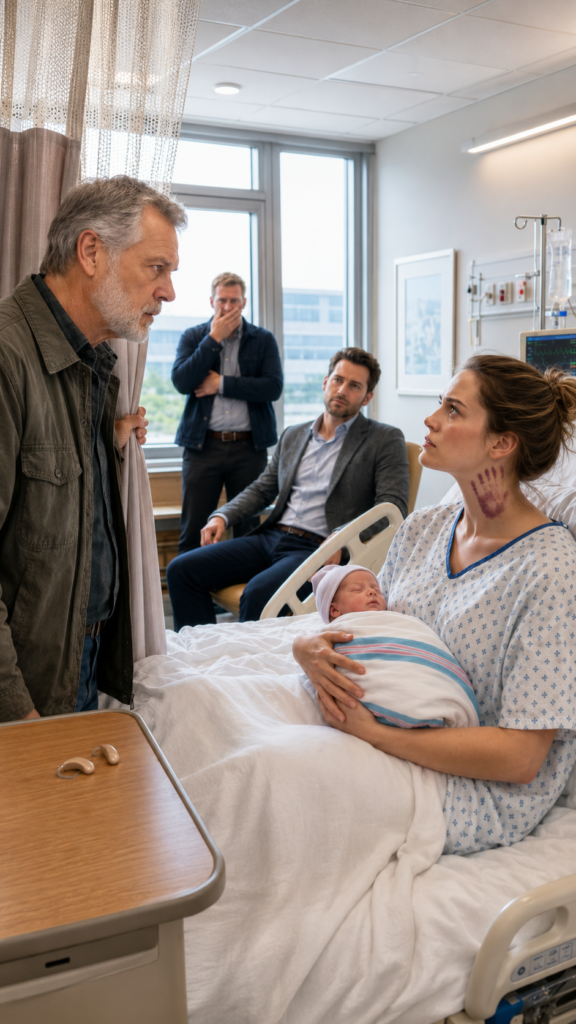
Valeria lay in the bed of a private room in an expensive clinic in Guadalajara, her newborn son pressed to her chest, her neck marked by five dark fingers.
They weren’t shadows.
It wasn’t fatigue.
They were imprints.
Rogelio Medina settled into the armchair, crossed his legs, and gazed at those marks with a satisfaction that chilled the blood.
—He’s already learned who’s in charge in this family—he said, softly, but venomously.
Valeria tightened her grip on the baby against her chest. The child moved his mouth searching for milk, oblivious to the fear that filled the room like smoke.
Outside, a nurse laughed with another. No one imagined anything. Rogelio had brought enormous flowers, imported chocolates, and a silver balloon that said: THE BEST DAD IN THE WORLD.
On Facebook, he had already posted a photo smiling next to the crib.
“Welcome, Emiliano Medina,” he wrote.
But Valeria had given him another name.
Mateo.
Like her maternal grandfather.
Like the only man who, in her childhood, never raised his voice at her.
Don Ernesto Medina, her father-in-law, stood by the window with his arms crossed. He was 68, wore expensive boots, a pressed shirt, and had that dry look of men used to having everyone bow their heads when they spoke.
—Don’t make a scene, Valeria—he murmured—. You just gave birth. Women can be very intense.
Rogelio let out a chuckle.
—She got stubborn with the name. But my son carries my last name, my blood, and my rules.
Valeria swallowed hard. It hurt to breathe.
—His name is Mateo—she whispered.
The chair squeaked against the floor.
Rogelio stood up slowly.
—What did you say?
At that moment, the door opened.
In came Uncle Simón with a bag of sweet bread, an old brown sweater, and his wooden cane. He was 72, walked with a slight limp, and wore hearing aids. To anyone else, he seemed like a quiet neighborhood old man.
To Valeria, he was home.
Simón stopped when he saw her.
His eyes dropped from her pale face to her purple neck.
The room changed.
It didn’t become louder.
It became dangerously silent.
—Who did that to you, mija?—he asked.
Rogelio let out a short laugh.
—Oh, uncle, don’t get involved. I was just teaching her who runs this new family.
Don Ernesto was about to laugh too.
But he froze.
Simón placed the bag of conchas on the table. Then he walked to the door, locked it, and drew the curtains.
Afterward, he took off his hearing aids and set them next to a glass of water.
—Close your eyes, Valeria—he said with a tenderness that was more frightening than a scream.
She didn’t close them.
She saw Simón’s sleeve roll up slightly.
On his forearm appeared an old tattoo: a black machete piercing through a broken crown.
Don Ernesto looked at him.
And the man who had intimidated half the family for years turned pale, took two steps back, and vomited on the pristine hospital floor.
Rogelio opened his mouth, confused.
—Dad? What the hell is wrong with you?
Don Ernesto couldn’t answer.
He just stared at the tattoo as if he had just seen a dead man rise.
And Valeria understood something terrible.
Rogelio hadn’t married a defenseless woman.
He had married the niece of the man his father still dreamed about in fear.
PART 2
Rogelio looked at his dad, then at Uncle Simón, then back at Valeria’s neck, as if he was just beginning to understand that the room no longer belonged to him.
—What is this?—he asked, trying to sound tough—. Who do you think you are closing the door?
Simón didn’t answer immediately.
He took a chair and placed it next to Valeria’s bed. He didn’t sit down. He just rested a hand on the back, with an ancient, heavy calm, one that is born after seeing too much darkness.
—I am the brother of Valeria’s mother—he said—. And I’m the man who’s going to teach you something your father never learned.
Don Ernesto wiped his mouth with a handkerchief. His fingers trembled.
—Simón Ortega…—he murmured.
Rogelio frowned.
—You know him?
Don Ernesto didn’t look up.
—Shut up.
The word was dry, but it no longer held authority. It held panic.
Valeria felt the baby stirring on her chest. Mateo made a small sound, as if he too knew something was about to break.
Rogelio approached the bed.
—My son’s name is Emiliano. And if this old family of resentful people thinks they’re going to meddle in my house…
He didn’t finish.
Simón raised his hand.
He didn’t touch him.
He just lifted it.
And Rogelio, not knowing why, stopped.
—Don’t get any closer to her—Simón said.
Rogelio smiled, trying to reclaim his role as the invincible macho.
—And what if I don’t want to, old man?
Don Ernesto let out a choked sound.
—Rogelio, please be quiet.
That plea was the first crack.
Valeria had never heard her father-in-law ask for anything politely. That man ordered, humiliated, signed checks, and destroyed reputations with a call.
But in front of Simón, he seemed like a trapped child.
There were three knocks at the door.
—Everything alright?—a nurse asked from outside.
Rogelio stepped forward.
—Yeah, yeah, everything’s fine.
But Valeria, for the first time since she had been taken to that room, raised her voice.
—No. It’s not fine.
The silence that followed was brutal.
Simón opened the door.
The nurse entered, looked at the floor, then at Valeria’s neck, then at Don Ernesto’s dismayed face.
—Ma’am, do you need help?
Valeria struggled to breathe.
—My husband squeezed my neck less than an hour ago. He did it because I wouldn’t agree to change my son’s name.
Rogelio let out a false laugh.
—She’s hormonal, nurse. Seriously, she just had a baby. She doesn’t even know what she’s saying.
But Simón pointed to Valeria’s phone, which lay on the table.
—Before coming, my niece accidentally sent me an audio without cutting the call. I heard everything.
Rogelio froze.
Valeria looked at him in surprise. She didn’t remember sending anything. Between the pain, the childbirth, and the fear, she had just pressed the screen searching for her uncle’s number.
Simón pulled out his own phone.
—I have 11 minutes recorded. Your voice, Rogelio. The threat. The hand on her neck. Your father’s laughter. Everything.
Don Ernesto closed his eyes.
—No, no, no…
The nurse ran out.
In less than five minutes, the doctor, hospital security, and two municipal police officers who were at the entrance for a traffic accident arrived.
Rogelio started shouting that he owned a construction company, that he knew the clinic’s director, that no one could remove him from his own son’s room.
Simón didn’t move.
He just put his hearing aids back on, as if he no longer needed to protect Valeria from the noise.
—That child is not property—he said—. And neither is she.
The doctor examined Valeria’s neck. She spoke in a low but firm voice.
—We need to document the injuries. This is not normal. There’s a risk.
Rogelio slapped the wall with his palm.
—She’s my wife!
Valeria felt a chill rise up her spine.
Because that phrase, said like that, didn’t sound like love.
It sounded like ownership.
Then the second blow happened.
Don Ernesto, still pale, fell into a chair.
—Don’t provoke him any further, Rogelio.
—Further?—Rogelio looked at him with rage—. You raised me like this! You told me that a woman should be corrected in time or she’ll get above herself.
The room went silent.
Valeria felt those words burning more than the bruises.
Don Ernesto clenched his teeth.
—I was also an idiot when Simón found me.
Simón barely turned his head.
—You weren’t an idiot, Ernesto. You were a coward in uniform.
Rogelio blinked.
—Uniform?
His father looked down.
And there, in front of everyone, the buried story began to emerge.
More than 40 years ago, Don Ernesto wasn’t a businessman. He was part of a private security group hired to evict families in a town in Jalisco, near the sugarcane fields. They would enter at dawn, beat men, threaten women, and burn documents so no one could claim land.
One night, they chose the wrong house.
The house of Simón’s younger sister.
Valeria’s mother.
She was 19.
She was pregnant.
Don Ernesto participated in that eviction. He didn’t touch her directly, but he watched. He allowed it. He laughed. And when Simón, then a retired soldier, returned to the town and found his family hiding in a chapel, he sought out every man involved.
He didn’t kill them.
He did something worse.
He turned them in with evidence, names, and recordings to a federal commission. Several ended up in jail. Others fled. Don Ernesto survived because his own father paid lawyers and got him out of the state.
But he never forgot the tattoo.
The machete piercing through the broken crown.
It was the symbol of the small group of veterans who helped dispossessed families.
Simón had never told Valeria that story because her sister asked him to leave the past buried.
Until that day.
Valeria looked at Don Ernesto in horror.
—Did you know my mom?
The man couldn’t hold her gaze.
—Yes.
—And still let your son treat me like this?
Don Ernesto opened his mouth, but nothing worthy came out.
Rogelio, on the other hand, reacted with fury.
—Enough! You’re not going to ruin my life with old tales!
He approached the baby’s crib.
It was a quick movement.
Too fast.
Valeria screamed.
Simón took one step, but it wasn’t enough.
Rogelio grabbed Mateo’s blanket and yanked it, as if he wanted to lift him.
The nurse intervened.
—Don’t touch the baby!
Rogelio pushed her by the shoulder.
That shove changed everything.
The police rushed in immediately. One held Rogelio against the wall. The other ordered him to put his hands behind his back. Rogelio struggled, shouting that his dad would pay for everything, that Valeria would regret it, that no one would take his son away.
Mateo began to cry.
Valeria did too.
But this time, she didn’t cry out of fear.
She cried because her body, after enduring so much, finally understood that she was no longer alone.
The doctor gently took the baby and placed him back in his mother’s arms.
—Mrs. Valeria, you decide who can be here.
Valeria looked at Rogelio, handcuffed, disheveled, red with rage.
Then she looked at Don Ernesto.
—Neither of them.
Don Ernesto tried to stand.
—Valeria, please. I didn’t know he would go this far.
She let out a broken laugh.
—Really? You didn’t know? You taught him to look at a woman as if she were less. You taught him that fear was respect.
Simón leaned closer to the bed and draped the blanket over her shoulders.
—Mija, the social worker has arrived. A lawyer from the support center is also coming.
Don Ernesto held his hands to his face.
—Simón… I paid for what I did.
Simón looked at him without hate, and that was worse.
—No, Ernesto. You paid to keep it hidden. It’s not the same.
In the following hours, the clinic stopped being the stage for a perfect family.
It became a case file.
Photos of Valeria’s neck.
Medical report.
Audio recording.
Nurse’s statement.
Report of the shove.
Request for protective measures.
Rogelio spent the night in detention. His company issued a lukewarm statement saying they would “investigate the facts.” But someone leaked the photo of the THE BEST DAD IN THE WORLD balloon next to Valeria’s medical report.
And Mexico did what Mexico does when a story smells of hypocrisy.
They commented.
They shared.
They were outraged.
Some said Valeria should have stayed quiet for the baby.
Others said that for the baby, she had to speak up.
The Medina family tried to use connections. Don Ernesto called lawyers, officials, and old friends. But everyone answered him with distance. No one wanted to be seen defending a man accused of assaulting a newly delivered woman.
On the third day, Simón took Valeria to his house in Tlaquepaque.
It wasn’t a mansion.
It was a yellow house with bougainvilleas, a kitchen that smelled of coffee, and a hammock in the yard.
Mateo slept there for the first time without anyone disputing his name.
Valeria, still weak, sat by the window while Simón warmed up soup.
—Why didn’t you ever tell me about my mom and Ernesto?
Simón froze.
—Because your mom wanted you to grow up without carrying others’ resentments.
—But I ended up marrying that man’s son.
Simón lowered his gaze.
—Sometimes the past isn’t buried. It disguises itself in an elegant surname, a new truck, and pretty pictures.
Valeria stroked Mateo’s little head.
—I feel foolish.
—Don’t say that.
—I didn’t see the signs.
Simón sat across from her.
—you did see them. But everyone around you told you that you were exaggerating. That doesn’t make you foolish. That’s called being surrounded.
The phrase stuck with her.
For weeks, Rogelio sent messages from unknown numbers. First insults. Then apologies. Then promises. He said he was sorry, that he wanted to see his son, that it had all been a bad moment, that fatherhood had overwhelmed him.
Valeria didn’t respond.
The lawyer did.
Each message was added to the folder.
The final twist came two months later.
Don Ernesto requested to testify.
No one expected that.
He arrived at the Public Ministry without a hat, without bodyguards, without the arrogance of an untouchable patriarch. He handed over a USB drive and an old folder.
Inside were documents from the time of the eviction, names of businessmen now respectable, illegal payments, forged signatures.
And there was something more recent.
Emails from Rogelio.
Messages where he spoke of pressuring Valeria to sign over rights to a house inherited from her mother. The same yellow house in Tlaquepaque, whose land was now worth millions because a shopping plaza wanted to buy the entire block.
Valeria felt the floor open beneath her.
It hadn’t just been control.
It hadn’t just been the baby’s name.
Rogelio had wanted to break her emotionally since childbirth to make her sign when she was weak, tired, and scared.
Don Ernesto confessed that he knew.
And confessed something worse: it had been his idea.
—My son got out of my hands—he said in front of the authorities—. But I taught him where to put them.
That phrase went viral.
Some called him brave for testifying.
Others said that a late confession doesn’t erase a lifetime of harm.
Valeria didn’t forgive him.
Nor did she insult him.
She just asked that justice do what so many Mexican families have waited for years: not to bend before money.
Rogelio faced charges for domestic violence, injuries, threats, and attempted abduction of a minor. Additionally, a property investigation began for the documents of the house.
Don Ernesto lost contracts, partners, and reputation. But what seemed to destroy him the most was seeing Simón at the hearing, sitting next to Valeria, holding Mateo as if carrying a promise.
The judge imposed strict measures.
Rogelio could not come near Valeria or the baby. Any future visitation would have to be evaluated by experts, mandatory therapy, and supervision.
When they left the courtroom, several reporters approached.
—Valeria, what would you say to women going through something similar?
She looked at Mateo. Then looked at Simón.
She still had a faint scar on her neck.
She no longer hid it with scarves.
—That the first blow isn’t always with the hand—she said—. Sometimes it starts when they change your son’s name, when they mock your fear, when everyone tells you not to exaggerate. And that asking for help doesn’t break a family. Sometimes it saves it.
That night, in the yellow house, Simón hung a new photo on the wall.
Valeria with Mateo in her arms.
There were no balloons.
There were no false phrases.
Just a tired mother, alive, standing tall.
The baby slept with his name embroidered on the blanket.
Mateo Ortega Salinas.
Because Valeria decided that no surname had the right to inherit fear.
And although many on social media debated whether Don Ernesto deserved compassion for confessing, Valeria understood something deeper:
There are men who repent when they lose power.
And there are women who begin to live when they stop asking for permission to survive.