PART 1
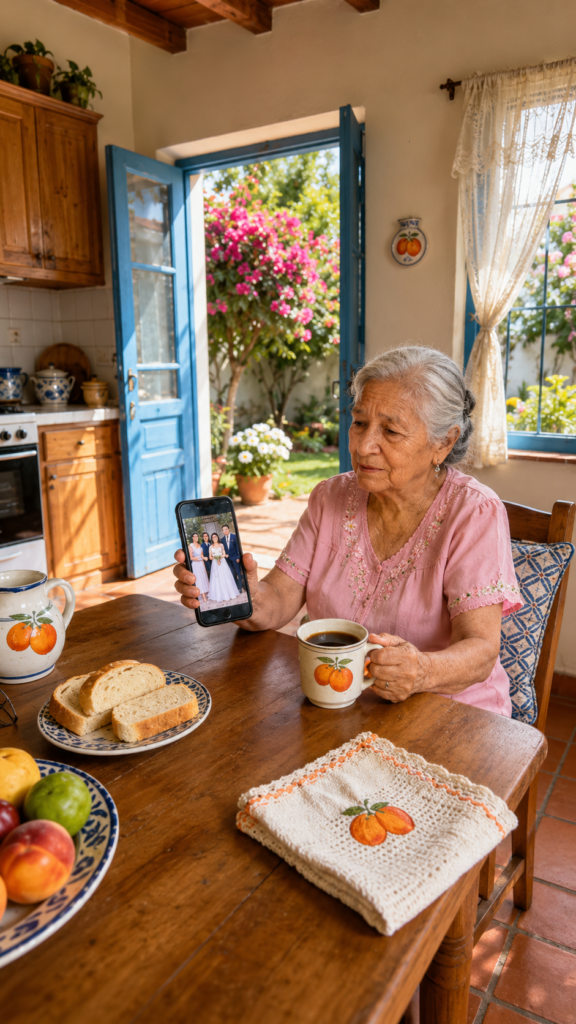
Every morning, Doña Mercedes would open Facebook while waiting for her pot of coffee to boil.
At 74 years old, this was her way of feeling close to family: watching birthdays, baptisms, dinners, and photos that were almost never sent to her directly.
But that Monday, one image left her coffee cup suspended in midair.
Her granddaughter, Renata, appeared dressed as a bride in front of a church in Guadalajara. Surrounding her were her uncles, cousins, friends, and even neighbors that Mercedes had known for years.
There were 40 photographs.
In none of them was she.
The wedding had taken place 3 days earlier, just a 40-minute bus ride from her home.
Mercedes zoomed in on a picture where everyone was toasting. In the front row, there was an empty chair with a blurry sign.
A sharp pang shot through her, though she didn't cry.
Since her son Arturo’s divorce 12 years ago, her relationship with Renata had grown cold.
Mercedes had supported Arturo because he was her son and because he swore that his ex-wife had destroyed him. Renata stayed with her mother, and over time, the calls became scarce.
Arturo, on the other hand, never stopped reaching out.
Every Sunday, he would ask if she had eaten, if she had taken her medicine, and if she needed anything from the market.
He was also the one who told her news about Renata.
He said the girl was proud, that she was resentful, and that she wanted nothing to do with her grandmother.
Mercedes believed him.
Four years earlier, Arturo even helped her set up a monthly transfer "for Renata's university."
"Just send it here, Ma. I'll make sure it gets to her," he said, jotting down a bank account on a piece of paper.
Mercedes deposited without missing a single month.
On Tuesday, Arturo called as usual.
Mercedes asked why no one had informed her about the wedding.
He fell silent and then replied that it had been Renata’s decision. According to him, she didn’t want fights or people who could ruin her day.
"How many guests were there?" Mercedes asked.
"About 80," Arturo replied, after taking too long to answer.
That response burned her chest.
Eighty people had a place.
She did not.
Without telling anyone, Mercedes went to the bank and canceled the transfer. Then she visited the notary and removed Renata from her will.
She didn’t call it revenge.
She told herself she was just accepting the place her granddaughter had given her.
Three weeks later, Renata called for the first time in years.
Her voice sounded nervous.
"Grandma, did something happen with the bank? I received a notice about a canceled transfer."
Mercedes gripped the phone.
"Yes. The one I was sending you every month for 4 years."
On the other end, there was a long silence.
"Grandma... I never received any money from you. Not a single peso."
Mercedes searched for the paper where Arturo had written the account and read the numbers.
Renata gasped.
"That account isn’t mine. And I did invite you, Grandma. I gave the envelope to my dad. He told me you said you wouldn’t go even if you were crazy."
Then Renata added, nearly in tears:
"Still, I saved a seat for you up front. It had your name. All night I looked at the door."
Mercedes went back to the photograph and zoomed in on the empty chair.
This time she managed to read it.
"Grandma Mercedes."
And as she dialed the bank to ask whose name that account was under, she understood that the person who had spent 12 years "protecting her" might have destroyed the entire family.
PART 2
The bank employee confirmed the name in an indifferent voice:
"The account belongs to Arturo Salgado Mendoza. It was opened 4 years ago."
Mercedes didn’t respond.
Hearing her son’s full name from a stranger was worse than suspecting it.
It was the same name he had proudly announced in the hospital the morning he was born.
For 4 years, she had been sending money for Renata’s studies to Arturo's account.
For 12 years, he had said that Renata despised her.
And every Sunday, after holding onto that lie, he tenderly asked if his mother had taken her pill.
Mercedes felt rage, shame, and a sadness so heavy it made it hard to breathe.
She grabbed her purse and went to Arturo's apartment in the Jardines del Bosque neighborhood.
She knocked several times.
No one answered.
A neighbor stepped into the hallway. It was Doña Chela, a gray-haired woman who immediately recognized the photograph Mercedes was holding.
"Looking for Arturo? He hardly comes by. He spends more time in the hospital than here."
Mercedes froze.
"Which hospital?"
The woman paled.
She explained that Arturo had been in and out of the Centro Médico de Occidente for over a year. He had lost so much weight that weeks ago, she had to help him up the stairs.
More than a year.
More than 52 Sunday calls.
More than 52 times he had asked Mercedes how she was, without saying a word about himself.
The rage didn’t disappear.
Arturo had stolen money. He had separated a grandmother from her granddaughter. He had turned love into resentment and silence into a sentence.
Being sick didn’t erase anything.
But as she returned home, Mercedes recalled details that once seemed insignificant.
The hoarse voice he called "the little cold," an oversized shirt, and the birria he barely tasted on his birthday.
The unexpected goodbye from six months ago:
"I love you so much, Ma."
She had laughed.
"What did you do now, you rascal?"
Arturo had laughed too, but that afternoon, he kept his eyes glued to the floor.
Mercedes spent the night sitting in the patio, going over every call.
Then she accepted something worse: she had also participated in the damage.
For years, she spoke poorly of Renata with her friends in the parish group.
She said the girl was ungrateful, that she had chosen her mother’s side, and that she didn’t even ask about her.
She repeated Arturo’s words as if they were verified truths.
She had judged her granddaughter without seeking her out.
She had preferred to feel abandoned instead of calling her.
At 7 in the morning, she took the bus to the hospital.
She found Arturo connected to an IV, his skin pale, and his face sunken.
For a moment, she didn’t recognize him.
The smiling man who raised a glass next to Renata looked like someone else.
Arturo tried to cover himself with the sheet.
"Ma... you shouldn’t have come."
"You never told me to come."
Mercedes left the piece of paper with the account on the bed.
She told him she knew everything: the money, the lies, the hidden invitation, and the 12 years Renata spent believing her grandmother rejected her.
Arturo didn’t deny anything.
He closed his eyes.
"Why?" Mercedes asked. "If you needed money, I would have given it to you. I’m your mother. Why did you do this to us?"
Arturo took his time to answer.
"Because if you and Renata started talking again, you would discover me."
He pointed to his body, the IV, and the machines.
He had pancreatic cancer.
The diagnosis had come years ago, but the illness had advanced rapidly in the last year.
Some medications were unavailable when he needed them. Arturo couldn’t afford them nor did he want to ask for help.
"I thought you wouldn’t miss that amount every month," he murmured. "I knew it was wrong, but I was afraid you would know."
Mercedes looked at him in disbelief.
"Afraid of what? Of me taking care of you?"
Arturo pressed his lips together.
"Of you seeing me die. A mother shouldn’t bury her son. I wanted to spare you that."
The phrase made her furious.
"You had no right to decide what pain I could bear. You also had no right to take a grandmother away from your daughter."
Arturo lowered his gaze.
"That has no forgiveness."
He confessed that at first, he only wanted to hide the illness. When Renata asked about Mercedes, he invented one excuse after another until any conversation between them could crumble everything.
"I became a coward," he said. "And then I didn’t know how to fix it."
Mercedes remembered the wedding.
"Why didn’t you give me the invitation?"
Arturo started crying silently.
"Because it was the last day I could see myself whole."
He had postponed hospitalization to accompany Renata.
He injected himself with painkillers before putting on the suit and spent the ceremony pretending he could stand.
He wanted his daughter to have a photograph where her father was smiling, not an image next to a hospital bed.
"If you entered the hall, Ma, you would have looked at me for 2 seconds and known something was wrong. I wouldn’t have been able to pretend in front of you."
The raised glass in the photos wasn’t a carefree celebration.
It was a sick man gathering his last strength to give his daughter a worthy memory.
Mercedes sat next to the bed.
She was still furious.
She was still his mother.
She brushed his hair back as she had when he was a feverish child, but she didn’t say the word "forgive".
Not yet.
"I’ll come back later," she said.
Arturo nodded.
Mercedes left the hallway and cried among families asleep on plastic chairs.
Then she returned home.
That was the mistake she would never forgive herself for.
She thought she needed a few hours to sort through her anger and that Arturo still had to answer for Renata.
She acted as if time was hers.
At 2 in the morning, she woke up with a brutal certainty: she might live many more years, but Arturo might not make it to dawn.
She called Renata.
"Your dad is very sick," she told her. "He lied to both of us because he didn’t want us to see him die."
Renata let out a choked sob.
Mercedes asked her to come to the hospital early.
"I’ll wait for you at the entrance, daughter. Just like I should have always waited for you."
Then she remembered the canceled transfer.
The money hadn’t paid for studies, but for medications.
By cutting the deposits to punish Renata, Mercedes had left Arturo without a part of the money for his last treatments.
She didn’t know how much it had influenced, but guilt settled in her chest.
At 7 in the morning, Mercedes and Renata met in front of the hospital.
They looked at each other like two strangers who knew each other’s features by heart.
Renata hugged her before saying anything.
Mercedes felt the same vanilla scent she had when she was a child.
"Forgive me, Grandma."
"No, my love. You forgive me."
They went up holding hands.
A nurse stopped them before entering.
Arturo had died at 5:30.
They were 90 minutes too late.
Mercedes didn’t get to tell him she understood why he had been afraid.
Renata didn’t get to ask her why she turned her love into abandonment.
The nurse handed them a bag with Arturo’s belongings: his wallet, watch, a chain, and the gray jacket he wore at the wedding.
In the inner pocket, they found a sealed envelope.
On the front, in Renata’s round handwriting, it read:
"For my Grandma Mercedes."
It was the invitation.
Arturo had never thrown it away.
He carried it close to his heart until his last day.
On the back, he had written a single shaky sentence:
"If I see her walk through that door, I won’t be able to stand."
Mercedes hugged the envelope.
Then she understood the tragedy.
Arturo didn’t exclude her because he didn’t love her.
He excluded her because he loved her in a wrong, desperate, and cruel way.
He wanted to protect her from pain, but in doing so, he created a much larger one.
He wanted to die looking strong and ended up leaving two women convinced they didn’t love each other.
Renata began visiting Mercedes every Sunday, at the same time Arturo used to call.
At first, they talked about small things: recipes, neighbors, and old photographs.
Then they started to rebuild the 12 lost years.
They couldn’t recover them.
They learned not to waste the ones they had left.
Mercedes put Renata back in her will, though she no longer thought much about inheritances.
The porcelain display case stopped being a reward and became what it should have always been: a family memory.
The envelope remained sealed.
Mercedes never wanted to open it.
She said that inside was an invitation for a day that could no longer be repeated, but outside were the two truths she needed.
Her name written by a granddaughter who did wait for her.
And the confession of a son who loved her so much and so poorly that he destroyed what he was trying to save.
Every Sunday, before Renata arrived, Mercedes would take the envelope out of the drawer and run her fingers over her name.
Then she would serve two cups of coffee from the pot.
Sometimes, while waiting, she would look at the photograph of the empty chair.
She no longer saw a humiliation.
She saw everything a family can lose when someone decides to lie "for love."
And she always thought the same:
There are pains that don’t arise from a lack of affection, but from affection that becomes secret, pride, and silence.
That’s why, when Renata crossed the door, Mercedes left no word for later.
She hugged her tight.
She told her she loved her.
And even though the coffee would cool again in her hands, she never allowed another chair to remain empty for a truth that no one dared to say.