PART 1
At 8:47 in the morning, Clara Ríos heard the first bang against the black gate of her house in Lomas de Angelópolis, Puebla.
It wasn't a normal knock.
It was a harsh, angry thump, as if someone was trying to break into a property they'd already decided to steal.
Clara placed her coffee cup on the garden table and walked to the window.
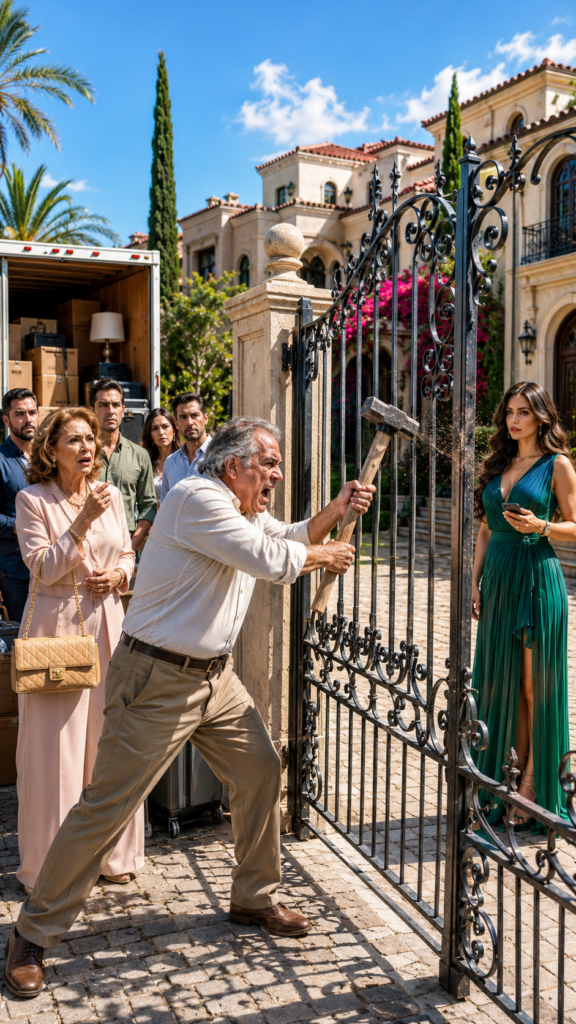
On the other side of the gate stood Don Ernesto, her ex-father-in-law, holding a crowbar. Next to him, Doña Silvia, her ex-mother-in-law, wore huge dark sunglasses and carried an expensive purse on her arm, as if she'd come to claim an inheritance.
Behind them were Mauricio, her ex-husband’s younger brother; Paola, his wife; two uncles Clara barely remembered from family gatherings; and three men with boxes, tape, and tools.
But what chilled her blood was the moving truck parked in front of the curb.
A moving truck.
“Open the gate, Clara!” shouted Don Ernesto. “You’ve divorced my son. You’re not going to live like a queen in a house that also belongs to the family.”
Clara didn’t respond.
It had only been nine days since her divorce from Julián Arriaga had been finalized. They had been married for eight years, and for nearly three, she had lived exhausted, paying off other people’s debts, enduring blackmail, and hearing the same phrase from Doña Silvia:
“When you marry into a family, you share everything.”
At first, Clara thought that meant affection.
Then she understood it meant money.
She had purchased that house five years before marrying, with what she earned from selling her stake in a digital logistics company she built from scratch in Monterrey.
Julián never paid a peso for that property.
Nor did his parents.
Nor did his brother.
But to them, Clara was always “the daughter-in-law with money.” The one who could pay for an uncle’s surgery, save Mauricio’s failing workshop, cover tuition fees, lend for vacations, and even buy a truck “because Don Ernesto deserved it.”
From the kitchen, Martina, the woman who had worked with Clara for six years, approached trembling.
“Ma’am, should I call the police?”
Clara looked toward the street.
There was Julián.
Leaning against a gray car, arms crossed, not meeting anyone’s eyes.
Silent.
As always.
That silence hurt more than the shouting.
Because Julián knew the truth.
He knew that house wasn’t his. He knew his family had no right. He knew Clara had worked late into the night for years to build what they now wanted to divide.
Don Ernesto banged on the gate again.
“Sign, and we won’t make a scene! If you behave, we can settle this today!”
Neighbors began to come out.
A woman in sweatpants with a coffee in hand stood watching from the sidewalk. A man recorded with his cell phone. The private security guard spoke nervously into his radio.
Clara took a deep breath.
Then she pressed the button on the panel.
The gate began to open slowly.
Doña Silvia smiled, satisfied.
“See?” she murmured. “The girl understood.”
They entered as if the house already belonged to them.
Paola pointed to the garden.
“Perfect spot for Christmas tables.”
Mauricio saw Clara’s car in the garage and whistled.
“Wow, that’ll sell well too.”
Clara said nothing.
She let them enter the main living room.
Doña Silvia climbed the stairs without asking.
“The master bedroom will be for me and Ernesto when we visit Puebla,” she said, opening doors. “Mauricio and Paola can have the one with the balcony.”
Don Ernesto placed a yellow folder on the table.
“Here’s the document. Give half the house to Julián, and everyone stays calm.”
Clara looked at her ex-husband.
She waited for one word.
Just one.
Julián lowered his head.
Then Clara took out her cell phone and dialed.
“Mr. Salgado, you can come in now.”
She hung up.
And while the family continued dividing rooms, cars, and furniture, no one imagined that the true owner of the silence had just unleashed the first piece of an unstoppable truth.
PART 2
Doña Silvia came down the stairs with one of Clara’s dresses in her hands.
“You have too much clothing,” she said, as if going through her own closet. “What you don’t take today, we can divide between Paola and my nieces.”
Clara felt a stab in her chest.
It wasn’t about the dress.
It was about the way that woman touched her life, her things, her memories, with brutal confidence, as if Clara had stopped being a person the moment she stopped being a daughter-in-law.
“Put that down,” Clara said.
Doña Silvia let out a small laugh.
“Oh, dear, don’t get intense. After eight years, something belongs to us.”
“Nothing belongs to you.”
Don Ernesto slammed the table with the yellow folder.
“Yes, it does. My son lived here. My son accompanied you. My son gave you family status. You’re not going to kick him out empty-handed.”
Mauricio entered the office and turned on a screen.
“Dude, she has like four computers here. This room’s mine. I’ll make it an office and gamer room.”
Martina approached the door.
“Please, don’t touch the ma’am’s things.”
Don Ernesto turned, furious.
“You shut up. You probably live off my son’s money too.”
Clara took a step forward.
“You don’t speak to Martina like that in my house.”
“Your house?” replied Don Ernesto. “We’ll see if you’re still saying that soon.”
The front door opened before anyone could answer.
A man in a navy blue suit, about 55, with a leather briefcase and a gaze so calm it was unsettling, walked in. He was followed by a young lawyer with a laptop and an assistant carrying several folders.
Clara walked toward him.
“Thank you for coming, Mr. Salgado.”
“At your service, Clara.”
Don Ernesto frowned.
“And who are you?”
The man placed the briefcase on the table.
“Arturo Salgado. Property lawyer for Ms. Clara Ríos.”
The word “lawyer” fell like a bucket of cold water.
Paola stopped smiling.
Mauricio turned off the screen.
Doña Silvia clutched the dress to her chest.
Julián closed his eyes.
He knew who this lawyer was. He’d seen him years ago, just before the wedding, when he signed the marriage agreement his family now pretended to forget.
The lawyer opened the first folder.
“Before this becomes a criminal issue, let’s clear something up. The property located in Lomas de Angelópolis was acquired by Clara Ríos on May 12, five years before her marriage to Julián Arriaga. The deed is solely in her name.”
Don Ernesto let out a dry laugh.
“My son lived here for eight years.”
“Living in a house doesn’t make anyone the owner,” Salgado replied. “If that were the case, half of Mexico would own rented apartments.”
The neighbor recording lowered his phone slightly, as if even he felt embarrassed.
The lawyer took out another document.
“Additionally, Clara and Julián married under a separation of property agreement. Here are the prenup agreements signed by both.”
Doña Silvia removed her sunglasses.
“That’s a lie.”
Salgado looked at Julián.
“Mr. Arriaga, do you recognize this signature?”
Everyone turned to him.
Julián took too long to speak.
“Yes,” he finally said. “That’s my signature.”
Doña Silvia paled.
“What do you mean, yes?”
Don Ernesto turned angrily.
“You knew about this?”
Julián pressed his lips together.
“Yes, Dad. I always knew.”
The room fell silent.
Clara didn’t move. She didn’t smile. She didn’t celebrate. She just held Julián’s gaze, like someone who hears a truth too late that could have saved years of pain.
The lawyer placed a red folder on the table.
“And this isn’t even the worst part.”
Mauricio swallowed hard.
“What else is there?”
Salgado opened the folder.
“Messages, emails, audios, and transfers. All certified by a notary. For months, the Arriaga family pressured Clara to give up money, properties, and assets that didn’t belong to them.”
Don Ernesto raised his voice.
“That’s family! She had the means to help!”
“Helping isn’t the same as supporting,” Clara replied, for the first time with a voice that broke. “I paid debts, doctors, tuition, workshop repairs, vacations, and even the down payment for a truck. But when I said enough, you stopped seeing me as family and started treating me as an enemy.”
Doña Silvia tried to speak, but Salgado interrupted her calmly.
“Message from Julián Arriaga to Clara Ríos, three weeks before the divorce: ‘My parents still want to claim your house. I told them they have no right. Don’t sign anything if they pressure you.’”
Doña Silvia looked at her son as if the ground had been pulled out from under her.
“Julián…”
The lawyer continued.
“Email sent five days before the hearing: ‘I recognize the house as Clara’s exclusive property. I won’t claim it in the divorce. I’m sorry my family keeps insisting.’”
Don Ernesto approached Julián.
“Did you betray us?”
Julián looked up for the first time.
His eyes were red.
“No, Dad. I told you the truth. You preferred to invent another version because it suited you.”
The phrase cut through the room.
Clara felt anger, but also sadness. Julián wasn’t innocent. For years, he allowed abuses just to avoid confronting his parents. But at that moment, at least, he stopped hiding.
Don Ernesto clenched his fists.
“She left you with nothing.”
“No,” said Julián. “I lost her because I never defended her.”
Doña Silvia burst into tears.
“I thought after all these years, you’d love us, Clara.”
Clara looked at her with a calm that had taken years to build.
“I did love you. That’s why I helped. But you loved me more when I deposited money.”
No one responded.
At that moment, Martina entered from the hallway.
“Ma’am, there are two patrol cars at the entrance. The guard called them because of the banging on the gate.”
Through the windows, the police could be seen talking to the neighbors.
The three movers exchanged glances. One placed a box on the floor.
“I was told we were picking up furniture from a family house,” he said nervously.
Salgado looked at him.
“Then you’d better leave before you get involved in trespassing, threats, and possible damage to private property.”
He didn’t need to repeat it.
The men left almost running.
Mauricio raised his hands.
“I don’t want trouble.”
Paola looked at him indignantly.
“Now you’re scared?”
“Yeah, seriously. This has turned ugly.”
The uncles began to walk toward the door. The family that had entered like an army dissolved in silence, without dignity and without furniture.
Don Ernesto remained standing by the table, trapped between his pride and shame.
Clara approached him.
“You can leave through the same door you entered. Without shouting. Without banging. Without touching anything.”
He looked at her with resentment.
“You always thought you were better than us.”
“No,” she replied. “I just built something of my own. You decided that because I was a woman and had been your daughter-in-law, you had the right to take it from me.”
Doña Silvia left the dress on the couch.
Her hands trembled.
“I’m sorry,” she whispered. “I… I thought Julián would end up with nothing.”
Clara took a deep breath.
“Julián lost this house because it was never his. And he lost the marriage because he let you into everything he should have protected.”
Julián took a step forward.
“Clara, forgive me.”
She turned.
He seemed smaller than ever.
“I’m sorry for today. But also for every time I asked for ‘just one more support.’ For every time I saw you cry after talking to my mom and did nothing. For every time I stayed silent to avoid fighting them.”
Clara felt a lump in her throat.
It wasn’t love.
That was over.
It was the pain of hearing too late the words she had needed for years.
“Julián, I didn’t need you to hate your family,” she said. “I needed you not to leave me alone against them.”
He lowered his head.
“I know.”
“And that’s what broke everything.”
Doña Silvia left crying.
Mauricio and Paola followed without saying goodbye. Don Ernesto was the last. Before crossing the door, he looked at the living room, the garden, the piano, the paintings, everything that he had tried to divide as spoils.
“I made a mistake,” he murmured.
Clara didn’t feel triumph.
Just exhaustion.
“I hope you remember it before knocking on another door that doesn’t belong to you.”
Don Ernesto left.
Julián stood at the threshold.
“I won’t bother you anymore.”
“I hope so.”
“Thank you for not taking this further.”
Clara looked at him without hatred.
“I didn’t do it for you. I did it for me. I don’t want to live in war anymore.”
He nodded and left.
Martina closed the door.
The silence that remained in the house wasn’t empty.
It was peace.
Clara walked to the panel and closed the gate. The metal clicked into place with a firm thud, as if an entire chapter of her life had just been locked out.
Mr. Salgado packed up the documents.
“Everything was in order because you protected yourself from the start. Today the papers spoke for you.”
Clara looked around the living room.
Nothing was broken.
Not the furniture.
Not the glass.
Not the walls.
What finally broke, thankfully, was the fear.
That night she didn’t dine at the big table. She made herself a quesadilla, poured a glass of hibiscus water, and sat barefoot on the terrace.
Her phone vibrated.
It was Julián.
“I’m sorry again. Today I understood everything I allowed. I’m starting therapy. Thank you for being more generous than we deserved.”
Clara read the message twice.
She didn’t respond.
Not out of cruelty.
But because she no longer had to bear anyone’s guilt.
For years, she had been a wife, daughter-in-law, bank, mediator, savior, and shield. Now she wanted to learn to be just Clara.
Six months passed.
The house felt calm again, but no longer like home. It echoed too much. Too many awkward dinners. Too many calls asking for money. Too many times she locked herself in the bathroom to cry quietly.
One day, she decided to sell.
Her friends didn’t understand.
“After everything you fought for, you’re going to sell it?”
Clara smiled.
“I didn’t fight for the house. I fought for my right to decide.”
She sold the property to a young family with two small children. When she handed over the keys, she didn’t feel defeated.
She felt relieved.
With part of the money, she bought a bright apartment in the Roma district of Mexico City. It wasn’t a mansion. It didn’t have a huge gate or expensive marble. But it had a balcony, plants, a small kitchen, and a peace that didn’t need guarding.
With another part of the money, she created a fund to support women wanting to study technology, finance, or entrepreneurship.
The day she awarded the first ten scholarships at a public university, an 18-year-old girl hugged her, crying.
“I thought someone like me could never enter that world.”
Clara felt pride.
Not for proving she had money.
But for remembering that what one builds can also be used to open doors, not to allow others to destroy everything.
A year later, Clara saw Julián again at a business forum in Polanco.
He approached cautiously.
“Hi, Clara. I don’t want to make you uncomfortable. I just wanted to say hello.”
He looked different. More serene. Less lost.
“Hi,” she replied.
Julián told her he was living in Querétaro, working again, and had distanced himself from his parents.
“My mom asks about you sometimes,” he said. “I tell her you’re doing well. That’s what matters.”
Clara nodded.
She felt no resentment.
That, too, was freedom.
To be able to look at someone who had hurt her and not need to punish them.
Just let them go.
“You were right,” Julián said. “A family can’t be built on the sacrifice of one person.”
“It took you a while to understand that.”
“Yes. Too long.”
They parted with a handshake.
That night, Clara returned to her apartment, opened the balcony, and listened to the city alive: cars, distant laughter, a barrel organ on the corner, someone selling tamales.
She took a new notebook and wrote:
“Kindness without limits becomes a cage.”
Then she turned off the light.
Clara didn’t just recover a property.
She regained her name.
Her voice.
Her peace.
And she understood something many should discuss before calling someone selfish for defending themselves:
helping family can be beautiful, but allowing yourself to be devoured in the name of family is not love.
It’s abuse with a pretty surname.
And no one, no matter how much they claim to be family, has the right to demand what they never built.