PART 1
When Don Ignacio arrived at the lake house in Chapala, the first thing he noticed was that the two wooden chairs were no longer facing the water.
To any guest, it would have seemed like a simple change in decor.
To him, it was like seeing an open grave.
For 41 years, those chairs had faced the sunrise. In one sat him, in the other his wife Mercedes, with her cinnamon coffee, her wine-colored shawl, and a notebook where she jotted down recipes, expenses, and prayers.
Since Mercedes died, Ignacio had never allowed anyone to move them.
Not for storms.
Not for parties.
Not because the wood creaked like old bones.
But that morning, he found them piled up next to the tool room, covered with a blue tarp, as if they were trash.
In their place were new armchairs, a glass table, scented candles, and wine glasses where Mercedes once left sweet bread for the herons.
Ignacio turned off his old truck and just stared.
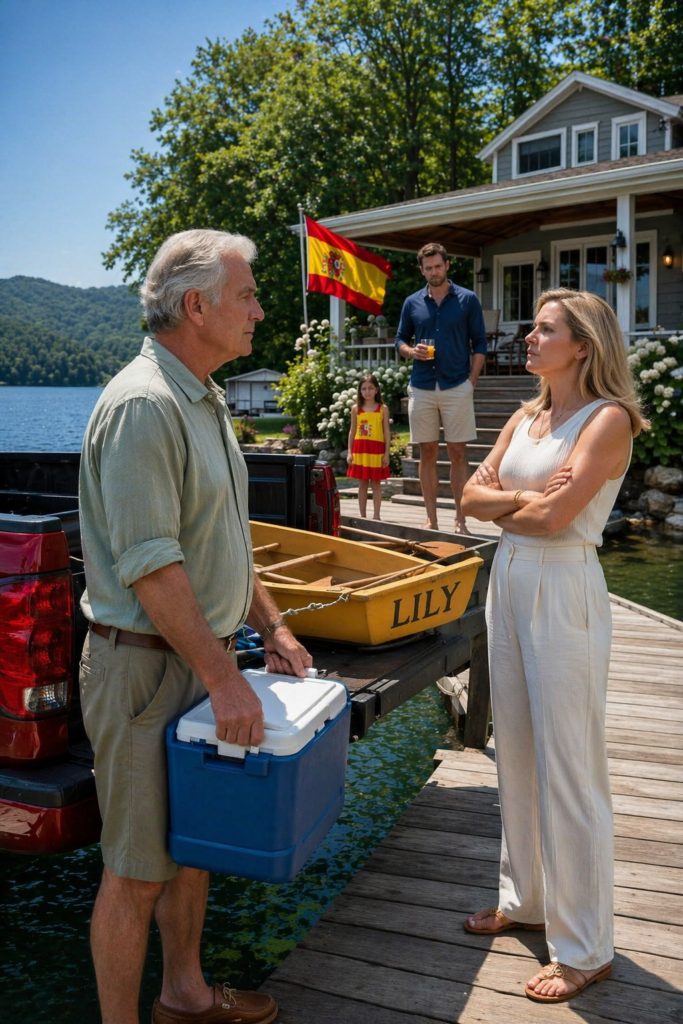
He was 72 years old, with a recently operated knee and a small green boat tied to the back. He had repaired it for Camila, his 9-year-old granddaughter, because she always said she wanted to fish "like the grandparents of old."
He also brought tamales, fruit, sodas, a bag of rolls, and a cajeta cake.
He had come happy.
Until he saw Jimena, his daughter-in-law, come out.
She didn't come out to greet him.
She came out to stop him.
She wore beige pants, a white blouse, expensive sandals, and a smile so stiff it seemed rehearsed. Behind her, on the terrace, were strangers with dark glasses, glasses in hand, and ready phones.
"Good morning, Jimena," Ignacio said, carefully getting out and leaning on his cane. "Where's Camila?"
She didn't answer that.
"Ignacio, we need to talk."
He felt the blow to his chest.
Not "Don Ignacio."
Not "father-in-law."
Not "glad you're here."
Just Ignacio.
As if he'd already been downgraded.
He tried to take the cooler.
Jimena stood in front of him.
"Don't bring your things up."
Ignacio raised his eyes.
"What do you mean don't bring them up?"
The music on the terrace turned down.
It didn't stop.
It just turned down enough for everyone to hear.
Jimena crossed her arms.
"The family decided that this weekend it's better for you not to stay here."
The lake shone behind her, calm, beautiful, cruel.
"This house is mine," Ignacio said.
Jimena sighed, as if speaking to a spoiled child.
"That attitude is exactly what concerns us."
Ignacio looked toward the terrace.
There was Martín, his son.
39 years old, linen shirt, tense face, and a half-finished beer. He didn't look surprised. He looked resigned.
As if the betrayal had already happened before Ignacio arrived.
"Martín," he called. "Son, tell me what's going on."
Martín didn't come down immediately.
He looked at Jimena.
Then he looked at the ground.
"Dad, maybe you should rest at your house in Guadalajara. Just for today."
Ignacio felt the cane weigh twice as much.
Jimena took advantage of the silence.
"After what happened last year, we can't keep pretending. You left the stove on, confused the keys, went out at dawn without telling anyone. Camila was really scared."
Ignacio opened his mouth, but nothing came out.
The stove hadn't been left on. Only a pot of beans had spilled.
The keys he hadn't confused. Jimena had changed the keychain.
And going out at dawn was to check that the boat hadn't come loose in the wind.
Then he understood.
Jimena had pieced together bits of old age.
A forgetfulness.
A stumble.
A medicine.
An operation.
And with that, she'd built a cage.
"I have important guests," she said, lowering her voice. "People who shouldn't have to see uncomfortable scenes."
She looked at his cane.
His worn shoes.
The cooler.
Ignacio could have shouted that he paid for that house by selling auto parts for 30 years.
He could have asked how Martín dared to stay silent in the house where his mother's photos were.
But if he got angry, Jimena would win.
So he lifted the cooler again and barely smiled.
"It's okay."
Jimena blinked.
"What?"
"Enjoy my lake."
Ignacio returned to the truck.
Martín went down one step.
"Dad..."
Ignacio didn't turn.
Because if he turned, his voice would crack.
He started slowly.
Through the mirror, he saw Jimena standing with her arms crossed, surrounded by people pretending not to look.
But Ignacio was no longer thinking about the humiliation.
He was thinking about something worse.
Why did Jimena need to get him out of his own house with so many witnesses watching?
PART 2
For almost an hour, Don Ignacio drove without knowing where he was going.
He passed birria stands, grocery stores, families with coolers, and children running with floaties. Everything remained the same, as if they hadn't ripped his surname from him in front of half a terrace.
When he finally could breathe without his chest burning, he reached his friend Eusebio's house.
Eusebio was 76 years old, had a white mustache, and a way of looking that didn't need questions.
He opened the door, saw the crushed cake on the seat, the green boat, and Ignacio's red eyes.
"Come in, Nacho. I'll warm up some coffee for you."
That's how true affection shows.
It doesn't interrogate you first.
First, it sits you down.
Then, it listens.
Ignacio told just enough: Jimena had kicked him out, Martín didn't defend him, and Mercedes's chairs were piled up like old scrap.
Eusebio gripped the cup with rage.
"That woman always had a face like she charged for breathing."
Ignacio didn't smile.
That night, he couldn't sleep.
He stayed on the couch, staring at the ceiling, repeating Jimena's phrases.
"He's confused."
"We're worried."
"Guests shouldn't have to put up with it."
Then he remembered Martín's face.
That hurt him the most.
Not Jimena's cruelty.
His son's cowardice.
Around three in the morning, Ignacio sat up.
Something felt off.
Jimena didn't just want to avoid a scene.
She wanted to keep him from entering.
The study.
The mailbox.
The drawers where Mercedes kept receipts, titles, and notebooks with dates.
At dawn, Ignacio asked Eusebio:
"Did you get any of my mail? Jimena said she'd pick up my mail while I was being operated on."
Eusebio frowned.
"I didn't get anything, buddy."
"Then where is it?"
At 8:20, Ignacio called the Chapala post office.
He gave his full name and the lake house address.
The employee took a few seconds to respond.
"Mr. Rivas, your mail was redirected to a private box in Zapopan."
Ignacio closed his eyes.
"I never requested that."
"Here, there's a request signed April 3rd."
"On April 3rd, I was just getting out of the hospital."
There was silence on the other end.
"Yes, sir, but the request is in your name."
In his name.
As if those three words could erase an entire life.
Eusebio told him to call Licenciada Beatriz Mena immediately, the lawyer who had handled Mercedes's will and the house papers.
Ignacio took his new phone, the same one Jimena had "configured" for him because, according to her, the old one was too outdated.
He dialed.
The call didn't go through.
He tried again.
Nothing.
He searched for Beatriz's contact.
It was gone.
Eusebio lent him his phone.
The lawyer answered urgently.
"Mena Law Office."
"Licenciada, this is Ignacio Rivas."
There was heavy silence on the other end.
"Don Ignacio, thank God. I sent you five messages, two certified letters, and even tried to reach your son. Where have you been?"
"They took my letters."
Beatriz didn't ask who.
She simply said:
"Come today. Don't tell Martín. Don't talk to Jimena. Bring your ID, your titles, and any property tax receipts you have."
At 11:10, Ignacio was sitting in front of her.
Beatriz placed a thick folder on the desk.
Before opening it, she looked at him carefully.
"Don Ignacio, I want you to hear this first: I don't believe you signed anything I'm about to show you."
Ignacio tightened his grip on the cane.
"Signed what?"
She opened the folder.
The first document was a transfer of rights dated April 14th.
It said Ignacio Rivas Morales transferred the lake house to a company called Brisa Dorada Inmobiliaria S.A. de C.V.
Ignacio felt his tongue dry.
"I don't know that company."
"I know."
"I never gave up my house."
"I know that too."
Beatriz pointed to the bottom.
There was his signature.
It wasn't a clumsy forgery.
It was almost perfect.
The open "I."
The slanted "R."
The final shake left by arthritis.
From afar, it seemed his.
Up close, it was frightening.
Ignacio swallowed hard.
"That's not my hand."
"That's why I called you."
The second document was worse.
A broad power of attorney.
Naming Jimena as legal representative to sell, manage accounts, and make financial decisions if Ignacio was deemed incapable.
Incapable.
A fine word to turn a living man into a burden.
The third document was a purchase promise.
Brisa Dorada Inmobiliaria was selling the property to Lago Azul Desarrollos for 39 million pesos.
The project included 14 luxury villas, a private gym, a nautical club, and total demolition of the existing construction.
Existing construction.
That's what they called the house where Mercedes danced barefoot to boleros.
The hallway where Martín learned to walk.
The room where Camila drew a huge sun on a napkin and gave it to her grandfather.
"Who appears in that company?" Ignacio asked.
Beatriz took a deep breath.
"Jimena is listed as the sole administrator. Martín appears copied in some emails but not as an owner."
Ignacio closed his eyes.
Jimena had been clever.
Used Martín's silence but ensured the dirty signature was hers.
Beatriz explained everything calmly.
The redirected mail prevented Ignacio from receiving legal notices.
The blocked phone avoided the lawyer from reaching him.
The comments about his supposed confusion were preparing the family to see him as an old man who could no longer decide.
And the scene on the terrace wasn't a tantrum.
It was theater.
Jimena needed witnesses.
Needed everyone to see Ignacio as a disturbed, weak, stubborn, incapable man.
"What do we do?" he asked.
Beatriz closed the folder.
"We don't shout. We don't beg. We don't warn. We prove."
That same day, they requested a notarial review, called a graphologist expert, and prepared a complaint for forgery, fraud, and attempted dispossession.
They also asked for the post office record of the false request.
When Jimena left with her guests from the lake house, Ignacio returned with Eusebio.
The key still worked.
That almost made him cry.
The house smelled of foreign perfume.
Not home.
There were dirty glasses in the living room, a wine stain on the oak table, and Lago Azul Desarrollos brochures in the kitchen.
"Live luxury by the water."
Ignacio found Mercedes's chairs behind the tool room.
He took them out one by one.
Wiped them with a cloth.
Placed them on the terrace, facing the sunrise.
That was the first thing he fixed.
Then he found Mercedes's wine-colored shawl stored among pool towels.
He placed it over the right chair.
As if she were coming back for her coffee.
Then he changed the locks.
Front door.
Kitchen.
Study.
Storage.
Dock.
He also installed four cameras.
The technician explained the app three times.
Ignacio asked him to explain it a fourth.
He wasn't embarrassed.
The shame wasn't learning.
The shame was letting others decide for him.
Two days later, the expert confirmed the signatures were copied.
There were forced pauses, irregular pressure, and repeated strokes.
They seemed his because someone had studied them.
But they didn't breathe like his hand.
Beatriz notified the real estate company and froze the operation.
The problem was that the tour with foreign buyers was still scheduled for Saturday at 9:00.
Beatriz suggested sending a warning.
Ignacio shook his head.
"No. She kicked me out with an audience. The truth will also find her with an audience."
Saturday at 8:37, Ignacio's phone vibrated.
Movement detected.
On the screen, he saw Jimena's white truck arrive.
Then Martín.
Then two black cars with men in expensive shirts, a woman with a briefcase, and an architect with rolled-up plans.
Jimena got out smiling.
Wore a blue dress, dark glasses, and a face of assured commission.
She reached the door.
Inserted the key.
Turned.
Nothing.
Tried again.
Nothing.
Went to the kitchen.
Nothing.
Then to the terrace window.
Nothing.
Then she saw the camera.
Her smile broke.
Ignacio’s phone started to ring.
Martín.
Jimena.
Martín again.
Ignacio waited until the sixth call.
"Good morning, Jimena."
"Ignacio, glad you answered. The keys don’t work."
"They do. They’re just not yours anymore."
There was silence.
"What did you do?"
"I changed the locks."
"You can't do that."
"In my house, I can."
Jimena let out a fake laugh.
"This confirms everything. You’re acting erratically. There’s a meeting scheduled."
"What meeting?"
She moved away from the buyers.
"Open the door."
"Explain to me first why you brought people to sell a house that’s not yours."
The silence turned hard.
Then she lowered her voice.
"Who put these ideas in your head?"
That's where she gave herself away.
She didn’t ask "what are you talking about?"
She asked who had told him.
"My lawyer, the expert, the notary, the post office, and soon the Public Ministry," Ignacio replied.
Through the camera, he saw Jimena go still.
Martín approached her.
"What’s going on?"
Ignacio said:
"Pass me my son."
There was noise.
Then Martín’s voice came through low.
"Dad..."
"Ask your wife what Brisa Dorada Inmobiliaria is. Ask her why she redirected my mail to Zapopan. Ask her why there’s a fake power with my signature. Ask her why those men think they’re going to demolish your mother’s house."
Through the camera, Ignacio saw Martín turn to Jimena.
She tried to take his hand.
He pulled away.
"Dad, I didn’t know about that."
"That?" Ignacio asked. "What part did you know?"
Martín didn’t answer.
And that silence said more than a confession.
Ignacio hung up.
At 9:18, a patrol car arrived.
Jimena ran to the officers, pointing at the house and saying Ignacio was agitated, wasn’t well, and it was dangerous to leave him alone.
Ignacio went out slowly, with a folder under his arm.
He didn’t shout.
He didn’t insult.
He didn’t tremble.
He handed over his original title, his ID, the property taxes, the expert's report, the legal notice from Beatriz, and the redirected mail report.
The officer reviewed everything.
Then looked at Ignacio.
"Is the property in your name?"
"Yes."
"Do you authorize these people to enter?"
"No."
"Do you request medical support?"
Ignacio held his gaze.
"I request they remove those trying to enter without my permission."
The buyers were the first to leave.
Without saying goodbye.
Without looking back.
The architect rolled up his plans so fast he seemed to be hiding a shame that wasn’t his.
Jimena turned pale under her makeup.
"This is a misunderstanding," she said.
The officer asked her to leave.
She looked at Martín, expecting a defense.
But Martín didn’t move.
For the first time, the son looked at his father as if he had just discovered that the peace he had wanted so much was pure dirt under the rug.
Jimena got into the truck and drove off, kicking up dust.
Martín stayed at the entrance.
Ignacio didn’t invite him in.
Not that day.
Sometimes opening the door too soon is also a form of self-betrayal.
Three days later, Martín returned alone.
He sat in his car for almost 30 minutes before getting out.
When he reached the terrace, he had a grown beard, a wrinkled shirt, and swollen eyes.
"Dad, Jimena left. She emptied an account. Her lawyer says I’m also responsible for the emails. I didn’t know about the fake signature. I swear."
Ignacio repeated slowly:
"About the fake signature."
Martín lowered his head.
"She told me it was estate planning. That you couldn’t handle the house anymore. That selling it would secure Camila’s future."
"Did you ask me?"
"No."
"Did you ask if I wanted to sell the house where your mother’s memory is?"
"No."
"Did you defend me when she called me confused in front of strangers?"
Martín covered his face.
"No."
Ignacio took a deep breath.
"Jimena tried to rob me of the house. That makes her a thief. But you let her slowly erase me from your mind. That makes you responsible."
Martín cried quietly.
Ignacio didn’t hug him immediately.
Because boundless love sometimes teaches children they can break you and come back as if nothing happened.
After a while, he put a hand on his shoulder.
"I love you, son. But forgiving isn’t pretending it didn’t happen. Forgiving also needs time, proof, and respect."
A year passed.
Jimena lost her real estate advisor registration and faced trial for fraud, forgery, and attempted dispossession. Brisa Dorada was dissolved. Martín divorced and had to testify everything he knew.
Camila suffered the most in silence.
She used to open the door running and shout "grandpa."
Now she asked:
"Can I come in?"
That hurt Ignacio more than any fake paper.
Over time, Martín began to repair what he could.
Not with speeches.
With actions.
He paid part of the legal expenses, sold his truck, and sought work away from Jimena’s friends. He also accepted something that initially burned him: if he wanted to stay some weekends with Camila at the lake house, he’d have to pay rent and respect the rules.
Not for money.
For dignity.
Love isn’t shown by keeping someone else’s keys.
One Saturday, Ignacio took Camila to the dock.
The green boat was ready.
The girl touched it gently.
"Is it for me?"
"It was always for you, sweetie."
"Why didn’t you give it to me before?"
Ignacio looked at the lake.
"Because last summer got filled with lies."
Camila thought for a moment.
"Did my mom try to take your house?"
"Yes."
"Did my dad fail to stop her?"
Ignacio took a while to answer.
"Yes."
The girl pressed her lips.
"And you still love him?"
"A lot."
"Even though he was wrong?"
"Loving doesn’t mean pretending it didn’t hurt."
Camila lowered her gaze, as if that phrase was too big for her nine years.
Then she asked:
"Can sad people fish too?"
Ignacio released a soft laugh.
"Of course. Sometimes they fish better because they stay quiet."
They got on the boat.
Camila took the oars.
Ignacio taught her:
"Pull evenly. If one side does all the work, the boat goes in circles."
Martín stood at the dock, listening.
He said nothing.
It wasn’t necessary.
Camila rowed poorly at first.
The boat spun.
She got frustrated.
Ignacio touched her shoulder.
"Slow down. Correct without throwing the oar."
The girl breathed and tried again.
This time the boat moved forward.
Not perfectly.
But straight.
Martín said from the dock:
"She's learning."
Ignacio looked at the two chairs on the terrace, one with Mercedes's wine-colored shawl over the back.
"We're all learning."
The sun rose behind the lake.
The house remained standing.
The chairs returned to facing the water.
Ignacio's name regained its rightful weight.
Jimena thought humiliating him in front of everyone was taking away his power.
She was wrong.
What she did was give him distance.
The distance gave him questions.
The questions gave him proof.
And the proof returned something no false deed could steal from him.
His place.
Don Ignacio Rivas.
Not a confused old man.
Not a burden.
Not a hindrance.
A father.
A grandfather.
A man who learned late, but with his whole soul, that a family without respect can seem like home, but it can also be the prettiest prison in the world.