PART 1
—My daughter was never a soldier —Teresa Villalobos declared, one hand on the Bible and the other pressed to her chest—. The scars, the medals, and that hero story were lies to take the company from her own father.
Courtroom 7 in Mexico City fell silent.
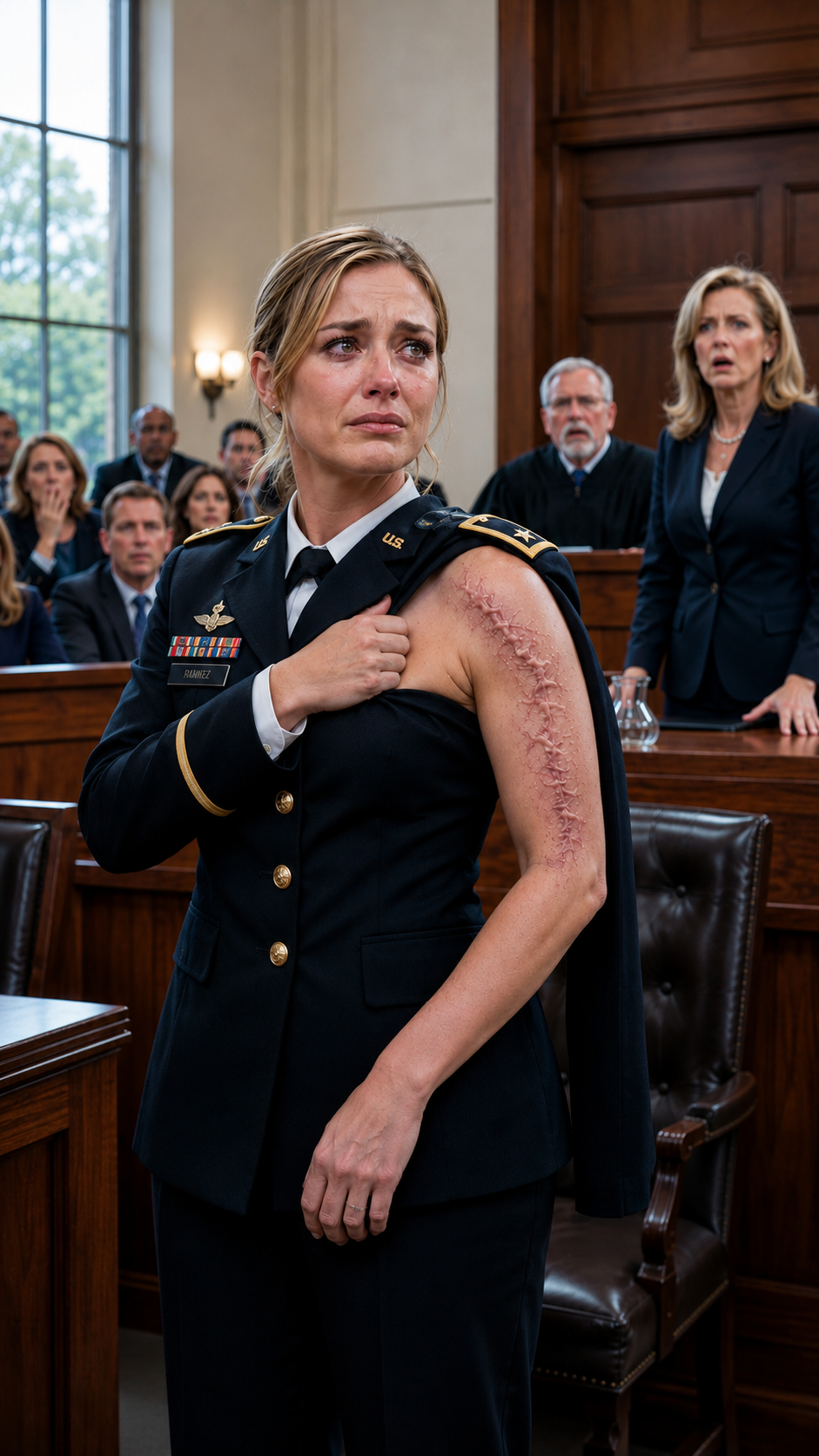
Lucía Villalobos did not lower her gaze. She sat next to her lawyer, hair pulled back, dressed in a simple gray suit, a fine scar peeking out from under her blouse's collar.
She didn’t look like a defeated woman.
She looked like someone who had been waiting for this blow for years.
Her mother, on the other hand, played the martyr. Dressed in black, a rosary on her wrist, and tears perfectly placed, the kind that make people murmur, “poor lady.”
In the front row, Rodrigo, Lucía's younger brother, barely smiled. He wore a luxury watch he hadn’t owned before the death of Don Aurelio Villalobos, founder of Centinela del Norte, a Mexican company dealing in armor, vests, and tactical gear.
The feud began four weeks after the funeral.
The original will named Lucía as CEO and majority shareholder. Rodrigo received money, two apartments, and a minor stake.
But Rodrigo showed up with another document.
One where he inherited everything.
When Lucía contested it, her own family accused her of falsifying her military past to manipulate their sick father.
The press turned the case into a spectacle. Outside, reporters, cameras, and onlookers gathered. Inside, cousins, former partners, and employees who once sought favors from Lucía now looked at her as if she were a fraud.
Rodrigo’s lawyer lifted a wooden box.
Inside lay three medals, a burnt plaque, and an old photograph where Lucía appeared covered in dust, blood on her forehead, and a torn uniform.
—Mrs. Teresa, do you recognize these items?
Teresa breathed as if speaking caused her pain.
—Yes. They are part of my daughter's lie. She bought them, had them engraved, and deceived Aurelio when he was already weak.
A murmur swept through the room.
Lucía felt the scar under her ribs burn. She remembered the overturned truck, the smell of diesel, the screams over the radio, and a voice ordering her to crawl because the fire was coming behind her.
But she couldn’t say anything.
Her file remained sealed by official order.
Her father had been the only one who knew the complete truth. Before he died, his voice broken by cancer, he asked her something:
—Don't fight with screams, daughter. Fight with evidence.
Lucía promised him.
—Did your daughter serve in the Mexican Army? —the lawyer asked.
—Never.
—Did she receive real decorations?
—No.
—Was she wounded in service?
Teresa lowered her gaze.
—That too was a lie.
Rodrigo let out a laugh.
Lucía's lawyer leaned in toward her.
—A few minutes left. Hang in there.
Lucía glanced at the clock.
11:55.
Rodrigo’s lawyer displayed documents showing no missions, no decorations, no deployments.
—Fantasy captain —he mocked—. A cardboard hero.
Some laughed.
Then Rodrigo took the stand. He swore to tell the truth and claimed he had found a letter from their father in the family safe. According to him, Don Aurelio stated that Lucía had pressured him and wanted to leave the company to his son.
—Are you sure you found that letter there? —Lucía’s lawyer asked.
—Absolutely.
The lawyer showed a photo.
The safe appeared destroyed, burnt from an electrical failure that occurred 18 days before the date Rodrigo mentioned.
Rodrigo turned pale.
Teresa clenched the Bible so tightly her knuckles turned white.
And just as the judge was about to speak, firm boots echoed from the other side of the door.
The entire room turned at once.
The doors swung open.
And the man who entered made Teresa stop pretending to cry.
PART 2
The man wore a dress uniform, his face serious and a clear scar crossing his left temple. He walked in accompanied by two federal investigators and a military attorney with a sealed black portfolio.
Lucía didn’t move.
But her eyes changed.
For the first time during the entire hearing, she stopped looking like a solitary woman.
The judge gently tapped the gavel.
—Identify yourself before this court.
The man stopped at the center of the room.
—Brigade General Ignacio Armenta, I come with limited authorization from the National Defense Secretariat to speak about the sealed file of Lucía Villalobos.
The room erupted in murmurs.
Rodrigo turned to his mother.
—What’s happening?
Teresa didn’t answer.
Rodrigo’s lawyer stood up.
—Your Honor, this is irregular. That witness was not announced.
The military attorney placed the portfolio on the table.
—The authorization was released today at 12:00. Before that hour, no one could reveal this information without violating a national security order.
The judge reviewed the documents.
His expression changed.
He looked at Lucía.
Then at Teresa.
—The testimony is admitted.
General Armenta took the stand. Before sitting down, he glanced at the wooden box with the medals.
He didn’t look at it like someone viewing fake objects.
He looked at it like someone recognizing the dead, smoke, and debt.
—Do you know Lucía Villalobos? —her lawyer asked.
—Yes. I have known her for 11 years.
—Was she a soldier?
—Yes. She was a captain assigned to a special unit. Part of her operational identity and missions were classified for national security.
Another wave of murmurs filled the room.
Teresa lowered her head.
Rodrigo opened his mouth, but said nothing.
—Are the presented decorations authentic?
—They are.
—And her wounds?
The general took a moment to respond.
—They are too. She sustained them during an ambush in an international cooperation operation. I cannot reveal tactical details, but I can confirm that Lucía crossed a fire zone to rescue several injured personnel. She refused to evacuate until everyone was out.
Lucía pressed her lips together.
She didn’t want to cry.
Not there.
Not in front of Teresa.
But there were silences heavier than a sentence. For years, they had called her ridiculous, a liar, intense. At family dinners, Rodrigo mocked her, calling her “the little soldier” who watched action movies. Teresa said Lucía’s scars were from “a botched surgery.”
And she could only remain silent.
Because obedience also hurts.
The judge turned to Teresa.
—Mrs. Villalobos, you testified under protest that your daughter was never a soldier.
Teresa lifted her face.
—I… I didn’t know.
General Armenta slowly turned to her.
—You did know.
The room froze.
Rodrigo stood.
—What do you mean she knew?
The judge ordered him to sit down.
The general continued:
—Seven years ago, I personally went to Don Aurelio Villalobos's house. I delivered Lucía's personal belongings after an operation. Mrs. Teresa was present. She heard when I explained that her daughter had been wounded in service and that her history could not be made public.
Teresa swallowed hard.
—That’s not true.
—You cried that night —the general said—. But not for Lucía. You cried when Don Aurelio said that a woman with that courage deserved to lead Centinela del Norte.
Rodrigo looked at his mother as if he were seeing her without makeup for the first time.
—You knew?
Teresa remained silent.
That silence was worse than a confession.
Lucía’s lawyer requested to reproduce audios delivered by Nora Salcedo, former assistant to Don Aurelio. Nora had worked with him for 16 years and knew every contract, every signature, and every odd movement within the company.
Rodrigo had sought her to buy her off.
What he didn’t know was that Nora had recorded everything.
The first audio played in the courtroom.
Rodrigo’s voice was clear:
—I need a letter that looks like it was written by my dad. Something sentimental. Something that says Lucía manipulated him when he was already sick.
Then Teresa’s voice was heard:
—You leave the court stuff to me. If I cry right, everyone will believe me. No one defends a daughter who wears fake medals to rob her family.
Lucía closed her eyes.
Not in surprise.
But in exhaustion.
The second audio was even more brutal.
Rodrigo said:
—When they put her in prison, we sell the company before she can appeal.
Teresa replied:
—And if she insists, we plant receipts for those medals in her apartment. Make it look like she bought them online. People swallow everything, Rodrigo. Seriously, everything.
The prosecutor, who until that moment had treated Lucía as a suspect, stood with a tense face.
—Your Honor, I request a recess to review possible crimes committed by the complainants.
Rodrigo tried to stand up.
A guard stepped toward him.
—Don't even think about it, young man.
Teresa searched for Lucía with her eyes.
For the first time, she wasn’t pretending sadness.
She was angry.
Angry for losing control.
Then Lucía’s lawyer pulled out a white envelope.
—Before the recess, Your Honor, we request to present one last piece of evidence. It’s a video recorded by Don Aurelio Villalobos five days before he died, with notarial instructions to open it only if his daughter was criminally accused by her own family.
Teresa stiffened.
Rodrigo whispered:
—Mom...
The screen lit up.
Don Aurelio appeared in a hospital bed, thin, bald, a blue blanket over his legs. His lips were dry, but his gaze was firm.
Lucía covered her mouth with her hand.
She hadn’t seen that video.
—If you’re watching this —Don Aurelio said—, it’s because Teresa and Rodrigo did exactly what I feared.
No one breathed.
—For two years, they diverted money from Centinela del Norte to phantom suppliers. I had already documented that. But then I discovered something worse.
The judge leaned forward.
—One of those suppliers delivered defective materials for vests and ballistic plates. Equipment that could end up in the hands of police, bodyguards, or soldiers.
General Armenta lowered his gaze.
Don Aurelio continued:
—Lucía never wanted her military story to be used to sell products or for advertising. My daughter never flaunted her medals. She never asked for special treatment. But when she returned wounded, she asked me to review our production lines because she knew what it meant to trust a vest when you have nothing between a bullet and your body.
Teresa began to cry.
But now her tears moved no one.
—I found inflated invoices, false certifications, and altered laboratory tests. Rodrigo signed several orders. Teresa authorized payments from private accounts. When I confronted them, they tried to convince me that Lucía was crazy, that her career was a tale, and that I was too sick to understand.
Rodrigo shook his head.
—That doesn’t prove anything.
The judge shot him a glare.
On the screen, Don Aurelio raised a red folder.
—Everything is here. Transfers, emails, contracts, expert reports. I leave control of Centinela del Norte to Lucía because she understands something they never understood: this company doesn’t sell metal; it sells protected lives.
Lucía could no longer hold back her tears.
Her father continued:
—Rodrigo wants money. Teresa wants power. Lucía wants responsibility. That’s the difference.
The recording seemed to be ending, but Don Aurelio took a deep breath and looked directly at the camera.
—And there’s something else. If my daughter is being accused today, check the accident she had on the road to Querétaro four months before I changed my will.
Lucía froze.
She remembered the rain.
The hard steering wheel.
The brake pedal sinking unresponsive.
She recalled the crash against the barrier and the metallic taste in her mouth. At that moment, she was told it was a mechanical failure.
Don Aurelio spoke with difficulty.
—I had a private assessment done. The brakes were tampered with. I couldn’t prove who ordered it before I got sicker, but I knew who would benefit if Lucía didn’t return.
Teresa let out a dry sound.
Rodrigo turned as pale as paper.
The entire room understood.
The fight was not just over a company.
It was over a life.
The prosecutor requested the red folder. The judge reviewed the first pages, and his face hardened.
—The documents are incorporated into the file —he ordered—. And the prosecution is instructed to open an immediate investigation into the mentioned events.
Rodrigo lost control.
—It was her idea! —he shouted, pointing at Teresa—. She said Lucía couldn’t defend herself because her file was closed!
Teresa turned to him.
—Coward! You were the one who wanted to sell the company before your sister discovered the contracts.
—Because you said that as long as Lucía was alive, Dad would never leave everything to me!
Silence fell like lead.
Lucía raised her gaze.
The prosecutor repeated slowly:
—As long as Lucía was alive?
Rodrigo realized too late what he had said.
Teresa closed her eyes.
The judge ordered the investigators to approach.
—Rodrigo Villalobos, you are under arrest for document forgery, procedural fraud, potential criminal conspiracy, and whatever else arises.
—No, wait —Rodrigo stammered—. Lucía, tell them we’re family. Tell them it was a sibling dispute. Come on, don’t be like this.
Lucía looked at him with frozen sadness.
—A brother doesn’t fabricate evidence to imprison his sister.
Then a detective approached Teresa.
—Teresa Villalobos, please come with us.
The woman stood up slowly. Without public support, without useful tears, she seemed older, but not more remorseful.
When they placed the handcuffs on her, she sought Lucía's gaze.
—Don’t let them take me out like this —she said in a broken voice—. I’m your mother.
The entire room waited.
For a moment, Lucía was a child again. She remembered Teresa telling her not to speak too loudly, that Rodrigo needed more support because he was a man, that a good daughter obeyed even if it hurt.
Then she remembered her father in the hospital bed.
And the men she pulled from the fire.
And those she couldn’t save.
—Mother was the word you used to get close —Lucía said—. Not how you acted.
Teresa lowered her gaze.
This time, she had no response.
The judge formally dismissed the charges against Lucía, validated the original will, and ordered the securing of accounts, contracts, and assets linked to Teresa and Rodrigo.
Outside, reporters who had come to photograph a supposed liar ended up capturing a mother and son handcuffed.
Rodrigo tried to cover his face.
Teresa walked upright, still proud, but no one believed her victim role anymore.
Months later, Rodrigo accepted some of the charges and received a ten-year prison sentence. Teresa was sentenced to six years for procedural fraud, perjury, and participation in the financial scheme. The investigation into Lucía’s accident remained open, but the fake suppliers fell one by one.
Centinela del Norte nearly collapsed.
Lucía could have sold it, collected, and disappeared.
She didn’t.
She renamed a division as the Aurelio Villalobos Foundation and dedicated it to supporting soldiers, police, and veterans with incomplete records, denied benefits, and unjust accusations.
She also ordered a review of all donated equipment to small corporations in states where no one checked anything because, as her father used to say, a defective vest doesn’t fail in an office: it fails when someone is praying to come home.
On the inauguration day, General Ignacio Armenta arrived with the restored box.
Inside were the medals, the burnt plaque, and a new photograph of Don Aurelio.
—Your father asked me to give you a message when the truth could speak —he said.
Lucía took the box with both hands.
—What message?
The general smiled slightly.
—That the truth can take years to enter through a door, but when it does, it doesn’t ask for permission.
Lucía hung the box behind her desk.
Not to flaunt.
Not to take revenge.
But to remember that her silence had been obedience, but her truth was already freedom.
Since then, every person who came in seeking help looked at those medals behind the glass.
Some asked what they meant.
Lucía almost never told the whole story.
She only said:
—Sometimes those who scream the loudest that you’re a lie are the ones who tremble because someone is about to discover the truth.