PART 1
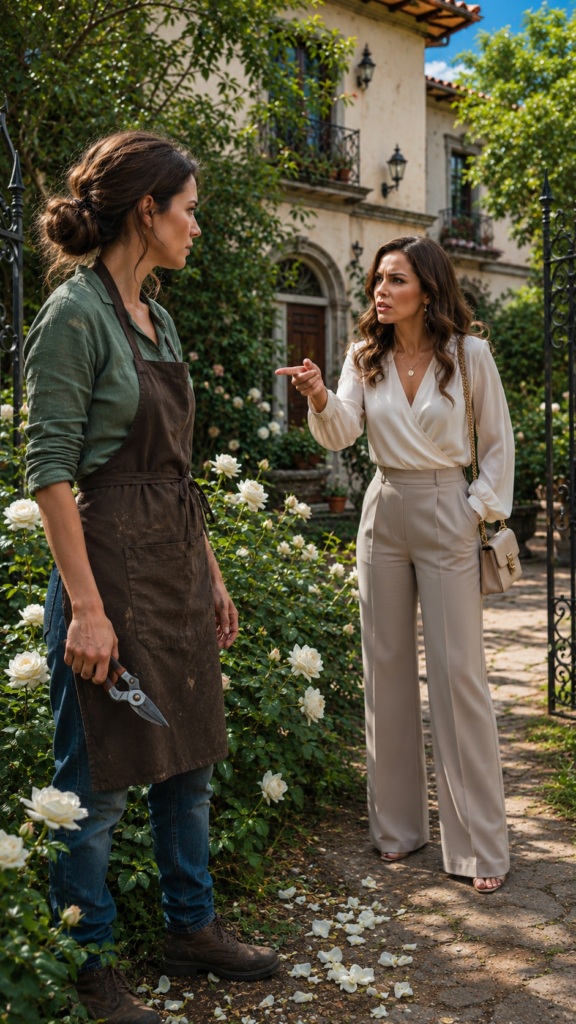
Marisol arrived at the house in Coyoacán wearing dark sunglasses, high heels, and a smile so fake that even the street dogs stopped barking when they saw her walk in.
Valeria was in the garden, trimming the dry branches of the white rose bushes her father had planted years ago. The scent of wet earth, cold coffee, and recent mourning still lingered in the air.
Don Ernesto had been buried for only 21 days.
And yet, Diego's new wife, as if she owned the place, showed up without a hint of remorse.
"You’d better start packing," Marisol said, without greeting her. "Tomorrow the will is read, and this house will pass into Diego's hands. It’s best if you don’t make a scene."
Valeria didn't raise her voice.
She continued holding the pruning shears with the same calm her father had taught her to care for the flowers: firm, without destroying them.
"This house belonged to my father," she replied. "And until something is read, you don’t have to be here."
Marisol let out a low laugh.
"How naive you still are. Diego was like a son to Don Ernesto. It hurts, but your dad loved him. And Andrés knows it."
The mention of her brother fell like a stone in a glass of water.
Andrés hadn’t come to see her since the burial. He didn’t answer her messages either. Valeria thought he was broken by grief, but now she understood that perhaps there was something more.
"What does Andrés have to do with you?" she asked.
Marisol took off her sunglasses and looked at her shamelessly.
"Let’s just say he understands better than you how your dad was in the end. Sick, confused, weak. Not all of us live in a fairy tale, Valeria."
Valeria felt her throat close up.
Her father had died of cancer. Yes, he had lost a lot of weight, but until his last week, he could remember dates, names, and even the exact recipe for the mole his late wife used to make on Sundays.
Confused? Never.
"Get out of my house," Valeria said.
Marisol walked toward the rose bushes and stepped on a fallen flower with the tip of her heel.
"Enjoy them today. Diego wants to remodel everything. He says these roses look old, like something out of a grandma's garden. We’re going to put in a modern terrace, something fancier, more magazine-worthy."
That’s when Valeria felt rage.
Not for the house.
But for her father.
For every morning Don Ernesto had watered those flowers with trembling hands, even when the illness had already bitten into his bones.
Marisol stepped a little closer.
"I’m telling you for your own good. Pack up. Because tomorrow, when everyone knows the truth, not even your tears will save you."
Then she left.
Valeria stood alone among the rose bushes, breathing heavily, dirt on her hands and fire in her chest.
Then she saw something strange beneath a broken flower pot next to the talavera fountain.
A small envelope.
Her name was written in her father's handwriting.
Her hands trembled as she opened it.
Inside was an old key and a note of just a few lines:
"Daughter, if anyone tries to touch my roses before the time, look behind the blue tile. Don’t believe those who talk of inheritance before talking of love. I knew more than they imagined."
Valeria ran to the fountain.
She removed the loose tile.
Behind it was a wooden box wrapped in plastic.
She opened it with the key.
Inside, she found a USB drive, a notarized document, and an old photo of her wedding with Diego.
But what left her frozen was a folder marked with her brother’s name:
"ANDRÉS: IF HE BETRAYS VALERIA."
PART 2
Valeria did not open the folder immediately.
She stared at her brother's name as if those letters were a fresh wound. Andrés was her younger brother, the boy she defended in elementary school, the young man their father paid to go to university, the same one who cried in her arms the day they buried their mother.
It couldn’t be.
Not him.
She called Lourdes, Don Ernesto's trusted lawyer.
The attorney arrived 40 minutes later, with a black briefcase and a serious expression. She didn’t seem surprised to see the box.
"Your father warned me this could happen," she said.
Valeria felt cold.
"What did my dad know?"
Lourdes connected the USB drive to a laptop. There were several folders. One was titled "Diego." Another "Marisol." Another "Andrés." And one more had a title that made Valeria feel as if her father was still breathing in that house:
"FOR MY DAUGHTER, WHEN THEY TRY TO TAKE HER OUT OF HER HOME."
The video began.
Don Ernesto appeared seated in his study, thinner, with a gray sweater and a blanket over his legs. His eyes, though tired, were completely alive.
"Valeria," he said on the screen, "forgive me for not telling you everything. I thought I could leave in peace, but some people mistake illness for permission to steal."
Valeria covered her mouth.
"Diego came to see me 4 times. First, he apologized. Then he asked for money. After that, he suggested that, out of gratitude, I should leave him a part of the house. When I told him no, his face changed. That’s when I understood he never came to say goodbye. He came to measure how much he could take from me."
Lourdes looked down.
The video continued.
"Andrés also came. Your brother has debts, daughter. More than he dared to say. Diego helped him with loans, but not for free. He wanted him to convince me that you were emotionally unstable due to the divorce, that you couldn't handle the house, that it was best to leave it in his hands."
Valeria closed her eyes.
Betrayal doesn’t always scream.
Sometimes it enters silently, bearing the face of someone who shares your blood.
"I didn’t hate Andrés," said Don Ernesto. "It made me sad. Shame makes many people cowardly. But Diego's ambition was another matter. That’s why I prepared everything."
Lourdes paused the video.
"Tomorrow, at the notary's office, they will try to declare that your father wasn’t lucid when he modified the will. That’s what Marisol came to provoke."
Valeria took a deep breath.
"Then we let her talk."
"Exactly," Lourdes replied. "Your father left evidence, medical evaluations, messages, recordings, and a special clause. If they attack the will, they sink themselves."
That night, Valeria did not sleep.
She wandered through the Coyoacán house, touching the furniture, the walls, the picture frames. Her father's chipped cup still sat next to the coffee maker. His cane was leaning near the bookshelf. In the dining room, there was still a wine stain from last Christmas.
Everything was still there.
Except for him.
The next morning, she arrived at the notary's office in the Del Valle neighborhood dressed in black. Not as a widow. Not as a victim. As a woman who would no longer ask for permission to defend what was hers.
Diego was sitting next to Marisol.
He avoided looking at her. He had the same expression as always: clenched jaw, cell phone in hand, the face of an important man even though inside, he was falling apart.
Marisol, on the other hand, was smiling.
Andrés was at the back. He had dark circles under his eyes and his hands together, as if praying.
The notary began the reading.
First, he mentioned small donations: a sum for the nurse who accompanied Don Ernesto in his last days, another for the parish of San Juan Bautista, and one more for a public hospital.
Then came the house.
"The property located in Coyoacán is to be held in lifetime usufruct, total management, and legal protection for Ms. Valeria Salvatierra, daughter of the testator. It cannot be sold, seized, assigned, or transferred under pressure from third parties."
Marisol's smile vanished.
Diego straightened up.
"That can’t be," he murmured.
The notary requested silence and continued reading.
"Upon my daughter's death, the property shall be allocated to the Rosales Foundation of Elena and Ernesto Salvatierra, created to support women who have suffered economic abuse, patrimonial abandonment, or family dispossession."
Valeria felt her chest shatter.
Her father had not only left her a roof.
He had left her a mission.
Then a lawyer, sitting behind Diego, stood up.
"My client will challenge the will. We have reason to believe that Mr. Ernesto Salvatierra was not in full possession of his mental faculties when he modified his last wishes."
There it was.
The exact phrase.
The bait taken.
Lourdes didn’t flinch. She took out a folder and placed it on the table.
"How convenient. Just so happens that Mr. Salvatierra left instructions for this scenario."
Marisol turned pale.
Diego frowned.
Lourdes handed over 2 medical evaluations signed by specialists. Both certified that Don Ernesto was lucid when he modified his will.
Then she opened the laptop.
"He also left a recording."
Don Ernesto's voice filled the room.
"If Diego Mendoza, his wife Marisol, or anyone related to them tries to say that I was confused, I authorize my lawyer to present all the evidence of pressure, threats, irregular loans, and emotional manipulation exerted on my son Andrés."
Andrés broke into tears.
Marisol stood up abruptly.
"This is a trap!"
Lourdes looked at her calmly.
"No, ma'am. A trap was going to a grieving daughter’s house to tell her to pack before reading the will."
Diego turned to Marisol.
"Did you go to see her?"
She hesitated for just 1 second.
That second destroyed her.
"I just went to make it clear what was going to happen," she spat. "You said Andrés had already done his part."
The room fell silent.
Andrés raised his head.
"I didn’t do my part," he said, his voice breaking. "I was scared."
Diego clenched his teeth.
"Shut up, dude."
But Andrés wouldn’t be silenced anymore.
"No. Not anymore. I owe Diego money. A lot. He helped me when I was drowning, but then he asked me to talk to Dad. He wanted me to say that Valeria was unwell, that the divorce had left her crazy, that she couldn’t handle the house."
Valeria stared at him without blinking.
Andrés cried like a child.
"Dad realized. He asked me how much I owed. I lied to him. And still… still he left me help."
The notary checked the last clause.
Don Ernesto had left a protected sum for Andrés to pay part of his debts and receive psychological and financial treatment. But if he participated in any attempt to take the house from Valeria, he would lose everything.
Andrés covered his face.
Diego, on the other hand, had nothing.
No inheritance.
No house.
No forgiveness.
No false image of a beloved son he had used for years.
Marisol grabbed her bag in anger.
"Let’s go, Diego."
But Diego didn’t move. He stared at the frozen screen showing Don Ernesto’s face. For the first time, he didn’t have a lie ready.
"Your dad loved me," he said, almost in a whisper.
Valeria looked at him with a tired sadness.
"My dad loved the man you pretended to be. Not the one you are."
No one said anything.
Marisol left first, stomping on the floor with her heels. Diego followed her, defeated. His lawyer packed up his papers without saying goodbye.
Andrés stayed behind.
When the room emptied, Valeria approached her brother.
He didn’t dare to look at her.
"Forgive me," he said. "Honestly, I was scared of losing everything."
Valeria swallowed hard.
"And out of fear, you almost took away the only thing Dad left me to keep standing."
Andrés cried harder.
"I know."
Valeria didn’t embrace him.
Not yet.
"I’m going to respect the help Dad wanted to give you. But I’m not going to rescue you from your lies. If you want to be my brother again, you’re going to have to earn it from scratch."
He nodded.
"Don’t swear it to me," she added. "Prove it."
Three months later, the white roses bloomed as if they had been waiting for the storm to pass.
The house remained a home.
There was no cold remodel. No magazine terrace. No one ripped out the bougainvilleas or replaced the talavera fountain with a soulless glass wall.
Lourdes helped register the Rosales Foundation. The first workshop was held in the dining room. Nine women came. One had lost her business after a divorce. Another didn’t know how to read a contract. Another just needed to hear that she wasn’t exaggerating.
Valeria brewed coffee, bought sweet bread, and opened the windows.
The house came alive again.
Andrés started therapy. He sold his truck to pay part of his debts. Every Sunday, he arrived with soil for pots, paint, or tools. At first, they spoke little. Then a little more.
One day, while they were fixing the fountain, he touched the blue tile and said:
"Dad really knew how to hide the important things."
Valeria looked at the roses.
"Yes. Even when we didn’t know how to find each other."
Little was known about Diego. The challenge never progressed. His lawyer resigned when he saw the complete evidence. Marisol left him six months later when she understood there would be no house in Coyoacán, no fortune, no surname to flaunt.
Valeria didn’t celebrate.
She only felt peace.
Because justice doesn’t always arrive with shouting. Sometimes it comes like a door that remains closed to those who tried to force their way in.
On the first anniversary of Don Ernesto’s passing, Valeria gathered the women from the foundation in the garden. They placed candles around the fountain and a photo of him next to a cup of coffee.
As she spoke, Valeria held a white rose.
"My father used to say that roses should be treated firmly, but never cruelly. I thought he was talking about gardening. Now I know he was talking about boundaries, dignity, and not tearing oneself apart for others to feel comfortable."
No one spoke for a few seconds.
Then a woman raised her cup.
"To the roots."
They all repeated:
"To the roots."
That night, Valeria cut a rose and placed it next to her father’s last letter. On the back, she found a line she hadn’t seen before:
"The house won’t make you strong, daughter. You already are. It will only remind you when you forget."
Valeria cried.
But not for what was lost.
She cried because she understood that some inheritances aren’t read in a notary’s office.
Some bloom after betrayal and teach you that no one can take you away from a place where, at last, you returned to belong.