PART 1
When Don Armando arrived at the lake house in Valle de Bravo, the first thing he noticed was that his wife’s two rocking chairs had been moved.
For anyone else, it would be a detail of no consequence.
For him, it was everything.
For 43 years, those white chairs had faced the dawn. There, his wife Lucía would sit, coffee in hand, wrapped in a blue shawl, watching the water gleam like silver.
Since her death, Armando had never touched them.
Not for rain.
Not for visitors.
Not even because the paint had chipped away.
But that morning, they were shoved against a wall, like old junk.
In their place sat wicker chairs, a glass table, and champagne flutes where Lucía once left her Bible.
Armando turned off the truck and took a deep breath.
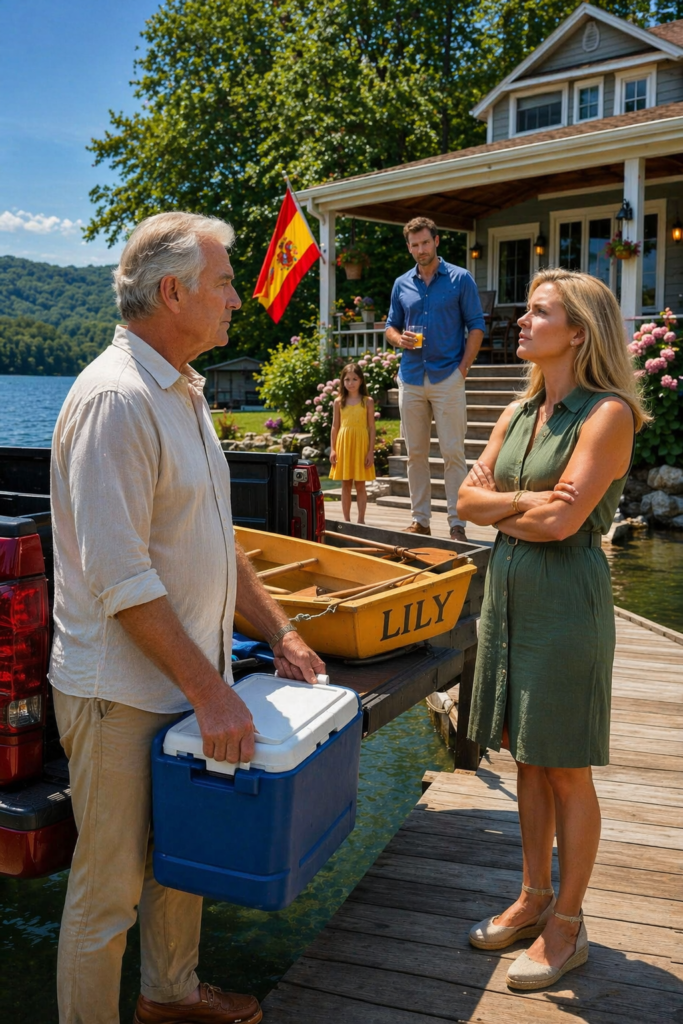
He was 71 years old, had a recently operated hip, and a little yellow boat in the bed. He had built it for Sofia, his 8-year-old granddaughter.
He also brought corn, carnitas, salsa, sweet bread, and a tres leches cake.
He was happy.
Until he saw Renata, his daughter-in-law, coming down the stairs.
She wasn’t walking.
She was marching.
Dressed in white pants, a navy blue blouse, and expensive sunglasses perched on her head. Behind her, on the porch, stood guests with glasses in hand.
People Armando didn’t know.
People looking on as if they were waiting for a show.
“Good morning, Renata,” he said, slowly descending with his cane. “They’ve already started.”
She didn’t smile.
“Armando, we need to talk.”
That was the first blow.
No “father-in-law.”
No “what a pleasure to see you.”
No “how are you doing after the operation?”
Just Armando.
As if his name were a nuisance.
He reached for the cooler.
Renata stepped in front.
“Don’t go up.”
Armando blinked.
“How?”
The music from the porch lowered.
It didn’t stop.
It just lowered.
And that hurt more.
Renata crossed her arms.
“The family talked. We decided it’s better if you don’t stay this year.”
The lake sparkled behind her. A dog barked in the distance. Children laughed from another house.
Everything felt too normal for such a huge humiliation.
“This is my house,” Armando said.
Renata pressed her lips together.
“That reaction is exactly what worries us.”
“Us?”
Armando looked at the porch.
There was Diego, his son.
38 years old, broad-shouldered, his mother’s eyes, and a beer in hand. He didn’t seem surprised. He looked tired.
As if he had rehearsed this betrayal already.
“Diego,” Armando called. “Son, tell me what’s going on.”
Diego didn’t come down.
He looked at Renata.
Then at the ground.
“Maybe it’s better this way, Dad.”
He didn’t say it loudly.
It didn’t need to be.
A quiet betrayal echoes in the soul.
Renata stepped a little closer.
“After what happened last year, we can’t pretend anymore. The rag you burned, your confusions, your midnight walks… scared everyone.”
Armando felt a chill in his chest.
The “fire” had been a napkin that touched the burner while he washed tomatoes. He put it out in seconds.
There was no smoke.
No danger.
And the midnight walks had been to the dock to set up fishing rods for Sofia.
Then he understood.
Renata had pieced things together.
A burned rag.
A forgotten medication.
An early exit.
A stiff hip.
She had turned his normal old age into a dossier.
“It’s not right,” she said. “I have clients here. Important friends. They shouldn’t have to endure this.”
She looked at his cane.
His old shirt.
His cooler.
Armando could have screamed.
He could have reminded them that he built those walls with his own hands.
He could have asked Diego what kind of son would allow his father to be thrown out of the house where his mother’s ashes were.
But he knew what would happen.
If he got angry, Renata would have the scene she wanted.
So he lifted the cooler and barely smiled.
“Okay.”
Renata blinked.
“What?”
“Enjoy the lake.”
Armando went back to the truck.
Diego stepped down one stair.
“Dad…”
Armando didn’t turn.
If he did, he might say something he could never take back.
He climbed into the driver’s seat and started the engine.
In the mirror, he saw Renata with her arms crossed, trying to decide if she had won.
She hadn’t won.
She had only awakened a question.
Why was she so eager to keep him away from his own home?
PART 2
For almost an hour, Don Armando drove aimlessly.
He passed flags, corn stalls, families with coolers, and trucks filled with kids. The world continued as if he hadn’t just had the ground ripped from beneath him.
When his hands stopped shaking, he arrived at his sister Violeta’s house.
She was 74, short, and had a character that demanded no permission.
She came out, looked at the little yellow boat, then at his face.
She didn’t ask anything.
“I’m going to make coffee.”
That’s how someone who loves you acts.
First, they warm your soul.
Then they ask.
Armando only shared what was necessary: Renata kicked him out and Diego looked the other way.
Violeta clenched her jaw.
“That woman was always too refined to be clean.”
That night, Armando didn’t sleep.
He remembered Renata’s words.
“It’s a shame.”
Then he recalled Diego’s.
“Maybe it’s better this way.”
That hurt more.
Around 2 in the morning, an idea jolted him from bed.
Renata didn’t want to keep him away from the party.
She wanted to keep him away from the house.
From the desk.
From the mailbox.
From the papers.
At dawn, he asked:
“Did Renata bring my mail?”
Violeta frowned.
“What mail?”
“She said she’d keep it while I recovered.”
“She didn’t give me anything.”
At 8:05, Armando called the post office.
He gave his name and address.
The employee took a few seconds.
“Mr. Salgado, your mail has been redirected to a P.O. Box.”
“I didn’t request that.”
“The request is signed from May.”
“I was recovering in May.”
There was silence.
“Yes, sir, but it’s made under your name.”
Under his name.
That phrase froze his blood.
Violeta told him to call Patricia Montes, his lawyer of nearly 30 years.
Armando tried dialing from the new cell Renata had set up for him.
The call wouldn’t go through.
He tried again.
Nothing.
Violeta handed him her landline.
Patricia answered on the first ring.
“Montes Law Firm.”
“Paty, it’s Armando.”
On the other side, there was a sigh of relief.
“Thank God. I called you four times. Sent messages and a certified letter. Where have you been?”
“I didn’t receive anything.”
Patricia fell silent.
Then spoke slowly.
“Come in today. Don’t call Diego. Don’t call Renata. Bring your ID and your deeds.”
An hour later, Armando was sitting in her office.
Patricia placed a folder on the table.
“Before I show you this, I want to say something: I don’t believe you signed this.”
Armando tightened his grip on the cane.
“Signed what?”
She opened the folder.
The first document was a deed of donation dated May 14.
It stated that Armando Salgado had ceded his land and the lake house to Horizonte Lago Residencial S.A. de C.V.
“I don’t know that company.”
“I know.”
“I never gave away my house.”
“I know.”
Patricia pointed below.
There was his signature.
It wasn’t crude.
From afar, it didn’t look fake.
It was almost perfect.
The long A.
The slanted g.
The slight tremor at the end of his fingers with arthritis.
Armando felt the room spin.
“That’s not mine.”
“I believe you.”
The second document was worse.
A broad power of attorney.
It named Renata as the representative to manage properties, accounts, and decisions if he was declared incapacitated.
Incapacitated.
An elegant word for taking someone’s life without burying them.
The third paper was a sales promise.
Horizonte Lago Residencial was selling the property to Grupo Cárdenas Desarrollos for 42 million pesos.
The project included 18 luxury apartments, a private dock, and demolition of existing construction.
Existing construction.
That’s what they called the house where Lucía sang.
The porch where Diego learned to walk.
The wall where Sofia taped her drawings.
“Who runs that company?” Armando asked.
Patricia looked at him carefully.
“Renata appears as the sole administrator. Diego is listed in emails but not in the main deed.”
Armando closed his eyes.
That was Renata.
Using him close.
Protecting herself far away.
Patricia explained the plan.
The redirected mail prevented Armando from seeing notices.
The blocked cell kept the lawyer from finding him.
The stories of his supposed confusion prepared everyone to believe he could no longer decide.
The humiliation at the lake wasn’t a tantrum.
It was part of the fraud.
Renata needed witnesses to show that Armando was a lost old man.
“What do we do?” he asked.
“We don’t notify. We don’t threaten. We test.”
They hired a handwriting expert, notified the notary, and prepared a complaint for forgery, fraud, and attempted dispossession.
When Renata and her guests left, Armando returned to the lake.
The key still opened.
That nearly broke him.
The house smelled strange.
Not dirty.
Handled.
There were forgotten glasses, wine stains on the oak table, and brochures from Grupo Cárdenas in the kitchen.
“Luxury living by the lake.”
Armando found Lucía’s shawl tucked behind beach towels.
He took it out.
He placed it where it belonged.
Then he went to the porch and arranged the rocking chairs.
One on the left.
One on the right.
Facing the sunrise.
That was the first thing he fixed.
The second were the locks.
He changed the doors, the storage, the shed, and the dock.
Then he installed three cameras.
The kid who helped him showed him the app three times.
Armando learned.
Because asking for help isn’t giving up.
Giving up is letting others decide for you.
Two days later, the expert confirmed that the signatures were traced. They had odd pauses, irregular pressure, and copied movements.
From afar, they looked like his.
Up close, they didn’t breathe the same.
Patricia notified the developer.
The sale was frozen.
But the tours with buyers were still scheduled for Saturday.
Patricia suggested notifying Renata.
Armando said no.
She humiliated him in public.
The truth would also come with witnesses.
On Saturday at 8:41, his cell vibrated.
Movement detected.
On the screen, he saw Renata’s truck pull in. Behind her came Diego. Then two black vehicles with well-dressed men.
Renata got out in a cream coat, golden earrings, and a commission-driven smile.
She reached the door.
Inserted the key.
Turned.
Nothing.
Tried again.
Nothing.
Went to the kitchen.
Nothing.
To the porch.
Nothing.
Then she saw the camera.
Her face changed.
The phone rang.
Diego.
Then Renata.
Then Diego again.
On the sixth call, Armando answered.
“Good morning, Renata.”
“Armando, I’m so glad you answered. The keys aren’t working.”
“I know.”
“How do you know?”
“I changed the locks.”
Silence.
“Why would you do that?”
“Because it’s my house.”
Renata let out a fake laugh.
“This confirms what we’re saying. You’re confused. There’s a meeting scheduled.”
“What meeting?”
“You know.”
“No. I want to hear you explain it.”
She stepped away from the men.
“Open the door.”
“No.”
“Armando.”
“You’re on my porch with people who came to buy a house that isn’t yours.”
The silence had teeth.
Then she whispered:
“Who have you been talking to?”
There it was.
She didn’t ask, “What are you talking about?”
She asked, “Who?”
“With my lawyer, an expert, the notary, the developer, and soon the Prosecutor’s Office.”
Renata stood still.
Diego moved closer.
“What’s going on?”
“Put my son on,” Armando ordered.
There was noise.
Then Diego spoke.
“Dad?”
“Ask your wife what Horizonte Lago Residencial is. Ask her why she moved my mail. Ask her why there’s a false power of attorney with my signature. Ask her why those men think they’re going to tear down your mother’s house.”
Through the camera, Armando saw Diego turn to Renata.
She tried to touch his arm.
He pulled away.
“Dad… what are you saying?”
“That I never signed. I never sold. I never gave permission. And if you didn’t know, son, it’s time to start asking in front of everyone.”
Armando hung up.
Twenty minutes later, a patrol car arrived.
Renata ran toward the police, pointing at the house, the cane, and the camera.
Armando opened only when they knocked.
He handed over a folder with his original deed, ID, property tax, expert report, lawyer notification, and record of the redirected mail.
The officer read everything.
Then said:
“Is the property yours?”
“Yes.”
“Do you want them to enter?”
“No.”
“Do you request medical assistance?”
“I request that the invaders be removed.”
The officer nodded.
The developers were the first to leave.
No greetings.
No farewells.
Renata turned pale under her makeup. The officer pointed to the exit.
She got into her truck and drove away, kicking up dust.
Diego remained, staring at the porch.
Armando didn’t come out.
Not that day.
Three days later, Diego returned alone.
He sat in his truck for 20 minutes before getting out.
When he reached the porch, he looked broken.
“Dad… Renata left. She emptied an account. Her lawyer called mine. I didn’t know about the false deed. I swear I didn’t know that part.”
Armando repeated:
“That part.”
Diego looked down.
“She told me it was planning. That you could no longer take care of the house. That selling it was best.”
“Did you ask me?”
“No.”
“Did you tell me you were in debt? That you needed help?”
“No.”
Armando took a deep breath.
“Renata wanted my land. That makes her ambitious. But you wanted peace so desperately that you let her make me small in your mind. That makes you responsible.”
Diego cried silently.
Armando didn’t hug him right away.
Limitless mercy teaches others they can use you again.
Then he placed a hand on his shoulder.
“I love you. But forgiving isn’t flipping a switch. It’s time, trial, and work.”
A year passed.
Renata lost her real estate license and faced charges for fraud, forgery, and attempted dispossession. The company was dissolved. Diego divorced her.
Sofia suffered quietly.
She would ask before opening drawers.
One day she said:
“Is Grandpa’s house still Grandpa’s?”
That hurt Armando more than all the papers.
With Diego’s help, he fixed the shed at the dock and turned it into a simple little house for him and Sofia.
It had its own door.
Its own lock.
That mattered.
Love isn’t handing over your keys.
Diego paid rent. Not much, but enough to not hide behind his father’s kindness.
One Saturday, Sofia found the little yellow boat.
“Is it mine?”
“It was always for you.”
“Why didn’t you give it to me before?”
Armando breathed.
“Because last summer was complicated.”
“Because my mom did something bad?”
“She made very bad decisions.”
“Did she try to steal your house?”
“Yes.”
“Should my dad have stopped her?”
“Yes.”
The girl thought for a moment.
“Can angry people still go fishing?”
Armando let out a clean laugh.
“Of course, honey.”
That morning, they launched the boat into the water.
Sofia took the oars.
Armando told her:
“Pull evenly. If one side does all the work, you’ll spin.”
Diego was behind.
Armando didn’t need to look at him.
The girl rowed crooked at first.
Then she corrected.
The boat moved.
Not perfectly.
But straight.
Diego said softly:
“She’s learning.”
Armando looked at the lake.
“We’re all learning.”
The two rocking chairs still faced the dawn.
Lucía’s shawl was in its place.
The house still stood.
Renata thought throwing him out in front of everyone would strip him of his dignity.
She was wrong.
Throwing him out gave him distance.
Distance gave him questions.
Questions gave him evidence.
And evidence returned something greater than the house.
It returned his name.
Armando Salgado.
Not confused.
Not useless.
Not a burden.
A father.
A grandfather.
A man who learned late, but firmly, that peace without respect is also a prison.