PART 1
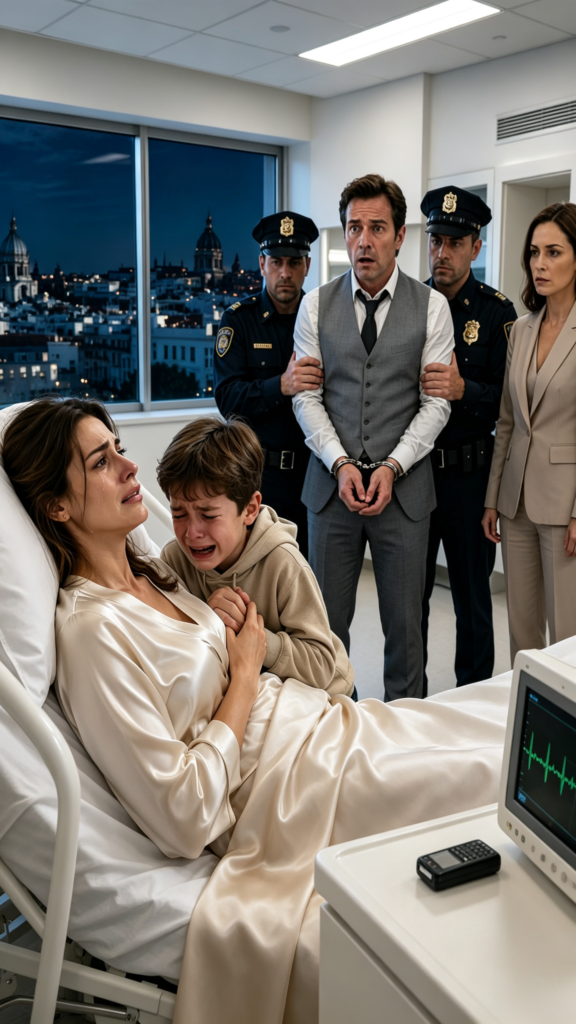
—When the judge gives me custody, I’ll sell the house… and then we’ll take her off life support.
Valeria Montiel heard her husband’s voice as if it came from a room closed off underwater.
She couldn’t open her eyes. She couldn’t move her head. She couldn’t clench her teeth in rage. But each word pierced her clean, sharp, straight to the soul.
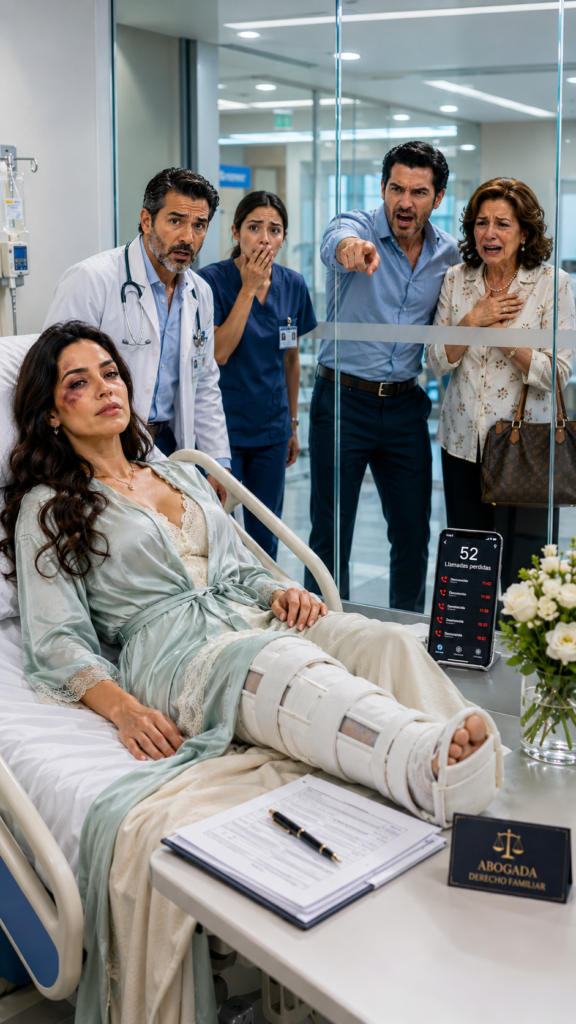
At San Javier Hospital in Guadalajara, everyone spoke of her in the past tense.
They said that attorney Valeria Montiel, a criminal lawyer known for never losing tough cases, was no longer really there. That her body was still hooked to machines after the crash on the road to Colima, but that her mind had shut down.
The doctors lowered their voices in front of her bed.
The nurses adjusted the sheets with a sad tenderness.
And her son Leo, 8 years old, came every afternoon with his green backpack, sat beside her, and told her about his day as if they were still in the kitchen of their home.
—Mom, today I got a 10 in reading —he whispered—. The teacher said I read beautifully. Dad didn’t pick me up again, but Mr. Beto from the stationery store helped me cross the street. Don’t worry, I know how to wait alone now.
Valeria wanted to scream.
She wanted to tell him that no child should learn to wait alone on a sidewalk.
She wanted to touch his hair, hold him tight, promise him she would come back.
But her body was a prison.
Her husband, Rodrigo Salcedo, entered the room when there were important visitors. He arrived in expensive shirts, with enormous flowers from Providencia and a face of an anticipated widower that made you want to applaud.
—My Vale is a warrior —he said in front of everyone—. I would give anything to see her wake up.
Valeria, trapped in darkness, learned to hate that phrase.
Because Rodrigo never wanted to see her shine.
Before the accident, she had discovered strange movements in the office accounts. Misappropriated fees, copied signatures, altered power of attorney documents. And every time she asked, Rodrigo smiled as if she were exaggerating.
—Oh, love, don’t turn the house into a courtroom.
The night she understood everything, the room was cold.
Leo had fallen asleep in a chair, his little hand resting on his mother’s sheet. Outside, it rained, and the drops tapped against the window like nervous fingers.
The door opened slowly.
Valeria recognized Rodrigo’s footsteps.
She also recognized the sweet perfume of Jimena, his personal assistant.
—What if she wakes up? —she asked, trembling.
Rodrigo let out a dry laugh.
—She’s not going to wake up. Doctor Ibarra already said her responses are minimal.
—But she’s still alive.
He approached the bed. Valeria felt his breath near her ear.
—That’s why we need to hurry. They declare her incapacitated, I sell the house in Chapalita, liquidate her share of the office, and pull the investment money out. Then Ibarra signs the withdrawal of support.
Jimena remained silent.
Rodrigo added:
—I already cut the brakes once, and everyone thought it was an accident. This is easier.
Valeria’s world shattered without making a sound.
The curve. The pedal pressed down. The stiff steering wheel. The trailer lights. The crash. The glass. The nothing.
It hadn’t been bad luck.
It had been him.
Then she felt a minimal pressure in her hand.
Leo was awake.
—Mom… —he whispered with a cracked voice—. If you can hear me, do something.
Rodrigo and Jimena continued talking, sure that the woman in the bed was no longer anyone.
Valeria gathered all the rage she had left in a single finger.
And just barely, almost like a sigh, she brushed her son’s palm.
Leo stopped breathing.
PART 2
The boy didn’t scream.
He didn’t call a nurse. He didn’t look at his father. He didn’t do anything that could betray his mom.
He simply lowered his head, pressed his forehead against the sheet, and cried silently, as if he had just discovered that miracles could also be frightening.
Rodrigo didn’t notice anything.
Jimena neither.
They were too busy planning how to erase Valeria from her own life.
—The boy is acting weird —Jimena said—. He stays here for hours, talks to himself, asks questions.
—He’s 8 years old —Rodrigo replied—. He cries, gets tired, and shuts up. Just like his mother.
If Valeria could have smiled, she would have done so with disdain.
Rodrigo always believed strength was shouting, commanding, signing checks, and humiliating anyone who was of no use to him.
He never understood that strength was also remembering.
And Valeria remembered everything.
Rodrigo’s voice. The date of the accident. The name of the doctor. Jimena’s perfume. The word brakes.
For 3 days, Leo returned to the hospital with a strange calm. He sat beside her, talked about school, about the quesadillas the neighbor Lupita made for him, and how his dad didn’t even look at him when he got home.
But every afternoon, he repeated the same ritual.
He placed his open palm beneath Valeria’s fingers and whispered:
—Again, Mom. Just a little.
At first, nothing happened.
Valeria’s body was a house without light. She knocked on doors from the inside, but none opened.
Until one afternoon, while Rodrigo talked on the phone in the hallway, Valeria’s index finger moved barely 1 millimeter.
Leo closed his eyes tightly.
—You’re there —he said—. I knew it, I really knew it.
The next day, the boy arrived with Doña Carmen, Valeria’s godmother and a retired notary from Tlaquepaque. She was a thin woman with white hair tied up, a stern gaze, and a wooden cane. One of those ladies who don’t need to raise their voice to make a liar tremble.
Rodrigo tried to block her entry.
—Valeria needs to rest.
Doña Carmen looked him up and down.
—Valeria needs you to stop managing a life that doesn’t belong to you.
—You’re not direct family.
—No —she replied—. I’m the executor of her will.
Rodrigo froze.
Valeria too, inside.
The will.
She had signed it 2 years earlier when she began to suspect the embezzlement from the office. No one knew. No one, except Doña Carmen.
When Rodrigo stormed out furiously into the hallway, the godmother leaned closer to the bed.
—Daughter, if you can hear me, hold on. Leo told me about your finger. And your safe also spoke.
Valeria felt something akin to hope pierce her chest.
In her safe were copies of transfers, altered contracts, recordings of meetings, and a special clause: if she became incapacitated under suspicious circumstances, Doña Carmen would assume control of her assets, not Rodrigo.
Rodrigo hadn’t attacked a defenseless wife.
He had attacked a lawyer who had prepared her defense before falling.
That afternoon, Leo hid a small digital recorder under the pillow.
—It was yours, Mom —he whispered—. I found it in the drawer of your fine pens. The godmother says not to be afraid, but I am.
Valeria wished she could hug him.
Since then, every visit from Rodrigo became a trap.
Leo pretended to play on the tablet, but he turned on the recorder when he heard his father’s footsteps.
And Rodrigo, convinced he was surrounded by a dead woman and a weak child, talked too much.
—Jimena, move the money before Carmen sticks her nose in.
—Ibarra will sign irreversible deterioration on Friday.
—The mechanic already crossed into Guatemala.
—The house needs to sell quickly. I don’t want the boy there crying like a ghost.
Each sentence was a nail in his own coffin.
But Friday came before the Prosecutor’s Office had everything ready.
At 2:17 AM, the door to the room opened without the friendly sound of the nurses.
Valeria recognized Rodrigo’s shoes.
Then Jimena’s heels.
Then Doctor Ibarra’s heavy breathing.
Something was wrong.
Very wrong.
—Do it fast —Rodrigo ordered—. A respiratory complication. A stop. Whatever.
—This is no longer a false signature —Ibarra murmured—. It’s homicide.
—Don’t come at me with morals, doctor. I already paid off your clinic debt in Zapopan.
Jimena spoke almost crying.
—Rodrigo, what about Leo?
—Leo knows nothing. And if he talks, no one will believe him. He’s a traumatized child.
Valeria felt the fear transform into fire.
Not for herself.
For Leo.
For that boy who had learned to walk alone on avenues, to cry softly, to record conversations of corrupt adults, and to hold his mother’s hand as if he were holding the world.
Doctor Ibarra approached.
Valeria heard the sound of gloves. A metal tray. A syringe.
—I’ll just adjust the sedation —he said—. Then the saturation will drop.
—Perfect —Rodrigo replied—. Today this show ends.
Then a small voice cut through the air.
—If you touch her, everyone will hear it.
Rodrigo turned around.
—What are you doing here?
Leo was at the door.
Valeria couldn’t see him, but she imagined him with his green backpack, pale face, and that sad bravery no child should carry.
—I told you to go with your grandmother —Rodrigo growled.
—I didn’t come alone.
The door opened wide.
Two agents from the Jalisco Prosecutor’s Office entered, a public prosecutor in a wet raincoat, Doña Carmen leaning on her cane, and a nurse recording with her phone. Behind them came a man from the forensic unit with a body camera on.
Rodrigo stepped back.
—What is this nonsense?
The public prosecutor raised a folder.
—Rodrigo Salcedo, you are under arrest for attempted femicide, fraud, forgery, conspiracy, and whatever else results.
—My wife is in a vegetative state —he said, trying to regain his elegant tone—. This old woman is manipulating my son.
Doña Carmen didn’t blink.
—For weeks, you spoke next to a recorder. You also spoke with the mechanic from the parking lot. And your assistant sent emails from the office account. It wasn’t hard, Rodrigo. You’re not smart, you’re arrogant.
Ibarra dropped the syringe.
—I didn’t want to kill her.
—But you did want to collect —the public prosecutor replied.
Jimena tried to leave, but an agent blocked her path. When they searched her bag, they found a USB drive, papers with Valeria’s forged signatures, and a custody request with modified dates.
Rodrigo looked at Jimena with hatred.
—Tell them you didn’t know anything.
She started to tremble.
—You said it was just money.
—Shut up!
Doña Carmen took out a small speaker and connected it to Leo’s phone.
Rodrigo’s voice filled the room:
—I already cut the brakes once, and everyone thought it was an accident. This is easier.
No one spoke.
Not the rain outside.
Not the machines.
Not Rodrigo.
Valeria felt Leo’s hand searching for hers beneath the sheet.
—Mom —he whispered—. Don’t be afraid anymore.
Something broke inside her.
It wasn’t a pretty miracle. It was rage. It was love. It was a mother listening to her son face the man who tried to destroy them.
Valeria concentrated everything in her eyelids.
Open them.
The light hit her like a knife.
First, she saw white. Then shadows. Then the ceiling. The lamp. Leo’s tear-streaked face.
The boy opened his mouth, unable to believe it.
—Mom?
Valeria moved her lips. Her throat burned as if filled with glass.
—I… heard you.
Leo broke down.
He cried with his face pressed against her hand, finally like a child and not like a little adult forced to save his mother.
Rodrigo seemed to see a dead woman rise just to accuse him.
—Vale… my love…
She barely turned her eyes toward him.
—Don’t… call me… love.
The agent put handcuffs on him.
In that second, Rodrigo stopped being the respectable husband, the fine businessman, the worried father. Without his expensive shirt, without bought doctors, without display flowers, he was nothing more than a coward trapped by a child’s hand.
—She’s confused —he said desperately—. She just woke up, she doesn’t know what she’s saying.
The public prosecutor approached the bed.
—Attorney, you don’t have to testify now.
Valeria swallowed with pain.
She had waited too long to be quiet.
—I… heard… everything.
Ibarra confessed before dawn. Not out of remorse, but out of fear. He handed over messages, deposits, and the name of the workshop where they tampered with the brakes. The mechanic was arrested weeks later in Chiapas, trying to cross with false documents. Jimena wanted to say that Rodrigo had forced her, but the emails and transfers proved she had participated from the beginning.
Doña Carmen took control of the office.
The house in Chapalita was protected.
The accounts were frozen.
And Leo, for the first time in months, slept a whole night in a bed, not in a hospital chair.
Valeria’s recovery wasn’t like in the movies.
That didn’t make the headlines.
The news talked about “the attorney who woke up to denounce her husband.” The recording went viral. Half of Mexico debated whether a child should bear such a burden, whether Doña Carmen did well, whether Rodrigo deserved to rot in prison.
But real life was tougher.
Valeria had to learn to swallow again. To hold a spoon. To speak complete sentences without losing her breath. To walk 5 steps with 2 therapists while Leo applauded as if he’d won the World Cup.
Some nights she woke up crying, convinced she was still locked in darkness.
Then Doña Carmen would turn on the hallway light and say:
—Here you are, daughter. Here you are.
And Valeria would breathe.
Four months later, she gave her first formal statement. It was in a small room, with doctors present and pauses every few minutes.
She didn’t scream. She didn’t insult. She didn’t put on a show.
She just told.
She told how she heard Rodrigo talking about selling the house. How she recognized the confession about the brakes. How Leo asked her to move a finger. How Doctor Ibarra was going to disconnect her with a medical lie.
When they played the main audio, Rodrigo looked down for the first time.
—I already cut the brakes once, and everyone thought it was an accident.
Seven seconds of his own voice were enough to destroy years of a perfect image.
On the day of the sentencing, Valeria entered the courthouse supported by a cane. She wore a navy blue suit and had her hair tied back. Leo walked beside her, holding her hand.
Rodrigo was sentenced to prison. Ibarra lost his license and received a sentence. Jimena also fell for fraud, forgery, and complicity.
As she left, reporters surrounded Valeria.
—Attorney, do you feel you won?
She looked at Leo.
She thought of the hospital bed, of the finger that had barely moved, of her son’s hand holding hers when no one else believed.
—I didn’t win —she said slowly—. I survived. And sometimes surviving costs more than winning.
The phrase went viral.
But for Valeria, it wasn’t a phrase.
It was her life.
A year later, she opened a small office in the Americana neighborhood. She didn’t want to return to the cold building where Rodrigo had forged signatures and smiles. She rented a big house with bougainvilleas, wooden floors, and a room where frightened women could feel heard, not judged.
Doña Carmen tended to the plants as if they were important files.
Leo did his homework by the window.
Sometimes he asked:
—Did you win today, Mom?
Valeria smiled.
—Today we helped someone. That counts.
One afternoon she found Leo looking at the digital recorder inside a box.
—Do you want to throw it away? —she asked.
He shook his head.
—No. I want to keep it. To remember that I did listen to you.
Valeria sat down slowly beside him.
—And I listened to you too.
Leo hugged her tightly.
—I thought I was going to be left alone.
That phrase hurt her more than any therapy.
—You’ll never be alone again because of an adult’s secrets —she promised.
That night, as the rain pounded against the window, Valeria heard Leo’s laughter from his room.
And understood that true justice wasn’t seeing Rodrigo handcuffed.
It was that laughter.
It was waking up every morning without asking for permission to live.
Rodrigo wanted to turn her into a voiceless body.
But he forgot something.
Valeria had spent her life defending buried truths.
And hers, sooner or later, would rise too.