PART 1
The night before her wedding, Valeria returned to her future mother-in-law's apartment for an item that no one else would have deemed important.
It was a cream cardigan, knitted by her mother during the last months of her life. It had two flowers embroidered near the collar: one for peace and another for prosperity.
Valeria had left it on a chair after the family dinner in Del Valle. She was already driving toward her apartment in Narvarte when she felt a hollow ache in her chest and turned around.
The next day, she would marry Diego, her boyfriend of five years. The venue in San Ángel was paid for, her dress hung in her bedroom, and 120 guests were ready to watch her walk down the aisle.
Then there was the apartment in Santa Fe, bought with six years of hard work, a loan, and the inheritance her mother had left her before passing away.
Diego always said, in his sweet voice:
—When we're married, what’s yours and what's mine will be ours.
Valeria thought it was love. For years, she genuinely wanted to believe it.
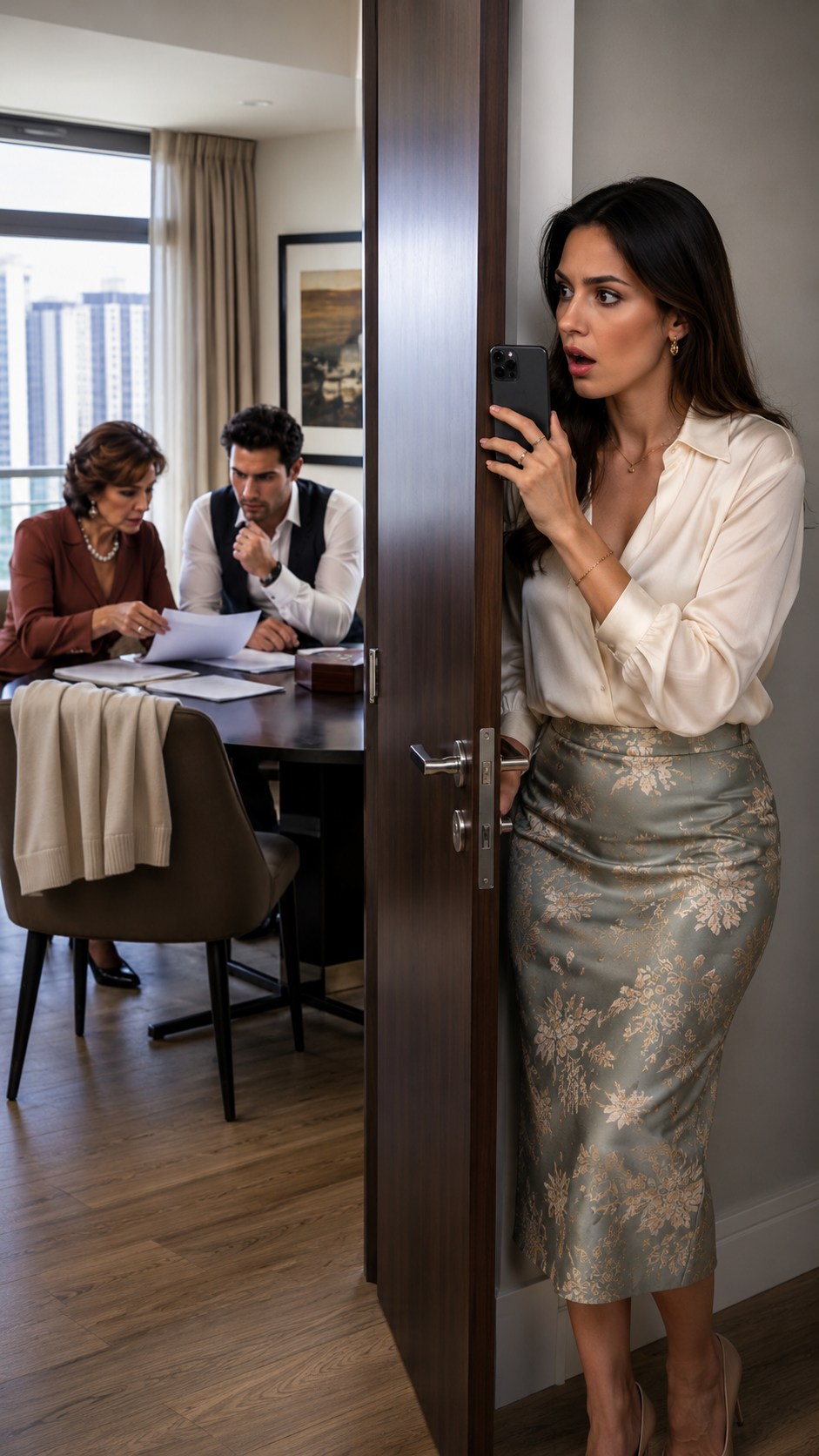
She climbed to the fourth floor and raised her hand to ring the doorbell, but before she could, she heard Doña Teresa's voice, her future mother-in-law.
—Once she’s married, Diego will convince her to put the apartment in both their names. Then we’ll mortgage it and save the business.
Valeria froze.
On the other side of the door, Fernanda, Diego's younger sister, let out a giggle.
—That apartment is worth about 8 million, right? With that, they could help me change my car too.
Valeria's legs began to tremble.
An hour earlier, Doña Teresa had hugged her in front of everyone, telling her she was “the daughter God never gave her.” Fernanda had even cried, saying that finally they would be family.
But in there, they spoke of her as if she were a bank account cloaked in bridal veils.
—Valeria is head over heels in love — said Doña Teresa —. She’ll sign whatever Diego puts in front of her. Plus, she’s terrified of what others will say.
—Diego already has the papers ready — responded Fernanda —. He’ll tell her they’re travel insurance documents. She’ll sign them on the honeymoon, and that’s it.
Valeria carefully opened her purse, activated her phone's recorder, and held it to the gap in the door.
Then she heard the phrase that shattered something inside her.
—The only thing I worry about is that Diego backs out — said Fernanda.
Doña Teresa replied without hesitation:
—He won’t. He was the one who suggested using the apartment as collateral. Once the bank releases the money, he’s off the hook.
Valeria felt the air leave her.
This was not an ambitious mother-in-law speaking out of turn. This was not an immature sister dreaming of someone else's luxury. Diego, the man who would swear to love her for the rest of his life the next day, was neck-deep in this.
She put her phone away and walked toward the elevator without retrieving the cardigan.
In the mirror, she saw her pale face, her eyes wide with terror, but also something new: a sharp calm.
When she reached the street, Diego called her.
—Darling, have you arrived? Tomorrow starts our life.
Valeria glanced at the lit window of Doña Teresa's apartment.
—Diego, do you really love me?
There was a silence that stretched too long.
—Of course. Why do you ask that?
—Nothing — she said —. Sleep well.
She hung up, got into her car, and drove without crying. She still didn’t know that recording was only the first door to a much larger betrayal.
PART 2
Valeria didn't sleep.
Upon entering her apartment, the wedding dress seemed to gaze at her from the hanger. For months, she had envisioned it as the symbol of her happiness. That morning, however, it looked like the entrance to a cage.
She sat in the living room and played the recording three times.
Every phrase hurt more than the last: “the bank,” “the papers,” “the collateral,” “8 million.” But the worst remained the same: Diego had proposed using her apartment.
She remembered he had created a shared digital folder to store tickets, reservations, and honeymoon documents. She opened her laptop with cold hands.
Among copies of passports and hotel confirmations, she found a file labeled “International Couple Insurance.”
She opened it.
It wasn’t insurance.
It was a general power of attorney for acts of administration and ownership, drafted so that Diego could manage, mortgage, or even sell properties in Valeria's name.
There were her complete details, her CURP, the apartment's deed number, her pay stubs, and her mortgage information.
Her signature was missing.
But on the last page, something stirred her stomach: a signature resembling hers, as a prior proof of consent.
Resembling, but false.
Valeria covered her mouth to stifle a scream.
She also found a draft email directed to a bank executive:
“After the wedding, my wife will sign the final document. The property will be available as collateral to cover the pending financing for the family business.”
At 4 a.m., she called her aunt Elena, her mother’s sister and a civil lawyer.
Elena arrived before dawn, with her hair pulled back, glasses on, and the look of someone who had seen too many atrocities disguised as love.
She listened to the full recording. Reviewed the PDF. Read the email. Then she looked at Valeria seriously.
—This isn’t family gossip, honey. This is a plan to take control of your property through deceit.
Valeria swallowed hard.
—I feel stupid.
—No. Trusting doesn’t make you stupid. Abusing that trust does make them miserable.
Elena made several calls. To the bank, to the notary named in the draft, and to a contact at the Civil Registry.
At 7 a.m., Valeria took her phone and wrote a single message:
“Diego, the wedding is canceled. Do not contact me directly again. Everything must be handled through my lawyer.”
The calls started immediately.
First Diego. Then Doña Teresa. After that, Fernanda. Then a cousin, an aunt, a family friend. The phone vibrated as if it too were desperate.
Valeria didn’t answer.
At 9, someone banged on her door so hard the glass rattled.
—Valeria, open up! — Diego shouted from the hallway —. You’re destroying everything over a conversation you misunderstood!
Doña Teresa cried behind him.
—Think of the shame! The guests are already on their way to the venue!
Valeria stood in silence, wearing the white blouse she used for work. She wasn’t in the dress. She wore no makeup. No flowers.
She carried evidence.
Elena called building security and then received an email from the bank. She opened it, read it twice, and her expression changed.
—Valeria — she said quietly —, there’s something else.
—What?
—Diego not only presented a false signature. He also declared that you had been married for three months.
Valeria felt the floor shift beneath her.
On the other side of the door, Diego kept screaming for her to trust him.
Elena opened the door just a crack, enough to speak.
—I’m Valeria’s lawyer. From this moment, any communication will be in writing.
Diego tried to push.
—She’s my fiancée!
—Not anymore — Valeria said, stepping out from behind her aunt.
Diego stood frozen at the sight of her.
—Love, please, let me explain.
—Explain to me why you told the bank we were already married.
Doña Teresa stopped crying.
Fernanda, who had just stepped out of the elevator, lowered her gaze.
Diego opened his mouth but couldn’t say anything convincing.
—It was a preliminary requirement — he murmured —. The executive said it would be corrected later.
—And my signature?
—I didn’t make it.
—Then tell me who did.
The silence was so heavy that even the guards exchanged glances.
Fernanda started crying.
—I copied it — she confessed —. Diego told me it was just to push the process along, that you would sign anyway later.
Doña Teresa slapped her on the arm.
—Shut up, you idiot!
Valeria felt no satisfaction. She felt a deep sadness, as if five years of memory were being ripped away.
—I was going to be married to use my house — she said.
Diego shook his head.
—It wasn’t like that. I was desperate. The business was sinking.
—Then you should have told me.
—I was embarrassed.
—You weren’t embarrassed to forge my signature.
The guards asked Diego and his family to leave. Before entering the elevator, Doña Teresa pointed at Valeria with rage.
—You’re going to regret this. No man wants a woman who puts money above family.
Valeria didn’t raise her voice.
—And no decent family tries to take a home from a woman who just lost her mother.
The doors closed.
That same day, while the San Ángel venue remained decorated with white flowers and empty tables, Elena filed legal notices with the bank and the notary. The case was blocked.
The truth came out quickly.
Diego’s company had been losing money for almost a year. He had debts, suppliers breathing down his neck, and a loan rejected for lack of collateral. Then Doña Teresa suggested “taking advantage” of Valeria’s apartment.
The wedding was not just a ceremony. It was the deadline for the plan.
During the honeymoon, Diego planned to give her the power of attorney among other documents, tell her it was a formality for insurance, and ask her to sign without reading.
If the business failed, Valeria could lose the apartment bought with her mother’s inheritance.
Elena also reviewed the transfers from the last few years. Valeria had lent that family nearly 1.2 million pesos: for a surgery for Doña Teresa, Fernanda’s master’s degree, repairs on the apartment, and supposed emergencies for the business.
All with promises of repayment.
All with saved messages.
A week later, they met in Elena’s office.
Diego arrived haggard. Fernanda looked as if she hadn’t slept. Doña Teresa wore black, as if she were the victim of a tragedy.
On the table were the proofs: 17 transfers, messages, emails, the recording, the forged power of attorney, and the bank file.
—You never said they were loans — Doña Teresa said.
Elena slid several printed sheets.
“We’ll return it when we sell the car.”
“Thanks for lending us for the tuition.”
“In two months, you’ll get it all back, dear.”
Doña Teresa fell silent.
Diego tried to speak softly.
—Valeria, I can pay you part, but if you force me to return everything, the company will close.
—Your company was already closing when you decided to put my life at risk — she replied —. The difference is that I didn’t know.
Fernanda burst into tears.
—I thought you’d accept. Honestly, Diego said you were a couple, that everything was yours.
Valeria looked at her with pain.
—My signature wasn’t yours. My home wasn’t ours. My mother’s inheritance wasn’t ours.
The agreement established guaranteed payments with Fernanda’s car and a share Diego still had in the company. It also included a prohibition on using Valeria’s documents, name, or financial information.
The investigation for forgery would continue separately.
Before leaving, Doña Teresa placed a transparent bag on the table.
Inside was the cream cardigan.
—Because of this item, you ruined my son’s life — she spat.
Valeria took the bag and looked at the two flowers embroidered by her mother.
—No, Doña Teresa. This item saved me from your son ruining mine.
It was the last time she saw her.
The first few days were horrendous. Some guests demanded flights, hotels, and gifts. Others asked if she had suffered “a nervous breakdown.” Fernanda posted on social media that Valeria had used Diego for years.
Elena sent a legal warning, and the post disappeared that same afternoon.
Valeria did not go out to tell her version with tears or hints. She always responded the same:
—The wedding was canceled for serious and documented reasons.
Her silence bothered them because they could no longer manipulate her.
Months later, the payments came. Diego’s business closed. He moved to another city and, according to acquaintances, blamed his mother for pushing him.
Perhaps it was true in part.
But the messages proved Diego had many opportunities to stop and didn’t.
Valeria stopped asking about him.
She also decided to move to the Santa Fe apartment. For a long time, she had envisioned it as “her home with Diego.” Upon entering alone, the empty rooms seemed enormous.
She opened the windows, let in the sun, and understood something: a broken dream doesn’t curse the place where it was meant to come true.
Her friend Mariana helped her with the furniture. Her aunt Elena brought a bougainvillea for the balcony. In the kitchen, Valeria placed a photo of her mother smiling in front of a sewing machine.
The wedding dress remained in a box for several weeks.
One day, she donated it to an organization that supported low-income women getting married civilly.
The volunteer opened the box, surprised.
—It’s beautiful. Are you sure you want to donate it?
Valeria caressed the tulle one last time.
—Yes. I hope someone uses it who walks toward a marriage where they are respected.
As she left, she didn’t feel like she was giving away a failure. She felt like she was transforming a wound into something useful.
One Sunday, she visited Doña Lupita, her mother’s neighbor. The lady handed her an old box she had kept for years.
Inside were photos, receipts, and a small notebook.
On the last page, Valeria found a phrase written in her mother’s shaky handwriting:
“Little daughter, don’t confuse being good with allowing others to make you small. True love will never ask you to disappear for others to be comfortable.”
Valeria cried sitting on the curb.
But it was no longer the cry of betrayal. It was relief.
That afternoon, she went to the cemetery wearing the cardigan. She left two flowers in front of her mother’s tombstone.
—I didn’t make it to the altar, Mom —she whispered —, but I arrived in time to save myself.
There were no miracles or signs. Just a gentle breeze and a peace that at last didn’t ask permission from anyone.
Since then, Valeria stopped believing in love that demands silent sacrifices, shared bills out of obligation, and loyalty tests that always benefit the same.
She kept believing in love, yes.
But in one with respect, truth, and the freedom to say no.
Because canceling a wedding may bring shame for a few days.
But marrying someone who sees you as a financial solution can destroy you for a lifetime.