PART 1
They called her a liar in front of the entire courtroom.
Mrs. Elena Márquez raised her right hand, looked at the judge with eyes filled with false tears, and swore that her own daughter had fabricated eight years of military service, that she had pretended to be a combat-wounded soldier, and that she had manipulated the whole family to take possession of a ranch.
In the Civil Courtroom of Querétaro, the silence grew heavy.
Some turned to look at Nora Márquez as if she were a criminal.
At 34 years old, she sat upright, hands clasped on her knees, exuding a calm that many interpreted as arrogance.
But it wasn’t arrogance.
It was exhaustion.
Nora had been a combat nurse in the Mexican Army for eight years. She had carried wounded soldiers under gunfire in the mountains, watched comrades die while squeezing their hands, and returned with a valor medal, a permanent injury to her left shoulder, and nightmares that still jolted her awake at 3 AM.
None of that mattered to her mother.
To Elena, Nora was merely a burden.
Everything began when Don Aurelio Márquez, Nora’s grandfather, passed away. The old man left a simple will: the family ranch in Amealco and a modest investment account would go to his granddaughter, the only one who visited him until the end.
It wasn’t a fortune, but it was enough to awaken greed.
Two weeks later, Nora received the lawsuit.
Fraud.
Emotional damage.
Economic exploitation.
Elena and her younger son, Daniel, were asking the judge to officially declare that Nora was a fake soldier to strip her of her inheritance.
That morning, Elena arrived at the courtroom dressed in black, as if mourning a daughter who still breathed. Daniel walked in behind her wearing a cheap camouflage jacket he had bought at a flea market just to mock.
Every time he passed by Nora, he smiled.
—You’re done for, little sister—he murmured.
Nora didn’t respond.
What Daniel didn’t know was that she had a file showing he had been expelled from military training after only eight weeks for theft.
But Nora stayed silent.
The Army had taught her something: when someone is sinking, it’s unwise to take away their shovel.
Then she listened.
She heard her mother point at her from the witness stand.
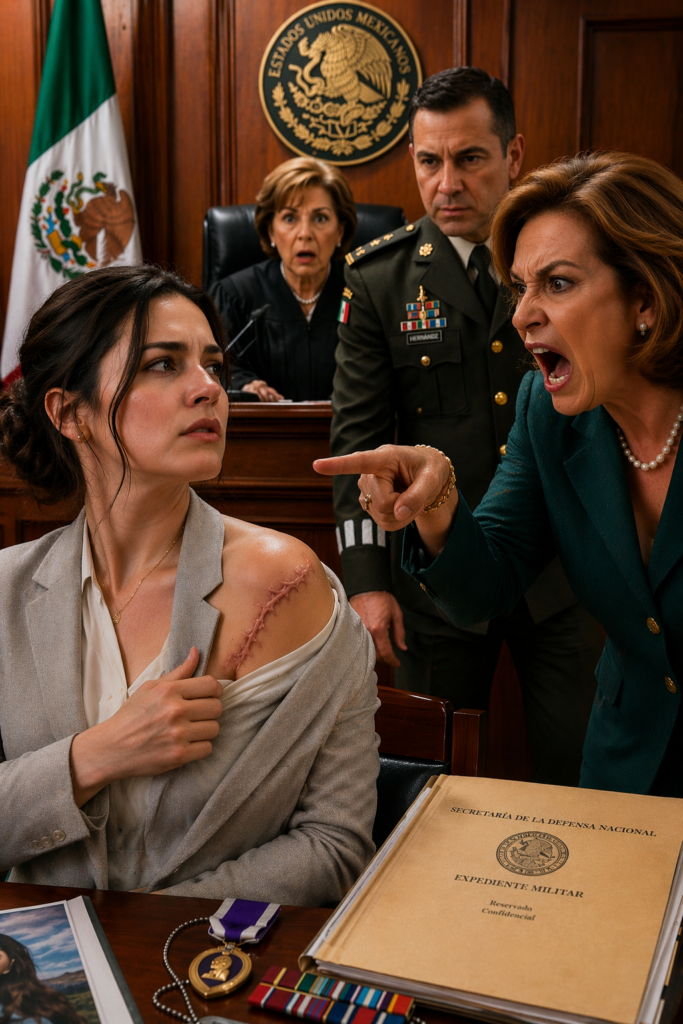
—My daughter never served anywhere!—Elena shouted—. She spent years living off us, inventing war stories to squeeze money from my dad. She has scars because she got into fights in bars, not for serving Mexico!
A murmur swept through the room.
Judge Ramiro Salcedo looked up.
—Miss Márquez, these accusations are serious. Do you have proof of your service?
Nora took a deep breath.
—Yes, Your Honor.
Her voice came out strong.
Then she stood up.
She removed her navy blue jacket.
She brought her fingers to the collar of her blouse.
—I request permission to show a physical piece of evidence.
The judge nodded.
Nora lowered the fabric from her left shoulder and revealed a wide, irregular, sunken scar, like a burned crack on her skin.
The entire room seemed to lose its breath.
But that scar wasn’t the real proof.
The real proof lay in a closed folder on her lawyer’s table.
And when the judge ordered it opened, no one could believe what was about to happen.
PART 2
Nora’s lawyer, Licenciada Mariana Rivas, slowly rose and placed the folder in front of the judge.
She didn’t perform theatrics.
She didn’t shout.
She simply said:
—Your Honor, we request that 14 official documents, 3 certified testimonies, and 1 audio recording be added to the record that demonstrate not only my client’s military service but also the deliberate fabrication of evidence by the plaintiffs.
Elena blinked.
Daniel stopped smiling.
The judge opened the folder and the first thing he saw was a certificate stamped by the Secretary of National Defense.
Name: Nora Márquez Aguilar.
Length of service: 8 years.
Position: military nurse assigned to a medical support operational unit.
Recorded injury: trauma from explosion in left shoulder, with surgical intervention at Central Military Hospital.
Award: valor recognition for evacuating wounded personnel under fire.
The judge read in silence.
Then he turned to the next page.
There were official photographs: Nora as a younger woman, in uniform, her face covered in dust, holding an unconscious soldier while two comrades ran behind her.
In another image, she was at a ceremony, receiving a medal from a general.
The courtroom began to murmur again, but now the murmur was not against Nora.
It was against Elena.
The mother swallowed hard.
—That could be forged—she suddenly said—. These days anyone can make documents, Your Honor. Don’t be fooled.
Mariana raised an eyebrow.
—That’s why we also called 3 witnesses.
The side door opened.
Retired Captain Arturo Leal entered, walking with a cane. Behind him came a military doctor and a sergeant with a scar on his cheek.
For the first time, Nora looked down.
The sergeant was Iván, the man she had carried for 600 meters while blood soaked her uniform.
He sat in front of the judge and spoke in a trembling voice.
—If Nora hadn’t been there, I would be dead. She pulled me out of a danger zone while my shoulder was open. She didn’t do it for money. She did it because that’s who she is.
Elena turned pale.
Daniel shifted uncomfortably in his seat.
But the worst was yet to come.
The lawyer pulled out a USB drive from a clear bag.
—We also present this recording, legally obtained by Don Aurelio Márquez ten days before his death.
The grandfather’s name made Elena press her lips together.
The judge authorized the audio to be played.
Don Aurelio’s voice filled the courtroom, weak, tired, but clear.
—Elena, I know what you’re doing. I know you and Daniel want to say that Nora is a fraud to take the ranch. But that ranch isn’t for you. Nora was the only one who came to see me, the only one who paid for my medicine when you all said you had no money.
There was a frozen silence.
Then Elena’s desperate voice was heard.
—Dad, don’t be unfair. Daniel needs that money. Nora doesn’t even have family. Besides, that girl always plays the martyr with her little soldier stories.
Don Aurelio’s voice responded:
—They aren’t stories. I saw her papers. I spoke with her commander. And I also know Daniel was kicked out for stealing.
Daniel slammed the table.
—That has nothing to do with this!
The judge shot him a glare.
—One more interruption and I will remove you from the courtroom.
Nora didn’t move, but inside something shattered.
It wasn’t just the lawsuit.
It wasn’t just the lie.
It was hearing her mother speak about her as if her life, her wounds, and her sleepless nights were a nuisance.
As if surviving didn’t grant her the right to exist.
The recording continued.
Don Aurelio coughed.
—I’ve left everything in writing. If you try to fight this, you will expose yourselves. And if you harm Nora, she will know how to defend herself. That girl learned to survive far away from you.
The lawyer stopped the audio.
No one spoke.
Then Mariana presented the twist that sank them further.
On the table, she placed a second, thinner folder.
—Your Honor, the plaintiffs submitted as evidence a supposed bank statement that placed Nora in Querétaro during the dates she claimed to be in service. But we requested an expert examination and the result is clear: the document was altered.
The judge picked up the sheet.
—Altered by whom?
Mariana looked at Daniel.
—By Mr. Daniel Márquez. The metadata of the original file is linked to his personal email. We also have invoices from a stationery store in San Juan del Río where he sent to have the fake stamps printed.
Daniel turned red.
—That’s a lie, man!
The judge slammed the gavel.
—Moderate your language.
Elena stood up as if the chair were burning her.
—My son didn’t do anything! This is all a trap by Nora!
But Licenciada Mariana wasn’t finished yet.
—There’s more. Don Aurelio also left a record of bank transactions. Over the last four years, Mrs. Elena withdrew 782,000 pesos from the elderly man’s account using an additional card. And Mr. Daniel received 11 transfers labeled as “ranch repairs,” though nothing was ever fixed.
Nora closed her eyes.
She remembered her grandfather telling her over the phone that he didn’t want to bother her, that he was fine, that his back only hurt a little.
She recalled sending money from wherever she could, terrified of not coming back alive.
And while she stitched others’ wounds in dangerous areas, her mother and brother drained the account of the old man who said he was “fine.”
Elena began to cry.
But no one believed her anymore.
—I just wanted to protect my family—she sobbed—. Nora has always been cold, she always thought she was better than us since she joined the Army.
For the first time, Nora spoke without being asked.
—I didn’t think I was better, Mom. I left because in that house I learned that love came at a cost. And yet, I returned for my grandfather. I came back every time I could.
Elena looked down.
—You don’t know what it means to need.
Nora let out a sad laugh.
—I do know. I know what it’s like to sleep with muddy boots on. I know what it’s like to carry someone begging you not to let them die. I know what it’s like to wake up smelling smoke even though you’re in your bed. What I didn’t know was that my own mother could stand under oath and say that all of that was made up.
The judge called for silence.
After reviewing the documents, hearing the witnesses, and confirming the expert analysis, he issued immediate measures.
Elena and Daniel’s lawsuit was dismissed.
Don Aurelio’s will was recognized as valid.
The ranch and the investment account would remain with Nora.
But that wasn’t all.
The judge ordered the Public Ministry to be notified for document forgery, procedural fraud, and possible financial abuse against an elderly person.
Daniel, who had entered mocking in his camouflage jacket, left handcuffed after pushing an official and screaming that it was all Nora’s fault.
Elena wasn’t detained that day, but she left the courtroom with an investigation hanging over her and shame plastered on her face.
Outside, under the dry sun of Querétaro, Nora breathed as if she had just come out of another war.
Captain Leal approached and placed a hand on her uninjured shoulder.
—Sometimes the hardest battle isn’t in the mountains, daughter.
Nora looked toward the street.
—Yes, Captain. Sometimes it’s at the same table where one learned to eat.
Weeks later, Nora returned to the ranch in Amealco.
The house smelled of old wood, wet earth, and coffee brewed in a clay pot. On the wall was still a picture of her grandfather in a hat, smiling as if he knew that in the end, the truth would come out.
Nora didn’t sell the ranch.
She turned it into a retreat for wounded veterans and their families.
At the entrance, she had a simple plaque put up:
“For those who served in silence, and for those who had to prove their pain to those who should have believed them.”
Elena tried to call her many times.
Nora never answered.
Not out of resentment, but because she understood something that many people take years to accept: blood doesn’t always make family, and forgiving doesn’t mean reopening the door again to someone who wanted to destroy you.
When the story became known in town, some said Nora was too hard on her mother.
Others said Elena only received a taste of justice.
But the question lingered among all who heard the case:
How far can a family go when inheritance is worth more than the truth?