PART 1
Marisol Hernández had been called 'chubby' for as long as she could remember, but no one did it as sharply as Doña Elvira, her mother-in-law.
Marisol, 29, lived in Toluca with Diego, her husband of three years, and worked all day seated at an insurance office.
She wasn't a woman who ate uncontrollably, though everyone in Diego's family seemed to believe so.
Doña Elvira always made comments with a fake smile.
"Oh, dear, another pastry? Don't say the clothes shrink on their own later."
Diego would scold her, but she'd shrug.
"I'm saying it for your own good. You'll cry when it's too late."
Marisol learned to swallow her anger.
Oddly, sometimes Doña Elvira didn't look at her with mockery. She looked at her with fear.
Especially when Marisol removed her shoes because her feet swelled in the afternoon, or when she couldn't put on her wedding ring because her fingers were like sausages.
Marisol said it was stress, heat, work, age.
She was 29, but that's how she lied to herself to avoid going to the doctor.
In Diego's family, there was a deceased sister, Lucía. No one talked about her. If someone mentioned her name, Doña Elvira would freeze and change rooms.
Marisol's birthday was in May.
Diego organized a meal at Marisol's parents' house, with carnitas, tres leches cake, and the whole family seated around the table.
Doña Elvira arrived with a huge golden box tied with a red ribbon.
"Open it here, dear. So everyone can see."
Marisol smiled politely.
Inside was a tight blue dress, of thin, shiny, almost transparent fabric. At least three sizes too small.
It had no tag. It looked used, washed many times, like a garment stored for years.
Doña Elvira laughed.
"I bought it as motivation. So you hang it in your closet and remember to shut your mouth. Diego deserves a wife who takes care of herself, not one who lets herself go."
The table fell silent.
Marisol's mother lowered her gaze. Her brother clenched his fists. Diego stood up, furious, but Marisol didn't cry.
She put the dress back in the box and swallowed the humiliation like swallowing a stone.
From that day, she didn't speak to Doña Elvira again.
Until the stormy Saturday.
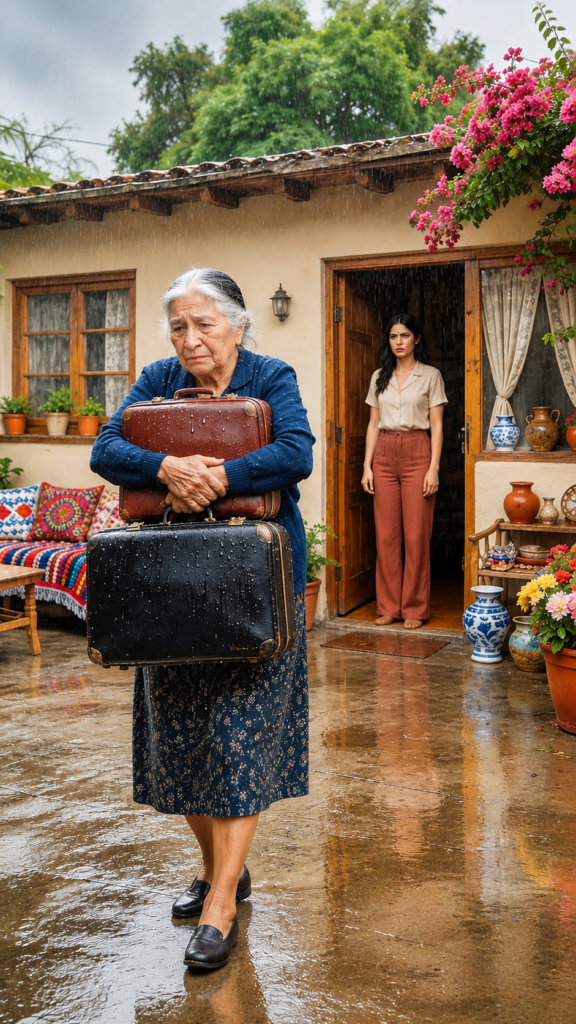
At 6 p.m., with streets turned into rivers by a heavy rain, Doña Elvira knocked on Marisol's door carrying two large suitcases and a handbag.
"My house flooded due to the drainage. I'll be staying here for a few days. Diego already knows."
Diego wasn't home.
Marisol let her in without a word. She listened to her mother-in-law complain about the traffic, the water, the neighborhood, everything.
Then she saw the two suitcases by the entrance.
They were too heavy.
Marisol dragged them to the backyard, where water from the roof fell like a waterfall.
Then she returned to the living room, took the golden box, and placed it on Doña Elvira's lap.
"Since this house is mine, I set the rules here."
Doña Elvira frowned.
"What does this mean?"
Marisol spoke slowly.
"Your suitcases are outside, under the rain. If you want to save them, put on the dress you gave me. Since it's so tight, it should protect you."
Her mother-in-law turned white.
She ran to the patio, screamed as if something alive had been ripped from her, and left, carrying the soaked suitcases under the downpour.
That night, when Diego arrived and Marisol told him everything, hoping he'd defend her, he didn't laugh.
He froze.
"My mom didn't come because of the flood," he said, his voice breaking. "She came to bring you some test results from the health center."
Marisol felt the ground shift beneath her when Diego added:
"They're yours. And they say what you have isn't fat."
PART 2
Marisol went out to the patio without an umbrella.
The rain kept falling hard, pounding on the sheets, the pots, the wet concrete. On the sidewalk was a dark mark where Doña Elvira had dragged the suitcases.
There, stuck next to the drain, was a white envelope, soaked, with the IMSS logo and Marisol's full name written in smeared ink.
Diego bent down, but she got there first.
She picked it up with trembling hands.
The paper almost disintegrated, yet she could make out several words underlined with blue pen.
"Edema."
"Fluid retention."
"Altered renal function."
"Urgent cardiology evaluation."
Below, in shaky handwriting, was a note.
"Dear, it's not fat. Please see a doctor before it's too late."
Marisol was breathless.
For two years, she'd felt her body swell inexplicably. Her ankles hurt at the end of the day. Her eyelids were heavy in the morning. The rings no longer fit.
And she'd blamed herself.
She'd called herself lazy, a glutton, careless.
She'd also allowed others to look at her as if her body were a public shame.
Diego carefully took the envelope from her.
He read it and covered his mouth.
"My mom went to the health center for you," he said. "She used a copy of your CURP because you never wanted to go for the results."
Marisol remembered that weeks earlier, a doctor at the health center had asked for tests because she was worried about the swelling.
Marisol went, did the tests, and then never returned.
She was scared.
She was ashamed.
She thought they'd tell her to lose weight again.
"My mom had been begging me to take you," Diego confessed. "But I thought she was exaggerating. Honestly, I thought she was just making her usual horrible comments."
Marisol felt rage, but she no longer knew at whom.
Because Doña Elvira had been cruel.
That remained true.
She'd humiliated her in front of her parents, her siblings, everyone.
But she'd also crossed half the city under the storm with those papers, desperate to arrive before her own son.
Marisol entered the house soaked.
The golden box was still on the coffee table.
The blue dress was inside, wrinkled, with a corner stained with mud from being thrown.
She took it for the first time without hatred.
She spread it across her legs.
It had no new seams. It didn't smell like a store. It smelled of an old, sweet perfume, like from an old dresser.
In one part of the lining, there were initials hand-stitched.
L. M.
Lucía Martínez.
Doña Elvira's maiden name.
Marisol looked up.
"This dress was Lucía's," she whispered.
Diego didn't respond.
But his silence was an answer.
Marisol felt a chill that didn't come from her wet clothes.
"Why didn't anyone tell me?"
Diego sat in front of her, with a devastated look.
"Because in this house, no one knows how to talk about it without breaking."
The story came out in pauses.
Lucía, Diego's sister, had died at 31. First, she began to swell. Her feet. Her face. Her hands.
Everyone thought she was gaining weight.
Everyone.
Doña Elvira would tell her to take care of herself. Her dad hid the sweet bread. Her aunts recommended teas. At family gatherings, they served her less food 'for her own good.'
Lucía also laughed to avoid crying.
Then she got tired climbing stairs. Then she got dizzy. Then one day, she collapsed in the kitchen.
When they reached the hospital, the problem was severe. Her heart and kidneys had been pleading for help for months, but everyone was too busy looking at her belly.
Doña Elvira never forgave herself.
Since then, when she saw swollen ankles, she didn't see fat.
She saw a grave.
Marisol pressed the dress against her chest and cried.
It wasn't a pretty cry. It was the kind that comes with shame, guilt, snot, everything.
"I kicked her out," she said. "I threw her suitcases into the water."
Diego called his mom seven times. She didn't answer.
Then he called his younger sister, Patricia.
Patricia's voice was furious.
"Now you remember her? My mom arrived trembling, with soaked suitcases. She doesn't want to open them. She doesn't want to talk. She says Lucía got wet."
Marisol closed her eyes.
That phrase pierced her chest.
"Lucía got wet."
She didn't fully understand until she reached Patricia's house.
Diego wanted to drive, but Marisol took the keys.
The rain continued. The avenues of Toluca were full of puddles, motorcycles stopped under bridges, and vendors covering their stalls with plastic.
When they knocked, Patricia opened with red eyes.
She looked at Marisol as if she wanted to kick her out.
"Are you here to finish her off or what?"
Marisol didn't reply.
She entered.
Doña Elvira was sitting on the edge of a couch, wrapped in a blanket, hair sticking to her face, hands purple from the cold.
The two suitcases were by the door, dripping water onto a mop.
She hadn't opened them.
Doña Elvira saw Marisol and looked down.
For the first time, she didn't have a ready comment.
Marisol approached slowly.
She knelt before her.
"I read the results."
Doña Elvira closed her eyes, as if that phrase weighed twenty years.
"Why didn't you tell me properly?" Marisol asked, crying. "Why did you have to humiliate me with the dress?"
Doña Elvira clutched the blanket between her fingers.
"Because properly, you wouldn't listen."
The room was silent.
Patricia leaned against the wall. Diego stood by the door, the soaked envelope in his hand.
"I spoke nicely to Lucía too," Doña Elvira said. "I told her 'take care, my girl.' I made her soups. I bought her loose clothes so she wouldn't feel bad. I said we'd go to the doctor later."
Her voice broke.
"Later never came."
Marisol felt the world shrink.
"When I saw you the same," Doña Elvira continued, "with swollen feet, tired face, saying it was nothing... I went crazy inside."
Her mother-in-law looked at her with eyes full of water.
"I said things harshly. Yes. I was a cruel old woman. I know. But I thought if your pride hurt, even out of anger, you'd run to the doctor to prove me wrong."
Marisol shook her head, broken.
"You made me feel horrible."
"I know."
Doña Elvira lowered her voice.
"I preferred you hate me alive than see you in a box like my daughter."
No one spoke.
There was no phrase that could fix something like that.
Because cruelty was still cruelty, even if born from fear.
And the intention to save didn't erase the wound of humiliation.
But it wasn't fair to deny that this woman had seen what everyone else ignored.
Marisol took her cold hands.
"I was cruel too."
Doña Elvira tried to pull away.
"No, dear. You were hurt."
"And yet I threw into the water what you were protecting."
Doña Elvira opened her eyes.
"Don't open those suitcases."
But it was too late.
One of the zippers, swollen with water, opened on its own when Diego moved the suitcase to lift it.
There were no clothes of Doña Elvira.
There were young sweaters, photos in paper envelopes, a rag doll with a loose eye, folded letters, small children's shoes, quinceañera shoes, a university gown, a notebook with recipes, and an album wrapped in plastic.
It was Lucía.
Not in body, but in memory.
Doña Elvira had packed into those two suitcases everything she could save of her deceased daughter when the water entered her house.
She didn't carry jewelry. She didn't carry deeds. She didn't carry dishes.
She carried Lucía.
And she went to Marisol's house because she thought she'd be dry, cared for, safe there.
Marisol let out a moan and covered her mouth.
She knelt in front of the open suitcase.
The water had reached some photos. In one, a smiling girl with curly hair wore the same blue dress.
The same shiny fabric.
The same small size.
The same life before swelling, before getting tired, before everyone mistook illness for lack of will.
Marisol touched the photo carefully.
"Forgive me," she said, though she wasn't sure if she was speaking to Lucía, Doña Elvira, or herself.
Doña Elvira knelt beside her.
She didn't say "dear, calm down."
She didn't say "see."
She said nothing about her body.
She just hugged her.
And that hug hurt more than any insult because it was full of everything they hadn't known how to say to each other for three years.
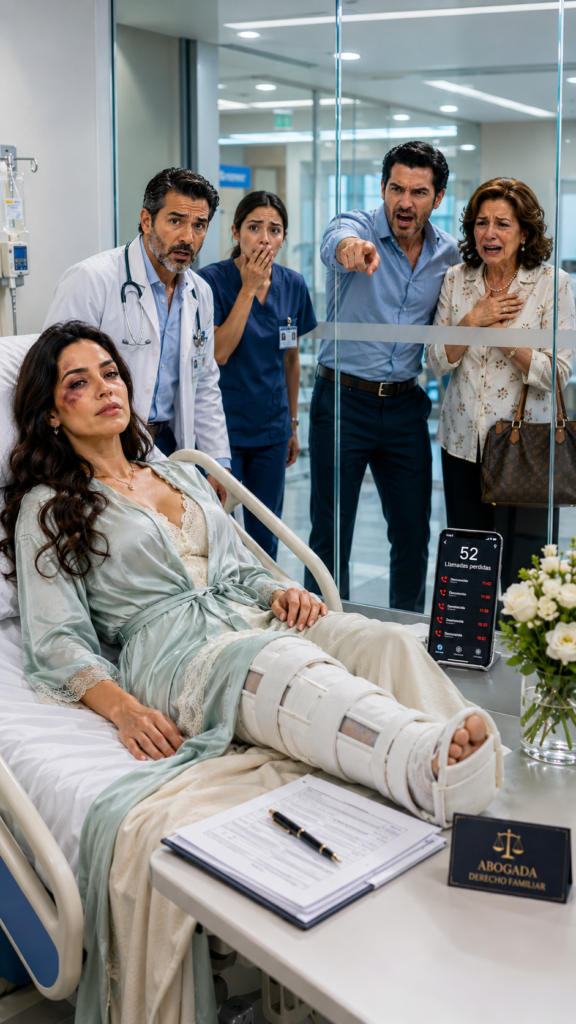
The next day, Doña Elvira accompanied Marisol to the hospital.
They didn't go as friends.
Not yet.
They went as two women full of guilt, holding onto the same folder of studies, trying to arrive in time where Lucía didn't.
The diagnosis was serious, but not impossible.
There was a kidney problem that had caused fluid retention and high blood pressure. There were also signs of early heart damage.
The doctor was clear.
"If you'd waited longer, this would have gotten much more complicated."
Marisol looked at Doña Elvira.
Doña Elvira covered her face.
Diego cried silently.
The following months weren't like a novel.
There were pills, supervised diet, consultations, tests, fear, and fatigue.
There were also uncomfortable conversations.
Marisol told Doña Elvira that saving someone didn't give permission to destroy them.
Doña Elvira admitted she'd repeated with Marisol the same violence that slowly killed Lucía: talking about the body as if it were guilt, not a symptom.
Diego had to accept his part.
It wasn't enough to say "my mom is like that." It wasn't enough to stay silent to avoid conflict.
Silence also weighs.
Sometimes it weighs more than a taunt.
The blue dress hung in Marisol's room.
Not as a goal to lose weight.
Not as punishment.
As a reminder.
It had a mud stain on the bottom, from that night in the patio. Marisol tried to wash it three times, but it wouldn't come off.
Doña Elvira asked her not to remove it.
"That's how truth remains," she said. "Stained, but alive."
On Sundays, Doña Elvira arrived with chopped fruit, her pillboxes, and that bossy manner she never quite lost.
But she no longer said "another tortilla."
Now she asked:
"How are your ankles this morning?"
Marisol sometimes laughed.
Sometimes she cried.
Sometimes she still got angry because forgiving doesn't erase what hurt.
One afternoon, facing the dress, Doña Elvira said Lucía's full name for the first time without leaving the room.
"Lucía Martínez Reyes."
Marisol repeated it softly.
And the two stared at the blue garment, which one day was a taunt, then a threat, then proof, then inheritance.
Many in the family had opinions.
That Marisol exaggerated.
That Doña Elvira asked for it.
That a mother-in-law like that didn't deserve forgiveness.
That a daughter-in-law like that didn't deserve help.
But none of those who opined had carried a suitcase full of a dead daughter in the rain.
And none of those who judged had lived years believing their body was a shame when it was actually crying for help.
That's why Marisol never let anyone comment on her weight at a family meal again.
Not as a joke.
Not as affection.
Not 'for her own good.'
Because since then, she understood something many still don't:
sometimes the body doesn't need criticism to change.
It needs someone to listen before it's too late.