PART 1
—Your mother is gravely ill and you’re out there strolling on the beach with the girl… really, Mariana, you have no mother.
Rodrigo's voice boomed through the phone while Mariana sat under a beach umbrella in Puerto Morelos, watching Sofia chase after a wave with her little pink bucket.
Years ago, that call would have made her cry.
She would have packed the swimsuits, bought the first ticket back to Mexico City, and arrived with guilt weighing heavily on her chest to care for Doña Elvira, her mother-in-law.
But that afternoon, Mariana simply took a deep breath and answered with a calmness that hit Rodrigo harder than a scream.
—If your mom is gravely ill, you go take care of her.
There was silence.
—What did you say?
—What you heard, Rodrigo. I am no longer a nurse, a maid, or anyone’s doormat.
She hung up before he could insult her.
To Rodrigo’s family, Mariana was an ungrateful daughter-in-law. The woman who went on vacation while Doña Elvira was “laid up” with a fractured hip.
But nobody talked about the ten years Mariana spent trapped in a house in the Agrícola Oriental neighborhood, serving, silencing herself, and asking for permission even to buy shampoo.
Rodrigo earned almost 80,000 pesos a month as a marketing director at a telecommunications company. Yet each paycheck left Mariana with just 3,000 pesos on the table.
—For food, school, and whatever else is missing. Don’t come at me with your dramas.
With that, Mariana had to pay for groceries, medicine, transportation, Sofia’s school supplies, and Doña Elvira’s whims, who would arrive unannounced demanding beef broth, sweet bread, and freshly brewed coffee.
If Mariana said it wasn’t enough, Rodrigo would utter the same phrase:
—Then get a job, though I doubt anyone would hire you.
He said it knowing he had asked her to quit her job as an editorial proofreader when Sofia was born.
The last humiliation happened on their tenth anniversary. Mariana prepared green enchiladas, bought a small cake, and set a simple table with candles.
Rodrigo arrived drunk, with another woman’s perfume lingering on his shirt. He looked at the dinner and laughed.
—Is this it? How embarrassing.
With a swipe of his hand, he knocked a plate to the floor. The glass shattered, and a shard sliced Mariana’s ankle. Sofia came out of the room, crying.
—Daddy, stop yelling at Mommy.
That night, Mariana slept holding her daughter and understood that staying was also a way to teach her fear.
The next day, she contacted Diego Santillán, a lawyer who had been her classmate in college.
—Don’t announce anything — he told her. — Gather evidence. Economic violence, threats, receipts, audio recordings. Without proof, he will play the victim.
Mariana complied.
For weeks, she recorded conversations, saved receipts, screenshots, and bank statements. Additionally, she continued proofreading manuscripts at night, in secret, until she saved money to leave.
On Friday, before the trip, Doña Elvira called, crying.
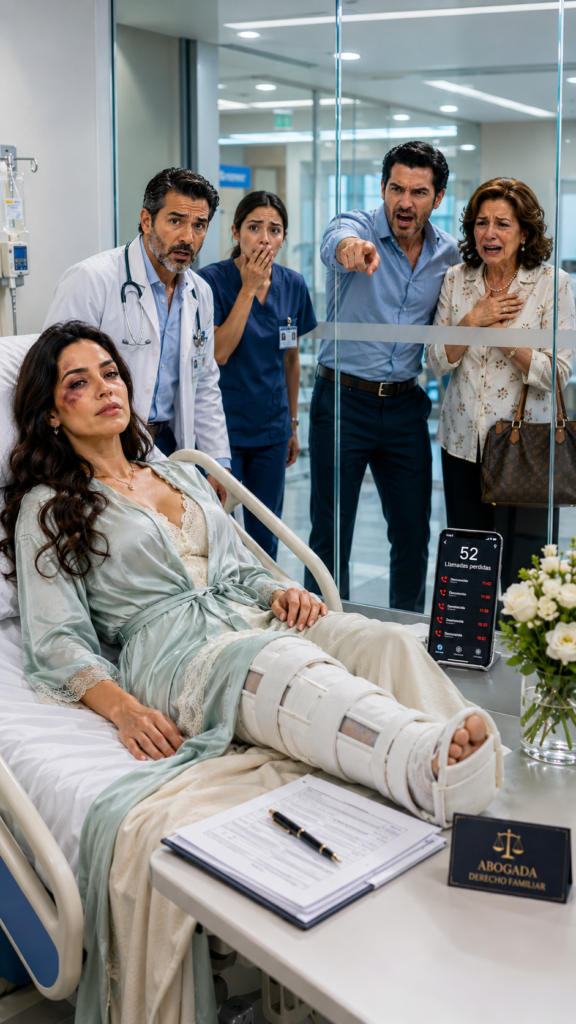
—I fell badly, sweetheart. My hip is a mess. Come take care of me. Rodrigo is working, and you’re doing nothing.
But that very morning, Mariana had seen her in a neighbor’s video, salsa dancing at a fair in golden high heels.
So she bought two tickets to Quintana Roo, packed a suitcase, and left two hidden recorders in the living room and kitchen.
That night, from the hotel, she opened the app.
First, she heard her neighbor Lupita's voice:
—Elvira, yesterday you were dancing and today you're using a walker. What happened to you?
Then came a dry laugh.
—Nothing, dear. My nephew from the clinic got me a note and a brace. Let’s see if that useless Mariana learns her place.
Next, Rodrigo’s voice came through.
—Do it right, Mom. If she doesn’t come back, we take Sofia away from her.
Mariana froze.
And she hadn’t even heard the worst part yet.
PART 2
Mariana replayed the audio three times, not out of doubt, but because she needed to accept that the threat hadn’t been a moment of rage.
Rodrigo and Doña Elvira had planned it.
They didn’t want her back out of love. They wanted to break her, bring her back home, and force her to wash dishes, prepare broths, and apologize for breathing.
Sofia slept in the hotel bed, her little face sunburned and a dolphin stuffed animal clutched in her arms.
Mariana looked at her and sent the audios to Diego.
The response arrived in less than five minutes.
“This is useful. And check the file I sent. There’s something stronger.”
It was a bank report for Rodrigo.
Mariana downloaded the PDF with cold hands. At first, she saw only numbers, dates, and repeated concepts. Then she understood.
On the 5th of each month. Transfer to Elvira Robles. 40,000 pesos. Concept: support for Mom.
40,000 pesos a month for 36 months.
1,440,000 pesos.
Mariana felt nauseous.
She had patched Sofia's uniform three times. She had bought half a kilo of ground beef to stretch it over two meals. She had borrowed money for an antibiotic when the girl had a throat infection.
Meanwhile, Rodrigo was handing his mother more than half of what she thought was the family income.
Diego wrote again.
“They are married under community property. That money is also part of the common estate. If he diverted it without consent, we can ask for liquidation, precautionary measures, and provisional alimony.”
Mariana didn’t scream.
She didn’t cry like before.
She simply put her phone away, washed her face, and promised herself Rodrigo would never use Sofia as a chain again.
The next morning, Doña Elvira sent a photo lying in bed, wearing a brace, looking like a martyr.
“Sweetheart, it hurts to even breathe. Come back. Don’t be a bad Christian.”
Mariana enlarged the photo.
In the closet's mirror, Doña Elvira could be seen sitting, legs crossed, a plate of chilaquiles in hand, and freshly painted red nails.
Mariana called her on a video call.
Doña Elvira took time to answer. When she did, she covered the camera.
—Oh, Mariana, what a horrible pain. I feel like I’m dying.
—How strange, Doña Elvira. In the mirror, you looked very alive, very made up, and with chilaquiles.
On the other side, there was not a whimper, but a scream.
—You damn equal!
—Next time, remove the mirrors before you act.
She hung up.
Two minutes later, Rodrigo called.
—What did you say to my mom? You upset her!
—I didn’t upset her. I discovered her.
—I’m going to report you for taking Sofia without my permission.
—Go ahead. And while you’re at it, explain to the Public Ministry why you and your mother planned to fake an illness to force me to come back.
Rodrigo breathed heavily.
—You don’t know who you’re messing with.
—I do know. I’m dealing with a man who gave me 3,000 pesos to survive while he transferred 40,000 a month to his mom.
The silence stretched long.
—Where did you get that?
—That doesn’t matter anymore.
—Mariana, listen...
For the first time, his voice didn’t sound arrogant. It sounded scared.
That afternoon, Rodrigo called again, but he no longer threatened. He cried.
He told her that his uncle Fermín, Doña Elvira’s brother, was suing him over a promissory note for 1,000,000 pesos. Supposedly, Rodrigo had signed it for an investment in land in Morelos.
Doña Elvira had promised him she would receive the 40,000 monthly and would take care of paying Fermín little by little.
But she hadn’t paid anything.
—My uncle wants to seize the house — Rodrigo said, desperate —. I need your savings, Mariana. I know you have money saved.
—My savings are for Sofia and me.
—You’re my wife.
—I was your wife when you needed to humiliate me. Now it turns out I’m also your bank.
—Don’t be like that. My mom could lose everything.
—Your mom faked being gravely ill to turn me back into her servant.
—I'll take the girl away from you!
Mariana put the call on speaker and activated the recording.
—Repeat that, Rodrigo.
He hung up.
Two days later, Mariana returned to Mexico City. She didn’t announce the exact time, but Rodrigo showed up at the Benito Juárez International Airport as if he had been watching every move.
He came with a wrinkled shirt, unshaven, and bloodshot eyes. When he saw Sofia, he tried to approach.
The girl hid behind Mariana.
—Give me your savings — he murmured —. Or I swear I’ll make sure you never see Sofia again.
Mariana looked up. There were people around: families with suitcases, ladies eating tortas, a guard near a column.
Rodrigo grabbed her wrist.
—Don’t make me angry here.
Mariana pulled out her phone with her other hand and played the audio at full volume.
Rodrigo's voice filled the hallway:
—Do it right, Mom. If she doesn’t come back, we take Sofia away from her.
Several people turned to look.
Rodrigo’s face drained of color.
Then Mariana played another snippet.
—My mom told me to send her 40,000 a month to pay my uncle Fermín. If I don’t give Mariana my savings, we’re getting seized.
A guard came over.
—Sir, let go of the lady.
Rodrigo released her as if she burned.
—Mariana, please...
—Don’t ever touch me again. Don’t ever threaten me again. And don’t ever use my daughter as a bargaining chip.
Sofia took her hand.
—Mom, are we leaving?
—Yes, my love.
They didn’t go home. Diego had already found them a small apartment in Narvarte, lent by a cousin. It had two bedrooms, an old table, and a window overlooking a jacaranda tree.
To Mariana, it felt like a palace.
That same night, Doña Elvira called from an unknown number.
Mariana answered with the recorder ready.
—Wretched woman — the woman spat —. Because of you, my son is sinking. Bring me the 200,000 pesos you hid or I will come for the girl.
Mariana closed her eyes.
—You’re not coming for anyone.
—I am her grandmother.
—And you’re also the woman who used a fake brace, a clinic note, and your own son to extort me.
Doña Elvira let out a bitter laugh.
—You have no proof.
—Yes, I do. I also know about the two plots in Cuernavaca you bought in your name. Your pension doesn’t even reach 9,000 pesos. Want to explain to the judge how you paid for them?
The silence grew heavy.
—Who told you that?
—Tomorrow, the divorce lawsuit will be filed, the liquidation of community property, and the precautionary seizure of those plots.
Doña Elvira screamed so loudly that Mariana pulled the phone away from her ear.
—My properties are off-limits!
—Then you shouldn’t have touched Sofia’s money.
The next day, Diego submitted everything.
The divorce lawsuit. The request for provisional custody. Alimony for Sofia. Proof of economic violence. The audios. The bank statements. And the precautionary seizure of Doña Elvira’s properties.
Rodrigo agreed to meet in a café across from the family courts.
He arrived wearing dark glasses, even though it was cloudy. He sat down without greeting her.
Mariana placed a folder on the table.
—Custody for me. Supervised visits at first. Monthly alimony for Sofia. And a refund of 720,000 pesos, half the money you diverted to your mom.
Rodrigo let out a dry laugh.
—Do you really think a judge will believe you? You don’t have a job.
Mariana opened another folder.
There was her contract as a full-time editor at a publishing house in Polanco. 36,000 pesos a month, benefits, and a flexible schedule.
Rodrigo stared at the paper as if it were a betrayal.
—You didn’t work.
—I worked at dawn while you slept. That’s how I was able to leave.
He clenched his teeth.
—I’m not signing.
Mariana slid the last document across.
—Then Diego will send your company the false invoices with which you withdrew 380,000 pesos last week to pay Fermín. They bear your signature.
Rodrigo froze.
—That can’t be...
—Sign, Rodrigo. Or explain to your boss why you used fake suppliers.
His hand trembled as he took the pen.
He signed.
But the real fall came two weeks later, in the civil court where Fermín was suing Rodrigo for the promissory note of 1,000,000.
Doña Elvira arrived in a wheelchair, with huge glasses and a scarf around her neck. She tried to appear fragile, but nobody believed her too much.
Fermín showed up in a brown suit, wearing the smile of a confident man.
The judge requested to hear from both parties.
Fermín lifted the promissory note.
—My nephew owes me 1,000,000 pesos. I demand payment or the seizure of the family house.
Rodrigo stood up.
—I signed because my mom and my uncle told me it was an investment. I was giving my mom money to pay him.
Fermín slammed the table.
—Liar! I never received anything.
Then Diego asked for permission to present a video sent by neighbor Lupita.
Doña Elvira’s eyes widened.
The screen showed the backyard of her house. The image was blurry, but the audio was crystal clear.
Fermín argued with her.
—Elvira, Rodrigo transferred you 1,440,000 pesos. You bought properties and only gave me 250,000 in commission. I invented the promissory note, but now my creditors are pressing me. Give me 500,000 or I’ll ruin you.
Doña Elvira’s voice responded with venom:
—That money is mine. I birthed Rodrigo. Mariana deserves nothing. Let her sell her savings, let her pay. Daughters-in-law are meant for that.
The courtroom fell silent.
Rodrigo looked at his mother as if seeing her for the first time.
—Did you steal from me?
Doña Elvira tried to cry.
—Son, I just wanted to secure my old age.
—With my daughter’s money?
Fermín tried to leave, but a court officer blocked his path.
The judge suspended the proceedings and ordered the evidence to be sent to the Public Ministry for possible fraud, simulation, and procedural fraud. He also maintained the seizure of the properties to guarantee economic reparation for Mariana and Sofia.
Doña Elvira screamed:
—No! My properties!
Mariana felt neither pity nor hatred.
She only saw a woman who had confused motherhood with ownership, family with abuse, and obedience with love.
Months later, the properties were sold by court order. Mariana received the 720,000 pesos agreed upon. Rodrigo lost his job due to the false invoices and had to accept supervised visits until he could demonstrate emotional and economic stability.
Doña Elvira stopped faking illnesses. Now nobody ran when she called, crying.
Mariana bought a round table for her apartment. That first night, she had dinner with Sofia, noodle soup, quesadillas, and lemonade.
Sofia placed a sunflower in a glass.
—Mom, it feels peaceful here.
Mariana hugged her tightly.
For years, they made her believe that enduring was being a good wife. That silencing herself was taking care of the family. That a woman without an income had no right to demand.
But this simple peace, at a small table and without shouting, was worth more than any house full of appearances.
Because sometimes a woman doesn’t harden.
She simply stops apologizing for surviving.