The call came on a Thursday morning in late October, when the leaves outside Clara's office window had turned the color of old copper and the sky carried that particular weight of a season ending.
Clara didn't take personal calls during work hours. She had a rule about that — one of many small rules she had built around herself over the years, careful structures that kept the days moving forward, productive, purposeful. But her assistant knocked twice on the glass partition and held up a sticky note with the words ATTORNEY — RE: ESTATE written in capital letters, and something about the formality of it made Clara set down her coffee.
"Ms. Reyes?" The voice on the other end was measured, professional. A man in his sixties, she guessed, someone accustomed to delivering news of all varieties. "My name is Gerald Hoffman. I'm an estate attorney with Hoffman and Associates. I'm calling on behalf of the estate of Patricia Anne Whitmore."
Clara waited. The name meant nothing to her.
"Ms. Whitmore passed away twelve days ago," Hoffman continued. "She has named the Second Chance Foundation as a primary beneficiary in her will. The bequest is substantial — in excess of one point four million dollars."
The silence that followed was long enough that Hoffman asked if she was still on the line.
"I'm here," Clara said. "I'm sorry — did you say one point four million?"
"Yes. There are conditions attached to the acceptance of this bequest, which I would prefer to discuss in person. Would you be available to come to our offices in the next week?"
Clara looked at the corkboard above her desk, the one covered in photographs of the young people Second Chance had helped over the past eight years. Kids aging out of foster care with nowhere to go, no safety net, no one to call. She thought about the foundation's operating budget, which had been running tight for the past two quarters. One point four million dollars.
"Yes," she said. "I can make that work."
She spent the rest of that afternoon trying to find Patricia Anne Whitmore in any donor database, any grant records, any correspondence. There was nothing. The name appeared nowhere in Second Chance's history. A woman Clara had never heard of had apparently decided, before dying, to leave more money to her foundation than Clara had raised in the past three years combined.
She told herself it happened sometimes. Elderly donors with no family, moved by a mission they'd read about. She told herself not to overthink it.
She was not yet aware of how wrong she was.
The reading of Patricia Whitmore's will had taken place eleven days earlier, in Gerald Hoffman's conference room on the fourteenth floor of a building in downtown Hartford, Connecticut. The room had a long mahogany table and windows that looked out over the river, and it smelled of old paper and the particular stillness of money.
Patricia's two adult children had arrived separately, which told Hoffman something he already suspected about the state of the family. Richard Whitmore, fifty-two, arrived first. He was tall and fleshy in the way of a man who had once been athletic and stopped trying sometime in his forties. He wore a dark suit that fit badly across the shoulders and a watch that fit well at his wrist, and he spent the first ten minutes checking his phone.
Diane Whitmore-Castillo arrived eight minutes later, her heels announcing her down the hallway. She was forty-nine, sharply dressed, with their mother's silver-blonde coloring darkened somewhat with help from a salon. She and Richard nodded at each other in the way of people who share a history and a mutual low-grade grievance, and they sat on opposite sides of the table.
Hoffman had done this long enough to know that the next thirty minutes were going to be unpleasant.
He read the will in the careful, neutral voice he had perfected over decades. Patricia had left her personal effects — jewelry, furniture, a collection of first-edition books — to Diane. She had left her car and her watch collection to Richard. She had left her lake house in Vermont to a wildlife conservation fund.
And she had left everything else — the house in West Hartford, the investment portfolio, the remaining liquid assets, the entirety of her estate valued at approximately two point one million dollars — to an organization called the Second Chance Foundation.
The silence in the room had a specific texture. Hoffman had learned to recognize it: the silence of people doing rapid arithmetic and arriving at numbers they don't like.
Richard spoke first. "Who is Second Chance Foundation?"
"A nonprofit organization based in Hartford. They provide transitional support services to young adults aging out of the foster care system."
"I've never heard of them."
"Your mother was not required to discuss her charitable giving with you."
Diane's voice, when it came, was very quiet and very precise. "Are you telling us that our mother — our mother, who watched her grandchildren grow up from a distance because she was too busy with her causes — left them two million dollars?"
"The estate is valued at approximately two point one million, yes. After applicable taxes and the specific bequests I mentioned, the remainder going to Second Chance Foundation will be in excess of one point four million dollars."
"That's our inheritance," Richard said. His voice had gone flat.
"Connecticut is not a forced heirship state, Mr. Whitmore. Your mother had the legal right to distribute her estate as she wished."
"We'll contest it," Diane said.
"That is your right. I would advise you to consult with your own counsel before making that decision." Hoffman paused. "I will also tell you that the will was drafted four years ago, updated twice since then, and that your mother was examined by two physicians and a psychologist over the past eighteen months, all of whom found her to be of sound mind. A contest would be lengthy, expensive, and in my professional assessment, unlikely to succeed."
What Hoffman did not tell them — what he was not yet required to tell them — was the other thing. The letter. The condition attached to the foundation's acceptance of the bequest, the condition that could change everything about what this moment meant.
That part was not for them. Not yet.
Clara Reyes had aged out of the foster care system at eighteen with forty-three dollars in her pocket, a garbage bag of belongings, and the phone number of a case worker who never picked up when she called.
She did not like to talk about the years that followed. Not because they were shameful — she had long since made peace with the fact that survival was not shameful — but because they had a quality of rawness that she found difficult to translate into language that didn't sound like a plea for pity, and Clara had never been comfortable asking for anything.
What she would say, if pressed, was this: she had found her way. She had worked three jobs in her early twenties, earned an associate's degree at community college, then a bachelor's at a state school, mostly online, over six years. She had a gift for logistics, for seeing the shape of a problem and organizing a response to it. She had ended up working for a small nonprofit in Hartford, doing program coordination, and she had been good at it.
The idea for Second Chance Foundation had come from a kid she met at a community outreach event in 2017. He was nineteen, had been out of the system for a year, and was sleeping in his car because he'd lost his apartment after missing a rent payment while in the hospital with pneumonia. He had no family. He had no emergency contact. He had fallen through every gap in every system that was supposed to catch people, and he was quietly disintegrating, and no one was doing anything about it.
Clara had found him an emergency placement, helped him navigate the housing assistance application, sat with him in waiting rooms. And then she had gone home and written a business plan for what should have existed for him — for her younger self — and hadn't.
Second Chance Foundation launched in 2018 with a borrowed office space, two part-time staff, and a first-year budget of eighty thousand dollars scraped together from small donors and one local business grant. By 2024, it had a staff of fourteen, a residential transitional housing program, a job training partnership with three local employers, and had served over four hundred young people.
The anonymous founding donation — the hundred thousand dollars that had made the first real office possible — had arrived in early 2018. No name. A cashier's check sent through an attorney's office, with a letter that said only: For the young people who fall through the cracks. May they find solid ground.
Clara had framed the letter and hung it in the reception area.
She had always assumed it was a wealthy local donor who wanted privacy. She had sent a thank-you letter to the attorney's office and heard nothing back. The donations had continued, smaller after that first year — five thousand here, ten thousand there, always anonymous, always arriving at moments when the foundation needed them most.
Eight years. Eighty-three thousand dollars in anonymous donations, not counting the initial hundred thousand.
She had not known. How could she have known?
Gerald Hoffman's office was on the fourteenth floor of a building Clara had passed a hundred times without ever going inside. The elevator was slow and wood-paneled, and she studied her own reflection in its brass door and thought about what she was going to say.
Accept the bequest. Thank the attorney. Find out what the conditions were and determine whether Second Chance could comply with them. That was all. She had run this organization for eight years on clarity and practicality, and that was what had gotten them this far.
The receptionist led her down a hallway lined with framed photographs and documents, the accumulated record of a legal career. Hoffman's office was at the end, a corner room with the river view she could see even from the doorway.
But it was not the river that stopped her.
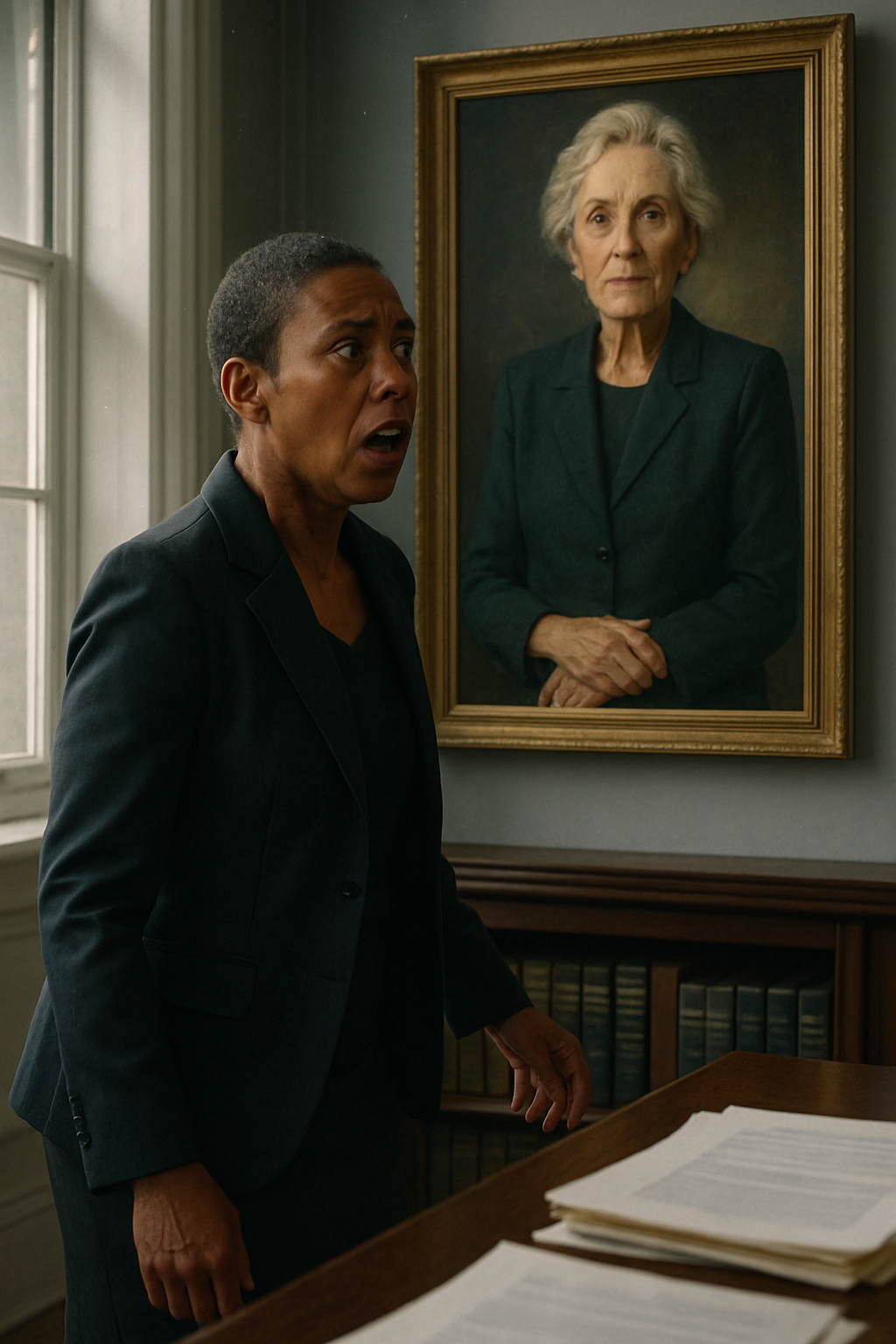
On the wall to the left of Hoffman's desk, between a bookshelf and the window, hung a portrait. Not a photograph — a painted portrait, the formal kind, the kind families commissioned for significant birthdays or anniversaries. A woman in her late sixties or early seventies, silver-haired, wearing a dark green dress, her hands folded in her lap with practiced composure.
Clara stopped walking.
She didn't know why she stopped. The portrait was of a stranger. She had never seen this woman in her life.
But the eyes.
The eyes in the portrait were a specific shade of dark amber-brown, set at a particular angle, with a quality of watchfulness in them — not suspicion, exactly, but attention. The kind of eyes that saw things clearly and chose carefully what to do with what they saw.
Clara had looked at those eyes in the mirror every morning of her life.
"Ms. Reyes." Hoffman had risen from behind his desk, his hand extended. "Thank you for coming."
She shook his hand. She was still looking at the portrait.
"Who is that?" she asked.
Hoffman paused. It was a fractional pause, barely perceptible, the pause of a man who had been waiting for this question and had prepared his answer.
"That is Patricia Anne Whitmore," he said. "The woman whose estate you're here to discuss."
Clara looked at him. Then she looked back at the portrait. At the eyes that were her eyes, looking back at her from the face of a dead woman she had never met.
"Please," Hoffman said quietly. "Sit down."
She sat. Hoffman poured water from a crystal pitcher and set a glass in front of her, and she was grateful for the small ordinary action of it.
"Before we discuss the terms of the bequest," Hoffman said, "I want to be transparent with you. Patricia Whitmore made the initial anonymous donation to Second Chance Foundation in January 2018. She had been following your work for approximately a year prior to that. She continued to make anonymous donations for eight years."
"Why?" Clara asked.
"That is answered in a letter she left with me. But the letter has a condition — it can only be opened if you accept the bequest. She wanted to make sure that if you learned what the letter contained, it would not feel like coercion. She wanted you to have already made a free choice before you knew why she cared."
The conditions of the bequest were two: the funds must be used exclusively for Second Chance's programs, and Clara herself — as founder and executive director — must personally accept. Not a board member. Not a representative. Her.
"Why does it have to be me personally?" Clara asked.
"Because," Hoffman said carefully, "Patricia's letter is addressed to you specifically. And she wanted to be certain that you would be the one to read it."
Clara looked at the portrait again. Patricia Whitmore looked back at her with those eyes — those familiar, impossible eyes — composed and still and carrying something that Clara, even from across the room, could only describe as love.
"All right," Clara said. "I accept."
Hoffman opened his desk drawer and removed a sealed envelope. Cream-colored, thick, with Clara's name written on the front in a careful, old-fashioned hand. He slid it across the desk.
Clara picked it up. She could feel the weight of the other thing too — the thing she didn't have a name for yet, the thing that had started the moment she looked at those eyes in the portrait and felt the floor shift beneath her.
She broke the seal.
Dear Clara,
I have started this letter fourteen times over the past three years. Each time I have thrown it away, because I could not find the right words, and because I was afraid. I am seventy-one years old and I have done a great many things in my life that I am proud of, and I have done one thing that has never stopped costing me something. I gave you away when you were three days old, and I have never forgiven myself for it, and I have never stopped watching over you from whatever distance you would allow me without knowing.
You were born on March 14, 1982. Your birth certificate lists your biological mother as Jane Doe, which is what the hospital used because I would not give my name. I was twenty-three years old, unmarried, from a family that would not have survived the scandal, and I was terrified in a way that I cannot adequately describe to you now, from this distance, having lived long enough to understand that most of the things I was terrified of were not worth the price I paid for avoiding them.
I named you, in my own heart, before I gave you up. I called you Clara, because it means clear and bright, and because I wanted you to have something of yourself that was not shadowed by my failure.
I don't know how you came to be called Clara. I don't know if that name followed you somehow, or if it was simply a coincidence. I have thought about it often.
I married two years after you were born. I had two children — Richard and Diane — whom you will almost certainly hear from, and who will almost certainly not make this easy for you. I am sorry for that in advance. They are not bad people. They are people who grew up believing they understood who their mother was, and they did not. That is my fault, not theirs.
I found you in 2009. I hired a private investigator, which felt both necessary and wrong. I learned your name. I learned that you had been in the foster care system until you were eighteen, that you had survived it, that you were working and building a life. I did not reach out. I told myself it was because you deserved not to have your life disrupted by someone who had already made her choice. The truth, which I am old enough now to admit, is that I was still afraid. Afraid of what you would think of me. Afraid of what I thought of myself.
I watched you from a distance for years. I followed your career. When you started Second Chance Foundation, I understood immediately what you were doing and why you were doing it, and I felt something I can only describe as recognition — the kind of recognition that comes when you see yourself in someone else and understand that the connection between you is real, regardless of the choices that were made.
I could not give you a mother. But I could give you what I had, for the work that mattered most to you.
The anonymous donations were my way of being present without disturbing you. I know how that sounds. I know it may feel like watching instead of helping, like the same distance I always kept. But I want you to understand that every time I wrote one of those checks, I was trying to say something I did not know how to say out loud: that I saw you, that I was proud of you, that what you built from nothing — from a beginning that I gave you and that was not good enough — was extraordinary. That you were extraordinary.
I am not asking for your forgiveness. I gave up the right to ask for that a long time ago, and I do not believe it is something that can be asked for, only given, and only when the person who was hurt is ready to give it, if they ever are.
What I am asking — the only thing I am asking — is that you read this letter and know the truth. That you know you were not forgotten. That you know there was never a day in forty years when I did not think about you and hope that you were safe and whole and building something worth building.
The money is yours. It belongs to the work you do. Use it for those children — those kids who fall through the cracks, who age out of systems that were supposed to love them and didn't, who need someone to be there when no one else is. Use it for them, because you were one of them once, and because I owe you — and them — more than money can repay, but money is what I have left to give.
You have a brother and a sister. They don't know about you yet. That conversation will be hard, and I am sorry to leave it to you and to them without me there to navigate it. I was a coward about this for too long, and the consequences of that cowardice are yours to manage now, which is not fair. I know it is not fair.
I watched you for eight years build a foundation on the principle that people deserve a second chance regardless of how they started. I am hoping, with whatever part of me is still capable of hope, that you might find it in yourself to believe that extends to imperfect mothers who loved badly and too late and from too far away.
Your mother, Patricia
Clara read the letter twice.
The second time, she was aware of Hoffman sitting quietly on the other side of the desk, giving her the silence she needed. She was aware of the portrait on the wall, Patricia's painted eyes watching her with that expression she now understood was not just watchfulness. It was longing. It was the careful, contained face of a woman who had practiced for years not showing what she felt.
She recognized that too.
When she set the letter down, her hands were still steady. She had trained herself, long ago, to keep her hands steady. But her chest felt as though something large and heavy had settled into it, something she would need time to understand the shape of.
"She was my mother," Clara said. It was not a question.
"Yes," Hoffman said.
"She knew who I was for eight years and she never said anything."
"She was afraid of — "
"I know what she was afraid of." Clara's voice was quiet, even. "I read the letter."
She looked at the portrait one more time. "The portrait — is it part of the estate?"
"It was painted eight years ago. Patricia specified it should be offered to you. If you decline, it goes to her daughter Diane."
Clara looked at Patricia Whitmore's face. At the eyes she had seen in the mirror for forty-three years without understanding what they meant.
"I'll take it," she said.
She sat in her car in the parking garage for twenty minutes before she could drive. Not crying — that would come later, probably at two in the morning when the controlled surface of herself finally gave way. Just sitting. Letting the enormity of it settle.
She had grown up telling herself the story she needed to keep going: her mother had been young and frightened, had not had a choice, had thought she was doing the right thing. The stories were true. She had been right about all of them.
But the woman in those stories had also been alive, twenty miles away, for forty years. Had known Clara's name and her work and her face. Had written fourteen drafts of a letter and thrown them all away.
Her phone buzzed. A text from her program director: How did the meeting go?
Clara stared at the screen. She thought about the next week — the board meeting, the formal acceptance, the phone call that would eventually have to happen with Richard and Diane Whitmore, her half-siblings, who were about to discover that their mother's estate had gone to the biological daughter they'd never known existed.
She thought about For the young people who fall through the cracks. May they find solid ground.
Who writes that? Who writes that, anonymous, in the dark, and never signs their name?
A woman who spent forty years finding indirect ways to say the thing she was too afraid to say directly.
A mother.
Clara typed back: Meeting went well. Big news. I'll explain Monday.
She started the car.
Diane Whitmore-Castillo found out about Clara ten days later. She had hired a private investigator within forty-eight hours of the will reading, and what he found had taken her two days to accept as true: Clara Reyes, forty-three, born Hartford, March 14, 1982, biological mother Patricia Anne Whitmore. Given up at three days old. In and out of the foster care system until eighteen. The investigator had included a photograph. Diane had sat with it for a long time — those eyes, their mother's eyes, in the face of a woman she had never met.
She called Richard and told him everything. He was silent for a long stretch, and then said: "Mom knew. Mom knew for years."
"Apparently she found her in 2009," Diane said. "Watched her for fifteen years without saying anything to any of us. And then died and gave her everything."
The question neither of them said aloud — the one that hurt more than the money — was whether their mother had simply loved this stranger more. Whether the distance between them and Patricia had culminated in this: a will that wrote them out of the story entirely. It was easier to look for fraud than to sit with that. But looking at the photograph, at those unmistakable eyes, Diane already knew there was no fraud to find.
"We're not contesting," she told Richard finally. "I've already decided."
The call from Diane came on a Friday morning. Clara had been expecting it. She took it calmly, and Diane's voice on the other end was precise and controlled, carrying something that hadn't decided yet whether it was anger or grief.
"I have a photograph of you," Diane said. "Your eyes are — " She stopped.
"I know," Clara said.
"I'm furious at my mother," Diane said. "She should have told us. All of us. A long time ago."
"Yes," Clara said. "She should have."
A long silence. Then: "The estate — we aren't going to contest it. I want you to know that. The kids your foundation helps — she chose them. Chose you. I want to understand what she saw."
"Maybe," Clara said carefully, "you'd like to come visit the foundation sometime."
"Yes," Diane said, after a pause that worked something through. "I think I would."
The portrait of Patricia Whitmore hung now in Clara's office, beside the corkboard covered in photographs of the young people Second Chance had served. Clara looked at it sometimes, in the quiet between meetings — Patricia looking back with those amber eyes, composed and still, carrying the same careful containment Clara recognized in herself.
The foundation's operating account received the bequest transfer in December: one point four million, two hundred thousand dollars. Clara sat with the bank notification for a long time, then opened a document and began writing the program expansion proposal she had been putting off for three years for lack of funding. The residential capacity expansion. The mental health partnership. The alumni network. All the things she had known were possible and hadn't yet had the resources to build.
She named the new residential program Patricia's House. Not because she had forgiven everything — the grief of the missing years, the questions that could never be answered, would take a long time to settle. But because Patricia had given what she had to give, in the only way she'd known how, and because Clara understood that sometimes love looks like the letter thrown away fourteen times before it finally gets sent.
Sometimes love looks like a hundred-thousand-dollar cashier's check and a note that says: For the young people who fall through the cracks. May they find solid ground.
Sometimes the person who most wanted to give you solid ground was the same person who had, a long time ago, let you fall.
You carry both of those things. And you build anyway.
That was what Second Chance Foundation had always been about. Now it had a name on the door to prove it.