Her Husband Filed for Divorce After Eighteen Years. His Lawyer's Expression Changed When He Read Who Actually Owned the Business.
Part 1
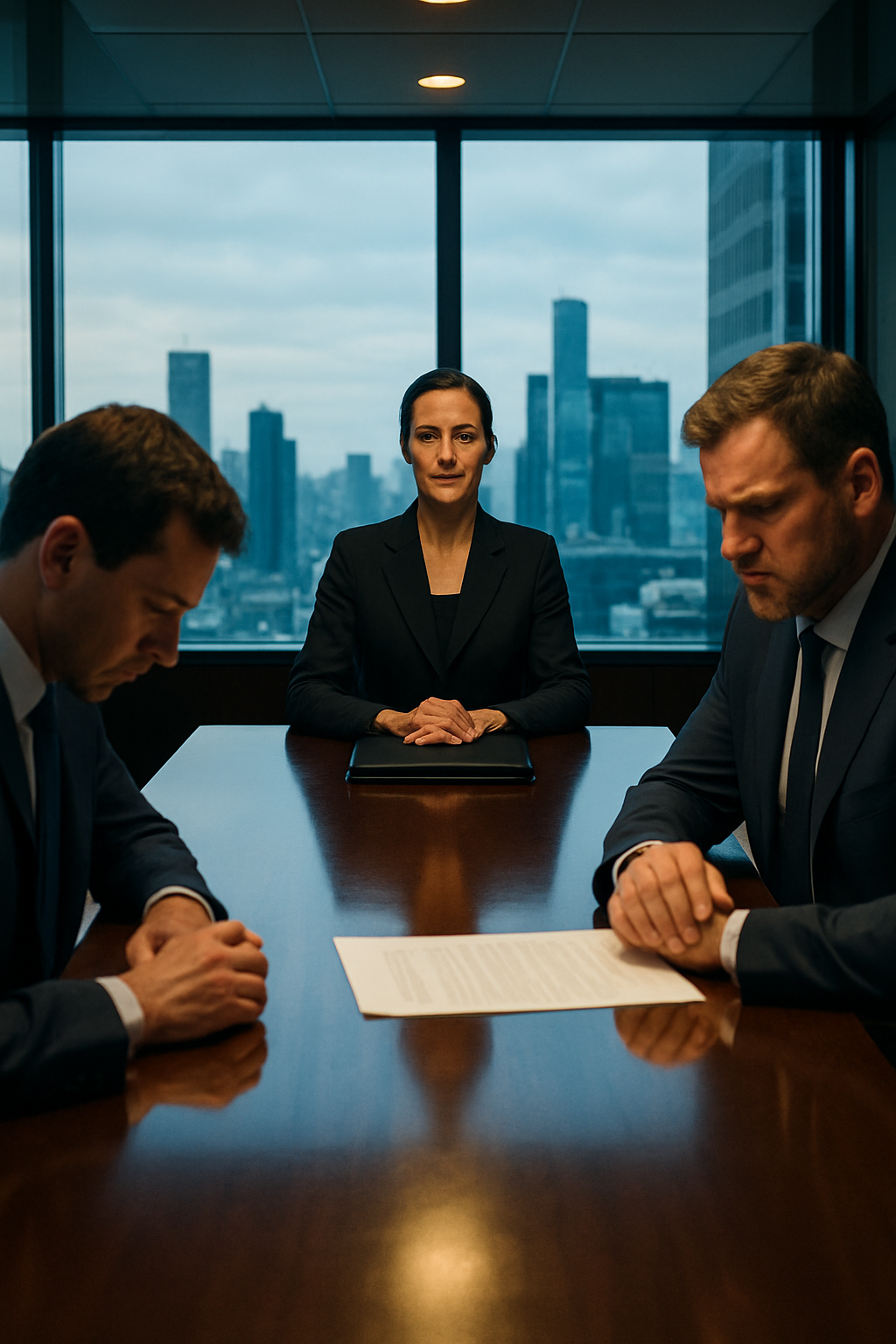
The conference room on the forty-second floor of Harrington & Cole smelled like old mahogany and fresh anxiety.
Sandra Mercer arrived seven minutes early, which was unusual for her. For the past eighteen years, Marcus had been the punctual one — the one who set three alarms, who left the house at the same time every morning, who believed that being on time was a form of respect. Sandra had always been the one who lost track of time, who got caught up in a chapter she was reading or a conversation she couldn't bring herself to end. Marcus used to laugh about it. "You'll be late to your own funeral," he'd say, and she'd throw a dishcloth at him across the kitchen, and they'd both laugh.
She wasn't laughing now.
She sat in one of the high-backed leather chairs and set her leather portfolio on the table. Inside it were eighteen years of carefully organized documents: tax returns, property deeds, bank statements, incorporation papers, shareholder agreements, board minutes. Everything her attorney, Patricia Vance, had asked for. Everything and more.
Patricia sat beside her, calm and immaculate in a charcoal blazer, her silver hair swept back in a way that suggested she had seen worse situations than this and survived them all. Which was exactly why Sandra had hired her.
"He's going to be late," Sandra said.
"Probably," Patricia agreed. "It's a power move. Standard."
"Marcus isn't interested in power moves."
"His attorney is."
Sandra looked down at her hands. She was wearing the ring still — the oval-cut diamond that Marcus had placed on her finger at the top of the Eiffel Tower on a rainy April evening in 2008. She hadn't been able to bring herself to take it off, even after the letter arrived. Even after the certified mail. Even after she'd read the words — Petition for Dissolution of Marriage — and understood, with a finality that felt like a door slamming shut in an empty house, that it was real.
She slid the ring off now and placed it in the small zippered pocket of her portfolio. It clinked softly against her pen.
Patricia noticed but said nothing.
The elevator doors opened at 10:08 AM.
Marcus Mercer walked into the conference room wearing a suit she'd never seen before. Navy blue, sharply tailored, the kind of thing he would have bought for a specific purpose. He looked good — tanned, rested, his dark hair trimmed close at the sides. He also looked like a stranger. Or maybe he'd always looked like this and she'd simply stopped seeing him somewhere along the way. Somewhere between the third miscarriage and the business's fifth year and the conversation they'd had in the parking garage of the hospital where Dr. Whitmore had gently explained that there wouldn't be a fourth pregnancy, not naturally, not safely.
Behind Marcus was his attorney, a man named Gerald Fitch. Sandra had done her research. Gerald Fitch was fifty-seven, Harvard Law, specialized in high-asset divorces and had a reputation for aggressive discovery tactics and a talent for making the other side feel like they'd already lost. He had the build of someone who had played football thirty years ago and hadn't entirely let go of it — broad shoulders, thick neck, a handshake that Sandra imagined could double as a threat.
"Sandra." Marcus said her name the way you might greet a colleague you barely knew.
"Marcus," she said.
Gerald Fitch set his briefcase on the table with a decisive thunk that Sandra suspected was calculated. He was already arranging papers, already taking control of the physical space of the room, pushing slightly past the neutral center line of the conference table as he laid out his documents.
Patricia watched him with the mild, patient expression of someone who had seen this performance many times before.
"Shall we begin?" Patricia said.
"Absolutely." Gerald Fitch opened his briefcase. "We've prepared a comprehensive proposal for asset division. I think you'll find it's quite fair given the circumstances."
"Given the circumstances," Patricia repeated, in a tone that managed to be perfectly pleasant and entirely skeptical at the same time. "And what circumstances would those be?"
Gerald Fitch smiled. "Mrs. Mercer's limited professional contribution to the marital estate, for one."
Sandra felt the words land somewhere below her sternum, like a stone dropped into still water. She didn't move. She'd prepared for this. Patricia had told her exactly what they would say and how they would say it, and she had sat in Patricia's office two days ago and practiced not flinching.
She didn't flinch.
"Mr. Mercer built Apex Digital Solutions from nothing," Gerald continued, his voice carrying the smooth confidence of a man who had rehearsed this speech many times. "The company is currently valued at approximately eleven million dollars. My client's contribution to that valuation — his vision, his leadership, his professional network, his decade of seventy-hour work weeks — represents the overwhelming majority of the company's success."
Patricia made a small note on her legal pad. "And Mrs. Mercer's contribution?"
"Administrative support in the early years. Some bookkeeping." Gerald waved a hand, the gesture almost dismissive. "Her role became largely domestic as the business grew. Which is not unusual, and we're not here to diminish that. My client is prepared to offer a generous settlement: the family home in Riverside, three years of spousal support at forty thousand per year, and a twenty percent stake in Apex Digital Solutions."
Silence.
Sandra looked at the surface of the conference table. It was very clean. She could see her own reflection in it, distorted and dark.
"Twenty percent," Patricia said.
"That's correct. We believe that fairly represents Mrs. Mercer's indirect contributions to the business's growth."
Patricia opened her portfolio. "I see." She slid a document across the table to Gerald Fitch. "Before we discuss the proposal, perhaps you could clarify something for us."
Gerald picked up the document. He glanced at it with the casual confidence of a man who expected to be in control of what documents appeared in this room.
His expression didn't change, exactly. But something shifted behind his eyes. A very slight recalibration. The way a person's face changes when they step onto a surface they expected to be solid and find it gives just slightly more than it should.
He read the first page.
Then the second.
He read more slowly.
Marcus was watching Gerald with a small frown now, trying to read his attorney's face, trying to understand what was in those pages that was making Gerald Fitch — Gerald Fitch, who had walked in here like he owned this room — go quiet.
"What is that?" Marcus asked.
Gerald held up a hand — a stay gesture, the kind you might use to stop traffic.
He kept reading.
Patricia folded her hands on the table and waited.
Sandra looked out the window at the city forty-two floors below. A June morning, bright and blue, the kind of day that had always made her want to drive to the coast with the windows down and a thermos of coffee and no particular destination. She and Marcus had done that once, in the second year of their marriage, before the business, before everything. They'd driven four hours and eaten fish tacos on a pier and watched the sun go down over the water, and Marcus had said, "I think this is the best day of my life," and she had believed him completely.
She still believed him. That was the strange part. She believed that he had meant it, then. She just wasn't sure what had happened between that pier and this conference room to turn the best day of his life into a man sitting across a table from her with a lawyer who used words like "limited professional contribution."
Gerald Fitch reached the last page of the document Patricia had handed him.
He set it down on the table very carefully, the way you set down something fragile.
He looked at Patricia. Then he looked at Sandra.
And Sandra met his gaze with the steady, unhurried expression of a woman who had been waiting a very long time for this exact moment.
"Mr. Mercer," Gerald Fitch said slowly, and there was something different in his voice now — the practiced smoothness was still there, but underneath it was something that Sandra could only describe as recalculation, "I think we need to take a short recess."
"What?" Marcus turned from his attorney to Sandra. "What's going on?"
Gerald laid one hand flat on the document and slid it across the table to his client.
Marcus picked it up.
He read the first line. Then he read it again. His jaw tightened. He looked up at Sandra, and for the first time since he'd walked into this room wearing his new suit with his new haircut and his new expression of deliberate distance, he looked uncertain.
"Sandra," he said.
She met his eyes.
"Sandra," he said again, and this time it wasn't a greeting, it wasn't a formality — it was the way he used to say her name when something had surprised him down to his foundations. Like the time he'd come home to find she'd gutted the entire first floor of their house and started renovation work she hadn't told him about. Like the time she'd told him she'd been quietly learning Japanese for two years because she thought they should take a trip to Kyoto for their tenth anniversary. Like all the times she had turned out to be more than he had accounted for.
"What is this?" he asked.
Patricia answered for her. "It's the corporate filing for Apex Digital Solutions, Mr. Mercer. The original one. From 2009."
Marcus stared at the document. "I know what it is. I'm asking —"
"Perhaps you'd like to read the shareholder section," Patricia said. "Page four."
Marcus turned to page four.
The color drained from his face so gradually and so completely that it looked less like shock and more like something being slowly erased.
Sandra had always kept the books.
That was the thing that Gerald Fitch had not understood when he'd waved his hand and said "some bookkeeping." He had heard the word bookkeeping and he had filed it away under "domestic support" and moved on, because that was the category in which men like Gerald Fitch put women who handled the administrative work of a business while their husbands built it. He had not asked what the books said. He had not asked what she had built while she was keeping them.
In the beginning — 2007, 2008, when Marcus had the idea and the talent and the drive but no capital — Sandra had been the one with the money. Not her own money, exactly. Her grandmother's money. Eloise Hartwell, who had been born in a farmhouse in rural Ohio in 1931 and who had worked as a seamstress and then a factory supervisor and then a small business owner and who had, with extraordinary discipline over sixty years, built a modest fortune that she had left to her only granddaughter with a handwritten note that said: "Use it for something real."
Sandra had used it to fund Apex Digital Solutions. Two hundred and forty thousand dollars, wired from the Hartwell Trust to the business account in three tranches across 2007 and 2008. Every cent of it documented. Every cent of it reflected in the original corporate filing, in the shareholder structure that had been drafted by the first attorney they'd used — a sole practitioner named Roger Cho who worked out of a strip mall in Pasadena and who had correctly documented what was actually true: that Sandra Mercer, née Hartwell, owned fifty-one percent of Apex Digital Solutions.
That she had always owned it.
That she owned it now.
Marcus set the document down on the table. He stared at it. Then he looked up at Sandra, and in his expression she saw something she hadn't expected to see — not anger, not calculation, but something raw and confused, like a man who had just realized he'd been walking through a house he thought he owned and had found a room he'd never noticed before.
"You never —" he started.
"I never what?" she said. Her voice was very quiet.
"You never said anything about this."
"You never asked."
The conference room was very still.
Gerald Fitch was studying the document with the intense focus of a doctor reviewing a diagnosis he hadn't expected. He was running calculations behind his eyes — Sandra could almost see it, the rapid reassessment of the position he'd walked into this room believing he held, the position he'd spent weeks preparing to defend. The aggressive opening. The dismissive framing. The "limited professional contribution."
Eleven million dollars.
Fifty-one percent.
Five point six million dollars, at minimum, that belonged to Sandra Mercer not because of a divorce settlement, not because of a judge's determination of equitable distribution, but because she had always owned it. Because her name had been on those corporate documents since the beginning. Because Roger Cho had done his job correctly in a strip mall in Pasadena in 2008 and no one had ever thought to look.
"We'll need more time," Gerald Fitch said. He had composed himself. His voice was measured again, professional — but the smoothness was different now, more careful, like a man choosing his footing.
"Of course," Patricia said. "Take all the time you need."
Marcus was still looking at Sandra. She let him look. She wasn't sure what he was looking for — confirmation, explanation, the woman he thought he'd known. She wasn't sure she could give him any of those things. She wasn't sure she wanted to.
She thought about her grandmother. Eloise Hartwell in her farmhouse in Ohio, getting up at five in the morning for sixty years, turning small careful choices into something real. The note. Use it for something real.
She had.
She just hadn't known, when she'd done it, that the something real would also be the thing that sat across from her in a conference room on a June morning and looked at her like she was a stranger.
"The proposal you brought today," Patricia said, pleasantly, "doesn't seem quite right anymore. When you're ready to discuss revised terms, we're here."
Gerald Fitch nodded once, stiffly.
Marcus didn't say anything.
Sandra picked up her portfolio. Inside it, in the small zippered pocket, she could feel the weight of the ring through the leather. Eighteen years. A rainy evening in Paris. A pier on the California coast. Three children they hadn't been able to keep. A business she'd funded and he'd run and neither of them had ever really talked about who owned what because they'd been married and ownership between people who love each other isn't supposed to matter.
Until it does.
"Marcus," she said.
He looked at her.
"I'm not trying to take it from you," she said. "I'm not trying to take anything. I just wanted you to know who you were married to."
She stood up, picked up her portfolio, and walked to the door.
Behind her, she heard Gerald Fitch begin to speak to his client in a low, urgent voice. She heard Marcus say something she couldn't make out. She heard the sound of papers being shuffled and chairs being pushed back and all the sounds of men who had walked into a room certain of the outcome discovering that the ground had shifted under them.
She did not turn around.
She pressed the elevator button and waited, looking out through the floor-to-ceiling windows at the city below. Forty-two floors down, people were walking to work, drinking coffee, arguing with parking meters, living the ordinary large-scale complicated dailiness of ordinary life. She was one of those people. She had always been one of those people, even when she'd been keeping the books and making the decisions that she had never bothered to make loud, because she hadn't needed them to be loud until now.
The elevator arrived.
Patricia stepped in beside her. The doors closed.
"Well," Patricia said, with something that might have been satisfaction, "that went better than expected."
"Did it?" Sandra said.
"Your fifty-one percent is intact. His attorneys will want to negotiate, of course. There's a long road still ahead. But they can't take what was always yours."
Sandra watched the floor numbers descend on the digital display. Forty-two. Forty-one. Forty. The ring was still in her portfolio pocket. She wasn't sure what she would do with it. She wasn't sure what she would do with any of it — the house, the business, the long complicated wreckage of a life built with someone who had turned out to be both more and less than she'd thought.
The lobby doors opened onto the June morning.
She stepped out into the light.
Use it for something real, her grandmother had written.
She had. She would.
She kept walking.
Three weeks after the conference room, Sandra sat in Roger Cho's office — he had moved from the strip mall, finally, into a proper suite in Pasadena — and they went through the documentation together. Every filing. Every board minute. Every piece of paper that proved what had always been true.
Roger Cho was sixty-four now, white-haired and careful, with the gentle precision of a man who had spent his career believing that the details mattered.
"You know," he said, setting down the 2009 incorporation papers, "I wasn't sure anyone would ever use these."
"I wasn't either," Sandra said.
"You were very clear at the time. You said you wanted it documented correctly."
"I did."
He looked at her over his glasses. "Did you think about this? Then? Did you think about needing it?"
Sandra considered this. Outside the window, a jacaranda tree was in full bloom, the purple flowers so dense they looked like a kind of weather.
"I thought about my grandmother," she said finally. "She always said: put your name on the things you build. Whether anyone else sees it or not."
Roger Cho smiled. He picked up his pen.
"All right," he said. "Let's make sure your name is exactly where it should be."
The negotiation took four months.
Gerald Fitch spent the first two weeks making calls, presumably trying to find some avenue he hadn't seen, some procedural angle that would change the fundamental math. Patricia let him. There was no avenue. Roger Cho had been thorough. The trust documentation was airtight. The 2009 filings were clear. Sandra Mercer owned fifty-one percent of Apex Digital Solutions, and she had owned it before Marcus had made the company into something worth owning, and she had owned it through every quarter of growth and every product launch and every seventy-hour week he'd worked, and the law did not care how he felt about that.
In the end they negotiated a buyout. Sandra wasn't interested in running a digital marketing firm. She was forty-four years old and she had ideas of her own — ideas she'd been sitting with for years, quietly, the way she sat with most things. Gerald Fitch came to the table with an offer that was, by then, considerably more than his initial "twenty percent." Patricia countered. They went back and forth five times over three weeks, and in the end Sandra walked away with four point eight million dollars and the family home in Riverside and two years of spousal support that she accepted not because she needed it but because Patricia told her she'd earned it.
Marcus signed the final papers on a Tuesday morning in October.
He came to the office without Gerald Fitch — sent him home, apparently, which Sandra heard about from Patricia's paralegal with a note of surprise in her voice, as if she couldn't quite believe Marcus Mercer had done something without his attorney present.
He sat across from Sandra at the same conference table, but it was different now — no performance, no new suit energy, just Marcus looking tired and a little older than he'd looked in June and carrying something in his expression that she recognized eventually as remorse.
Not shame. Remorse. There's a difference.
"I didn't know," he said. "About the fifty-one percent. I honestly didn't know."
"I know you didn't," she said.
"I would have asked. I would have —"
"Marcus." She stopped him gently. "I'm not sure what you would have done. I'm not sure what I would have done either. It doesn't matter now."
He was quiet for a moment. "The business was real," he said. "What I built was real."
"I know. I watched you build it."
"Then why didn't you ever —" He stopped himself. Tried again. "Why didn't we ever talk about it?"
Sandra thought about this carefully.
"Because we were married," she said. "And when you're married, the things you build are supposed to belong to both of you without anyone having to keep score. I didn't keep score, Marcus. I funded the business because I believed in it and I believed in you, and I kept the books because I was good at it, and I kept my name on the paperwork because my grandmother told me to put my name on the things I build." She paused. "I didn't do any of it strategically. I did it honestly. And then you filed for divorce."
He looked down at the table.
"And then I filed for divorce," he agreed.
They signed the papers.
When it was done, Marcus stood up and gathered his copies. At the door he paused with his back to her and said, without turning, "She would have liked you. My mother. She always liked people who were more than they appeared to be."
Sandra didn't say anything.
The door closed behind him.
Patricia came back into the room and sat down and poured two glasses of water from the pitcher on the credenza. She slid one across the table.
"Congratulations," she said.
"Is that the right word?" Sandra asked.
"Probably not. But I'm using it anyway."
Sandra picked up the glass and drank. Outside, the autumn sky was a clear hard blue, the kind that only happened in October in Southern California, the kind that had always made her want to do something she couldn't quite name.
She thought about what she would do next. The four point eight million. The house. The ideas she'd been sitting with.
Her grandmother's note, which she still had, folded in the same portfolio where she'd carried the ring and the documents and eighteen years of careful paper evidence of a life.
Use it for something real.
She already knew what she would do.
She had known for a long time.
She just hadn't been ready until now.
In November, Sandra Mercer filed the incorporation papers for a new company.
She filed them herself, in person, at the county recorder's office, on a Tuesday morning when the jacaranda outside Roger Cho's office had lost all its flowers and the branches were bare and waiting.
She used her full name. Sandra Eloise Mercer, née Hartwell.
She put her name at the top.
She always had.
END OF PART 1