PART 1
—Change the password before she gets here. Let her learn that giving birth doesn’t make her the owner of anything.
The words spilled from Doña Teresa's mouth as she spoke on her cell phone in the kitchen, a cup of coffee in one hand and poison carefully perched on her tongue.
Rodrigo, her son, said nothing. He merely stared at the smart lock of the apartment in Narvarte and obeyed.
Mariana didn’t hear that call.
At that moment, she was still in the hospital, the wound from her cesarean burning, her eyes sunken from sleeplessness, and her 3-day-old baby clinging to her breast, searching for milk as if the whole world fit within her.
His name was Mateo.
He had been born after 18 hours of agony, high blood pressure that terrified the nurses, and an emergency C-section that Mariana faced almost alone because Rodrigo had “gone to take care of something urgent.”
When they finally discharged her, Mariana left the hospital with slow steps, a tight girdle squeezing her abdomen, and an old diaper bag slung over her shoulder.
In the taxi, as they drove down Avenida Cuauhtémoc, she kissed the baby's forehead and whispered:
—We're almost home, my love. Your dad must be getting everything ready.
But Rodrigo was preparing nothing.
He was in Playa del Carmen with his mom and his sister Paola, toasting by the sea, posting stories with banda music, and writing: “Real family, the one that doesn’t bring problems.”
When Mariana arrived at the building, the doorman greeted her with pity.
—Good afternoon, ma'am. It’s great that you’re back.
She barely smiled, devoid of strength.
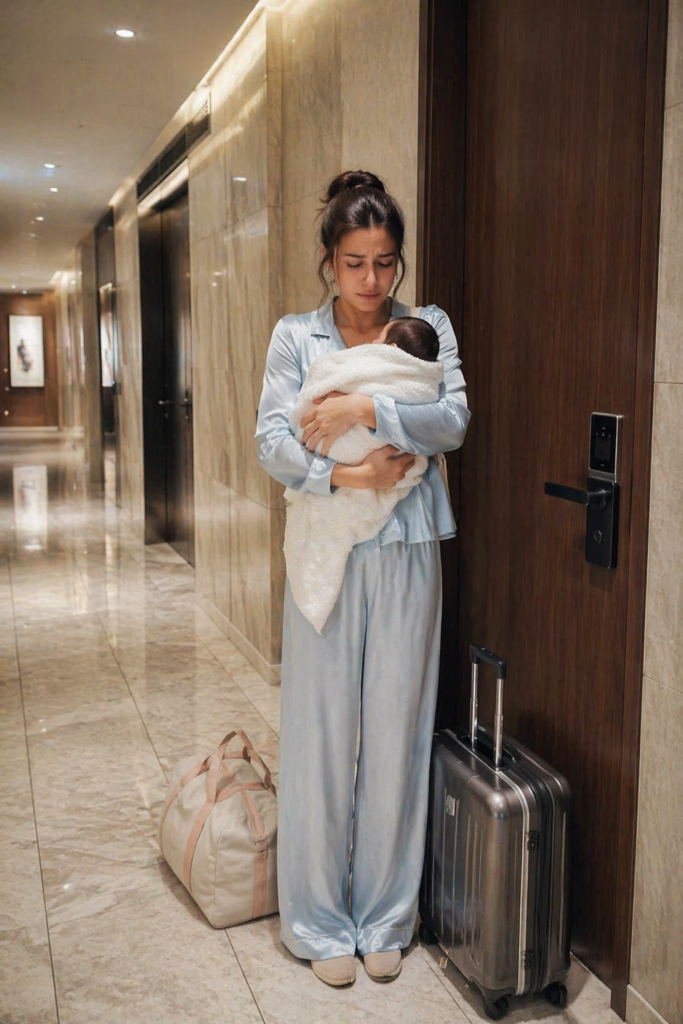
She climbed to the 6th floor, walked slowly down the hallway, and stopped in front of the door where she had imagined bringing her son for the first time.
She dialed the code.
The screen flashed red.
Error.
Mariana frowned. She thought maybe she had made a mistake from exhaustion.
She dialed again.
Error.
Mateo began to squirm restlessly against her chest.
She took a deep breath and dialed a third time.
Error.
Then she felt cold.
Not on her skin.
In her soul.
She pulled out her cell phone and called Rodrigo. It rang until voicemail.
She sent a message:
“I’m outside. The code doesn’t work. I just left the hospital with Mateo.”
Two check marks.
Nothing more.
She called Doña Teresa.
Her mother-in-law answered on the sixth try, her voice laced with annoyance.
—What now?
—I can’t get into the apartment. The code has been changed.
—Oh, Mariana, always being dramatic.
—I just had surgery. Mateo is crying. I need to get in.
On the other end, there was a dry laugh.
—Well, go look for your mom. That’s what family is for, right? My son deserves a break from your tantrums too.
Mariana fell silent.
—Where is Rodrigo?
—With people who actually value him.
And she hung up.
Mateo let out a loud, desperate cry. Mariana bent down to adjust the diaper bag, but the pull from her wound was so horrible that she had to lean against the wall.
At that moment, the door across opened.
Doña Amparo, a retired neighbor who always gifted her sweet bread during her pregnancy, stepped out with a worried look.
—Oh, sweetie… didn’t anyone tell you?
Mariana lifted her gaze.
—Tell me what?
The woman pressed her lips together.
—Yesterday, I saw Rodrigo leave with his mom and Paola. They had suitcases, hats, bags. Doña Teresa said they were going to the beach for a few days because you “needed to learn.”
Mariana didn’t cry.
She didn’t scream.
She didn’t bang on the door.
She simply lowered her gaze to the welcome mat and noticed a folded piece of paper underneath.
She picked it up with trembling fingers.
It said:
“When you learn to respect my son’s home, maybe you’ll come back.”
Mariana closed her eyes.
Then she called her father.
—Dad, come get me. Rodrigo left me outside with my baby.
Don Ernesto asked nothing.
—Don’t move, daughter. We’ll be there soon.
That night, at her parents' house in Coyoacán, Mariana slept for 40 minutes. When she woke up, she found her mom holding Mateo and her dad sitting at the dining table with a brown folder on it.
—Daughter —Don Ernesto said—, I think it’s time to use this.
Mariana opened the folder.
Inside was the deed to the apartment.
The property was not in Rodrigo’s name.
It never was.
Her parents had gifted it to Mariana two months before the wedding, when she still believed that marrying meant building a family, not handing over the keys of her life to people who despised her.
At dawn, Mariana called Attorney Ávila.
—I want a divorce. I want custody of my son. And I want to sell the apartment as soon as possible.
While Rodrigo posted photos sipping margaritas on the beach, Mariana was signing papers, blocking access, canceling cards, and preparing the blow that would leave him gasping for air.
Because when Rodrigo returned, believing that Mariana was still begging behind the door, he wouldn’t find his wife.
He would find a stranger living in “his” house.
PART 2
Rodrigo returned six days later, tanned, wearing dark glasses, an open linen shirt, and the vulgar confidence of someone who thinks a woman who just gave birth is too weak to defend herself.
Doña Teresa followed behind him, each hand gripping a very expensive bag.
Paola, his sister, was recording stories.
—Back to reality —she said, looking at the camera—. Though some realities are pretty intense, right, mom?
Doña Teresa burst into laughter.
—There are women who have a baby and think they run everything.
Rodrigo smiled, but said nothing.
In his mind, Mariana would be at her parents’ house, regretful, exhausted, with dark circles under her eyes, ready to apologize. He planned to let her suffer a few more days before allowing her to return.
That’s how he learned from Teresa: affection was given as a reward and taken away as punishment.
But upon arriving at the parking lot, he saw that his spot was occupied by a black Jetta he didn’t recognize.
—Who the hell is this? —he murmured.
He stormed furiously up to the 6th floor.
When he got to the door, he stopped.
The lock was new.
Not the one he had installed.
Not the one he had programmed.
It was different, more modern, with a small camera aimed directly at his face.
He dialed the old code.
Error.
He dialed the new one he had set for Mariana.
Error.
Doña Teresa stepped forward and began banging on the door.
—Mariana! Open up immediately! Don’t be ridiculous! This house belongs to my son!
The door opened.
But Mariana didn’t appear.
A man with gray beard, a blue shirt, and a calm gaze stepped into view.
—Good afternoon. Who are you looking for?
Rodrigo blinked, confused.
—Who are you?
—I’m the owner.
Doña Teresa nearly choked on her rage.
—Owner of what? This apartment belongs to my son!
The man pulled a folder from a small table by the entrance.
—I bought it three days ago in front of a notary. The previous owner was Mrs. Mariana Beltrán.
Rodrigo felt his stomach drop.
—No. It can’t be. I live here.
—You lived —the man replied—. And according to the administration, you are no longer authorized to enter.
Paola lowered her phone, pale.
Rodrigo pulled out his phone and saw 27 accumulated notifications. Among them was a message from Mariana.
“The apartment has been sold. The divorce is underway. Protective measures are in place. Don’t look for me. What’s coming will be resolved with lawyers.”
Teresa glanced over and exploded.
—Ungrateful! Broke! She robbed us of the house!
The new owner closed the door without arguing.
Rodrigo kicked the frame.
Five minutes later, the doorman arrived.
Fifteen, a patrol car.
Rodrigo tried to play the victim.
—My wife left me on the street with my things.
The officer checked documents, spoke with administration, and went straight to the point:
—Sir, you do not appear as the owner or resident. If you insist, a report will be filed for disturbing the peace.
Doña Teresa began to cry out of anger.
—This is an injustice! My son gave her everything!
But there was nothing to discuss.
That night, they ended up in a cheap hotel near Taxqueña. Paola refused to take them in at her apartment in Portales.
—I can’t, mom. Arturo is coming tomorrow with his parents. My wedding is in a month. Don’t ruin this for me.
Doña Teresa insulted her over the phone, but Paola hung up.
The next day, Rodrigo hired a lawyer and sued Mariana. He wanted half of the apartment, compensation for “abandonment of home,” and emotional damages because, according to him, she had humiliated him in front of his family.
When Mariana received the notification, she was sitting in her parents' living room, nursing Mateo with a pillow on her lap.
She read the lawsuit and let out a humorless laugh.
—Abandonment of home? He shut the door on me with a 3-day-old baby.
Attorney Ávila reviewed the documents calmly.
—You can’t touch the apartment. It’s entirely yours. But there’s something more serious.
Mariana lifted her gaze.
—What thing?
The lawyer placed bank statements on the table.
—While you were hospitalized, Rodrigo withdrew 420,000 pesos from the joint account.
Mariana's mother placed her hand on her chest.
—Why so much money?
The lawyer pointed out several transfers.
—In Paola’s name.
Mariana was left frozen.
She had thought Rodrigo was just cowardly.
But no.
He was also a thief.
The investigation took nine days. Receipts, invoices, proofs, and messages surfaced. The money from the account, where Mariana had also deposited her savings, was not used for diapers, medicine, or baby expenses.
It went to Paola’s wedding hall, the advance for the banquet, an imported wedding dress, and a down payment on a white truck.
There was even a message from Doña Teresa on Rodrigo's phone:
“Transfer it to your sister. Mariana won’t even notice. Right now she’s busy with the baby.”
Mariana read that in silence.
She didn’t cry.
She had cried enough behind closed doors.
—I want everything presented in court —she said.
The family court hearing was set for 18 days later.
Rodrigo arrived in a gray suit and an offended look. Doña Teresa wore black, as if she were the victim of a tragedy. Paola sat in the back, overly made up, with swollen eyes and her engagement ring still shining on her hand.
Mariana entered slowly.
Her cesarean still ached when she walked too much, but she held her back straight. She didn’t bring Mateo into the hearing. Her mother was taking care of him outside, in the car, away from that filth.
Rodrigo spoke first.
—I always wanted to build a family. But Mariana acted with resentment. She sold our house without telling me and left me unprotected.
Doña Teresa spoke next.
—My son worked hard for that marriage. Mariana was always arrogant. Since she got pregnant, she became unbearable. We only tried to impose some order.
Some of Rodrigo’s relatives nodded, as if closing the door on a woman who just had surgery was a normal way to educate her.
Then Attorney Ávila stood up.
—Your Honor, we present the public deed, the donation contract, and the notarial record. The apartment was acquired by Mrs. Mariana Beltrán before the marriage through a donation from her parents. Mr. Rodrigo Méndez did not contribute a single peso to its purchase.
The room fell into silence.
Doña Teresa stopped pretending to cry.
The lawyer continued:
—We also present records of the lock, testimony from the neighbor, and messages. Mr. Méndez changed the code while his wife was hospitalized for a cesarean. He then traveled to Playa del Carmen with his mother and sister, leaving Mrs. Mariana outside with a 3-day-old newborn.
The judge looked at Rodrigo.
—Do you acknowledge that you changed the code?
Rodrigo swallowed hard.
—It was a family decision.
—Did your wife participate in that decision?
Rodrigo lowered his gaze.
—No.
Mariana closed her eyes for a second.
There it was.
It wasn’t a misunderstanding.
It wasn’t exhaustion.
It wasn’t pressure from his mom.
It was punishment.
Then the lawyer opened another folder.
—Additionally, we present evidence of the withdrawal of 420,000 pesos from the joint account during Mrs. Mariana’s hospitalization. The money was transferred to Paola Méndez.
Paola jumped up suddenly.
—That was a loan!
—A loan used to pay for your wedding —the lawyer replied.
The screen showed invoices: hall in Jardines del Pedregal, banquet for 180 people, flowers, dress, truck.
At that moment, Arturo, Paola’s fiancé, walked in. He looked serious, holding a folder in his hand.
Paola turned pale.
—Arturo, my love, don’t listen to them. They’re exaggerating.
He didn’t approach.
—Paola told me that money came from an inheritance from her grandmother. I didn’t know it came from Rodrigo and Mariana’s account.
The room murmured.
Arturo took a deep breath.
—I also didn’t know it was taken while she was in the hospital with her baby. I’m not going to marry someone capable of celebrating a wedding with money stolen from a new mother.
Paola began to cry.
—Rodrigo gave it to me! I didn’t force anyone!
Rodrigo lifted his face, furious.
—You said you needed it urgently!
Doña Teresa screamed:
—Shut up, both of you!
But it was too late.
The family that had humiliated Mariana was falling apart in front of everyone.
The judge requested order and issued clear measures.
The apartment was entirely Mariana’s. Rodrigo had no rights to it. His claim for emotional damages was dismissed. An investigation was ordered for the misuse of common funds, restitution of the money, covering legal expenses, and maintaining protective measures.
The provisional custody of Mateo was granted to Mariana.
Rodrigo tried to protest.
—He’s my son too!
The judge looked at him without emotion.
—Then start by behaving like a father, not as punishment.
Mariana didn’t smile.
She just breathed.
For the first time since the hospital, she felt like the air could fit in her chest.
Outside, her mom was waiting with Mateo wrapped in a green blanket. Mariana took him in her arms and kissed his nose.
—Is it over? —her mother asked.
Mariana looked toward the courthouse door. Rodrigo was arguing with Teresa. Paola was crying because Arturo had just canceled the wedding. None seemed remorseful for what they had done, only furious that there were consequences.
—It’s not over —Mariana said—. But I’m no longer alone.
The following months were tough.
Rodrigo appealed and lost. Then he posted indirect messages online, calling Mariana selfish, cold, and a bad mother. The lawyer responded with a defamation action, and he had to delete everything.
Doña Teresa ended up living with Paola in a smaller apartment, blaming Mariana for ruining the family. Paola sold the truck to pay off debts from a wedding that never happened.
Rodrigo rented a room with a friend in Iztacalco, and every time he asked about Mateo, Mariana responded only through lawyers.
It wasn’t revenge.
It was care.
One afternoon, while sorting boxes at her parents' house, Mariana found an old college notebook. Before marrying, she had studied industrial design. Before fading away to avoid bothering Rodrigo, she dreamed of creating useful things.
Among the yellowed pages were drawings of lightweight strollers, baby carriers, and nursing pillows.
On one page, it said:
“Designing is also about protecting.”
Mariana cried in silence.
The next day, she took Mateo to a maternity expo at Centro Citibanamex. She walked among booths seeing what she hadn’t noticed before: hard clips, hot fabrics, impossible strollers for broken sidewalks, backpacks that hurt the back.
She pulled out a pen and began to sketch on a brochure.
—Mariana?
She looked up.
It was Julián Ortega, a former college classmate. He now ran a Mexican brand of baby products called Casa Nido.
—Did you just do that? —he asked, pointing to the drawing.
Mariana wanted to hide the paper.
—they're just ideas.
Julián looked at it attentively.
—No. They’re solutions.
They had coffee. Mariana shared just enough: the hospital, the closed door, the trial, the fear. Julián listened without interrupting.
—I’m forming an innovation team —he said—. I need someone who thinks like a designer and a mother. I want you to lead it.
Mariana almost laughed.
—I can barely sleep.
—That’s why you know what no one in an office understands.
She accepted weeks later, with Mateo asleep in her arms and her parents promising their support.
At first, it was difficult. Some executives treated her like “the mom with ideas.” Mariana responded with data, interviews, prototypes, and real tests with women from clinics, parks, and daycare centers.
Her first product, a baby carrier called Abrazo, went viral. Moms from Puebla, Monterrey, Mérida, and Guadalajara posted videos saying that finally, someone had thought of them.
A year later, Mariana received a national award in Polanco. She walked on stage in a simple dress with a trembling voice.
—Once, I was left in a hallway with my newborn, unable to enter my own home. I thought I had lost everything. But my son taught me that a woman doesn’t end when she’s left alone. Sometimes that’s when she begins.
The audience stood up.
A reporter asked:
—Is this success a revenge against your ex-husband?
Mariana smiled calmly.
—No. Revenge still needs to look back. I’m already looking ahead.
Over time, Julián became part of her life without invading it. He played with Mateo, brought coffee when Mariana worked late, and never tried to save her, because he understood she was already saving herself.
One night, in a fonda in Roma Sur, he took her hand.
—I don’t want to erase what you experienced. I just want to walk with you without asking you to carry alone.
Mariana lowered her gaze.
—I’m afraid to trust.
—Then let’s go slow.
And they went slow.
Years later, Mariana bought a small house in Coyoacán, with a patio, bougainvilleas, and a blue wooden door. It didn’t have a smart lock. It had a regular key, the kind that sounds nice when you turn it.
On moving day, Mateo ran around the patio while Carmen arranged pots and Don Ernesto checked that the windows closed properly.
Mariana stood watching the entrance.
She remembered the cold hallway.
The cesarean wound.
Mateo’s cries.
The note beneath the mat.
Teresa’s voice calling her useless.
Then Mateo approached and took her hand.
—Mom, is this house really ours?
Mariana knelt down in front of him.
—Yes, my love. And here no one will leave you outside.
Later she learned from acquaintances that Rodrigo had lost his job due to garnishments. Teresa no longer boasted about trips or bags. Paola continued blaming everyone but herself.
Mariana felt no pleasure.
No pity either.
She just closed the message and continued preparing dinner.
Because she understood something that many people confuse: justice isn’t always watching those who hurt you be destroyed.
Sometimes justice is opening your own door, hearing your child’s laughter inside, and realizing you no longer need anyone to apologize to live in peace.