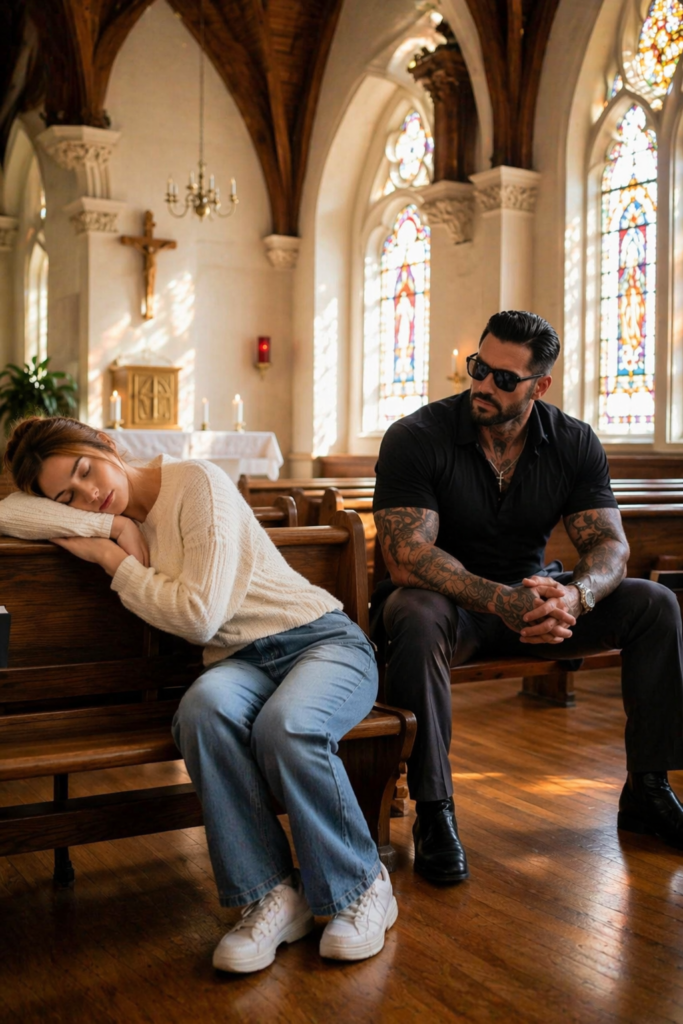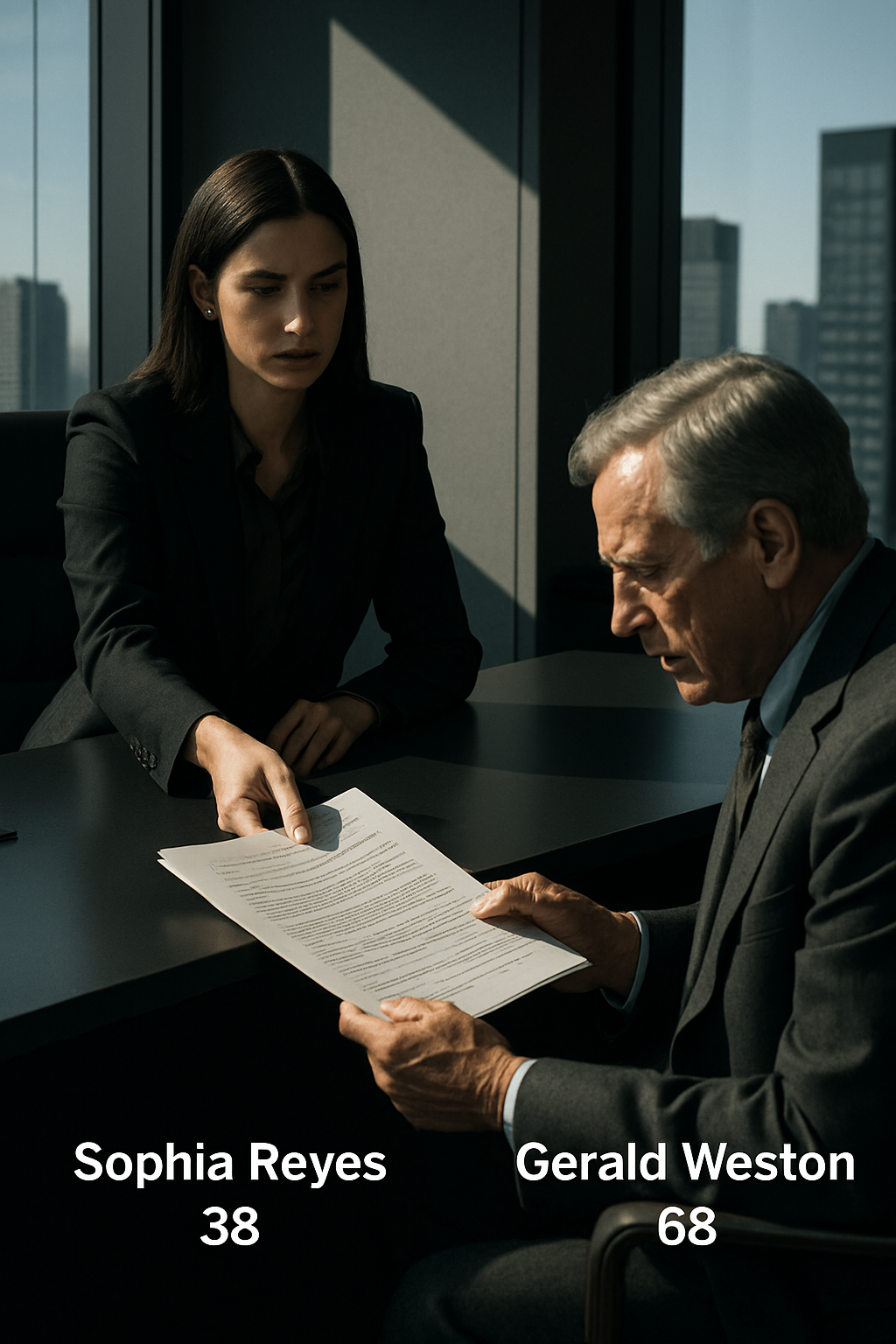
He had twelve years to call. He waited until he needed something.
The phone rang at 7:14 on a Tuesday morning. Sophia was already at her desk — she had been since six, the way she always was, the way she had taught herself to be back when being early was the only advantage she had. The number on the screen was one she hadn't deleted, only because she'd told herself it didn't matter either way.
Gerald Weston.
Her father.
She stared at it for three full rings.
She answered.
"Sophia." His voice was the same. That particular cadence — measured, accustomed to rooms that went quiet when he spoke. Except something underneath it had changed. A thinness. A careful quality she recognized as a man choosing every word with both hands.
"Dad." She kept her voice neutral. Behind her, through the floor-to-ceiling windows of her corner office, the city was waking up — pale gold light breaking across the skyline of a city that had once felt like it wasn't hers to claim.
There was a pause.
"I'm going to be straightforward with you," Gerald said.
She waited.
"Weston Capital is finished. The Denton deal collapsed in February. I held on through the spring thinking I could restructure, but—" He stopped. A breath. "The house is mortgaged. The firm's accounts are frozen pending an audit. I have creditors who've stopped being patient."
Sophia set down her pen. She said nothing.
"I need a bridge loan," he said. "Six months. Eight at the outside. Enough to settle the most pressing obligations while I liquidate the remaining assets in an orderly way." Another pause. "You've done well. I've—I've seen the press about ReVise."
ReVise. The consulting and brand strategy firm she had built from a kitchen table and two clients she'd charmed at a neighborhood networking event the same year her father told her she was no longer welcome in his home.
"How much?" she said.
He told her.
She didn't react. The number was significant. Not catastrophic for her, but significant — and he knew that. He'd done his research. She appreciated that, at least. He hadn't come begging without knowing what he was asking.
"I'm not saying yes or no on this call," she said. "I'll need to see the full picture. Come to my office. Wednesday, two o'clock."
Silence on the line. She could hear him processing the instruction. Her office. Not his club. Not even neutral ground. Her territory, her schedule, her terms.
"All right," he said finally.
"And Dad." She picked the pen back up. "Come alone."
She told Marco that night. They were in the kitchen — the big warm kitchen that had been Marco's design from the start, with the long island and the open shelving and the smell of whatever he'd been slow-cooking since the afternoon. He listened to the whole thing without interrupting, which was one of the things she had always loved about him. He knew when a story needed space.
When she finished, he poured her a glass of wine and set it in front of her.
"How do you feel?" he asked.
"I don't know yet." She turned the glass stem between her fingers. "Like I'm watching myself from above. Like it's a situation I'd advise a client on." A small pause. "He didn't apologize. Not for any of it. He explained what he needs and why. That's all."
Marco leaned against the counter. Forty years old, medium build, warm brown eyes that had a way of making people feel seen — the kind of face that Gerald Weston had once called "pleasant enough but hardly ambitious," which had said more about Gerald than about Marco. In twelve years, Marco had built a career in restoration architecture that people wrote features about. He had rebuilt old things with his hands and made them into something worthy of the present.
Sophia suspected her father had never done a day of physical work in his life.
"You're going to help him," Marco said. It wasn't a question.
"I haven't decided."
"Yes you have." Not unkindly. Just knowing her. "You decided in the first ten seconds. That's why you said yes to Wednesday instead of no on the phone."
She looked at him. "It's not for him."
"I know."
"It's because the kids—" She stopped. Collected herself. "Lily asks about him sometimes. She saw a photo in one of my old albums and asked who the old man was. I told her it was complicated."
Marco was quiet.
"She's nine," Sophia said. "She shouldn't have to grow up with a grandfather-shaped hole in her life because of choices that were made before she was born."
"He made those choices."
"I know." She took a sip of wine. "I just think — if there's a version of this where she gets to know him, even a little, even imperfectly—" She set down the glass. "I want to try. For her. Not for him."
Marco nodded slowly. He crossed the kitchen and stood beside her, not saying anything, just there. It was enough.
She went upstairs at ten to check on the kids. Lily asleep in a room full of drawings she'd made and pinned to the walls herself — faces, houses, animals, a world entirely of her own invention. Ben, seven, curled around a pillow with his arms flung out like he was falling through a dream.
Sophia stood in the doorways of both rooms for longer than she needed to.
Then she went to her home office and started drafting the document.
Gerald arrived at one fifty-seven.
Sophia watched him cross the lobby from the window of her second-floor office. He had aged — the twelve years had done what twelve years does, but they had also done something particular to a man who had always derived his size from his certainty. The suit was good but slightly wrong — cut for a man three years ago, worn by a man who had lost weight since. The silver hair was the same, neat and deliberate. He carried himself with the muscle memory of importance, but there was something effortful about it now. Like a posture held against gravity.
Her assistant showed him in at two on the dot.
"Sophia." He looked around the office, taking it in — the scale of it, the light, the awards and framed features on the far wall, the view. She watched him adjust. Something that might have been pride, or might have been its harder cousin.
"Dad. Sit down."
She gestured to the chair across the desk. The client's chair. He looked at it for a half-second — she clocked the recognition — and sat.
She had asked Meredith to bring coffee and left it at that. No small talk, no offer of lunch. She let the silence settle and then she let him fill it. He did — he'd prepared, she could tell. He walked her through the numbers with more precision than she'd expected. The Denton deal, the timing of the collapse, the decisions he'd made in the aftermath that had compounded the problem instead of resolving it. He spoke the way men of his generation spoke about failure: clinically, with passive constructions, as though the disaster had been a weather event rather than a series of choices. But the facts were accurate, and the facts were bad.
She asked two questions. He answered them. She wrote nothing down — she'd already read the public filings.
When he finished, she was quiet for a moment.
Then she said: "I'll help you."
His shoulders dropped. Just slightly — an involuntary exhale of something held for weeks. "Sophia, I—"
She reached into the drawer to her right and slid a document across the desk.
He looked at it. Looked at her.
"What is this?"
"It's a loan agreement. Standard terms — market rate, six-month term, renewable once at my discretion. The principal is what you asked for. The repayment schedule is realistic." She folded her hands. "There are eight clauses. The financial terms are in clauses one through six and eight. Clause seven is different."
He picked up the document and began to read.
He read it slowly.
She watched his face move through the financial terms — relaxing as he confirmed the numbers were workable, the rate reasonable, the structure sane. He was a businessman, even a reduced one, and the document was professionally drafted because she had asked her attorney to draft it properly.
Then he reached clause seven.
She saw the exact moment. A small stillness came over him — not the stillness of consideration, but the stillness of a man who has stepped on something unexpected in the dark.
He read it twice.
He set the document down on the desk.
For a long moment, neither of them said anything.
Clause 7 read, in full:
As a condition of the loan, Borrower agrees to attend one family dinner at the home of Sophia and Marco Reyes, at a date mutually agreed upon within thirty (30) days of the signing of this agreement. Borrower agrees to be introduced to and to spend a minimum of two (2) hours in the company of Lily Reyes (age 9) and Benjamin Reyes (age 7), the children of the Lender, who are the Borrower's biological grandchildren. Borrower further agrees that this meeting will take place without qualification, commentary, or reference to the circumstances of the Lender's marriage. Failure to fulfill this clause will result in immediate acceleration of the full loan balance.
Gerald looked up. "Sophia—"
"The financial terms are fair," she said. "I think you know that. I'm not gouging you. I'm not making this harder than it needs to be."
"This clause—"
"Is non-negotiable." She said it without heat. "Every other clause, I'll talk about. Clause seven stands as written."
He sat back in the chair. Looked out the window. Looked at the document. Looked at his hands — still holding the pen, she noticed, though he hadn't yet moved it toward the signature line.
"I never said they weren't my grandchildren," he said finally.
"No," Sophia said. "You just never acknowledged them. There's a difference, but I've spent twelve years not being sure which one is worse."
The words landed. She saw them land. He didn't deflect — which was, she admitted privately, something.
"They're good kids," she said, and heard how her voice changed when she said it. Softer. Certain in a way that the rest of the meeting hadn't been. "Lily draws everything she sees. Ben is obsessed with how bridges work — which I suspect has something to do with Marco taking him to job sites." A pause. "They have your eyes. I don't know if you knew that. Lily especially."
Gerald was quiet for a long time.
Sophia waited. She was good at waiting. She had learned it in this building, in rooms like this one, across tables not unlike this desk. She had learned that the person who speaks first in silence like this is usually the one who needs something.
Gerald needed something.
"I wasn't—" He stopped. Started again. "I handled things badly. After you left. After your wedding. I told myself it was principle. That I had standards, that the family name meant something, that I was protecting—" He shook his head. "I know how that sounds now."
"Twelve years later," she said. "After the money ran out."
He accepted that. "Yes."
She leaned forward slightly. "I'm not asking you to be someone you weren't. I'm not asking for a grand reconciliation or for you to tell Marco he was right. The contract doesn't require any of that. It requires you to sit at a table. To meet two children who didn't choose any of this. To give them two hours." She paused. "That's all. Two hours."
He looked at the pen in his hand.
"And after that?" he said. "After the dinner?"
"I don't know," she said honestly. "I'm not writing that part yet. Neither should you."
He signed on a Thursday afternoon.
Sophia kept her expression steady as he did it — watched the pen move across the signature line at the bottom of clause seven, and then the bottom of clause eight, and then his initials on every preceding page. Her attorney witnessed it. Her assistant notarized it. The whole thing took four minutes.
When it was done, Gerald capped the pen carefully. Set it on the desk. He looked older than he had an hour ago, or perhaps she was only now letting herself see it clearly.
"I'll have my assistant contact yours about the dinner date," she said.
He nodded.
He stood, straightened his jacket by reflex. At the door, he paused — and she saw him take a breath, the particular kind that precedes something a proud man has been building toward saying for a long time.
"She was right," he said. "Your mother, I mean. She told me, before she died, that I was going to lose you over this. She said I was choosing the wrong thing and I'd know it eventually." He looked at the carpet, not at her. "I didn't listen."
He walked out.
Sophia sat behind the desk for a while without moving.
Then she picked up her phone and called Marco.
"It's done," she said.
"Yeah?" His voice was warm. Careful.
"He signed. The dinner's in the next thirty days."
"How are you feeling?"
She looked out the window — same city, same skyline, the same view she had earned. "I don't know yet. Ask me after."
The dinner was on a Saturday.
Marco cooked, which was the right decision — not because Sophia couldn't, but because Marco's cooking was the kind that made a room feel like a home from the first half hour, the kind that made even a stranger at your table feel, against their intentions, like they were being welcomed.
Lily had been told: Grandpa Gerald is coming to dinner. He hasn't been part of our family for a long time, but we're going to give him a chance. She'd absorbed this information and asked two questions: did he like dogs (they didn't have one, but the neighbor did), and would he want to see her drawings. Sophia had told her she didn't know the answer to the first question and yes, probably yes to the second.
Ben had been told a simplified version and had spent the morning asking if Grandpa Gerald was a builder, because he was curious whether they had the same job as Dad. The answer was no, and Ben had considered this and moved on.
Gerald arrived at six.
He stood in the doorway of the house — their house, the one Marco had spent three years renovating himself, the one with the original moldings saved and the handmade kitchen and the garden that was still becoming itself — and he looked the way a person looks when reality is correcting a long-held image.
Sophia let him in. Marco came out of the kitchen, wiped his hands on a dish towel, and put out his hand. "Gerald. Welcome."
A pause. A long one. Then Gerald took the hand and shook it. "Marco."
That was all. But it was something.
The first thirty minutes were careful. Gerald sat at the table while Marco finished cooking and Sophia opened wine. Lily appeared from the hallway, looked at the new person at their table, and said: "Are you Grandpa Gerald?"
"I am," he said.
She studied him with the direct, unfiltered evaluation of a nine-year-old. "You have the same eyes as Mom," she said. "Like when she's thinking about something. Kind of far away."
Gerald looked at Sophia.
Sophia looked at her wine.
"Is that a good thing?" Gerald asked Lily.
Lily considered. "Usually. Except when she's deciding something we won't like."
Marco laughed from the kitchen. Gerald made a sound that was almost — almost — the same thing.
Ben appeared next, announced himself with the confidence of a seven-year-old, and immediately began explaining to Gerald the structural engineering principles of a suspension bridge, which he had recently become expert in. Gerald — whose professional life had been finance and capital, whose world had been numbers and leverage and the performance of certainty — listened with an attention that surprised Sophia. Asked a question. Got an explanation. Asked another.
At the table, over food that was warm and real and made by someone who cared, something happened that Sophia had not entirely let herself plan for.
Her father tried.
He was not easy. He was still, underneath, the man who had chosen his version of a family name over his daughter's actual happiness. He still had the reflexes of a man who had spent sixty-eight years being the most important person in any room he entered. There were moments — a pause before responding to Marco, a flicker of something old in his eyes when he looked around the house — that Sophia caught and let pass. She was not here to grade him. She was here to witness.
He stayed three and a half hours. Two past the contractual minimum.
At the end of the night, Lily showed him her drawings. She spread them across the kitchen table with the seriousness of a professional presenting a portfolio: cities she'd designed, faces she'd invented, a horse that she was still working on getting right. Gerald looked at each one. Really looked, in the way you look at a thing when it's surprising you.
"This one," he said, pointing to a drawing of a building with an improbable number of windows. "This one I like."
"That's the tallest building I could think of," Lily said.
"It's very tall," he agreed.
"I'm going to design buildings when I grow up," she told him. "Or draw pictures. I haven't decided yet."
"You have time," Gerald said.
Ben had already fallen asleep on the couch. Gerald looked at him for a moment before leaving — the small sprawled figure of a boy who had spent an hour explaining bridges to a man he'd only just met, who had listened like it mattered, because in the end, Gerald Weston had loved things that were well-built.
He put on his jacket at the door.
He shook Marco's hand again. Steadier this time.
He looked at Sophia.
"Thank you," he said. The word cost him something. She could tell.
"The next thirty days on the repayment schedule start Monday," she said.
He almost smiled. "I know."
He walked down the front path to his car. She watched until the taillights turned the corner.
Marco came up behind her, put a hand on her shoulder. "Okay?" he said.
"I don't know." She leaned back against him. "Yes. I think yes."
"He was better than I expected."
"He was." She was quiet for a moment. "It's not forgiveness. I want to be clear about that. I'm not — I'm not there yet, and I don't know if I will be. What he did, cutting me off, missing the years he missed—that doesn't get signed away in a contract. That's not how it works."
"I know."
"But Lily has a grandfather now," she said. "If he chooses to show up. That part I can give her."
Marco didn't say anything. He just stood there with his hand on her shoulder while the neighborhood went quiet around them and the lights in the kitchen glowed warm through the window.
Sophia thought about her mother — who had apparently warned Gerald, who had apparently known, who had apparently been right about everything and been unable to make him hear it while she was alive.
She thought about the version of herself that had been twenty-six and newly married and standing at a phone that would not ring, waiting for a father who had decided his pride was worth more than his daughter.
She thought about the version of herself now. Thirty-eight. A company she'd built from nothing. A husband who had never once asked her to make herself smaller. Two children asleep inside a home that felt — completely, entirely — like hers.
She had not needed her father's money to build any of it. She had not needed his approval, or his blessing, or his presence at the table. She had needed, for a while, to grieve his absence. And then she had needed to stop.
The contract wasn't about the money.
She'd known that before she drafted clause seven. The money was real, the terms were real, and Gerald would repay it because that was the kind of man he was — reliable in transactions if in nothing else. But the contract had never been about recovering what she'd lent.
It had been about recovering something that had always been hers and that he had withheld without the right to.
Not his blessing. Not his apology. Not even, really, his presence.
Just the chance to say: I have a life. It is full and real and it was built without you. And if you want a seat at this table, there is one. But you will earn it.
She had a drawer in her home office — a locked one — that contained two things. An old photograph of herself at eighteen, sitting beside her father at a function she no longer remembered, both of them unsmiling in the way of formal events, but close. And a card her mother had sent her the week after the wedding, after Gerald had made his position clear, after Sophia had cried more than she'd ever told anyone.
The card said: He is wrong. He may never know it. Love him anyway from a distance. Build the life you deserve. I am proud of you.
She had re-read it approximately once a year for twelve years.
She went inside. She checked on the kids. She washed the wine glasses while Marco dried them, their shoulders almost touching in the warm kitchen, the sound of the neighborhood settling into night coming through the window over the sink.
At no point did she feel that she had won anything.
But she felt, clearly and without question, that she had kept something.
The loan would be repaid. Gerald would either choose to continue showing up or he wouldn't. Lily would draw buildings and Ben would understand bridges and Marco would restore things that the world had let fall into disrepair, and she would get up at six in the morning and go to an office she had built from nothing.
And somewhere across the city, her father would sit alone in a house that wasn't quite his anymore, and perhaps he would understand, for the first time without anyone needing to explain it to him, that the most expensive thing he had ever owned was not a house or a firm or a name.
It was twelve years.
He had spent twelve years.
And what had bought them back — what had actually, finally, brought him to a table and made him stay for three and a half hours and look at his granddaughter's drawings like they were real — was not a favor.
It was a contract.
Standard terms. Market rate.
One clause he hadn't seen coming.
The pen in his hand.
And a daughter who had decided that the thing she was owed was not an apology.
It was a seat.
At a table she had built herself.
He had twelve years to call. He waited until he needed something.
She made sure that when he finally came, he gave her something back.