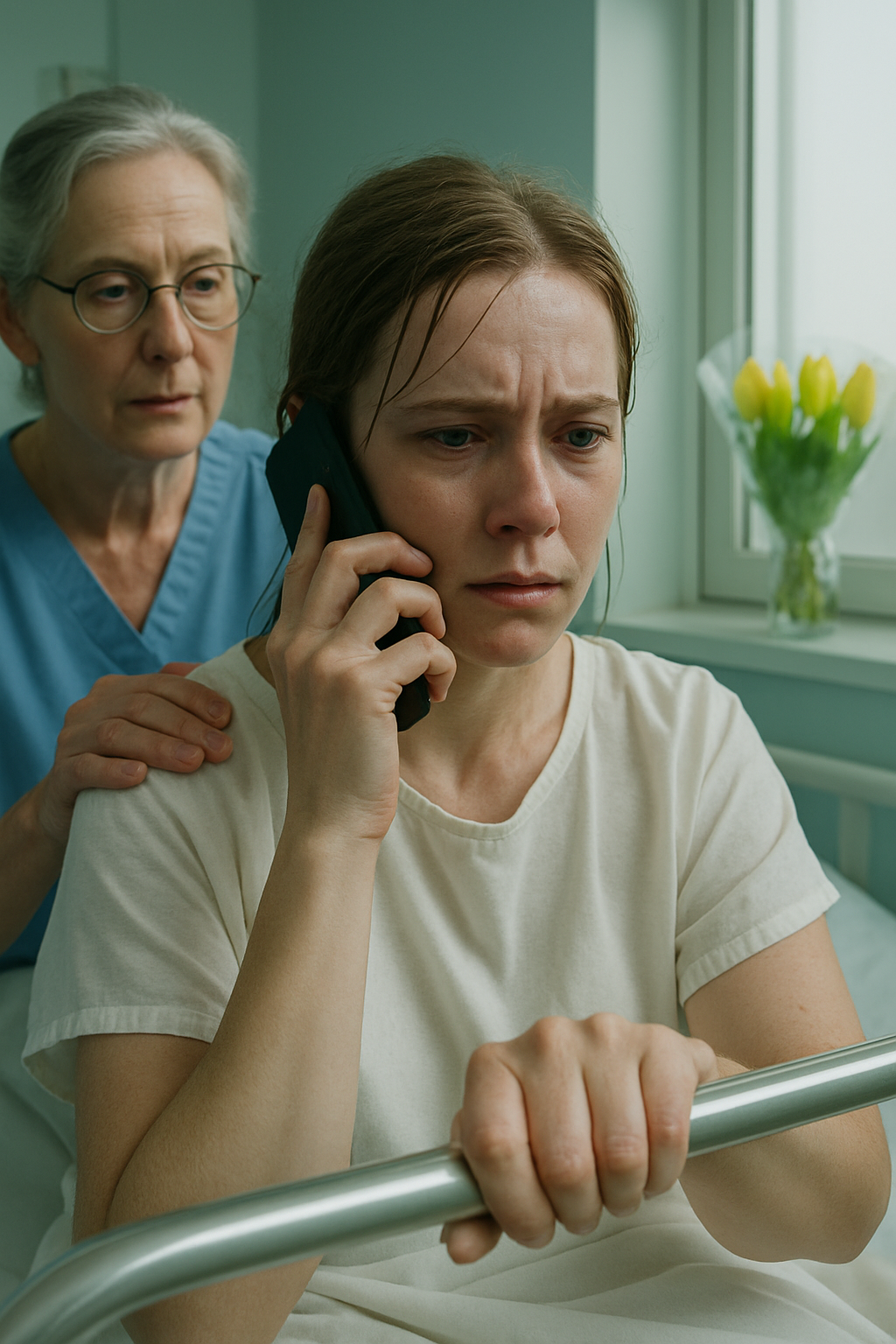
The forty-seventh call went to voicemail, same as the forty-six before it.
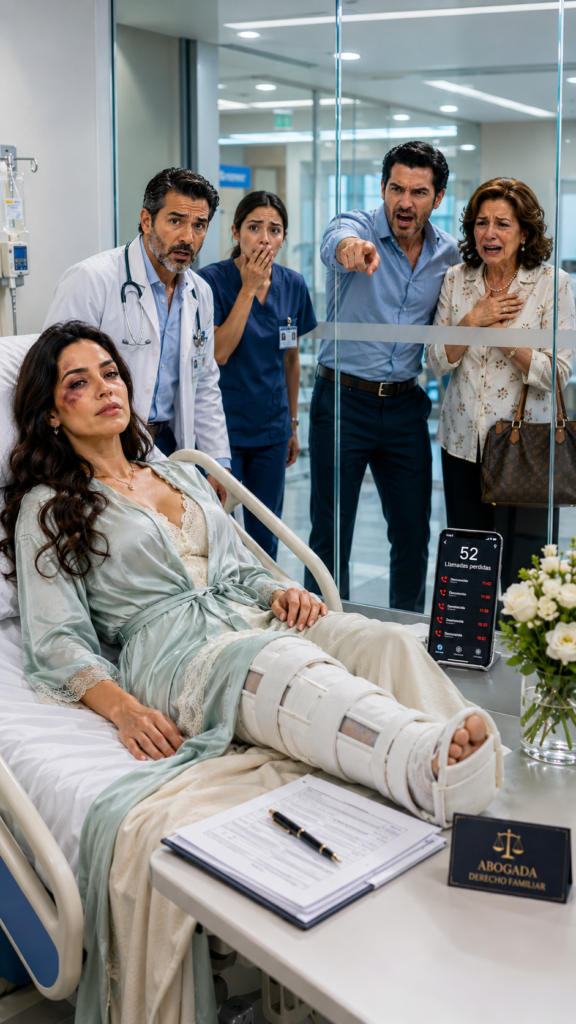
Anna Price set her phone down on the narrow hospital tray table and looked at the ceiling. Fluorescent. Water-stained in one corner. The kind of ceiling you memorize when you have nothing else to do and nowhere else to look and the contractions are coming every three minutes and you have been alone for four hours and forty-seven minutes.
The nurse — her name tag said DIANE, and she had kind eyes behind wire-rimmed glasses — adjusted the fetal monitor band across Anna's abdomen with practiced efficiency. "Someone's on their way?" she asked, not looking up, the way you ask a question when you already know the answer might be no.
"He's coming," Anna said. "He's just — his phone might be on silent."
Forty-seven calls. Three of them had vibrated through to voicemail in under ten seconds. He had declined them. She knew what declining looked like.
Diane patted her forearm and said nothing, which was the kindest thing she could have done.
It had started at 11:14 PM.
Anna had been lying in bed — their bed, the California king Owen had insisted on because he liked space when he slept — watching the ceiling of their bedroom instead of the television. The show was on. She couldn't tell you what it was. Something with people in a house making choices. She had stopped being able to follow plots sometime around month seven, when the baby had settled low and her hips ached and her brain had quietly renegotiated its priorities.
The first contraction had made her sit up so fast she knocked over her water glass.
She knew immediately it wasn't Braxton Hicks. She had been having those for six weeks — she knew exactly what they felt like, the tightening-without-edge, the wave that went nowhere. This was different. This had teeth.
She called Owen.
Voicemail.
She called him again.
Voicemail.
She timed the next contraction. Seven minutes. Then five. Then four.
She called Owen eleven times in forty minutes. Each time: voicemail. She left a message after the third call that she was not proud of — voice shaking, words clipped, not angry yet, just frightened in the specific way that being frightened alone feels different from being frightened with someone. She said: Owen, it's happening. Please call me. Please. She said please three times. She counted, later.
She called Kate.
Kate didn't answer either.
She had stood in the kitchen for a moment — barefoot on cold tile, hospital bag already packed and waiting by the door for three weeks, a list of numbers on the refrigerator that she had made with careful competence in month eight — and she had felt something she could only describe later as a kind of clarifying cold. The world going very still and simple. Okay. There is only what to do next.
She called herself a rideshare. She grabbed the hospital bag. She got in the car.
She was admitted at 12:03 AM. She was in a private room by 12:30. Diane was her nurse. The monitors went on. The contractions were every three minutes.
Owen still had not called back.
She called him again at 1:17 AM. Then at 1:32. Then at 1:45, 1:51, 1:58.
At 2:09 AM, on the forty-seventh attempt — she was mid-contraction, hand crushing the metal bed rail, Diane murmuring beside her to breathe, breathe, you're doing so well — the call connected.
"Hey," Owen said.
He sounded awake. He sounded fine. He sounded the way a person sounds when they have been awake for hours, just not answering your calls — relaxed, slightly low, slightly careful.
"Owen," Anna said. The contraction peaked. She breathed through it. Breathe, breathe. "I'm at the hospital. I've been here for two hours. I've called you—"
"Yeah, I'm sorry, I had my phone—"
In the background, she heard it.
A voice. Female. Familiar in the way that something familiar becomes briefly unrecognizable when it appears in the wrong place, like seeing a neighbor in another city, the half-second delay before the brain catches up.
— come back to bed, it's cold—
Three words. Maybe four. It didn't matter.
Anna knew that voice.
She had known that voice for eleven years. She had heard it in grief and celebration, across tables and phone lines, at 3 AM during her worst weeks and at noon on ordinary Tuesdays. She had heard it say I'm so happy for you at the pregnancy announcement party — Kate, standing at the kitchen island in Anna's house, glass of wine in hand, eyes bright. Anna had thought those eyes were bright with happiness. She had not thought to wonder what else they might be bright with.
The voice in the background of her husband's phone, at 2:09 AM, while Anna was alone in a hospital room three minutes from delivery, was Kate Morrison's.
Anna did not say anything.
Owen was still talking — she could hear him, a sentence beginning with "I can explain" or maybe "it's not what" or maybe something else entirely, it didn't matter, none of it mattered — and she pressed the red button and ended the call and set the phone face-down on the tray table.
She looked at Diane.
Diane looked at her. Not with pity. Not with the careful blankness of professional neutrality. With something that was steady and present and human.
"Okay," Anna said. "Let's have this baby."
Her son was born at 3:47 AM.
Seven pounds, four ounces. Twenty inches. A full head of dark hair, darker than Owen's, which Anna noted and filed away and did not think about yet. He was placed on her chest and he stopped crying almost immediately, which Diane said was a good sign, and Anna put her lips to the top of his head and breathed.
She did not cry.
She thought she should. She had imagined this moment for nine months — the relief and terror and overflow of it, the way she had assumed Owen's hand would be in hers, the way she had assumed Kate would be in the waiting room with bad coffee and good jokes. She had constructed an entire vision of this moment around the presence of people who were not there.
She breathed her son's smell. She listened to Diane's calm efficient instructions. She held him and learned the weight of him and let herself be exactly where she was: alone in a fluorescent room at 3:47 AM with a seven-pound, four-ounce reason to keep going.
Owen arrived at 5:52 AM, two hours and five minutes after his son was born.
He had flowers. Yellow tulips, which was strange because Anna had always told him she preferred white. He was wearing yesterday's clothes — the same dark jeans, the same navy shirt, slightly wrinkled — and his hair was not quite right, like he had combed it too quickly in a car mirror or a gas station bathroom.
He stopped in the doorway when he saw the baby in her arms. Something moved across his face that Anna could not name and did not try to.
"Anna," he said. He took a step. "I'm so—"
"His name is James," Anna said.
Owen stopped.
"James Michael Price." She looked at her son. She looked at Owen. Her voice was very calm, the way a room is very calm right before the walls come down. "After my grandfather. Not yours."
Owen stood in the doorway with yellow tulips and his wrinkled navy shirt and his easy smile that was not, in this moment, working at all.
"Anna, if you'll let me explain—"
"I heard her voice," Anna said.
One sentence. That was all. She said it the way you state a fact — a measurement, a diagnosis, a thing that has been confirmed and requires no further argument.
Owen opened his mouth.
"I heard Kate's voice," Anna said. "In your background. At 2:09 AM. While I was in active labor. With our son. Alone."
She looked at him for a long moment. He was not charming enough for this one. He had used up every variation of that smile, every smooth pivot, every I can explain and you have to understand and it's not what you think. She could see him cycling through them and finding them all empty.
"I'd like you to leave," she said.
Not angry. Not breaking. Just clear, the way Anna Price had always been clear — the strong one, the competent one, the one who handled things. She was discovering what that actually cost. She had been carrying it for years. She could feel, for the first time, exactly how heavy it was.
Owen left.
The tulips stayed on the windowsill in their crinkled cellophane, slowly wilting in the hospital-room warmth.
Diane came in an hour later to check on them and saw the flowers and saw Anna's face and quietly moved the flowers to the hallway without being asked.
Here is what Anna missed, and when:
September — fourteen months before James was born. Owen had started "working late on Thursdays." He had always worked hard; this had not seemed unusual. She had asked once, lightly, and he had said the Henderson account was a nightmare, and she had said that's the Henderson account for you, and they had both laughed, and that had been that.
November. Kate had cancelled their standing Tuesday lunch for the third week in a row. Overwhelmed with work, she'd texted, you know how it is. Anna had said of course, she knew how it was. She had not known.
January — eight months before James. Anna had told Owen she was pregnant on a Sunday morning, sitting at the kitchen island with a positive test in her hand, and he had done all the right things: stood up, crossed the room, held her, said oh my god in a voice that sounded genuine. She had believed it was genuine. She had no reason, then, not to.
February. She had told Kate over lunch — the Tuesday lunches had resumed — and Kate had cried.
Anna had thought those tears were for her. For the baby. For the shared joy of it.
She had hugged Kate and said you're going to be the best godmother, and Kate had cried harder, and Anna had thought: this is what friendship is. People who feel your joy as their own.
March. Owen had come home from a "dinner with clients" smelling different. Not of alcohol — she would have recognized that. Something else. The particular nothing-smell of a person who has recently showered. She had noticed it the way you notice a thing and then immediately find a reason not to follow it. She had been five months pregnant. She had been tired. She had filed it and moved on.
June. She had thrown a pregnancy party — their friends, their family, her living room decorated in yellows and greens. Kate had been there, helping set up beforehand, brilliant in a red dress, laughing, refilling glasses. At one point Anna had looked across the room and seen Kate and Owen in a conversation that ended abruptly when Anna walked over. She had assumed they were planning something for her — a surprise, a gift.
She had been the only thing they were hiding.
July. She had asked Owen, once, quietly, at the end of a long evening: "Is everything okay? With us?" And Owen had looked at her with that easy warmth and said "more than okay," and kissed her forehead, and she had believed him because she had wanted to and because he was good at it and because eleven years with a person builds a kind of faith that is slow to revoke.
She had told Kate about that conversation. Kate had said: "He loves you. You can see it."
She had said it looking right at Anna.
Three months later:
Anna's apartment is small and clean and full of afternoon light. The California king is gone — she'd had it taken away the week she moved out, which she'd done with a speed and decisiveness that surprised everyone who knew her, and surprised no one who actually understood her.
James sleeps in a secondhand crib that Anna painted white herself, standing on a drop cloth in the living room at 11 PM while he slept in a bassinet nearby, listening to a podcast about nothing important, painting careful strokes, feeling more herself than she had in a very long time.
Owen and Kate — she has heard this through third parties, has not sought it out — are together now. Officially. This is somehow both the most expected thing in the world and a fact that still lands with weight each time it surfaces. Not because she wants him back. She does not. She stopped wanting him back sometime around 3:47 AM, when she looked at her son's face for the first time and understood, completely and permanently, where her priorities lived.
The weight is about something else. The weight is about Kate. About eleven years of shared history, of knowing and being known, of the particular intimacy of female friendship which is its own country with its own language and its own rules. Anna had given Kate access to the most frightened version of herself — the pregnancy fears, the 3 AM insomnia, the secret private worries she didn't want to burden Owen with. She thinks about that sometimes. What Kate did with it.
She has told almost no one the full story. Her mother knows. Her cousin Rachel knows — Rachel had been so angry on Anna's behalf that Anna had spent twenty minutes talking her down, which was its own kind of love. Her therapist knows. And Diane, who sent Anna a card three weeks after discharge that said only: James is lucky to have you. — D.
Anna has that card on her refrigerator, next to the updated list of numbers.
On the night James was born, Anna wrote in his baby book. She had bought it in month six, a pale blue cloth-covered thing with gold lettering, and she had imagined filling in the night of his birth with a story of her husband and her best friend in the waiting room, with coffee and nerves and relief.
Instead she wrote:
You were born at 3:47 in the morning. It was me and you and a nurse named Diane who held your hand after mine when the contractions were hard, and she was the steadiest person in the room and she told me I was doing well every time I needed to hear it. You stopped crying the moment I held you. I want you to know that even in the worst moments — especially in the worst moments — there are people who show up. Not always the ones you expected. Diane showed up. And you showed up. You came into this world on the hardest night of my life and you made it the best one.
I will always show up for you. I will show up for you the way Diane showed up for me — present, steady, not going anywhere.
That is my promise to you, James. On the night you were born.
She closed the book.
She looked at her son sleeping in the secondhand crib she had painted white.
She went to make tea.
It was a Tuesday evening, which used to be Kate's night. It wasn't anymore. Anna was finding, slowly, that she liked Tuesdays fine on her own.