PART 1
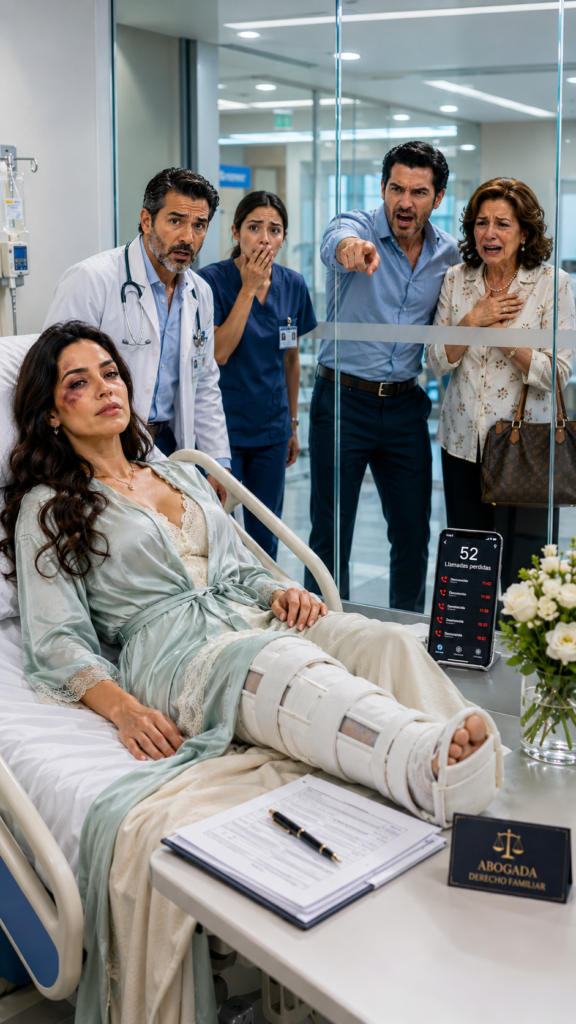
Natalia Rivera arrived at the Angeles Hospital in Puebla, barely able to open her eyes.
Her husband, Ernesto Beltrán, carried her as if he were the most worried man in the world. His shirt sleeves were rolled up, his hair perfectly styled, and that decent businessman face he often wore at dinners, baptisms, and family gatherings.
"She slipped in the bathroom," he said at the reception. "My wife is so clumsy, poor thing."
The nurse glanced at him for barely two seconds.
Natalia didn't look like a woman who had fallen.
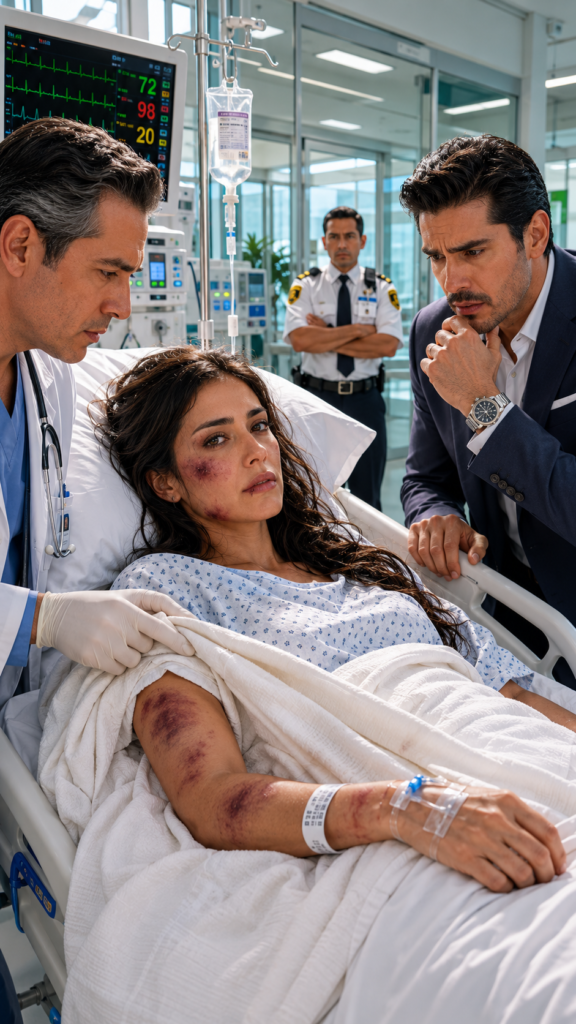
She had marks on her arms, a bruise near her cheekbone, and split lips. She was breathing with difficulty, as if every breath hurt from her ribs.
Ernesto smiled, nervously.
"She scares easily. Besides, her skin bruises from anything."
Doctor Mateo Salas appeared minutes later. He was an emergency room physician with years of experience seeing lies disguised as accidents. When he lifted the sheet and saw the bruises on Natalia's wrists, he stopped writing.
"Mr. Beltrán, please step out for a moment."
Ernesto clenched his jaw.
"I'm her husband."
"That's exactly why."
The doctor's tone left no room for discussion.
Natalia barely turned her head. Her gaze, though tired, searched for the brown bag a nurse had left on a chair.
Ernesto noticed.
And for a moment, he lost the mask.
"She doesn't need anything from there," he said quickly. "She's medicated. She doesn't even know what she's asking for."
Doctor Mateo approached Natalia.
"Who did this to you?"
She didn't respond immediately.
For three years, Ernesto had taught her to stay silent. Not always with yelling, but with control. He checked her phone, chose her clothes, spoke for her at parties, and repeated that no one would believe her.
To everyone in Puebla, Ernesto was the founder of "Hearts of Tomorrow," an organization supposedly helping sick children. He appeared in photos with politicians, handed out toys at Christmas, and donated blankets when it was cold.
At home, the story was different.
Natalia had learned to hide fear under makeup and to smile when her mother-in-law, Doña Rebeca, said:
"Be grateful, dear. Men like Ernesto aren’t easy to find."
But Natalia hadn't always been that silent woman.
Before marrying, she worked investigating financial frauds for a firm in Mexico City. She knew how to trace accounts, recover deleted files, and read what others tried to hide.
Ernesto forced her to resign.
What he couldn't take from her was her memory.
That night, as the doctor observed her wounds, Natalia gathered her strength and whispered:
"My bag... the red notebook."
Ernesto took a step toward the chair.
The hospital guard stopped him.
"Sir, step back."
"She's my wife!" Ernesto shouted. "I decide for her!"
Doctor Mateo looked at the guard and then took out his phone.
"Call 911."
Ernesto froze.
Natalia closed her eyes, but not out of fear.
Because after three years of waiting for the exact moment, it had finally arrived.
When the red notebook opened in front of the police, a USB fell between its pages.
And no one in that room could believe what was about to happen.
PART 2
Officer Jimena Torres picked up the USB with gloves and looked at Natalia.
"Is this yours?"
Natalia nodded slightly.
Ernesto let out a dry laugh, the kind men use when they want to seem confident even though the ground is slipping beneath them.
"Officer, my wife is unwell. She has anxiety attacks. She invents things. She's always been very dramatic."
Doctor Mateo didn't move from beside the bed.
"The injuries are not invented."
Ernesto turned toward him with rage.
"You just stick to treating her."
Officer Torres raised her gaze.
"And you stick to not intimidating a victim in a hospital."
The word "victim" hit Ernesto like a slap.
Until that moment, he still believed he could control the room. He believed that his last name, his money, and his contacts were enough to order reality like one orders a table at a fancy restaurant.
But Natalia had prepared something stronger than a complaint.
She had prepared a downfall.
The USB contained folders with dates, audios, photographs, bank statements, and videos. They weren't random files or blurry captures taken haphazardly. Everything was organized with precision: name, time, place, and backup.
There were recordings where Ernesto mocked her.
There were messages where he ordered her to wear long sleeves for meals with his associates.
There were audios of Doña Rebeca telling her:
"Don't exaggerate, Natalia. All smart women learn not to provoke their husbands."
Officer Torres opened another file.
It was a conversation between Ernesto and his accountant.
"The foundation can hold out another eight months," Ernesto said. "We move donations as medical expenses and no one questions anything. People are so dumb when they see photos of kids."
The silence in the emergency room changed.
It was no longer just about family violence.
The red notebook contained two hells written in the same ink: the one at home and the one at the foundation.
Ernesto tried to step forward again.
"That's false. She knows how to edit. She worked with computers. She's crazy."
Natalia opened her eyes.
Her throat hurt, but she spoke with a clarity that made everyone turn.
"I'm not crazy. I'm alive."
Officer Torres ordered him removed immediately. Ernesto was escorted to the hallway while shouting that he would call his lawyer, a congressman, the hospital director, and even the governor if necessary.
But it was already too late.
The Attorney General's office received the complaint that very night. The hospital submitted the medical report. Doctor Mateo signed the report. And Natalia, still with an IV in her arm, authorized access to three more backups: one in the cloud, one with her sister Valeria, and one hidden in an old computer at her mother's house.
Valeria arrived at the hospital at 6:20 a.m.
She entered running, hair tied up haphazardly and eyes full of guilt.
"Forgive me," she said as soon as she saw Natalia.
Natalia didn't understand.
"Why?"
Valeria covered her mouth.
"Because I saw the bruises many times. Because you told me you hit yourself with a door and I wanted to believe it. Honestly, I was a coward."
Natalia shed a tear.
"I also wanted to believe my own lies."
Valeria gently took her hand.
"Not anymore."
That morning, prosecutor Laura Villaseñor appeared, a woman with a calm voice and a hard gaze. She reviewed part of the material without making exaggerated gestures. She just took notes, breathed, and asked for another file.
When she finished, she closed the folder.
"Natalia, with this we can request protective measures and preventive detention. But I need to know if there's more."
Natalia looked at her sister.
Then at the prosecutor.
"Yes. There are names."
The prosecutor raised her eyes.
"What names?"
"Businessmen. Notaries. Officials. Doña Rebeca also signed transactions. The foundation wasn't just laundering Ernesto's money. It was a network."
Valeria was speechless.
For years, the Beltrán family had sold the perfect image: charity breakfasts in Angelópolis, art auctions, photos with kids, speeches about values and "Mexican family." Doña Rebeca always appeared in the center, dressed in white, as if goodness could also be accessorized with pearls.
But Natalia had followed the transfers.
Every time Ernesto fell asleep after drinking, she copied files. Every time he recorded his humiliations believing they were private trophies, she recovered metadata. Every time Doña Rebeca called her "ungrateful," Natalia kept the audio.
Her plan hadn't been born from hate.
It had been born from survival.
The news exploded in less than 48 hours.
"Pueblan businessman detained after assault on his wife."
"Foundation investigated for possible embezzlement."
"Donations for children may have ended up in private accounts."
Ernesto's face appeared on television. The same man who handed out toys in front of cameras now appeared handcuffed, ducking his head so they couldn't get a good shot.
Doña Rebeca arrived at the hospital on the third day.
She didn't ask to see how Natalia was.
She asked to "settle the misunderstanding."
Valeria confronted her in the hallway.
"Misunderstanding? Your son almost killed my sister."
Doña Rebeca didn't lower her voice.
"Your sister is destroying a family out of spite."
Natalia listened from her room.
She asked for the door to be opened.
The mother-in-law saw her lying there, pale, with marks on her face, and yet showed no compassion.
"You can still stop this," she said. "Ernesto would forgive you."
Valeria almost lunged at her, but Natalia raised her hand.
"I don't need Ernesto to forgive me."
Doña Rebeca pressed her lips together.
"Without him, you're nothing."
Natalia looked at her with a new calm.
"Funny. He said the same thing in the videos."
Prosecutor Laura, who was in the room, intervened.
"Mrs. Rebeca Beltrán, I recommend you don't approach the victim again. You will also be summoned for the financial investigation."
For the first time, the mother-in-law lost her color.
There was the first twist for the Beltrán family: Natalia hadn’t just reported Ernesto. She had also marked the path to the mother who had protected, financed, and trained him to feel untouchable.
In the first hearing, Ernesto arrived in a gray suit and a martyr's face. His lawyer tried to present him as a concerned husband, victim of a resentful wife who wanted to take his money.
Prosecutor Laura didn't argue.
She just asked to play an audio.
Ernesto's voice filled the room:
"If Natalia talks, I say she's unstable. With two paid doctors we lock her up for a bit and she loses the will."
The judge looked up.
Ernesto's lawyer asked for the evidence to be dismissed.
The prosecutor presented the forensic report: an unedited file with date and location.
Then she played another audio.
It was Doña Rebeca.
"Don't hit her in the face before events. It's too noticeable, Ernesto."
A murmur swept through the room.
Natalia didn't cry.
Not because it didn't hurt, but because for a long time she had imagined this moment. She had imagined someone finally hearing the whole truth. Not the pretty version. Not the society version. The raw, ugly truth, impossible to conceal.
The judge ordered preventive detention for Ernesto.
Doña Rebeca was later charged with concealment and money laundering.
And the "Hearts of Tomorrow" foundation was no longer untouchable.
Investigations found more than 96 million pesos diverted through false invoices, invented treatments, and shell companies. The accountant spoke. A notary fell. An official admitted receiving payments to look the other way.
From prison, Ernesto still tried to negotiate.
He offered money.
He offered a public apology.
He offered a quick divorce.
Natalia rejected everything that smelled of silence.
"I don't want revenge," she told the prosecutor. "I want him unable to hide behind a pretty cause again."
The trial lasted months.
There were days when Natalia trembled before entering the courtroom. There were nights she woke up sweating, convinced Ernesto was standing next to the bed. There were mornings she didn't even want to get up.
But Valeria was there.
Her mother was there.
Doctor Mateo also testified.
When asked why he called 911, he replied:
"Because a fall doesn't leave fingerprints on both arms. And because believing the abuser is the fastest way to abandon a victim."
That phrase was shared thousands of times on social media.
But the most powerful moment came when Natalia took the stand.
Ernesto looked at her like before, trying to instill fear from afar. She took a deep breath. Then spoke without shouting.
"For three years, he told me no one would believe me. He said a battered woman always seems guilty of her own pain. He said his last name weighed more than my word."
The room fell silent.
"But I didn't come here to prove I'm perfect. I came to tell the truth. I didn't fall in the bathroom. I'm not dramatic. I'm not crazy. I'm a woman who survived long enough to open the door."
Ernesto looked down.
And that gesture was stronger than any confession.
Weeks later, the sentence arrived.
Ernesto Beltrán was convicted of aggravated domestic violence, assault, threats, and related financial crimes involving the foundation. Doña Rebeca was sentenced for concealment and money laundering. Several associates lost properties, accounts, and prestige.
The house where Natalia had lived imprisoned was seized.
The luxury cars auctioned off.
And the recovered money was used to create a care center for women victims of violence and for children who truly needed medical treatment.
When they proposed naming the center after her, Natalia said no.
"Call it Open Door," she requested. "Because that's what I needed for three years."
Months later, Natalia visited the building in Coyoacán: clear walls, bougainvilleas at the entrance, consulting rooms with natural light, and a room for girls and boys with new toys.
Doctor Mateo was invited to the inauguration.
Valeria too.
Prosecutor Laura embraced her upon seeing her.
"You did it."
Natalia looked at the center's entrance, where a young woman sat waiting with a five-year-old girl. She wore sunglasses even though there wasn't much sun. Natalia recognized that type of silence.
She approached slowly.
"Are you here to ask for help?"
The young woman squeezed her daughter's hand.
"Yes... but I'm scared."
Natalia felt something break and mend within her at the same time.
"Then we start with fear," she said. "But we start."
Years later, Ernesto was no longer "Mr. Beltrán," nor "the philanthropist," nor "the pride of Puebla."
He was just Ernesto.
Without cameras.
Without a last name functioning as a shield.
Without people applauding his lies.
Natalia, on the other hand, returned to work analyzing frauds. She bought a small apartment, filled the living room with plants, and adopted a stray dog that followed her to the door like a guardian.
There were still difficult nights.
There were still sounds that chilled her blood.
But she no longer lived asking permission to breathe.
One afternoon, she received a message from the young woman she had met at Open Door. It said:
"Today my daughter and I sleep peacefully. Thank you for speaking when your voice trembled too."
Natalia left her phone on the table and cried.
Not out of sadness.
She cried because she understood that her story hadn't ended in a hospital or with a sentence.
It ended when her truth ceased to be just evidence against Ernesto and became an escape for someone else.
And perhaps that's why this story is so uncomfortable.
Because it forces us to ask how many women continue smiling at family gatherings while hiding bruises under their clothes.
How many continue hearing they exaggerate.
How many continue waiting for someone to look closely, to ask the right questions, and not believe the convenient lie.
Natalia didn't fall in the bathroom.
She was pushed into fear for three years.
But when she finally opened the door, she didn't walk out alone.
Behind her, many more began to emerge.