PART 1
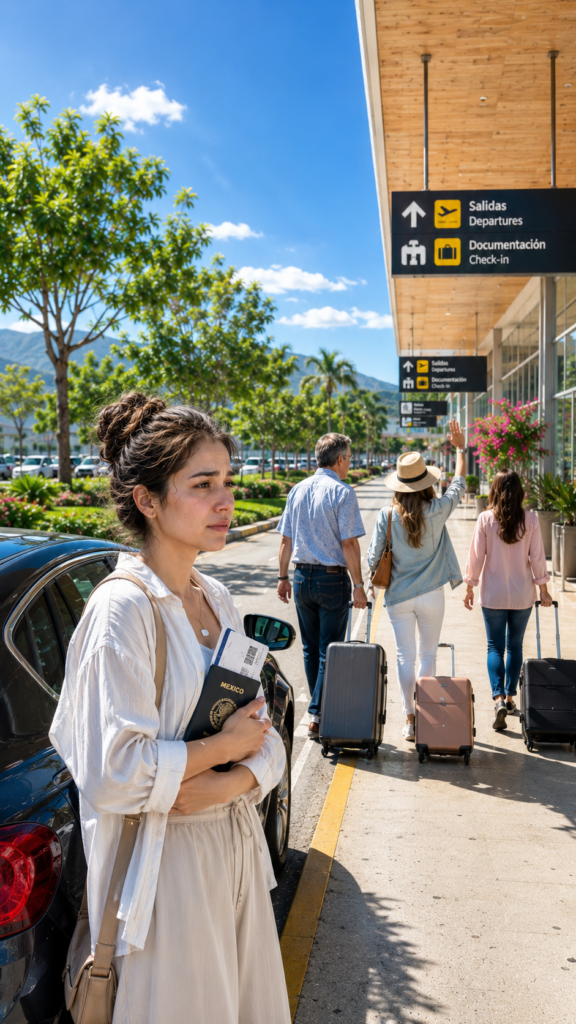
Mariana Torres was 34 years old and had been married to Esteban Rivas for 9 years, a man who could cry beautifully, speak softly, and lie as if he were praying.
They lived in a small apartment in the Narvarte neighborhood of Mexico City. It wasn’t luxurious, but Mariana had built it up through years of hard work, sleepless nights, and sewing orders delivered even in the early hours.
Esteban always promised he would one day give her "the life she deserved." But every time Mariana truly needed something, he found an excuse, a debt, a failed business, or a tear.
Mariana had a heart condition since she was young. For years, she managed it with medication, appointments, and care. But after turning 30, everything worsened.
First came the fatigue.
Then the shortness of breath.
Next, the fainting spells.
When the cardiologist said she needed urgent surgery, Esteban took her hand in front of the doctor and began to cry.
—I swear I won’t leave you alone, my love. Even if I have to sell everything.
Mariana believed him.
Because when a woman loves, she sometimes confuses promises with proof.
For 4 months, they saved money. Mariana sold her industrial sewing machine. Her mom pawned some gold earrings that had belonged to her grandmother. A neighbor organized a raffle. A friend lent her money. Mariana even accepted a loan that would take years to pay off.
The private hospital requested 185,000 pesos as a deposit to secure the operating room, medical equipment, tests, and the first days of hospitalization.
The night before admission, Mariana checked the account.
There were 187,400 pesos.
She cried in front of her cellphone.
Esteban hugged her from behind.
—See? I told you I wouldn’t let you die.
She closed her eyes and wanted to feel safe.
But for days, something had been gnawing at her.
One afternoon, she had seen a message on Esteban’s cellphone.
“If you really love me, prove it. I’m tired of taking Ubers while your wife plays the martyr in the hospital.”
The contact was saved as “Nancy Parts.”
Esteban said she was a demanding customer from the workshop where he worked part-time.
Mariana wanted to believe him.
But that same night, she found a brochure for a used car dealership in Tlalpan in his jacket.
A red 2019 Mazda.
Down payment: 140,000 pesos.
Mariana’s heart was failing, but her intuition still beat strong.
The next day, she entered the hospital with a small suitcase, a rosary from her mother, and a fear she didn’t want to voice.
Esteban signed papers at reception.
Or at least, that’s what he pretended to do.
In the afternoon, a nurse entered the room and said with a nervous smile:
—Mrs. Mariana, the finance department is reviewing some data. You rest.
Rest.
That word is often used when no one wants to tell the sick the truth.
Hours later, Esteban arrived with white flowers and a face too calm.
—Is everything settled? —Mariana asked.
He kissed her forehead.
—Yes, my love. Trust me.
But on the second day, the doctor entered seriously.
Esteban wasn’t there.
He had gone “to resolve an urgent call.”
The doctor closed the door.
—Mrs. Mariana, we need to talk.
She felt her body grow cold.
—What happened?
—The deposit was not covered. Without that payment, the surgery scheduled for tomorrow cannot take place at this hospital.
Mariana asked for her cellphone with trembling hands.
She entered the bank app.
There it was.
Transfer of 142,000 pesos.
To a car dealership.
Authorized with Esteban’s digital signature.
Below were more charges.
Gasoline.
Restaurant.
Flowers.
Motel.
Mariana didn’t scream.
Sometimes the pain is so great it makes no sound.
She just wrote:
“Esteban, where’s the money for my surgery?”
He saw the message.
He didn’t respond.
She wrote again:
“I saw the transfer.”
Then he called.
—Mariana, calm down.
—Did you steal my surgery money?
—Don’t say that.
—Did you buy a car?
Silence.
That silence smelled of cheap perfume, new leather, and betrayal.
—Who was the car for, Esteban?
He took a deep breath.
—Nancy was pressuring me.
For the first time, he said her real name.
Nancy.
She wasn’t a customer.
She wasn’t a parts store.
She was the mistress.
—And her pressure was worth more than my heart?
—I was going to replace the money.
—When? After you buried me?
Esteban started to cry.
But Mariana no longer listened to her husband.
She heard a coward.
That night, while she lay hooked to monitors and her mom cried in the hallway, Esteban didn’t return.
He didn’t answer calls.
Not from Mariana.
Not from her mother.
Not from the hospital.
Later, the reason became known.
Nancy wanted to take the car for a spin that very night. She wanted to post pictures on Reforma, go to Cuernavaca, show off that Esteban “had guts.”
But on the way, they argued.
She discovered the car was financed in his name.
He discovered Nancy was planning to leave him for another man if he didn’t buy her something better.
The fight turned into shouting.
The shouting turned into steering wheel.
The steering wheel turned into a blow.
The red Mazda crashed into a wall in the rain.
Esteban cut his forehead and fractured two fingers.
Nancy got out first.
She grabbed her bag, Esteban’s phone, and the money he had kept in the glove compartment.
Then she fled in a rideshare taxi before the ambulance arrived.
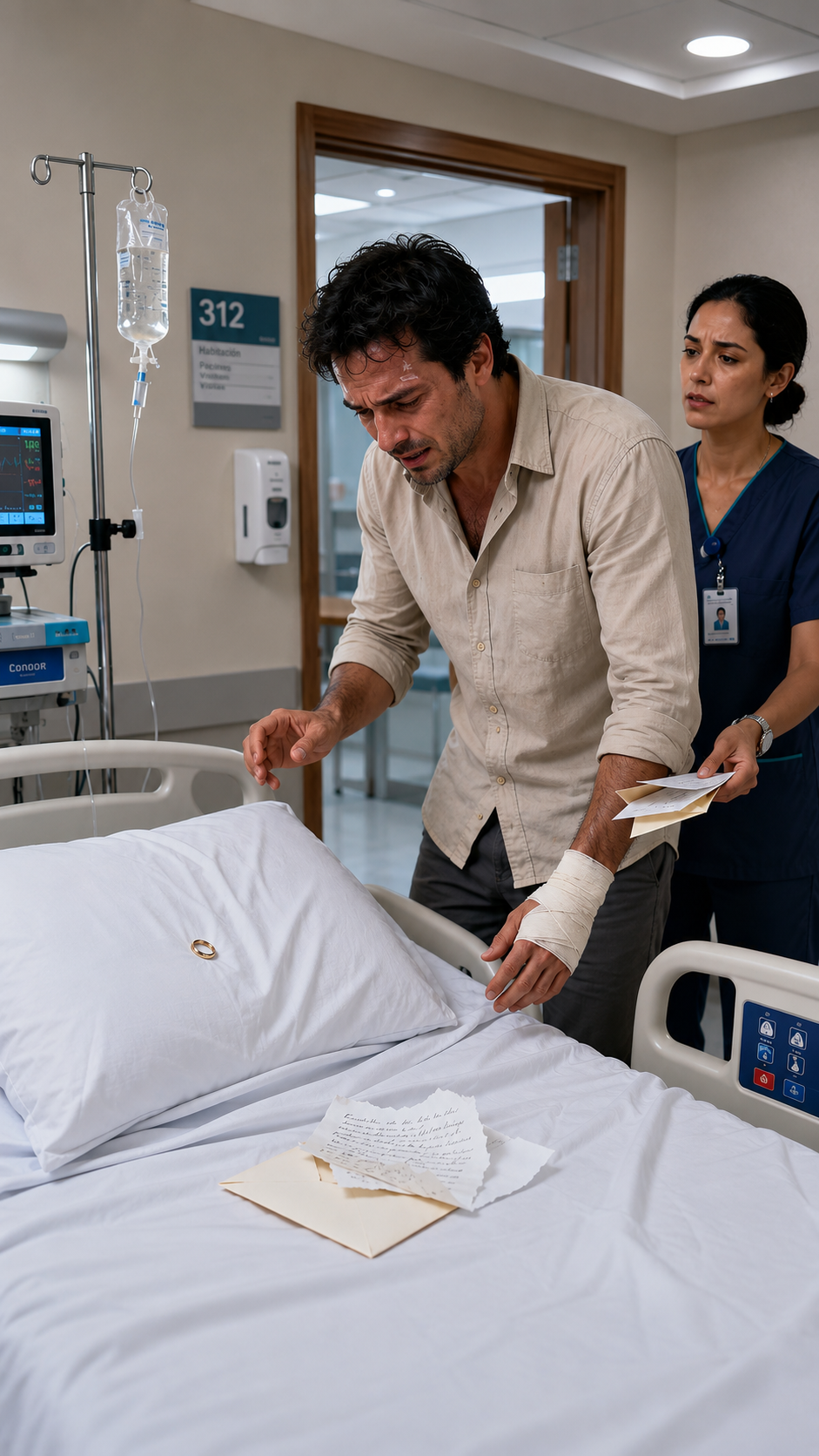
Almost at 3 in the morning, Esteban appeared at the hospital, with a stained shirt, a bandaged hand, and the face of a man who had lost his mistress, his car, and his lies.
He ran to room 418.
But the bed was made.
The pillow was empty.
There was no suitcase.
No rosary.
No wife.
Only his wedding ring on the pillow.
And a nurse behind him told him:
—Mr. Esteban is no longer authorized to receive information about the patient.
PART 2
Esteban stood staring at the empty bed as if the ground had been pulled from under him.
—Where is my wife? —he asked, his voice breaking.
The nurse held a folder against her chest.
—I can’t give you that information.
—I’m her husband.
The nurse looked at the ring on the pillow.
—In the updated record, you no longer appear as the medical responsible or authorized companion.
That hurt more than his open forehead.
Because Esteban couldn’t stand losing control.
He could lose money, dignity, mistress, and car. But he couldn’t bear that Mariana would make a decision without asking him.
He went down to reception.
He shouted.
He begged.
He showed his ID.
He said Mariana was confused, that she was delicate, that she needed her husband.
The guard had to approach him.
—Sir, calm down. This is a hospital.
The receptionist replied firmly:
—The patient left clear instructions.
Instructions.
That was the first time Mariana saved herself without a scalpel.
Hours earlier, when she discovered the transfer, her mother, Doña Teresa, arrived at the hospital devastated. She wanted to find Esteban, confront him, force him to return the money.
But Mariana, pale and with wires stuck to her chest, asked her for something different.
—Mom, don’t call him anymore. He’s already chosen.
Doña Teresa cried harder.
—Honey, what about your surgery?
At that moment, a woman nobody expected appeared.
Doña Amparo, a 76-year-old lady who had shared a room with Mariana since the first night. She had diabetes, a severe infection, and a look that had seen too many injustices.
She had heard everything.
The fake flowers.
The strange calls.
Mariana’s sobs.
The truth of the stolen money.
Doña Amparo called her son, an administrative doctor at a cardiology institute in Querétaro who handled urgent cases with social support.
—Honey —she told Mariana—, not all miracles come down from heaven. Some arrive when a nosy old lady makes the right call.
Doña Amparo’s son managed to get an emergency evaluation.
He promised nothing.
But there was a possibility.
A bed.
A transfer.
A team willing to check her case, as long as she arrived stable and with complete documents.
Doña Teresa signed.
Mariana signed.
And before leaving, she requested that Esteban be removed from the records.
Then she took the wedding ring he had given her 9 years ago and left it on the pillow.
Not as revenge.
As a return.
When Esteban received an envelope from the nurse, he opened it with desperation.
Inside was a page with a single phrase written by Mariana:
“You bought a car for her with the money from my heart. I left before you sold my last chance to live.”
Esteban read the phrase three times.
The first time, he got angry.
The second time, he understood she knew everything.
The third time, he started to tremble.
He tried to call Mariana, but Nancy had his phone.
He tried to call Doña Teresa from another number.
She answered two days later.
—Doña Tere, please tell me where Mariana is.
Her voice sounded calm, too calm.
—Where your lies can no longer reach.
—I need to see her.
—You needed to stay.
—I had an accident.
—My daughter did too. Only hers was sleeping next to her for 9 years.
Esteban cried.
Doña Teresa didn’t hang up.
But for the first time in her life, she didn’t rush to console a broken man.
—Is she alive? —he asked.
There was silence.
—Please.
—Yes, she’s alive.
He let out a sob.
—Thank God.
—Don’t bring God into this to clean up what you’ve dirtied. Thank the women who were there when you were busy playing the gallant.
Mariana’s surgery occurred 4 days later.
It was long.
Complicated.
It wasn’t a movie.
There was ICU, pain, fear, tubes, endless nights, and a mother asleep in a plastic chair, holding her daughter’s hand as when she had fever as a child.
When Mariana woke up, she felt her chest heavy.
Then she felt something strange.
Peace.
A weak peace, but real.
Esteban wasn’t there.
And for the first time, she didn’t look towards the door expecting a man who might get distracted with another woman along the way.
During recovery, Doña Teresa showed her Esteban’s messages.
“Forgive me.”
“I’m going to sell the car.”
“Nancy left.”
“She used me.”
Mariana almost laughed, even though it hurt to breathe.
He said Nancy had used him.
As if the betrayal was the mistress’s fault for escaping.
As if he hadn’t signed.
As if he hadn’t lied.
As if he hadn’t traded a surgery for a steering wheel.
When Mariana could speak better, she recorded an audio.
Her voice was low, but firm.
—Esteban, I’m alive. Not thanks to you. I had surgery. Not thanks to you. My mom is with me. Not thanks to you. I’m going to recover. Not thanks to you. Our marriage ended when you looked at the money from my heart and saw a car for another woman.
He responded immediately.
“Can I come see you?”
She wrote:
“No.”
He insisted:
“I’m your husband.”
Mariana replied:
“My husband died before I entered the operating room.”
And she blocked him.
Months later, Mariana returned to the Narvarte apartment to collect her things. She arrived with her mom and a lawyer friend.
Esteban was there.
Thinner.
Unshaven.
With one hand still injured.
When he saw her enter, he crumbled.
—Mariana...
She didn’t run.
She didn’t tremble.
She didn’t scream.
The woman who entered that apartment was no longer the same one who had cried in front of an empty bank account.
—I’m here for my documents and my clothes.
Esteban pointed to the living room.
—I sold the TV, the laptop, and some tools. I’m gathering to pay you.
—Money can’t buy back the night I thought I was going to die because you wanted to impress your mistress.
He looked down.
—I was wrong.
—No, Esteban. Being wrong is forgetting an appointment. What you did was cruel.
The word hung between them.
Cruel.
He knelt.
—I never wanted you to die.
—But you accepted the risk.
—I thought I would replace it.
—you gambled my life on a lie.
Esteban cried like a child.
But Mariana no longer confused tears with love.
—Sign the divorce —she said—. Don’t fight for the furniture, don’t fight for my medications, don’t fight for anything. Be accountable for the money you stole and if you ever tell this story, don’t say you lost me to a mistress. Say you lost me because you preferred a leather seat while I needed a beating heart.
He didn’t respond.
Because for the first time he had no beautiful phrase.
Weeks later, the red Mazda appeared.
It was abandoned in a parking lot in Iztapalapa, beaten, with fines, no stereo, no spare tire, and with incomplete papers.
Nancy never returned.
She just sent a message from another number:
“Don’t even look for me, dude. You got yourself into this alone.”
Esteban wanted to use that message as proof that he was also a victim.
But no one believed him.
Because suffering the consequences of a betrayal doesn’t turn the traitor into an innocent.
The divorce was finalized before a year had passed.
The judge ordered Esteban to account for the money withdrawn from the joint account and part of the documented medical expenses.
But the worst sentence didn’t come from the court.
It came from the void.
The apartment was sold.
Friends drifted away.
His family stopped defending him when they learned that Mariana almost lost the surgery because of him.
His own mother went to find Mariana at the Querétaro institute.
Crying, she said:
—Forgive me. I raised a son believing a woman should endure everything.
Mariana responded without hatred:
—You can still stop justifying him.
Over time, Mariana was able to walk again without getting so tired.
She couldn’t return to sewing as before, because her body couldn’t handle long hours anymore. But she opened a small workshop to teach sewing to sick women, single mothers, and widows who needed money without depending on anyone.
She named it “Empty Bed.”
One student asked her why.
Mariana looked at the plaque, took a deep breath, and said:
—Because one day a man returned to the hospital expecting to find me where he had left me suffering. But my bed was empty. And that’s when I understood that surviving also means stepping out of the place where others expect to see you destroyed.
Everyone fell silent.
Then one started to clap.
Then another.
And another.
Mariana cried.
Not from sadness.
From recognition.
Years later, Esteban ended up working as a rideshare driver to pay off debts.
The irony was brutal.
He drove other people’s cars because he destroyed the one he bought with the money he stole from his wife.
Once he sent a letter through his lawyer.
It said:
“Every passenger that gets into the car reminds me that I traded your life for a fantasy with four wheels. When I saw your empty bed, I thought I had lost you that night. But now I understand that I lost you when I took the money.”
Mariana kept the letter for a week.
Then she burned it.
Not out of hatred.
Because some truths don’t deserve a shrine.
Today, her scar flows down her chest like a fine line. Sometimes it hurts when the weather changes. Sometimes it reminds her of room 418, the ring on the pillow, and that empty bed.
But she no longer feels shame.
The empty bed wasn’t a tragedy.
It was her first victory.
He returned without his mistress, without a car, without money, and without a wife.
She left without false promises, without chains, and with a heart that still beats.
Not thanks to him.
In spite of him.
And each heartbeat reminds her of something many women need to hear:
The worst hospital bed isn’t the one that remains empty.
It’s the one that keeps a woman alive next to someone who has already decided to let her die inside.