PART 1
The week Valeria burned a hard-boiled egg, Doña Mercedes told her son he had married an 'incomplete' woman.
A hard-boiled egg.
No one in that house understood how someone could burn something that was sitting in a pot of water. But it happened.
When Diego entered the apartment in the Narvarte neighborhood, he found smoke billowing out of the kitchen, a black pot on the stove, and Valeria standing in front of the disaster, in a tailored suit, heels in one hand, and a face of shame that hadn’t even shown when she lost a tough case.
Valeria was 32.
She was a family lawyer, the kind who defended women who arrived in court with swollen eyes and broken lives.
Diego was 35, working as an engineer for a construction company, and had been married to her for barely a year.
From the start, Diego knew perfectly well that Valeria couldn’t cook.
She never hid it.
Once she tried to make rice and called him over video chat to ask if she should wash the rice first or sweet-talk it to keep it from sticking.
Diego laughed.
It didn’t bother him.
He cooked when he could. If not, they ordered tacos, sandwiches, takeout, or whatever came up. The household functioned differently.
Valeria didn’t make sauces or broths, but she was the one who paid the bills on time, who organized medical appointments, who remembered birthdays, who found lost documents, and who knew when Diego was tired even when he said, 'I’m fine.'
The problem was Doña Mercedes.
For her, a house without home-cooked meals was a sad house.
Every time she visited her son, she would throw the same jab.
“Has Valeria learned to make beans yet?”
Valeria would smile, though less and less each time.
“Not yet, Doña Meche. That's why I’m still arguing with judges.”
Diego would laugh to ease the tension.
But his mother didn’t always take it as a joke.
One Sunday, Doña Mercedes arrived unannounced with a bag of sweet bread. Valeria had just returned from the office, with her makeup smudged and a folder full of case files tucked under her arm.
The mother-in-law looked at the empty table and said:
“A woman can have many degrees, honey, but if her husband comes home tired and finds not even a broth, something is wrong.”
Valeria froze.
Diego felt the blow, but reacted too late.
Valeria dropped her things, went to the bathroom, and closed the door.
When she came out, her face was washed, but her eyes were red.
That night she didn’t eat dinner.
Later, in bed, she asked Diego in a tiny voice:
“Do you think I’m not cut out to be a wife, too?”
Diego hugged her and said no, of course not.
But Valeria kept staring at the ceiling.
A few days later, she wanted to prove something.
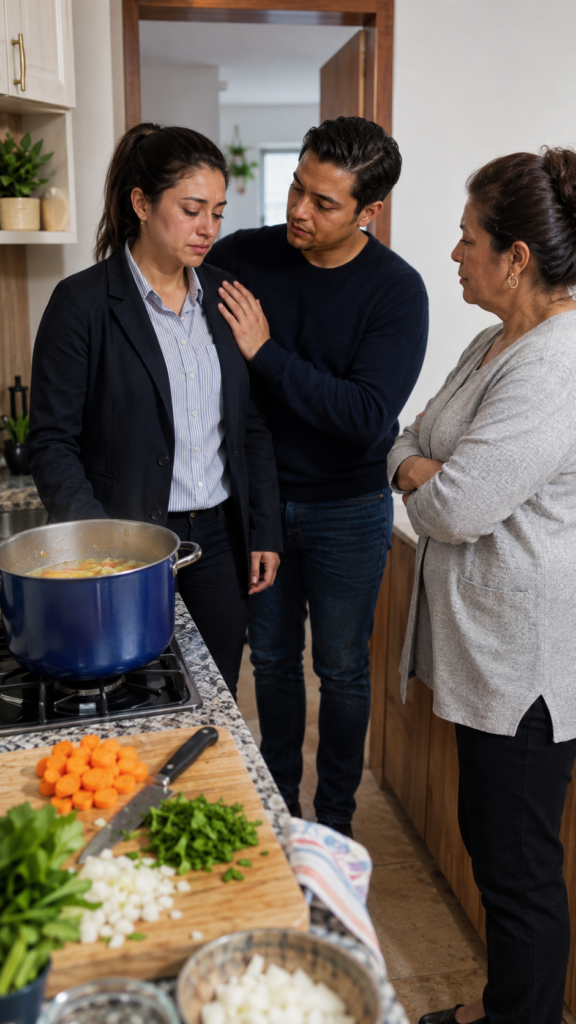
She asked to leave the office early, stopped by the market, and bought chicken, potatoes, carrots, chayote, onion, and cilantro.
When Diego arrived, he found Valeria in the kitchen, sweating as if she were testifying before the Supreme Court.
Doña Mercedes was already seated at the table.
Watching.
The soup turned out terrible.
The potatoes were hard, the carrots mushy, the chicken dry, and it seemed like all the salt had spilled in with the jar.
Valeria served the plates with shaking hands.
Doña Mercedes took a spoonful.
She said nothing.
That silence was worse than an insult.
Then Valeria dropped the spoon on the table and said:
“I can defend an abused woman in front of a judge without breaking. But here, in this kitchen, you make me feel like I’m worth nothing.”
Diego shot up.
“Mom, that’s enough.”
Doña Mercedes tightened her napkin.
But what she did next left everyone breathless.
She took the bowl of soup, stood up, and dumped it all into the sink.
Then she said:
“Well, if you can’t even do this, I don’t know what kind of home you’re going to give my son.”
Valeria went pale.
And Diego understood, too late, that that night was no longer about a bowl of soup.
PART 2
The sound of the soup hitting the sink lingered in the kitchen like a slap.
Valeria didn’t scream.
She didn’t insult.
She just took off her apron, folded it with a calm that hurt, and left it on the table.
Diego looked at her, waiting for her to say something, but she grabbed her bag, her keys, and left the apartment without looking back.
The door didn’t slam.
That was worse.
Doña Mercedes stood next to the sink, breathing heavily, as if she were the one who had been offended.
“She lacks character,” she murmured.
Diego turned to her with eyes full of rage.
“No, Mom. What she lacks is a mother-in-law who doesn’t humiliate her.”
Doña Mercedes opened her mouth, but Diego didn’t let her speak.
“I didn’t marry Valeria because I needed a maid. I married her because she’s my partner. Because she supports me when I can’t even support myself. Because while you ask if she knows how to make rice, she’s saving women who come to court terrified of going back home.”
His mother looked down for a second.
But pride won out.
“One thing doesn’t negate the other.”
Diego took a deep breath.
“Yes, it does, Mom. Because you’re not teaching. You’re punishing.”
Doña Mercedes left that night without saying goodbye.
Diego found Valeria an hour later, sitting on a bench in the nearby park, with her jacket over her shoulders and dry eyes.
That broke his heart even more.
When a person stops crying, sometimes it’s not because they no longer hurt.
It’s because they’re tired of asking for permission to grieve.
Diego sat next to her.
“Forgive me,” he said.
Valeria didn’t look at him.
“You didn’t empty the soup.”
“No. But I let us get to that point.”
She pressed her lips together.
“I don’t want to live feeling like I’m on trial in my own home.”
Diego nodded.
“And you won’t.”
That night they didn’t talk much.
They ordered tacos because neither had the strength to cook or pretend that everything was alright.
The next day, Diego called his mother.
He made it clear that he wouldn’t step back into the apartment if she was going to treat Valeria like an inept child.
Doña Mercedes was outraged.
She cried.
She said he was changing because of his wife.
She said he used to be closer, more obedient, more 'family-oriented.'
Diego said something he had never dared to say:
“Family doesn’t mean allowing you to hurt the one I love.”
Three weeks went by without seeing each other.
Valeria continued working late, but something in her had shifted.
She no longer joked about her clumsiness in the kitchen.
She no longer laughed when someone said a modern woman could handle everything.
If someone at a gathering asked if she cooked, she would respond:
“No. And that’s not up for discussion.”
Diego admired her, but he also saw the wound.
One Thursday morning, before 7, Diego’s phone rang.
It was a neighbor of Doña Mercedes.
“Excuse me, young man. Your mom fainted and fell in the patio. She says not to tell you, but I think she does need you to come.”
Diego flew out of there.
Valeria heard the call from the kitchen, where she was serving herself coffee.
She didn’t ask if she should go.
She just grabbed the car keys and said:
“Let’s go.”
They found Doña Mercedes on the sofa, blanket over her legs and a dignity very poorly placed.
“Exaggerated,” she said as soon as she saw them.
Her wrist was swollen and her face pale.
Diego started reprimanding her.
Why didn’t she call?
Why was she climbing to wash windows alone?
She was no longer 20.
Doña Mercedes closed up like a stone.
“I don’t need you treating me like an old woman.”
Then Valeria approached.
Not with resentment.
Not wanting to settle the score for the soup.
She sat next to her and touched her good hand.
“We’re not going to treat you like an old woman. We’re going to treat you like someone who matters to us.”
Doña Mercedes looked at her in surprise.
She didn’t know what to say.
While Diego spoke with the doctor, Valeria entered the kitchen to find something to give her.
She opened the refrigerator and froze.
There were two hard tortillas, half a dried lemon, an open gelatin, one egg, and a container of old soup that smelled off.
Valeria slowly closed the door.
She didn’t judge.
But she understood something.
The woman who talked so much about warm food had been eating loneliness for weeks.
When Diego returned, Valeria signaled for him.
He opened the refrigerator and his face fell.
“Mom… what are you eating?”
Doña Mercedes turned her eyes away.
“For me alone, it’s not worth cooking.”
That phrase was sadder than any fight.
Valeria heard it from the door and, for the first time since the night of the soup, felt compassion.
Not an excuse.
Compassion.
That day there was no perfect broth.
Diego made half-burned quesadillas. Valeria heated water for tea. The neighbor brought bread.
Doña Mercedes complained that it wasn’t food.
Valeria responded with a tired smile:
“Today the meal is that you’re not alone, Doña Meche.”
The lady lowered her gaze.
And her eyes filled with tears.
The wrist turned out to be a small fracture, but enough to keep her from cooking for a few weeks.
Diego suggested hiring someone.
Doña Mercedes said no.
He suggested ordering food.
Doña Mercedes said that didn’t nourish.
Then Valeria did something no one expected.
She pulled out a yellow notebook from her bag and placed it on the table.
“Teach me.”
Doña Mercedes frowned.
“What?”
“Teach me simple recipes. But without humiliating me. And I’ll come twice a week to help you while you recover.”
Diego looked at his wife as if he had just witnessed a miracle.
Doña Mercedes swallowed.
“After what I said?”
Valeria held her gaze.
“I’m not doing it because you deserve it. I’m doing it because I don’t want to become someone who returns pain for pain.”
That was the first blow to Doña Mercedes’s pride.
The second came the following Saturday.
Valeria arrived with vegetables from the market, a notebook, a pen, and a bag of bread.
Doña Mercedes was seated in the kitchen, her wrist bandaged.
The first recipe was noodle soup.
Something basic, according to the lady.
A deadly trap, according to Valeria.
“First, you lightly brown the noodles,” Doña Mercedes instructed.
“Lightly Mexican or lightly real?” Valeria asked.
Diego burst out laughing from the doorway.
Doña Mercedes tried to hold it in, but she also laughed.
It was brief.
But it was laughter.
The noodles turned out a bit mushy.
The tomato needed more seasoning.
And Valeria almost added sugar thinking it was salt.
But no one dumped the bowl.
Doña Mercedes ate slowly.
Then she said:
“For the first time, it didn’t turn out so terrible.”
Valeria raised an eyebrow.
“That, coming from you, sounds like a standing ovation.”
The lady smiled.
As days passed, the kitchen stopped feeling like a courtroom.
Valeria cut crooked carrots.
Doña Mercedes corrected less.
Diego washed dishes and played José José music.
Sometimes they argued over trivial things.
Sometimes they laughed.
Sometimes the past crept between them like old smoke.
One afternoon, while preparing picadillo, Doña Mercedes stared at the frying pan and suddenly said:
“My mother-in-law threw a tortilla in my face when I was 19.”
Valeria froze.
Diego, from the table, looked up.
Doña Mercedes continued speaking without looking at them.
“She told me that if I couldn’t make a round tortilla, my husband would find a real woman. I cried locked in the bathroom. The next day, I made 30 tortillas until I got them right.”
No one said anything.
The lady pressed her lips together.
“I promised I would never be like her.”
Valeria put down the knife.
“But you were with me.”
Doña Mercedes closed her eyes.
“Yes.”
That word weighed more than any long apology.
Then came the truth Diego didn’t expect.
Doña Mercedes confessed that when Diego was a child, many times she cooked sick, with fever or migraine, because her husband told her that a house without food was a failed house.
Diego’s father, now deceased, never slammed the table or raised his voice much.
But he had that silent way of making her feel guilty.
If the food was cold, he left the plate.
If the beans had little salt, he sighed.
If she wanted to rest, he would say:
“Then why did I marry you?”
Diego felt a knot in his throat.
He had never seen that side of his mother.
He remembered rich meals, full tables, hot tortillas.
He didn’t know that many had come from fear.
Doña Mercedes looked at Valeria.
“I judged you because it made me angry to see you free from something that kept me bound my whole life.”
Valeria didn’t respond right away.
Her eyes were glistening.
Then she said:
“I’m not your enemy, Doña Meche.”
The lady nodded.
“I know that now, honey. But it took me a while.”
After that afternoon, something truly changed.
Doña Mercedes began to ask before she opined.
Valeria began to relax in that kitchen that had once tightened her chest.
Diego learned not to wait for a wound to explode to set boundaries.
Three months later, Doña Mercedes’s birthday arrived.
Diego thought of taking her to a nice restaurant in Coyoacán, but Valeria suggested doing it at home.
“I want to prepare the appetizer,” she said.
Diego almost choked on his coffee.
“Are you sure?”
“Yes. But I don’t want to do it to prove anything. I want to do it because I’m no longer afraid.”
The night before, they cooked together.
Valeria made pumpkin cream.
She dropped onion on the floor, argued with Diego about what the hell a 'splash' of oil was, and consulted her notebook as if it were a penal code.
But she was calm.
That was the beauty of it.
The next day, Doña Mercedes arrived with a gelatin.
“Just in case,” she said.
Valeria opened the door and replied:
“Very wise of your distrust.”
The two laughed.
They sat at the table.
Diego served the cream.
Doña Mercedes took the first spoonful.
Valeria held her breath.
The lady swallowed slowly.
Then looked up.
“It’s good.”
Valeria squinted.
“Good for real or good so as not to ruin your birthday?”
Doña Mercedes smiled.
“Good for real, honey.”
Valeria got up without saying anything and went to the bedroom.
She returned with an envelope.
She handed it to Doña Mercedes.
Inside was a photo.
It was of the two of them in the kitchen, one ordinary afternoon, with flour on the table and tired faces. Diego had taken it without warning.
On the back, Valeria had written:
“Thank you for teaching me without making me small.”
Doña Mercedes covered her mouth.
Her eyes filled with tears.
“I have something to tell you, too.”
She pulled out a folded piece of paper from her bag.
It wasn’t a recipe.
It was an apology.
She read it with a trembling voice.
She said she had confused custom with love.
That she had called home many unjust burdens.
That she had hurt Valeria not because Valeria was a lesser woman, but because she never knew how to heal the 19-year-old girl who cried while making tortillas.
Diego cried in silence.
Valeria did too.
In the end, Doña Mercedes took her daughter-in-law’s hand and said:
“You don’t have to resemble me to be a good wife. And I had no right to make you pay for what was done to me.”
Valeria hugged her.
It wasn’t a movie hug.
It was awkward, long, real.
One of those that arrive late, but they arrive.
Since then, meals in that family changed.
Not because Valeria became a chef.
Far from it.
The rice still stuck.
She still asked if 'sautéing' was frying with patience.
Diego was still the one who moved best among the pots.
But no one used food as a test anymore.
On Sundays, they cooked together.
Sometimes Doña Mercedes chopped vegetables.
Sometimes Diego made stew.
Sometimes Valeria opened an app and ordered pizza without guilt.
And when something burned, there was no judgment.
There was laughter.
One Sunday, Valeria managed to make rice.
Not perfect.
A bit mushy.
Stuck to the bottom.
But rice.
Doña Mercedes tasted it, stayed serious, and said:
“This looks like a 40-year marriage.”
Valeria raised her spoon.
“Careful, Doña Meche, I might still burn the dessert.”
Everyone laughed.
Diego watched them from the table and understood something that hurt and gave him peace at the same time.
His wife never had to learn to cook to deserve respect.
His mother never had to deny her story to ask for forgiveness.
And he never should have waited for Valeria to cry to defend her.
In the yellow notebook, there was a page stained with sauce.
At the top it read:
“Little salt. Very little. Don’t be overconfident.”
Below, in trembling handwriting, Doña Mercedes wrote:
“And if it turns out badly, order pizza. No one is worth less for burning dinner.”
That phrase became the most important recipe in the house.
Because a family doesn’t stand on perfect soup, round tortillas, or women who silently endure.
It stands on the way someone looks at you when you fail.
On the hand that doesn’t push you to the sink.
On the voice that, instead of judging you, says:
“Come on, it’s okay… we’ll try again together.”