The night Nathan ended it, Emma had a glass of red wine she didn't touch.
She kept looking at it on the coffee table while he talked. The way the light from the lamp caught it. How still it was. She focused on that rather than his face, because if she looked at his face she would have to believe what he was saying.
He had been building to it for weeks.
She could see that now, looking back. The way he would come home from site visits already somewhere else in his mind. The way he stopped asking about her day, not rudely, just the way a person stops refilling a glass they've decided not to drink from anymore. Small withdrawals. The kind you only recognise when the account is finally empty.
They were five years in.
Emma had been twenty-five when they met. Nathan thirty-two. She'd been working at a small editorial agency, writing copy for property developers, which was how they crossed paths — he was the architect on a waterfront conversion she was writing promotional text for. He'd corrected one of her descriptions in a meeting. Politely but absolutely. She'd liked that. She'd liked that he knew things with certainty.
She thought that certainty would extend to her.
For three years, it did. He was attentive in the early way that feels like a promise. He remembered things she mentioned in passing — a book she wanted, a restaurant she'd looked up once. He knew how she took her coffee before she had to tell him twice. Those details felt like proof of something.
In year four, the details changed.
Not the facts of the relationship. They still lived in the flat he owned in Brockley, south-east London. Still split their weeks the same way — her cooking on Tuesdays and Thursdays, him doing Sundays. Still went to his practice's events, still met her friend Rosie for drinks every second Friday while he had his architecture group. The structure held. It was everything inside it that had gone quiet.
She tried to name it once. She said she felt like they were housemates with history.
He said she was being dramatic.
She let it go.
The night it ended, he came home at seven rather than nine, which should have been a sign she missed.
Emma was on the sofa, reading, wearing the grey cardigan he always said made her look like a librarian. She'd looked up when she heard the key. Said hello.
He sat down in the armchair. Not beside her. The armchair.
"I need to talk to you about something."
She closed her book.
"I've been thinking," he said, "about what I want. For my life. For the next twenty years." He paused, and the pause was the kind that comes from having rehearsed. "And I don't think we want the same things, Emma."
"What things?" she said.
He looked at her then. She looked back.
"Children," he said. "A house. The whole — setup. The Sunday roasts and the school runs. The mortgaged life." He shook his head slightly. "I don't want it. I've never wanted it. I thought I could — I thought it would change, being with you. But it hasn't."
Emma said nothing.
She thought about what she'd imagined. Not specifically, not consciously, she'd never been someone who planned weddings in her head. But there had been an assumption, a soft background assumption, the way you assume the heating will come on in October. That they were moving toward something.
"I don't want this life, Emma," he said. "I don't want children. I don't want the house. I don't want to stop."
"Stop what?"
"Everything," he said. "The travel. The freedom. The — not being accountable to a schedule that someone else set for me."
She picked up her wine. Set it back down.
"This is about me," she said. It wasn't a question.
"It's about us," he said. "What we're moving toward. Which I think you can see is different things."
"You've decided this."
"Yes."
She looked at him for a long moment. At the architecture of his face she'd been looking at for five years. The dark hair starting to go silver at the temples even then, at thirty-seven. The cheekbones. The set of his jaw when he'd made up his mind. She had always loved that jaw. That certainty.
Now she understood it differently.
"Okay," she said.
He blinked. He'd expected something else. An argument, probably. An appeal. She could see him recalibrate.
"Okay?" he said.
"Yes." She stood. She was steadier than she expected. "I'll need a few weeks to find somewhere else."
"Emma — "
"I'm not going to make this harder than it has to be," she said. "If you've decided, then you've decided." She walked to the kitchen. Poured the wine down the sink. Rinsed the glass carefully. Set it on the drying rack.
She heard him behind her.
"I do love you," he said. "That hasn't — I want you to know that."
"I know," she said. She turned to look at him. "That's the part that's hard to explain, isn't it. You can love someone and still not want the life they come with."
He had no answer for that.
Neither did she, really.
She moved into Rosie's spare room three weeks later.
Rosie was a primary school teaching assistant with a chaotic kitchen and an ancient cat named Gerald and very strong opinions about Nathan. She did not express them. She made Emma tea, and kept the biscuit tin full, and let her sit in silence when silence was what was needed.
Emma went to work. She edited copy. She took on two new clients. She started running in the mornings, not because she particularly wanted to but because moving through the world before the rest of it was awake felt like something close to agency. She was rebuilding, slowly, without examining it too closely.
She was fine.
She told herself that.
She almost believed it.
Eight weeks after the night Nathan ended it, Emma sat on the floor of Rosie's bathroom and looked at the test in her hand.
She had not been tracking anything. She had not been trying. Her cycle had always been irregular — stress, she'd assumed, and she had been under a great deal of stress — and she had not connected the nausea to anything beyond anxiety, which she was familiar with. She had not connected it to anything except the month itself being hard.
But Rosie had come home with a box from the chemist and placed it on the bathroom counter without saying anything, and Emma had waited until Rosie went to bed, and now it was two in the morning and Emma was sitting on the cold tile floor with the test in both hands.
Two lines.
She read it again.
Two lines.
She sat there for a very long time.
There was no one to call at two in the morning. Her parents were in Cornwall and had never met Nathan. Rosie was asleep. Nathan was — Nathan was somewhere else in the life he'd chosen.
Emma set the test on the floor beside her and leaned back against the bathtub. The tiles were cold through her pyjamas. Gerald came in at some point, probably drawn by the light, and sat on her feet. She let him.
Outside, a bus passed. Then nothing.
She thought: he doesn't want children.
She thought: neither of them planned this.
She thought: but she was already thinking of them as two things, not one thing. That was strange. She had just read the test two minutes ago and already she was thinking of them as two people.
She wouldn't understand why until December, when the twenty-week scan showed her exactly what she already somehow knew.
The weeks that followed were mechanical.
Emma told Rosie first, the morning after, over tea. Rosie sat very still. Then she asked, "What are you going to do?" and Emma had no answer. That was the honest truth. She had no idea. She knew what Nathan had said and she knew what two lines meant and that was the sum of her certain knowledge.
She made an appointment with her GP.
She walked home from the surgery in the rain, and she didn't take her umbrella out, and somewhere around the corner of the high street she stopped walking and stood still for a moment. A man walked past and looked at her like she might need help. She waved him on.
She stood there.
And she thought: I cannot call him.
Not because he had no right to know. She wasn't certain about rights. She just — he had sat across from her in that flat three weeks earlier and said, with the steady confidence she had once loved, that he did not want children. He did not want the house. He did not want to stop.
He had been crystal clear.
So had she.
She had not planned this either.
But she was thirty-two and she was pregnant and somewhere in that cold wet moment on the pavement the thing she felt, underneath the terror and the vertigo of it all, was something she was not prepared for.
She wanted them.
That was the truth of it. Underneath all the noise. She wanted them.
She called her mother that evening.
Her mother was quiet for a long moment. Then she said, "Are you safe?"
"Yes," Emma said. "I'm safe."
"And the father?"
Emma looked out the window. "He's not in the picture."
Her mother absorbed this. "Then we'll figure it out," she said. "You come to us at Christmas and we'll figure it out."
Emma went to Cornwall for Christmas. She was fifteen weeks by then, showing a little in loose jumpers. Her parents were steady people — her father was a retired postman, her mother had worked in the local library for thirty years. They were not equipped for drama. They were equipped for practical help. Her father researched council tax credits without being asked. Her mother found a maternal health midwife who did home visits. They did not say: this will be hard. They said: we will help.
She was grateful for that, afterwards. The way they just got on with it.
She found a flat at sixteen weeks.
It was a two-bedroom above a chip shop on a residential street in Lewisham. It was not beautiful. The carpets were a colour she could not name and the kitchen tiles were slightly wrong and the boiler was seventeen years old. But it was hers. She paid her first month and deposit from savings she had been building carefully because she had always been careful with money, it was one of the ways she and Nathan had been different.
She painted the second bedroom a pale yellow. She bought a second-hand cot from a woman on Gumtree.
She did not contact Nathan.
She drafted the text three times. She never sent it. Not because she was cruel. Not because she was punishing him. But because she had sat with it for weeks, turned it from every angle, and every angle led back to the same place: he had told her clearly who he was and what he wanted. She would not ask him to become someone different. She would not hand him an obligation he had never agreed to.
And — this was the thought she held most carefully — she was not willing to let the survival of her children, the texture of their lives, hang on a man who might say yes out of guilt and resent them for it.
She chose not to find out.
Oliver and Finn were born on a Tuesday in March, six weeks early, small and loud and absolutely themselves.
Oliver came first: seven minutes, one midwife said, before his brother arrived. Finn was smaller, stayed in the neonatal unit for eleven days. Emma would sit beside him with her hand through the incubator, touching his fingers, talking to him. She read him things from her phone — articles, weather reports, anything. Rosie came every day and brought food. Emma's mother came from Cornwall for three weeks.
The day she brought both boys home, carrying one in each arm up the stairs to the flat above the chip shop, she stood in the yellow room and understood something fundamental.
She had done this herself.
Not alone. She had help, and she was grateful for it. But the choice had been hers, and the weight of it had been hers, and she had held both without collapsing. That knowledge would carry her for years.
She met David Ward at a school parents' evening.
Not her children's school — the boys were only three. She was volunteering for a literacy programme two evenings a week at a secondary school in Catford. David was a history teacher there. He had sandy brown hair and wore the slightly overwhelmed expression of a man trying to track eight different year groups simultaneously. He held doors open without performing it. He was the first person in eighteen months who asked her a question and then actually listened to the answer.
They went for coffee after the second evening. Then for a walk the weekend after.
She told him about the boys on the third date.
"Two of them?" he said.
"Yes."
He absorbed this. "How old?"
"Three."
He nodded slowly. "And their father?"
"Not in the picture," she said. "Not by my choice or his. By the reality of who he was."
David looked at her steadily. "Okay," he said.
That was it. Okay. Not: that's a lot. Not: I'm not sure I can. Just okay, and a willingness to proceed.
She liked that.
David met Oliver and Finn four months later, when they were three and a half, at a Sunday morning trip to the park. He brought a football. He was terrible at anything resembling sport, which delighted them. They ran rings around him.
The boys called him David for two years.
Then one morning Finn — who was five by then, and had been watching something on television about families — came to Emma in the kitchen.
"Mum," Finn said, "can David be our dad?"
Emma crouched down. "What do you think that means?" she asked.
"It means he stays," Finn said. "It means he's ours."
Emma looked at her son. Dark-haired, serious, Nathan's eyes without her ever having pointed it out.
"I'll talk to him," she said.
She spoke to David that evening. He was quiet for a moment. Then he said: "I've thought of them as mine for a year already. I was just waiting for them to catch up."
They married the following spring. Small ceremony. Her parents, his parents, Rosie, a handful of others.
The boys wore matching bow ties and argued in whispers the whole time about whose side of the aisle was better.
The boys were six on the Friday before Emma's doorbell rang.
Six years old with specific preferences — Oliver liked trains and pasta carbonara; Finn liked beetles and anything with too much sugar. They had their father's cheekbones, though Emma never thought of Nathan when she looked at them, only thought of them as themselves. They had grown into her home and her life the way plants grow toward the light they have rather than the light they don't.
She had a good life.
She wasn't performing contentment when she said it. She had built it carefully from the rubble of a flat in Brockley and a cold bathroom floor and a decision made in the rain, and it was solid and real and hers.
David was at school — parents' evening, ironic, since that was how they'd met. The boys were upstairs, nominally doing homework, actually fighting over a felt-tip pen. Emma was in the kitchen, half-watching the news and half-writing a brief for a new client.
The doorbell rang at 4:47 in the afternoon on a Tuesday in September.
She wiped her hands on a tea towel.
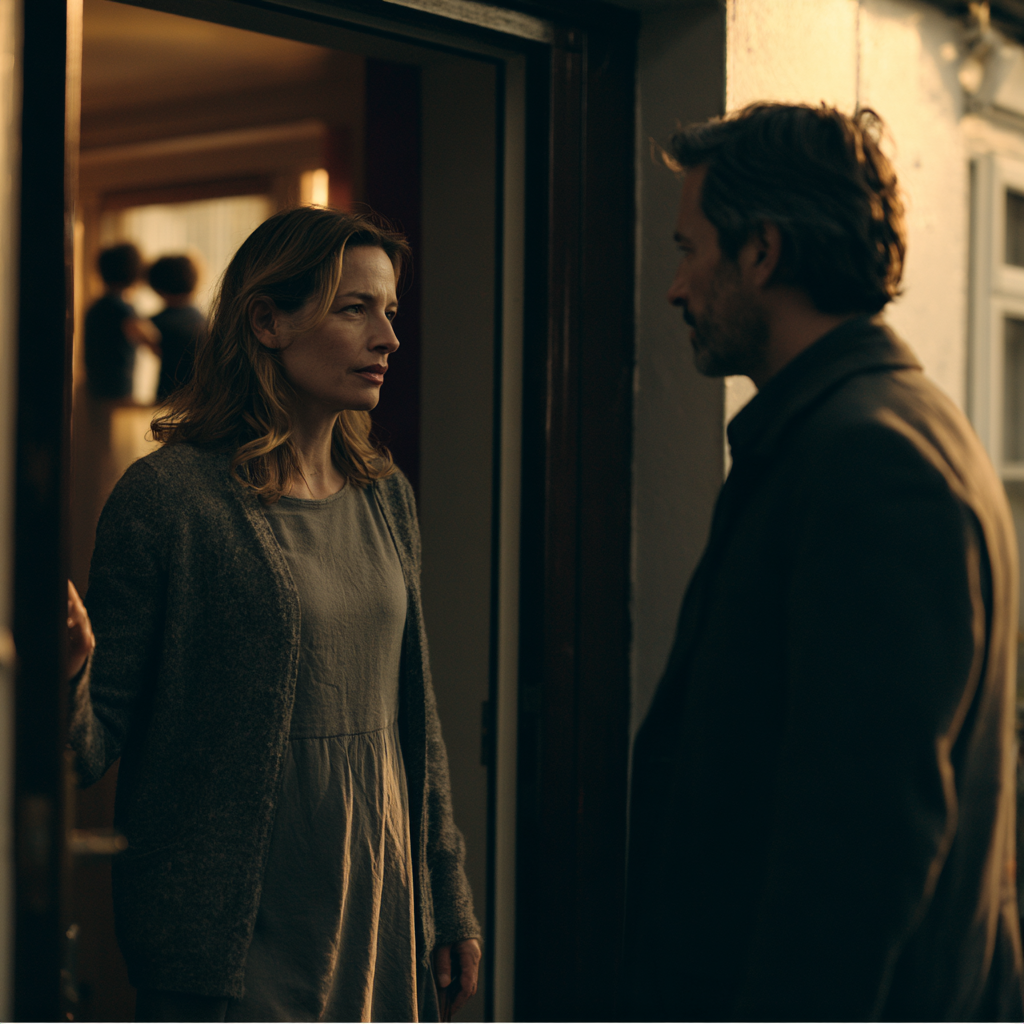
Opened the door.
Nathan Cole was standing on her front step.
He looked almost exactly the same, except the grey at his temples had spread and he was wearing the particular expression of a man who has rehearsed his opening line and is no longer sure it will hold.
Emma stared at him.
He said, "I know I have no right to be here."
She said nothing.
He said, "I'm not here to — I just. I needed to say something. To you. Before — " He stopped. "My marriage is ending. And I've been going through — I've been thinking about a lot of things. And I needed to see you."
Emma's hand was still on the doorframe.
From upstairs, very clearly, came the sound of Oliver yelling at Finn about the felt-tip pen.
Nathan looked up. A brief, instinctive look. Then back at her.
"I should go," he said.
"Yes," Emma said.
But she didn't move.
And neither did he.
She let him in.
She would think about that later — the precise moment she stepped back from the door and let him across the threshold of the life she had built without him. She would not be able to explain it entirely. Something about the look on his face. Something about the cold September air. Something about the fact that he had said I know I have no right to be here and she had believed him, and that honesty, that one thin honest thing after seven years, had been enough.
She stepped back.
He came in.
The hallway of their house was not much to look at.
Emma knew this. Hooks with the boys' school bags. A football neither of them could be persuaded to leave outside. A small table with her keys and her work bag and a permission slip she hadn't signed yet. The walls were a warm white she and David had chosen together, slightly scuffed now from years of small hands. Nothing about it said anything except: people live here and people live here reliably.
Nathan stood in it and looked at everything the way you look at a place you've never been in that still feels somehow familiar.
"Nice house," he said.
"Thank you," Emma said.
She didn't know what else to say. She felt the wrongness of him here — not violent wrongness, not rage, but the specific wrongness of a person from one chapter of your life walking unannounced into a chapter that came much later. Like seeing a word you recognise in a sentence you can't quite read.
"Your husband's — " he started.
"At school," Emma said. "He's a teacher."
Nathan nodded.
She went into the kitchen. Not because she wanted to but because she needed something to do with her hands, and the kitchen was where she did things with her hands. She filled the kettle without asking.
"You said your marriage is ending," she said, from behind the counter.
He leaned against the doorframe. He still did that, she noticed. That lean. The architect at rest.
"She found someone else," he said. "A year ago. I stayed longer than I should have. It's — it's done now."
"I'm sorry," Emma said.
"Are you?"
"Yes," she said. "I'm not glad you're unhappy." She looked at him steadily. "I'm not someone who needs that."
He absorbed this. "I know you're not," he said quietly. "That was a stupid question."
Upstairs, there was a bang. Then laughter. Then the specific thuddingof two small boys negotiating a staircase.
Emma watched the doorway.
Oliver appeared first. He was six years old and had the specific authority of a child who believes strongly in whatever he is currently carrying. He had a football boot in one hand and an expression of complete mission.
He stopped when he saw Nathan.
Finn came up behind him. Smaller. More careful. He stopped too.
They looked at the man in the kitchen doorway with the frank assessment of children who have not yet learned to pretend politeness.
"Who are you?" Oliver said.
Nathan looked at him.
Emma watched Nathan's face.
"This is — " she started.
"I'm an old friend of your mum's," Nathan said. His voice came out steady. His eyes did not leave Oliver's face.
Oliver considered this. "Did you know her before us?" he said.
"Yes," Nathan said. "From a long time ago."
Finn had not spoken. He was watching Nathan with his head slightly tilted, the way he watched things when he was cataloguing them. Emma knew that expression. She had seen it a hundred times. Finn thought before he spoke. He was thinking now.
"Do you want some squash?" Oliver said to Nathan. He was already moving toward the fridge. Hospitality was Oliver's solution to most situations.
"I'm — thank you," Nathan said. He sat down at the kitchen table.
Emma stood at the counter and watched.
They stayed for twenty minutes.
Oliver poured squash, badly, spilling some on the counter and mopping it with his sleeve with the confidence of someone who has weighed the situation and decided this was fine. He told Nathan about football in a steady stream of consciousness that required no input from the listener. He told him about his school, his class, a teacher he thought was probably a spy.
Nathan listened. He asked questions. He was careful with them, Emma noticed — not too eager, not performatively warm. He listened the way a person listens when they are managing something they don't yet understand.
Finn said almost nothing.
He sat across the table from Nathan and continued his quiet catalogue. His squash glass in two hands. His eyes moving between Nathan's face and Emma's face in a way that made Emma feel observed.
At some point Finn said: "You have eyes like us."
Oliver looked up from his football boot. "What?"
"He has the same colour eyes," Finn said. He looked at Nathan. "That's a coincidence."
Nathan's face did something complicated that happened very fast.
Emma put down her mug.
"Oliver," she said, "take that boot upstairs. You're getting mud on the table."
Oliver argued briefly about this. Finn slid off his chair and followed his brother. They were gone.
Nathan and Emma were alone in the kitchen.
He was looking at the table.
She waited.
"Emma," he said.
His voice was different. She had never heard Nathan Cole sound like that. Like a man standing at the edge of something he can't measure.
She said nothing.
He looked up. His face was — she searched for a word later and the closest she could find was stripped. Like something had been removed and what was underneath was not composed or architectural or certain. It was just a man looking at her.
"How old are they?" he said.
"Six," Emma said.
He was doing the arithmetic. She could see it. She watched him do it and did not help.
"March," he said. "Are they — when were they born?"
"The fourteenth of March," she said.
He put his hands flat on the table.
She had left his flat in December seven years ago.
He knew what that meant.
He looked at her.
And she looked back.
He didn't shout.
She had prepared herself, in the distant way you prepare for a thing you've imagined — she had imagined anger, accusation, disbelief. She had imagined him saying: you should have told me. She had imagined having to hold her ground.
He didn't shout.
He said, very quietly: "Are they mine?"
The kitchen was very still.
The boiler clicked. Outside, a car passed. Upstairs, Oliver said something to Finn in the particular register they used with each other, half-word, half-sound, the private language of brothers.
Emma said: "Yes."
Nathan closed his eyes.
He stayed like that for a moment. Both hands flat on the kitchen table. Eyes closed. Emma watched him and felt everything at once — the old grief of the bathroom floor and the cold rain and the choice she'd made; the life she'd built since; the man sitting in her kitchen who had been certain, once, about all the things he didn't want.
He opened his eyes.
"Why didn't you — " he started.
"You told me," Emma said. "Clearly. You told me exactly what you wanted and what you didn't want. You did not want children. You did not want the house." She kept her voice level. "I was not going to hand you an obligation you had never agreed to."
"Emma — "
"I was also," she said, "not going to let my children's lives depend on whether a man who had chosen differently would stay."
The word children sat between them.
His children.
His children who had poured him squash and argued about a felt-tip pen and had his eyes and were upstairs right now in the house he had never been to.
He pressed his hands together. She watched the knuckles.
"I need to — " he started. Stopped. "I don't know what I'm — " Stopped again.
He stood up.
"I'm sorry," he said. "I need to think."
"Yes," Emma said.
He walked to the hallway. She followed. He took his jacket from the hook where she'd put it — next to Oliver's school bag, next to Finn's coat. He noticed this. She could tell by the way he looked at them for half a second too long.
He opened the front door.
"Emma," he said.
She waited.
He didn't finish the sentence.
He went.
She stood at the closed door for a moment.
Then she went upstairs to check on the boys.
Oliver was on his bed building a bridge out of an empty cereal box and three pencils. He looked up when she came in and said, "Mum, do you think this bridge would hold a real train?"
"Probably not," Emma said.
"What if the train was very small?"
"Maybe," she said. She sat on the edge of his bed. "What did you think of my friend who came by?"
Oliver considered this with the deep seriousness he applied to structural questions. "He listened when I talked," he said. "That's good."
"It is," she said.
She went to Finn's room next. He was lying on his back on his bed, looking at the ceiling. He did this sometimes. Just lay there and thought.
"Finn."
"I was right," Finn said, still looking at the ceiling. "About the eyes."
"You were," Emma said.
He turned his head to look at her. "Is he going to come back?"
Emma looked at her son. At the grey-green eyes that were not hers and had never been David's.
"I don't know yet," she said.
Finn looked at her for a moment. Then he turned back to the ceiling.
"I think he will," he said.
He was right.
Nathan called the next morning.
She let it go to voicemail. He left a message: "I know you don't owe me anything. I know I have no ground to stand on. But I need — I want to talk. Please."
She did not call back that day.
She told David that evening.
Not everything at once — she sat at the kitchen table after the boys were in bed and she told him, slowly, as much as she could hold in one sitting. Nathan. The breakup. The test. The choice. The twenty years she had imagined and the six she had actually had.
David listened. He did not interrupt. When she finished, he was quiet for a long time.
She looked at her hands.
"Say something," she said.
He looked up.
"Did he seem like a threat?" David said. "To you or the boys."
"No," she said. "He seemed like a man who's just had the ground taken out from under him."
David nodded.
He got up and poured two glasses of water. Set one in front of her. Sat back down.
"Okay," he said.
She looked at him. "Okay?"
"I need a day," he said. "To sit with it. But — okay."
She reached across the table. He took her hand.
They sat like that for a while.
Outside, the street was ordinary. Inside the house, everything was the same and had changed completely.
Nathan called twice more over the following week.
Then he wrote a letter.
An actual handwritten letter, on paper, slipped through the door while Emma was at work. She found it on the mat when she got home, in an envelope with her name on it, and felt the exact strangeness of receiving a letter from the past in the present.
She read it standing in the hallway, still in her coat.
He wrote: I am not asking for anything I have not earned. I know that. I know I gave up the right to any of this. But they are alive and they are in the world and I would like, if there is any version of that which is possible, to know them. Not to displace anything. Not to lay any claim. I just want to know them.
Emma folded the letter.
Put it in the kitchen drawer with the permission slips and the spare batteries and the things that needed thought.
She made dinner.
She helped the boys with their reading.
She thought about it.
She talked to David that night, after the boys were in bed.
She had been going over it all day — Nathan's face when he saw them, the thing he had said in the kitchen, the careful way he had asked. The way he had looked when she told him.
David listened. He did not interrupt. He was good at that — at creating a space that was genuinely empty, not the kind of listening that is really just waiting.
When she finished he was quiet for a moment.
"What do you want to do?" he asked.
"I don't know," she said. "I've been trying to figure that out all day."
"Do you want my honest answer?"
"Yes."
He looked at the wall for a moment. Then at her.
"I think," he said slowly, "that they're going to find out one day regardless. They're seven. They're not babies. In another few years they'll start asking questions that go beyond what we've told them." He paused. "If Nathan knows, and they find out he knew and we didn't — that we kept them from him — what does that do to their trust in us?"
Emma looked at her hands.
"That's not the same as saying you owe him anything," David said. "Because you don't. He made choices. He forfeited things." He looked at her. "But the boys didn't."
She sat with that.
"You're remarkably calm about this," she said.
"I'm not calm," he said. "I've been thinking about losing them all day." He said it simply, without drama. "I've been thinking about what it means if he comes into their lives. What that looks like. What I become in that picture."
"You don't become less," Emma said. "Nothing changes what you are to them."
"I know that." He looked at her. "I know. But knowing it and feeling it are different things. I'm human." A pause. "I'm also not an idiot. They love me. Seven years of showing up — that doesn't evaporate."
Emma looked at him.
"What do you want to do?" he asked again.
"I think," she said slowly, "that I want to talk to someone first. A family counsellor, someone with experience in this kind of thing. Before we decide anything. Before we talk to the boys."
David nodded. "That seems right."
"And I think I want to write to Nathan. Tell him we're considering it. Tell him there are conditions. That this happens on our terms."
"What terms?"
She thought.
"He meets them here, the first time. With us. He doesn't tell them who he is — not yet, not until we've all talked about how and when and what that conversation looks like." She paused. "And he understands that if this goes badly, if he disappears again, we reserve the right to end it."
David looked at her.
"That's a good list," he said.
"It's not complete."
"No," he said. "But it's a start."
He reached across the table and put his hand over hers. Not a reassurance, not a consolation — just contact. The thing he had always been good at: being present without needing it to mean something larger than what it was.
Emma looked at their hands.
She thought about seven years ago, the test in the bathroom, the decision she had made alone in that small flat with the world quiet around her. She had made it without knowing what it would lead to. She had made it without knowing David, without knowing this kitchen, without knowing what her sons would be like.
She had made it knowing nothing except what she wanted, and she had been right.
She wrote to Nathan the following day.
Three paragraphs. Measured. Clear.
She told him she was willing to allow a conversation. She told him the conditions. She told him that she would be in touch once she had spoken to someone professional about how to proceed.
She sent it and felt, for the first time since he had rung the doorbell, something approaching solid ground.
She did not hear back for two days.
And then: Thank you. I understand the conditions. I will do whatever you need me to do. I just want the chance.
She read it.
Read it again.
Set her phone down.
She thought about the word chance. The strange weight of it, given to a person who had taken the first chance and walked away.
She also thought about Oliver, concentrating fiercely over his drawings, asking: how do you know when something is strong enough?
She thought about the answer Nathan had given, which was also, she understood, a kind of answer to a different question.
She thought: yes.
She thought: let's find out.
David had his day.
Emma gave it to him. She did not ask questions on Sunday. She made breakfast. She watched the boys play football in the garden and did not watch David watching them. She gave him the space he had asked for and did not fill it.
Monday morning, he got up before her. She came downstairs and found him already at the table with two mugs of tea. He pushed one toward her when she sat down.
She waited.
"They're my sons," he said. "That hasn't changed. That won't change."
Emma wrapped her hands around the mug.
"But," she said.
"But," he said carefully, "that doesn't mean they can't know who he is."
She looked at him.
"He's their biological father," David said. "I'm their dad. Those are two different things. They don't have to be in conflict." He looked at his tea. "Unless he tries to make them be."
"He said he doesn't want to displace anything," Emma said. "He wrote it."
"People write things," David said. "The question is what he does."
She nodded.
"I want to meet him," David said. "Before anything else happens with the boys. I want to talk to him."
"Okay," Emma said.
"And Emma," he said. He looked at her. "Whatever you decide — about any of this — I'm with you. Not behind you, not in spite of you. With you." He paused. "But I need to know you're deciding for the boys, not for him."
She held his gaze. "I know," she said.
"Good," he said.
He drank his tea.
She called Nathan that afternoon.
He answered on the second ring. His voice was careful.
"My husband wants to meet you," she said. "Before anything proceeds."
A pause. "All right."
"This is David's decision too," Emma said. "He's their father. He has been for three years. You understand that."
"Yes," Nathan said. "I understand that."
"Good," she said. "Thursday. Seven o'clock. The coffee place on Lewisham High Street — the one with the green sign. Do you know it?"
"I'll find it."
"Don't be late," she said.
She hung up.
The meeting happened on a wet Thursday evening.
Emma was not there. She had offered to come; David had said he needed to do this one alone. She had agreed, not without difficulty. She had sat at home and put the boys to bed and read them their chapters and then sat on the kitchen floor for a while, which was where she ended up when things were very much.
David came home at quarter to nine.
He put his keys on the hook. Took off his jacket. Sat across from Emma at the table.
"Well?" she said.
David looked at the table. He had the expression of a man who has absorbed something carefully and is filing it in the right place.
"He loves them already," David said. "He's known about them for four days and he already loves them. I could see it."
"That scares you," Emma said.
"A bit," David admitted. "Yes." He looked up. "But I don't think he's a bad man. I think he was a man who made a choice at thirty-seven and has spent the last seven years becoming someone different. Whether that's enough — " He shook his head. "We'll see."
Emma waited.
"He asked permission," David said. "He sat across the table and he asked me for permission to know them. He said he understood that I was their father and that he wasn't asking to change that. He said whatever the boys needed."
"What did you say?"
David was quiet for a moment.
"I said it wasn't my permission to give," he said. "I said they were six years old and they were old enough to have a say. I said we would tell them the truth, at a level they could manage, and then we would follow their lead."
Emma closed her eyes briefly.
"He agreed to that?"
"He seemed relieved by it," David said. "I think he expected me to tell him to leave."
She opened her eyes. "Did you want to?"
He looked at her honestly. "For about thirty seconds," he said. "Yes."
She almost smiled.
"Thank you," she said.
He reached across the table. "Don't thank me yet," he said. "We haven't told the boys."
They told them on a Saturday morning in October.
Emma had thought carefully about how. Not a formal sit-down with stern expressions — that would terrify them. She had cleared the kitchen table and set out the materials for making pancakes, because some conversations went better if hands were occupied. She made the first batch while David sat with them.
When they were all at the table with the pancakes and the syrup, Emma sat down.
"I want to talk to you about something," she said.
Oliver looked up. "About what?"
"About families," Emma said. "How families work. You know how you have a dad — David — and you have me?"
"And Grandad and Grandma," Finn said.
"Yes. And David's mum and dad. All of those people." Emma kept her voice calm. "Do you remember the man who came to visit last week? My old friend?"
Oliver's eyes moved. He was remembering.
Finn was already very still.
"He has a special kind of connection to you," Emma said. "When you were born — before you were born — he was part of how you came to exist. Not in the way David is your dad. Not in that way. But there's a connection."
Oliver stared at her. "Is he related to us?"
"Yes," Emma said. "He's your biological father. That means he's the person who — you know when we talked about how babies happen, how there's a mum's part and a dad's part?" She looked at them steadily. "He's the dad's part. But he didn't know about you until last week."
Finn was looking at her very carefully. "He didn't know?"
"No," Emma said.
"Why not?"
Emma had prepared for this. She had rehearsed it five times. "Because when I found out I was going to have you, he and I weren't together anymore. And I made a decision — a decision I made for you, because I thought it was the safest thing — not to tell him. That was my decision. Not his."
Oliver's brow was furrowed. He was working this out.
"So he's not our real dad," Oliver said.
"David is your real dad," Emma said firmly. "David is the person who has been here every day. Who helps with your homework and comes to your matches and knows that Oliver likes pasta carbonara and Finn likes beetles." She looked at Oliver. "He is your real dad. What Nathan is — what the man who came here is — is someone else. Someone who shares something biological with you. Someone who would like, if you want, to know you."
Finn said: "Does he want to know us?"
"Very much," Emma said.
Oliver picked up his fork. He ate a piece of pancake in thoughtful silence. Then he said: "Can I think about it?"
"Of course you can," Emma said.
Finn said: "I already thought about it."
Emma looked at him.
"I thought about it last week," Finn said. "When he was here." He looked at his plate. "He listened when Oliver talked. He was careful." He looked up. "I want to meet him properly."
Oliver considered his brother's analysis, nodded once, and said: "All right."
David was looking at his hands.
Emma caught his eye.
He gave her a small nod.
The first proper meeting happened two weeks later, on a Saturday morning in a park.
Emma had chosen the park deliberately. Neutral. Open. No table to sit across, no room to feel trapped in. The boys could run if they needed to. Nathan could arrive and leave without it feeling like a house call.
She stood with David on a bench near the gate. Nathan was already there when they arrived — early, she noticed, despite everything. He was wearing a dark jacket and ordinary jeans and he was standing with his hands in his pockets by the gate, looking exactly like a man trying very hard not to look like he was trying.
The boys ran straight past him toward the swings.
Emma watched Nathan watch them go.
He laughed. One short, surprised laugh.
David, beside her, made a sound that might have been the beginning of a laugh as well.
Oliver came back first. He had a very specific question to ask about whether Nathan had ever seen a real crane being built, because Oliver had been thinking about cranes lately.
Nathan said he had. More than one. Did Oliver want to hear about how the tower crane got up there?
Oliver sat down on the bench beside him.
Finn circled for a while. Doing his cataloguing. Then he came and sat on Nathan's other side, without ceremony, the way Finn did things.
Emma watched from across the grass with David's hand in hers.
She did not cry. She was not going to cry at this, at the complexity of it, at the way things could be broken and partially rebuilt and not quite what they were but something. She was not going to cry.
She was only a little.
A year later, these were the facts:
Nathan saw the boys once a month. Sometimes twice, if they asked. He had learned, over those months, that Oliver needed a project — a task, a building, something with a goal — to feel comfortable in a space with someone new. And that Finn needed questions. Not answers. Just questions that showed you thought he was worth asking.
He had brought Oliver to a site once, with hard hats. Oliver had not stopped talking about it for two weeks.
He had asked Finn, once, on a walk: what's the most interesting thing you've learned recently? And Finn had said: beetles can survive for two weeks without food but not without water, and did Nathan know why? And Nathan had said no, he didn't. And Finn had explained for fifteen minutes and Nathan had listened every second.
Emma watched this and felt the specific grief of the road not taken alongside the specific gratitude for the road she had taken. Both things at once. She had stopped waiting for one to cancel the other.
David never changed.
That was the thing she noticed, looking back. Through all of it — Nathan on the doorstep, Nathan at the table, Nathan learning her sons' names for preferences and questions and beetles — David had not changed. He had been the same man she'd met at the literacy programme. The same man who asked questions and listened. The same man who said okay when there was a lot in that word, and did not use it casually.
He said to her once, in the middle of all of it: "I always knew he existed. Some version of him. You didn't get to Oliver and Finn without someone." He looked at her. "I just hoped he wouldn't turn up."
"And now that he has?" she said.
David thought about it honestly, which was what she valued most about him — he was always honest.
"Now he has," David said, "I can see that the boys needed this. That they were going to need to know, eventually, one way or another. And it's better to do it while they're young enough to absorb it cleanly." He paused. "That doesn't mean I love it."
"I know," she said.
"I love you," he said. "And I love them. That's what I'm working from."
Nathan, for his part, never tried to be their father.
He was careful, consistently, not to confuse what he was with what David was. He did not give advice on their schooling or their health or their discipline. He did not try to come to the football matches or the parents' evenings. He kept within the lines that had been drawn and he kept within them without resentment, as far as Emma could see.
She asked him once, a year in, if it was hard.
He was quiet for a moment.
"It's the consequence," he said. "That's the right word for it. Not punishment. Not injustice. The consequence of who I was at thirty-seven." He looked at her. "You made the right call. I want you to know I believe that. You could not have known who I would become."
"No," she said.
"Neither could I," he said.
Emma thought about that for a long time afterwards. About the person you are at thirty-seven and the person you become by the time any of it catches up with you. About whether choices made from a true understanding of yourself at a particular moment were ever really wrong, even when the person you later became had different answers.
She did not arrive at a clean conclusion.
She suspected she wouldn't.
Oliver, on his seventh birthday, asked Nathan to help him build something.
Not because Oliver had decided Nathan was his father. He was clear about that, in the frank way he was clear about structural matters. "David's my dad," he said, without drama, to a classmate once. "Nathan's — he's also in my family. It's a different part."
But Oliver had been thinking about cranes. About towers. About things that were built from the ground up. And Nathan was an architect.
So he asked.
Nathan came on a Saturday in March. He brought a proper architecture set — paper, squared grid, a ruler, a small scale model kit. Oliver's eyes went very large.
David made them tea and left them to it.
Emma watched from the kitchen doorway.
Oliver, concentrating fiercely, asked Nathan: "How do you know when something you've built is strong enough?"
Nathan thought about it.
"You test it," he said. "You put weight on it and you watch what holds."
Oliver nodded. He seemed satisfied.
He went back to drawing.
Emma went back to the kitchen.
She thought: yes. That's the right answer.
For buildings and for everything else.
The counsellor's name was Dr. Anand. She specialized in blended family situations. Emma had found her through a friend and had spent the first session explaining the entire situation from the beginning, which had taken most of the hour.
Dr. Anand had listened, asked a few careful questions, and said at the end: "The question isn't what Nathan deserves. The question is what Oliver and Finn need. Hold onto that distinction. It'll keep you centred when things get emotional."
Emma had held onto it.
The first meeting took place on a Saturday afternoon at the house. Nathan arrived five minutes early — she had not expected that, somehow — and waited at the garden gate rather than knocking before the time.
David let him in.
Emma watched from the kitchen window as they shook hands: her husband and the man who had walked away from her seven years ago. Two men who were approximately the same age and had completely different relationships to the boys currently kicking a ball around the back garden.
She thought: this is a very strange life.
She thought: I chose this. I can hold it.
David came to stand beside her at the window.
"All right?" he said.
"Ask me in an hour," she said.
He put a hand briefly on her shoulder and went out to the garden.
Emma watched the three of them — David, Nathan, and the boys, who had not yet been told anything — and thought about the word chance. The weight of it. The unfairness of it. The fact that sometimes life requires you to give something to someone who forfeited it, not because they deserve it, but because someone else does.
Oliver and Finn tore across the garden with the particular focused energy of seven-year-olds who had decided that a visitor was interesting.
They skidded to a stop in front of Nathan.
Oliver said: "Are you a friend of Dad's?"
Nathan looked at David. David looked at Nathan.
"We're new friends," Nathan said carefully. "We just met."
Oliver considered this. "You can be our friend too," he said generously. "We're taking on new ones."
Finn said: "Do you know how to play football?"
"I used to," Nathan said.
"Good," Finn said. "Dad's not very good but he tries hard."
David made a face of exaggerated offence. Emma, in the kitchen, laughed before she could stop herself.
Nathan looked toward the kitchen window. He saw her laughing.
Something moved through his face.
Not regret, exactly. Or not only regret. Something more complicated — the expression of a man who is beginning, slowly and clearly, to understand the full scale of what he chose to walk away from.
Emma stopped laughing. She met his gaze for a moment.
Then she turned and put the kettle on.
She did not owe him her forgiveness.
But she was beginning to think that her sons might owe him a chance.
The two things were different. She was learning to hold both of them at once.