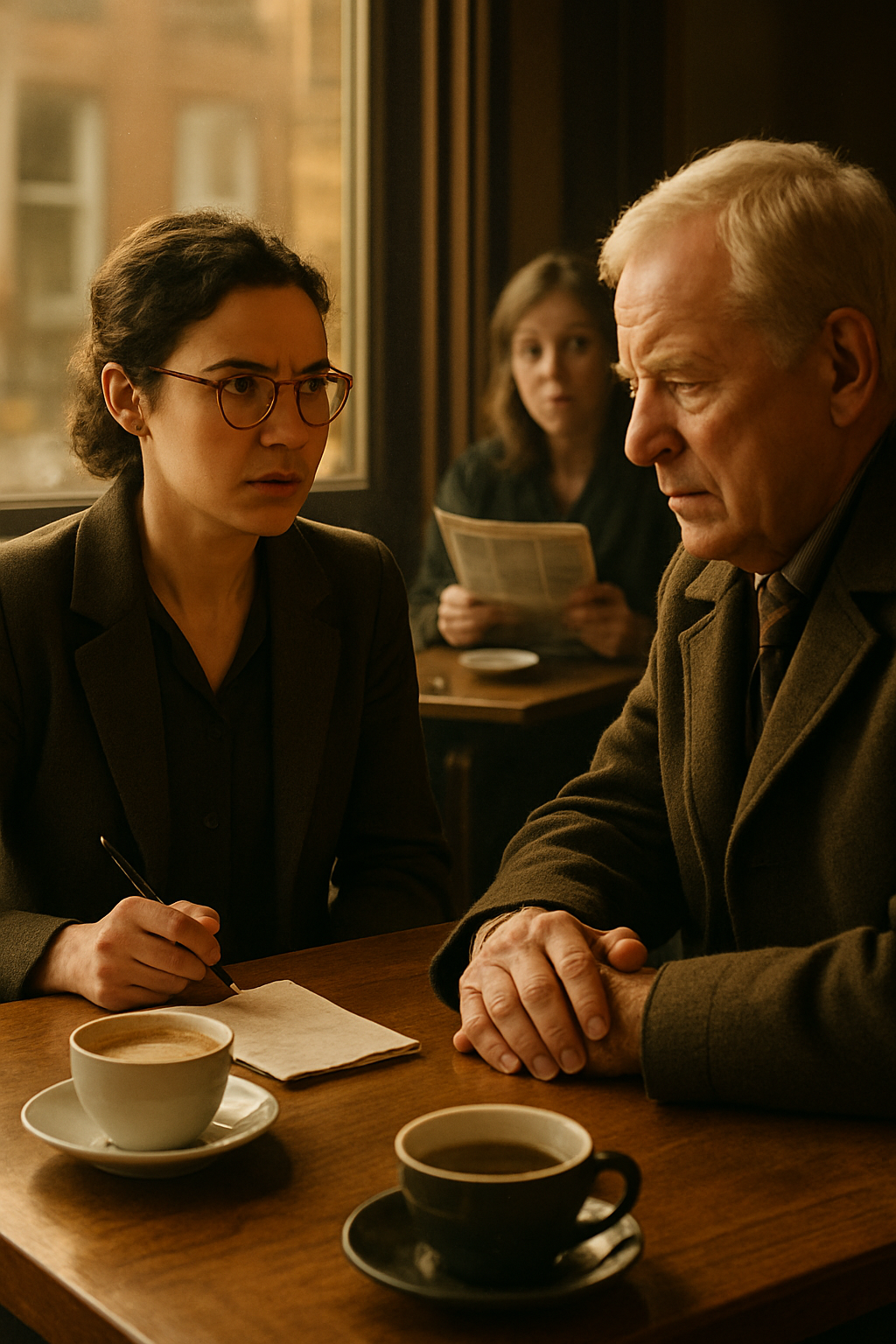
# He Paid Her University Fees For Four Years Without Her Knowing. The Day She Found Out, She Also Found Out Why.
## Part One: The Call
Sophie got the call on a Tuesday, which felt wrong for news like that.
She was at her desk in the open-plan office, one window to her left, the city grey and flat through it. She worked for a planning consultancy. Her job was to read documents other people had written and tell them what was wrong. She was good at it. She had a coffee going cold beside her keyboard and a document open on screen about drainage rights in a proposed residential development in Hertfordshire.
Her phone buzzed. Unknown number. She almost didn't pick up.
"Ms Adler? This is Janet Cheung from the University of Edinburgh alumni foundation."
"Yes," Sophie said. She picked up her pen and turned it in her fingers without writing anything.
"I hope I'm not disturbing you. We have a — a rather unusual situation. I'm not sure I've encountered anything quite like it before, actually."
Sophie waited.
"You were the recipient of the Alderton Anonymous Scholarship between 2014 and 2018. Four years, full tuition and accommodation."
"I was, yes." Sophie knew this. She had written the thank-you letter herself, addressed to no one, passed on through the foundation. She had been eighteen when she started university, which meant she had been in the worst year of her life, which meant she had been grateful in the wordless, overwhelming way people are grateful when something arrives that they cannot afford to refuse. She had studied. She had graduated. She had not thought very much about the scholarship since, except when she was paying back the small supplementary loan she'd taken for living expenses, which she had finished paying two years ago.
"The donor," Janet Cheung said, and she paused in the particular way administrators pause when they're not sure how much they should be saying, "has been anonymous for the past twelve years. He's contacted us. He's asked whether you would be willing to meet with him."
Sophie put down her pen.
"Meet him."
"Yes. He — he was quite clear that he doesn't want anything from you. No obligation. He said he simply felt it was time."
"What's his name?"
Another pause. "He's asked that I not share that until you've agreed to meet. I know that seems a little — it's rather unusual — but he was very particular about it. He said he thought you might be more willing to meet a stranger than someone you might recognise."
Sophie looked at her drainage document. She looked at her cold coffee. She thought about being eighteen.
"Fine," she said. "I'll meet him."
## Part Two: Before the Meeting
She told her flatmate Priya about it that evening over pasta.
"That's either incredibly sweet," Priya said, "or horrifying."
"Which way are you leaning?"
"Sixty-forty horrifying. What if he's obsessed with you?"
"He funded a scholarship. It wasn't specifically for me, I just qualified. There were two other recipients the same year."
"What if he's obsessed with all three of you?"
Sophie twisted pasta around her fork. "I'm meeting him in a café. In broad daylight. With my phone in my hand."
Priya pointed her fork. "Text me when you're there and when you leave."
"I will."
"And look him up."
"I tried. Janet wouldn't give me the name."
"So you're walking into a meeting with a nameless man who paid for your degree."
"When you put it like that."
"I'm putting it exactly like that because that's what it is."
Sophie ate her pasta. She was not afraid, exactly. She was something more particular than afraid. She was the way she got when she was about to read a document she suspected contained a significant error — that specific, taut kind of readiness. Prepared for something she couldn't name.
She called her mother that night from her bedroom, door closed.
"Just wanted to let you know," Sophie said, "I'm meeting someone on Thursday. Someone connected to university. To the scholarship."
The silence on the other end lasted two seconds too long.
"Oh?" said her mother.
"The anonymous donor wants to meet me. The foundation passed on the request."
"I see," said her mother. Her voice was exactly the same as always. Thin, careful, a little distant the way it had been since Sophie's father died, which was to say for the last ten years.
"Mum. Do you know who it is?"
"No," said her mother. "Of course not. How would I?"
"I don't know. That's why I'm asking."
"I hope it goes well, Sophie. Let me know how it turns out."
She hung up and Sophie sat with her phone in her hand for a moment, looking at nothing.
Her mother had said: of course not. Not: no, I don't.
She put her phone down. She told herself she was reading into things. She did that sometimes — the professional hazard of someone trained to find problems in text. You started applying it to everything. You started hearing what wasn't said.
## Part Three: Thursday Afternoon
The café was in Fitzrovia, one of those places with exposed brick and plants that were too healthy to be accidental. Sophie arrived seven minutes early and sat at a table by the window. She ordered a flat white she didn't particularly want and took out a piece of notepaper and a pen, because she always thought better when she had something to do with her hands.
She looked at the door.
She had been picturing someone soft. Someone with the guilty, hopeful look of a man who needed to be told he had done something good. She had been picturing someone who wanted something from her — reassurance, absolution, the specific emotional reward of being thanked.
The man who came through the door at three minutes past was sixty-something, broad-shouldered and slightly deflated, like a man who had once taken up more space. He was white-haired and ruddy, the kind of complexion that came from decades of outdoor work or decades of drink or both. He wore a good coat and carried it like it was someone else's. His eyes found her immediately, which meant he had been given her photograph, and that should have made her uncomfortable but instead what she felt was — noticed. He looked at her like he had been looking at her for a long time already.
He crossed the café and stopped at her table.
"Ms Adler."
"Yes."
"Frank Alderton."
She shook his hand. It was a firm, dry handshake, very brief. He sat down heavily across from her and did not take off his coat. He clasped his hands on the table and did not meet her eyes.
She waited.
The waitress came and he ordered tea, black, no sugar. When she had gone he looked up and Sophie had the sense of a man rehearsing something he had been rehearsing for a very long time.
"Thank you for agreeing to meet," he said.
"I was curious," she said. She kept her voice pleasant. This was the part of her job she was best at — the polite holding open of space. Letting people fill it.
"I should explain. I should—" He stopped. He looked at his hands. "I set up the scholarship through the foundation in 2013. A year before you started. You were one of the first recipients."
"Yes, I know. I wrote a thank-you letter."
"I received it. I — yes. I kept it."
Her pen moved between her fingers. "Why anonymous? If you don't mind my asking."
"Because I didn't want—" He stopped again. "Because I wanted it to be something you could use without it feeling like it came with a weight attached."
"That was considerate."
"No," he said, very quietly. "It wasn't."
She stopped turning her pen.
"It wasn't considerate," he said. "It was cowardly. I understand that now. I've understood it for some time. But at the time I told myself — I told myself I was doing the right thing. Being discreet. Not—" He looked up. "Not inserting myself into your life."
"Mr Alderton. Why did you set up the scholarship for me specifically?"
A beat.
"How do you mean?"
"The Janet Cheung said there were other recipients. But you asked to meet me. Not the others."
His hands tightened slightly against each other on the table.
"Yes," he said.
"So there is something specific. Something that connects us."
"Yes."
"Tell me," Sophie said, "what it is."
## Part Four: The Weight of It
He didn't speak for a moment. He looked at the table, then at the window, then back at his own hands.
"Do you remember," he said carefully, "2013. The spring. Your last year of school."
Something moved in Sophie's chest. Not recognition. Not yet. The shadow of recognition.
"Yes."
"The fourteenth of April."
Her pen stopped moving entirely. She set it down on the table.
The fourteenth of April, 2013. She had been seventeen years, eight months, and eleven days old. She had been taking her A-levels. She had been — she had been the kind of girl who wrote revision timetables in colour-coded ink and kept them on her bedroom wall. She had been a girl whose father drove her to her Saturday orchestra rehearsal every week and picked her up after and always brought a flask of tea because the pickup was at half nine and he said the evenings got cold.
"I know that date," she said. Her voice was perfectly level. She had always had a good voice for bad news. Her mother said she got it from her father.
Frank Alderton's jaw worked.
"I was driving the A316," he said. "Coming back from a site visit. Berkshire. I was — it was a long day. I had taken the motorway and I was trying to come off at the junction and the lights—" He stopped. "The lights were amber. I should have stopped. I told myself they were still amber when I cleared the box. They weren't. I've — I've thought about that moment more times than I can count and I've never been able to tell myself honestly that they were still amber."
Sophie did not say anything.
"I was in a large vehicle. A Land Rover. The driver of the other car—" He could not say it. He was a man who could not say direct things, she understood that now, a man who moved around the edges of what he meant. "He died at the scene. He was — he hadn't done anything wrong. He was simply driving home."
"He was driving home from picking me up," Sophie said.
Frank Alderton closed his eyes briefly.
"He drove me home from orchestra every Saturday," she said. She heard her own voice doing what it did. Flat. Careful. She folded the edge of her notepaper. "He always had tea in a flask. He was a terrible driver but he was always careful. He never ran amber lights."
"I know."
"How do you know?"
"Because I — because I found out everything I could. Afterwards."
"After the inquiry."
"Yes."
The inquiry had found insufficient evidence for prosecution. The CPS had not taken it forward. There had been a coroner's inquest. The verdict had been accidental death. Sophie's mother had held her outside the courtroom and neither of them had cried, they had both run out of crying by then, and Sophie's grandmother had said something in German that Sophie hadn't understood and that her mother had not translated.
"So you looked into us," Sophie said. "After the inquiry. After there were no charges."
"Yes."
"And you found out I was applying to university."
"I'd set aside — I had — yes. I set aside funds. For whatever you needed. I contacted the university foundation and they set up the scholarship mechanism. I gave them a name — Alderton, it was stupid to use my own name, I don't know why I did that, except I wanted there to be some record of it, I wanted—"
"You wanted credit," Sophie said.
The word landed exactly as she meant it to.
Frank Alderton looked at her then. Really looked. She saw what she had not expected to see: he did not flinch. He absorbed it. He sat with it the way a man sits with something he has been waiting to hear said.
"Yes," he said. "I think that's honest. Yes."
"You wanted to have done something good enough to offset the bad thing."
"I wanted to — yes. I think that's what it was. I told myself it was for you. But it was for me."
The café noise went on around them. Someone at the next table was reading a newspaper. A woman two tables away glanced at them once and then back at her phone. The ordinary world. Sophie looked at Frank Alderton across the table and felt something she had not expected, which was not grief and not anger but something that resembled recognition of a pattern.
Good men who did terrible things by accident and then spent the rest of their lives building elaborate monuments to their own guilt, monuments they insisted were gifts.
"My father's name was Daniel," she said. "In case you didn't know his first name."
"I knew."
"He was fifty-one. He had a terrible singing voice. He was a secondary school history teacher and his students made him a card when they heard he'd died, a hundred and forty-two of them, I still have it. He was driving a 2009 Honda Civic because he never cared about cars. He came to every one of my concerts. He used to make notes in the program about which pieces I'd played well."
Frank Alderton was very still.
"Did you know all of that?" she asked.
"Not all of it."
"Do you want to know why I'm telling you?"
He nodded.
"Because you paid for my degree," she said. "And then you were going to sit here and feel — absolved, or something like it. You were going to meet a grown-up woman who had a career and an education and tell yourself that it was partly because of you. That you'd done something. That it balanced."
She picked up her pen.
"I'm just telling you his name. So you don't get to replace him with the abstract. He was Daniel Adler and he was fifty-one and he came to my orchestra rehearsals and you killed him running an amber light on the A316 and no amount of scholarship money changes what that is."
The stillness in Frank Alderton was total now. He was not crying. He looked like a man who had moved past crying a long time ago and was now simply sitting with the truth of his own life.
"No," he said. "It doesn't."
"So why did you want to meet me?"
A long pause.
"Because—" He stopped. He looked at the table. "Because I thought I could — I thought if I explained. If I told you directly, instead of—" He exhaled. "I'm sixty-four years old. I have grandchildren. I've thought about this every day for eleven years and I suppose I thought if I said it to your face it would become something I could — put somewhere. Stop carrying it in the same way."
"Like putting it down."
"Yes."
"Mr Alderton," Sophie said, "I think you need to hear something."
He looked at her.
"I don't forgive you," she said. "I'm not going to today. I might never. I want you to know that what you did — the scholarship, the anonymity, the twelve years of not contacting us — that wasn't a gift. That was a way of managing your own conscience so that you didn't have to face us. And I want you to know that I know that. Even if you didn't know it at the time."
He absorbed this too. He did not argue with it.
"Okay," he said.
"I'm not going to ask you to leave. I'm going to finish my coffee. You can finish your tea. And then we're going to go our separate ways. But I needed to say that first. Before anything else."
"Yes," he said. "I understand."
They sat in silence for a while. The city moved outside the window. The coffee was nearly cold.
After a while Frank Alderton said, very quietly: "He sounds like he was a good man."
"He was the best man I ever knew," Sophie said. She looked at the window, not at Frank. "And he would have been very uncomfortable with me saying that, which is also something I think about."
Something in Frank's face shifted. Not quite a smile. More like the movement a person makes when they hear something that confirms a grief they were carrying.
"I should go," he said.
"Yes."
He stood. He was very careful, very deliberate about it, the way old men are when they are deciding not to make a scene.
"I'm sorry," he said. "I know it doesn't—"
"It doesn't," Sophie said. "But say it anyway. It's the right thing to say."
"I'm sorry, Ms Adler."
He left. Sophie watched him walk across the café and through the door and out into the grey afternoon.
She sat with her cold coffee.
She picked up her pen. She wrote nothing. She folded the corner of her notepaper once and then back again.
Then she picked up her phone.
## Part Five: The Call Home
Her mother answered on the second ring, which meant she had been waiting.
"It was Frank Alderton," Sophie said. "The driver."
Silence.
"Mum."
"Yes," said her mother. Very small. Very far away.
"You knew."
"I—" A breath. "Sophie."
"When did you know?"
Another pause. Sophie pressed her fingers flat against the table. The woman at the adjacent table was not reading her paper anymore. Sophie did not look at her.
"Shortly after he set up the scholarship," her mother said. "The foundation—they had a duty of care obligation when they accepted the funds. The name. Alderton. I remembered the name from the inquest. I — I looked into it."
"And you didn't tell me."
"You were eighteen, Sophie. You had just lost your father. You were about to start university. I—"
"I was eighteen for one year. Then I was nineteen. Then twenty. Then twenty-one—"
"I know."
"I've been twenty-eight for three months. You had ten years to tell me."
"I know." Her mother's voice was thin in that particular way, the way Sophie had always associated with her trying not to let her own hands shake. "I know. I told myself — I told myself it would only hurt you. That the scholarship was real, whatever his reasons were. That knowing would take something from you instead of giving you something."
"That's what he said," Sophie said. "He said the same thing. That he did it for me. That he didn't want me to carry the weight of knowing."
"I suppose we both—"
"You both decided," Sophie said, very carefully, "what I was strong enough to know. Without asking me."
The silence stretched.
"Yes," her mother said finally. "We did. And I'm — I'm sorry, Sophie."
"Do you forgive him? Alderton."
A very long pause.
"I don't know," said her mother. "I think I — I made a kind of peace with it. That's different from forgiveness. It's not the same thing."
"No," Sophie said. "It isn't."
Outside the café window the afternoon was getting darker. She could see her own reflection faint in the glass — dark wavy hair pinned back, wire-rimmed glasses, the pen still in her hand.
"Are you all right?" her mother asked.
Sophie thought about that honestly.
"I'm going to be," she said. "I think I'm actually going to be. But I need — I need to sit with this for a while. Can I call you tomorrow?"
"Of course. Sophie—"
"Tomorrow, Mum."
"Yes. Okay. Tomorrow."
She ended the call.
She sat with the phone face-down on the table. She signalled the waitress and ordered another coffee, a hot one this time. While she waited for it she wrote something on her notepaper, and then looked at it, and then folded it in half without reading it again.
The woman at the adjacent table was looking at her. Not unkindly. The look of someone who has been unable not to overhear and is trying to signal some small impotent human solidarity across the distance between tables.
Sophie nodded at her slightly. The woman looked back at her newspaper.
The coffee came. Sophie wrapped both hands around the cup.
She thought about her father making notes in orchestra programs. She thought about a flask of tea that nobody had ever drunk because the accident happened on the way home, not on the way there. She thought about a car that ran amber lights and a Honda Civic and a Tuesday in spring, eleven years ago, while she sat in the audience and waited for the concert to end so she could tell him which pieces she'd played well.
She thought about Frank Alderton sitting across a table from his own grandchildren, all these years.
She thought about her mother, carrying this alone for a decade.
She thought about the scholarship thank-you letter she had written at eighteen, addressed to no one, which a man who had killed her father had kept.
The weight of it. The oldness of it. The fact that no one in this story had been trying to do anything except make it smaller, and none of them had managed it, not really, because you cannot make grief smaller by handling it carefully. You can only wait until you are old enough to hold it differently.
She was twenty-eight. She was holding it differently already.
The folded piece of notepaper sat beside her coffee cup. She picked it up. She opened it.
She had written: He thought paying for her education would balance something.
She had underlined the last three words.
Below them she wrote now: It didn't. But she went to university anyway. She built something anyway. That part was hers.
She folded it again and put it in her coat pocket.
She finished her coffee. She paid the bill.
She walked out into the grey afternoon of a city that did not know and did not need to know what had just happened in a café in Fitzrovia, between a woman of twenty-eight and a man of sixty-four and the shadow of a man who had been driving home.
She texted Priya: I'm out. I'm fine. Tell you tonight.
She put her phone in her pocket.
She walked.
## Epilogue: What Gets Put Down
She called her mother the next morning, as she had promised.
They talked for an hour and a half. It was the longest phone call they had had since her father's funeral. Her mother cried, which Sophie had not expected — her mother was not a woman who cried easily, not anymore, not since she had apparently used up something fundamental in that first terrible year. Sophie listened. She asked questions. She did not make it easy, but she also did not make it a punishment. Those are different things and she knew the difference.
At the end of the call her mother said: "I have some things of his. Your father's. I've been — I've kept some things in storage and I think it's time we went through them together. If you want to."
"Yes," Sophie said. "I want to."
"Some of them are from the car. From afterwards. I don't know if you want those specifically."
"What things?"
"The flask. And his program from your concert. The one from that last night. He'd made his notes." Her mother's voice was very careful. "I saved it. I didn't — I didn't know if I should tell you I'd saved it."
Sophie closed her eyes.
"Yes," she said. "I want the program."
"Okay."
"And Mum?"
"Yes?"
"I love you. And I'm still going to be angry with you for a while. Both of those things are true."
A pause.
"I know," said her mother. "I know. I love you too."
Sophie Adler stood in her kitchen on a Wednesday morning with her coffee going cold on the counter and the city outside her window and her father's program notes somewhere in a storage unit in Croydon, a document she had never read, evidence of a man watching his daughter play, making note of what she did well.
She thought: I built something anyway.
She thought: That part was mine.
She put her glasses back on.
She went to work.