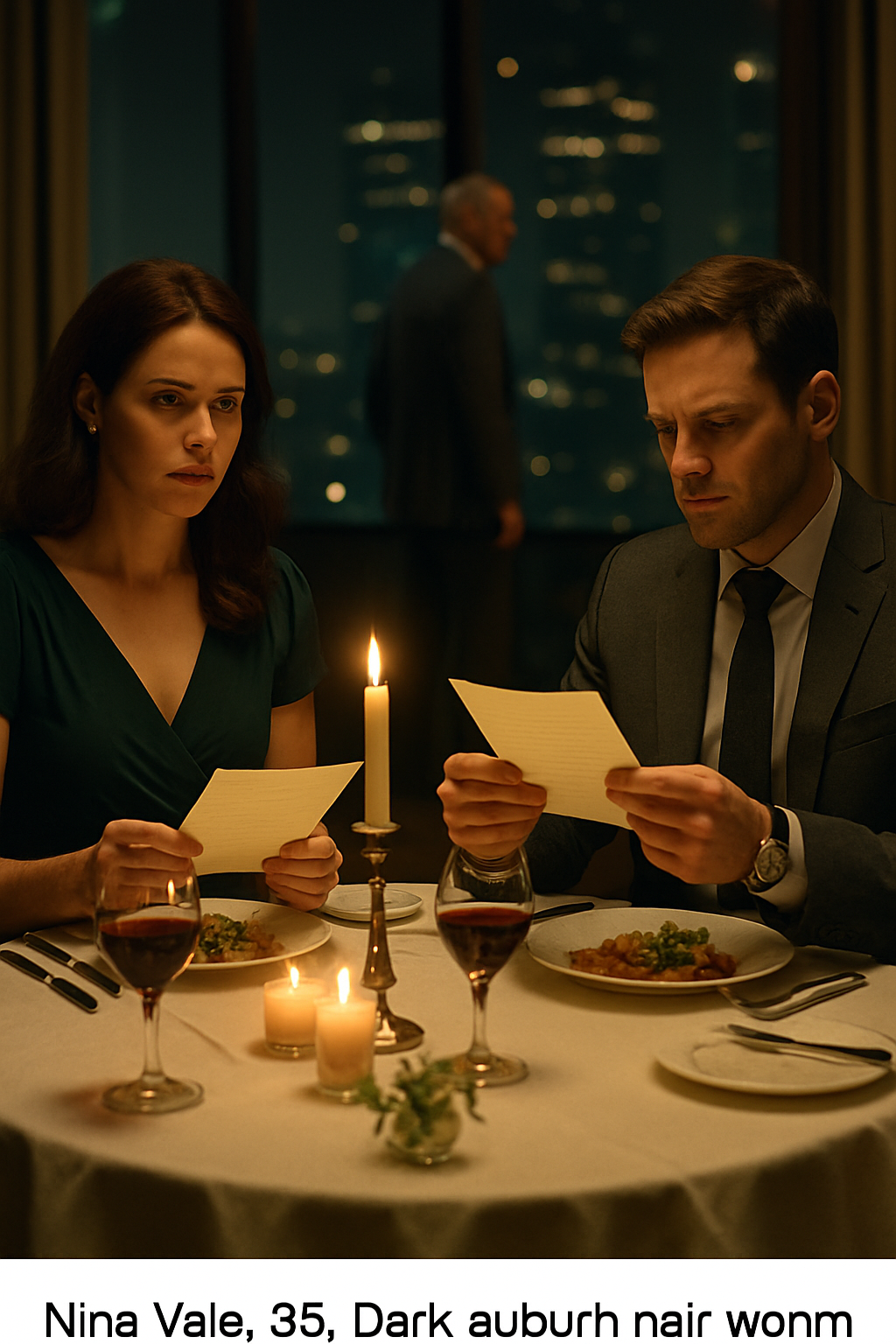
The restaurant had been booked for three months.
Not because they needed three months. Thomas had simply wanted to be certain — of the table, of the window, of the light at exactly eight in the evening when the city started to soften.
He had chosen everything with the same careful attention he brought to everything in his life, and Nina had said nothing because she had learned, in five years, that Thomas's certainty was one of the things she loved about him.
Even when she suspected it wasn't really certainty at all.
The restaurant was called Maison Verel. It occupied the top floor of a building in the old financial district — the kind of place where the menu didn't list prices, where the sommelier remembered your preferences from the previous visit, where the candlelight was engineered to make everyone look a little better than they were.
Nina had worn her dark green dress. She'd made the last two payments on it specifically to wear it tonight.
Thomas was already seated when she arrived. He stood when he saw her. He always stood when he saw her, and she had never quite gotten used to it — not because it felt false, but because it felt like something she didn't deserve and hadn't earned and couldn't explain.
—Five years, he said, when she sat down.
—Five years, she said back.
They ordered. The sommelier brought wine without being asked — the same Burgundy they'd had on their first date, which meant either the restaurant kept extraordinary records or Thomas had arranged it in advance. Nina suspected the latter.
She found she didn't mind.
The evening was exactly what it was supposed to be.
Thomas gave a toast. He was good at toasts — the right length, the right weight, the kind that made you feel seen without feeling exposed. He said something about how the best decisions were the ones you didn't fully understand until much later, and that marrying her was still the decision he was most proud of, and Nina felt the familiar complicated warmth of being loved by someone in a way she hadn't originally invited and had never quite figured out how to receive.
She raised her glass.
She drank.
And then the maître d' appeared at their table with an apologetic half-bow and a sealed white envelope, and said:
—I'm sorry to interrupt, Mr. and Mrs. Vale — there is a gentleman in the lobby who insists on hand-delivering these personally. He says it is time-sensitive and could not wait until morning.
Thomas frowned.
Nina said nothing.
The maître d' set two envelopes on the table — one for each of them, same cream stock, same embossed letterhead — and retreated.
The man who followed him across the restaurant was sixty-two years old and wore a grey suit of quiet expense. He walked with the deliberate pace of someone who had learned to slow himself down — not from age, but from the number of times he had walked into rooms like this one and changed everything inside them.
—Mr. and Mrs. Vale, he said. I apologize for the hour. My name is Mr. Pemberton. I represent the estate of Mrs. Dora Marsh, deceased, of Cornwall. You have each received a letter pertaining to matters that require your attention.
He paused.
—I would have come earlier, but I was asked by the deceased to deliver this on a specific date. Tonight is that date.
Nina's hand had already gone to the envelope.
She didn't open it immediately.
She looked at the name on the outside — her name, Nina Vale, née Marsh — and something moved through her that she didn't have a name for, something that had been waiting behind a door she'd kept closed for a long time.
—Thank you, Thomas said to Mr. Pemberton. His voice was exactly level.
Mr. Pemberton nodded.
—I will be in the lobby for thirty minutes, if either of you has questions.
He turned and walked back across the restaurant with the same measured pace.
Nina opened her envelope.
She read the first three lines.
Her face changed.
Not dramatically — not the way faces changed in films, with tears and gasped breath. Her face changed the way a room changes when a window is opened: something that had been still began to move, and you couldn't put it back.
She set the letter down on the white tablecloth.
She looked at the candles.
—Nina, Thomas said.
—Give me a moment, she said.
He did.
She took four slow breaths, the way she had learned to do in the years before Thomas, in the years when composure was the only currency she had.
Then she looked up at him.
—Open yours, she said.
Thomas picked up his envelope.
He read slowly. Nina watched him read. She had spent five years watching Thomas Vale read documents — contracts, reports, correspondence — and she knew the particular stillness that came over him when something mattered. She could see it now: the slight stilling of his hands, the minute tension at the jaw, the careful nothing of his expression.
She waited.
When he looked up, she could see it — the thing she had feared, or perhaps the thing she had known was coming since the moment the maître d' appeared.
He had understood something from his letter that he wasn't supposed to.
The question was how much.
—Your grandmother, Thomas said.
—Yes.
—Dora Marsh.
—Yes.
—You told me she died with nothing. His voice carried no accusation. That was almost worse.
Nina folded her hands on the table.
—I told you she had nothing when she was alive. That was true.
Thomas set his letter down beside his wine glass. He looked at it for a moment, then at her.
—Nina, he said quietly. How long have you known you had nothing?
The question landed with more precision than a slap.
She felt her breath leave and come back. She looked at him — at the careful neutrality of his face, at the good watch, at the jacket that fit because it was made for him, at the man who had appeared in her life at a moment when she had almost given up on appearing in anyone else's — and she said the thing she hadn't said in five years:
—Since before I met you.
The silence that followed had shape. It occupied the space between the candles and the untouched plates and the wine that was still exactly the right temperature.
Thomas picked up his glass. Set it down without drinking.
—I see, he said.
And then, because Nina Vale had spent five years becoming someone who did not blink first:
—How long have you known you didn't love me?
Thomas looked at her.
Something passed through his expression that she had seen before — in year two, in year three, in the particular quality of his silence at the end of certain evenings.
She had never named it. She hadn't trusted herself to.
—That's not— he started.
—The letter. She nodded at his envelope. It says something about why you were introduced to me. Doesn't it.
He was quiet for three seconds.
—Yes, he said.
They did not leave the restaurant.
That surprised Nina, afterward — that both of them had known, in the same wordless agreement, that this conversation needed to happen at the table with the candles and the Burgundy and the city below them softening into night.
Perhaps because leaving would have made it a scene.
Perhaps because they were both, at their core, people who preferred to hold things very still.
—Who introduced us, Nina said. It was not quite a question.
—My business partner at the time. Geoffrey Marsh. Thomas watched her face. Your mother's cousin.
—I know who Geoffrey is.
—He told me your family had significant holdings. Old money, quiet. The kind that doesn't advertise. Thomas paused. He was specific about the amount.
Nina's composure was extraordinary. She had built it over years from the raw material of a childhood in which money was never discussed because there wasn't any, in which every public occasion required a version of yourself that you could barely afford to maintain.
She had built it because she had nothing else to build with, and now she sat in an expensive restaurant in a dress she'd made installment payments on and she let Thomas Vale tell her exactly how he had weighed her.
—How much did he say? she asked.
Thomas told her.
Nina absorbed the number. It was significant. It was also completely invented.
—Geoffrey lied to you, she said.
—Yes.
—And you believed him.
—I had no reason not to. A pause. I had dinner with you twice before I ran a check. By the time the check came back incomplete, I had already— He stopped.
—Already what?
He looked at his hands.
—Already decided I wanted to continue.
—Because you thought the incomplete check meant the money was better hidden, not that it wasn't there.
—Yes.
The candle between them guttered slightly in a draft from somewhere.
—We got engaged four months later, Nina said.
—Yes.
—And you still hadn't confirmed.
—No. His voice was precise and honest in the way that hurt more than evasion would have. I kept finding reasons not to. After a certain point I realized I was finding reasons on purpose.
Nina looked at him.
—Because part of you knew.
—Because part of me didn't want to know. He met her eyes. There's a difference.
—There isn't a big one.
—No, he agreed. There isn't.
The sommelier appeared at their peripheral vision, read the table with professional accuracy, and disappeared.
—What about you, Thomas said. Geoffrey told you something too.
It wasn't a question.
Nina was quiet for a moment. Outside the window the city moved in its ordinary way, indifferent to what was happening in this room.
—Geoffrey told me you were in love with me, she said. That you'd been looking for someone like me. That the dinners weren't strategic — that you had asked about me specifically, because something about me interested you before you knew anything about my family.
Thomas looked at her.
—And you believed him, he said.
—I had no reason not to. She heard her own echo of his words and felt the precision of it. I had been— She stopped. Started again. I had been performing for a long time. Before you. I knew how to be what men wanted me to be. I was very good at it. And then Geoffrey said you had wanted me before you'd assessed me, and I—
She looked at the tablecloth.
—I wanted it to be true, she said. So I didn't look too hard.
Thomas was very still.
—I didn't have money, Nina said. But I thought I had you. I thought that was enough. She looked up. When did you start looking?
He understood what she was asking.
—Year two, he said. Sometime in year two.
—What changed?
He was quiet for a moment. When he spoke, his voice was different — stripped of the precision it usually carried, carrying instead something that sounded like it had cost him something to say.
—You laughed at something I said. It was nothing — some observation I made about a film we'd seen. Something stupid. And you laughed and it was completely real, and I looked at you and I thought: I have been watching this woman for eighteen months and I have never seen her not performing, and this is the first real thing I've seen.
He picked up his glass. Held it without drinking.
—I realized I had been watching for it. That somewhere in the strategic calculation I had started watching for something I hadn't budgeted for.
Nina said nothing.
—I fell in love with you, Thomas said. Sometime in year two. I didn't know what to do with it.
—Why not?
—Because I had married you for a reason that no longer existed. Because I didn't know if what I felt was real or whether I had simply— He paused. Made the mistake of falling in love with my own strategy. It seemed pathetic. It seemed like something I couldn't tell you.
—You could have told me.
—What would you have said?
Nina was silent.
—You would have thought I was lying, Thomas said. You would have thought it was a new strategy. Another calculation.
She looked at him across the candles and the untouched anniversary dinner and the two letters lying open between them.
—I did think that, she said quietly.
—I know.
—Year three. You started— She stopped. There were things you did that I couldn't explain. Small things. Things that didn't fit the man I thought I'd married. And I noticed, and I thought— She pressed her lips together. I thought you'd learned something. About the money. And that this was the new approach. Softer. More personal.
—And so you—
—I waited for the ask, she said. I kept waiting. For the conversation about assets, about what my family had. I kept composing the speech in my head — the one where I'd tell you there was nothing, and we'd see what you did with that.
—But I never asked.
—No.
—Because I didn't need to. I wasn't— He stopped. I wasn't thinking about it anymore. By year three I had forgotten why I'd married you and only knew that I had.
Nina looked at him.
The restaurant continued around them — the soft percussion of other people's evenings, the particular warmth of candlelight against glass, the city in its patient indifference beyond the window.
—We've been lying to each other for five years, she said.
—Not lying, Thomas said. Withholding.
—Is there a difference?
—Yes. He met her eyes. Lying is active. We were each carrying something we didn't know how to put down.
Nina picked up her letter again.
This time she read it from the beginning.
Dear Mrs. Vale,
I write on behalf of the estate of Mrs. Dora Agnes Marsh, who passed on the fourteenth of February of this year. You are named as the sole beneficiary of her estate. Mrs. Marsh requested that this letter be delivered on the evening of your fifth wedding anniversary, on a date she specified in her instructions to this firm eighteen months ago.
The estate comprises the following: the property at 14 Rosecliff Lane, Penzance, Cornwall — a coastal cottage valued at current market rates, which has been in the Marsh family since 1947. Additionally, a private savings account held at the Bank of Cornwall, the contents of which are detailed in the enclosed schedule.
Nina turned to the second page.
The savings account contained £340,000.
She read it again.
She read it a third time.
Then she looked up at Thomas and saw that he was watching her read it, and that his expression was the expression of a man who already knew.
—Your letter, she said. What does it say?
He set his own letter on the table between them, face up.
She read it.
It was shorter than hers. It was a letter from Mr. Pemberton's firm to Thomas specifically, separate from the estate letter, written in Mrs. Marsh's own words rather than legal language:
Mr. Vale,
I do not know you personally. I know of you through my granddaughter Nina, who has not told me much but who tells me enough. I have watched her build a life with you, and I have watched her not trust it. This has pained me.
I am leaving Nina what I have. I have kept it quiet for reasons I no longer need to explain. The reason I have written to you separately is this: I want you to know about the money before Nina does. I want you to have the choice that most people are never offered — the choice to stay before you know what there is to stay for.
You may be reading this and laughing. You may have married her for reasons that make this letter irrelevant. If so, this is a test you have already failed, and what you do with this information is between you and Nina.
But if I have read you correctly — through the things my granddaughter does not say, and through the particular way she has stopped waiting for things to fall apart — then perhaps you will understand why I needed you to know first.
Stay or leave. But do it knowing everything.
Yours, Dora Marsh
Nina set the letter down.
She looked at Thomas.
He was watching her with the specific quality of attention that she had spent years misreading — that quality she had catalogued as strategic, as calculated, as the particular focus of a man looking for an angle. She could see now that she had been wrong. Or rather: she had been right once and then the thing had changed, and she had kept reading the old version long after the text had shifted.
—She wrote to you first, Nina said.
—Yes.
—How long ago did you receive it?
—I didn't. He looked at her steadily. I received it tonight, same as you. Pemberton delivered both at the same time. I read mine in the lobby while you were being seated. He paused. That's why I was already at the table when you arrived.
Nina absorbed this.
—You knew, she said, for approximately twenty minutes that my grandmother had left me a significant estate. And then you sat down to dinner and gave a toast about the best decisions you didn't understand until later.
—Yes.
—And you weren't going to tell me.
—I was going to tell you. He picked up his glass. I was trying to figure out how. He looked at her. I was aware that the timing was — that it had the appearance of—
—Of you knowing and staying because of the money.
—Yes.
—And you wanted to find a way to tell me that didn't look like that.
—Yes.
They looked at each other across five years and two letters and a dinner neither of them had touched.
—Thomas, Nina said.
—Yes.
—I have £340,000 in a savings account I didn't know existed. And a cottage in Cornwall. And a dead grandmother who was apparently paying very close attention.
—Yes.
—And you had approximately twenty minutes to decide what you were going to do with that information before I found out.
—That's accurate.
—What did you decide?
He was quiet for a moment.
Then:
—I decided I wasn't going to bring it up. I was going to wait until you read your letter and you told me about it, and then I was going to tell you that I had known for twenty minutes, and that nothing about the previous twenty minutes had been different from the twenty minutes before that.
Nina looked at him.
—That's actually what happened, she said.
—Yes.
—So technically, she said carefully, you passed her test.
He made a sound that wasn't quite a laugh.
—Her standard was fairly minimal. She just wanted me to stay for a dinner.
—She wanted you to stay for a dinner knowing there was something to stay for. Nina's voice had lost some of its precision. That was the test. Not whether you'd leave. Whether you'd carry it quietly.
Thomas looked at her.
—And I should tell you, Nina said, that when you were seated and I walked across the restaurant and you stood up — I thought, just for a second, that you looked like you knew something. And I thought: the assessment is done. He's found out about something and now we're going to perform a dinner. She paused. I was performing. Beautifully. I had the toast response ready and everything.
—I know, Thomas said. You always do.
—Did you know I was performing?
—Since year two. He said it without hesitation. The same year I stopped.
The candle between them had burned down further. The restaurant around them had thinned — other tables finishing, the particular late-evening quietness of a room that had started to belong only to the people still in it.
Nina looked at her letter. At his. At the two envelopes lying open on the white tablecloth like evidence.
—She timed this, Nina said. The anniversary.
—She timed it.
—She wanted us both to know. Together. On the same night.
—She wanted you to see what I did with the twenty minutes. He paused. And perhaps she wanted me to see what you did when you realized I'd had them.
Nina thought about Dora Marsh — her grandmother, whom she had visited twice a year for most of her childhood, then once, then not at all. The cottage in Penzance with the salt smell and the low ceilings. The woman who had said, at Nina's wedding, very quietly, into her hair: You chose well. I hope he knows it.
And Nina had laughed it off because she was performing, and her grandmother had patted her hand once and said nothing else.
Eighteen months ago, Dora had written to a solicitor with instructions.
She had been watching.
—We both lied, Nina said. We both started from wrong information and built on it.
—Yes.
—And somewhere in the middle of that, something changed.
—Yes.
—And neither of us knew how to say so because saying so meant admitting what we'd started with.
—Yes. Thomas looked at her. What do you want to do about that?
Nina was quiet.
Outside the window, the city had gone to its late self — fewer lights, longer silences, the particular honesty of the small hours when everything performs less.
—I want to go to Cornwall, she said. I want to see the cottage. I want to see what she kept, and what she meant by keeping it. She looked at him. And I want you to come.
Thomas was still for a moment.
—When? he said.
—Soon. Next weekend, if you can clear your schedule. She looked at him steadily. And I want — on the drive, or in the cottage, or somewhere between here and there — I want to finish this conversation. The one we've been having tonight. The one we've apparently been not having for five years.
—The honest one.
—The honest one.
He picked up his wine glass. She picked up hers.
—I should tell you, Thomas said, that the honest one is not going to reflect well on either of us.
—I know, Nina said. I think we'll survive it.
He looked at her — really looked, with the quality of attention she had spent years misreading and could now, finally, read correctly.
—I think so too, he said.
They touched glasses.
Outside, Mr. Pemberton had long since left the lobby and taken the lift to the street. He had delivered many letters in his career — letters about estates, letters about children, letters about the particular kinds of decisions that only become visible in retrospect. He had learned, early on, not to wonder what happened in the rooms after he left.
But tonight, for some reason, he found himself wondering.
He thought about the woman at the table — the composure of her, the way she had looked at the letter before she opened it, as if she already knew it was going to change something.
He thought about the man who had read his letter in the lobby, standing very still, and then walked back into the restaurant with a kind of deliberateness that Pemberton recognized: the walk of someone who has made a decision and needs to move before they overthink it.
He hailed a cab.
He had done what Mrs. Marsh asked.
The rest was theirs.
Two weeks later, Nina stood in the doorway of a cottage on Rosecliff Lane, Penzance, and smelled the salt and the old wood and something underneath that she thought might be her grandmother's particular brand of hand cream, still faint in the air after four months.
Thomas stood beside her.
He didn't say anything about the size of the cottage, which was smaller than he was used to. He didn't say anything about the drive, which had taken five hours and covered more ground than the miles suggested. He had listened, mostly. He had said things when it seemed like what she needed was for him to say things, and he had been quiet when it seemed like she needed to be heard. She had noticed that he'd gotten better at the distinction in year four. She hadn't mentioned it at the time.
She mentioned it now, standing in the doorway.
—Year four, he said. About halfway through. I noticed I kept getting it wrong.
—And you adjusted.
—I tried.
—You did, she said. You got it right more than you got it wrong.
He looked at her.
—That's the first time you've said that.
—I know. She stepped inside. Come in. I want to show you something.
Inside the cottage, on the mantelpiece above the small fireplace, there was a photograph. Nina picked it up.
Thomas came to stand beside her.
The photograph was from their wedding.
Not the formal photographs — not the ones Nina remembered, the ones with the correct lighting and the arranged smiles. This one was from the reception, late in the evening, taken from some distance: Thomas and Nina at a table, not looking at the photographer, not aware of being photographed. He was saying something. She was listening with an expression Nina didn't recognize on herself — not the composed public face she knew from mirrors, but something open, something undefended.
She was looking at him like she trusted him.
—When was this? Thomas asked.
—Our wedding night, Nina said. I don't know who took it.
She turned it over. On the back, in her grandmother's handwriting: You chose well.
Nina stood in the small cottage with its salt-smell and low ceilings and the photograph in her hands, and she thought about five years of building a marriage on wrong premises and somehow, sideways, accidentally, building it correctly anyway.
She thought about the particular irony of that — the way the lie had been the scaffolding and the truth had been what grew inside it, unintended and finally visible.
—Thomas, she said.
—Yes.
—I loved you before I trusted you. I need you to know that. She looked at him. I think that was the right order, actually. Love first, trust earned. I think I just didn't know how to tell you the trust had come.
He was quiet for a moment.
—I calculated you, he said. Then I miscalculated. Then I didn't bother calculating anymore. He looked at the photograph. I think the moment I stopped calculating was the moment I actually started.
Nina set the photograph back on the mantelpiece.
Outside, the sea was doing what the sea does in Cornwall — making itself known in the background of everything, constant and indifferent and somehow reassuring in its refusal to be dramatic about anything.
—We're staying the weekend, she said.
—I know.
—We're going to have the honest conversation.
—I know.
—And then, she said, we're going to figure out what to do with the cottage.
Thomas looked around the small room — the worn furniture, the good bones of the walls, the particular quality of light that came through old windows.
—I like it, he said. Which was true, and also the last thing she would have predicted him saying, and also exactly right.
Nina picked up her keys and looked at him — her husband, the strategic man who had made the mistake of becoming something else, the man she had not trusted for five years because she had trusted him too much to risk being wrong about it.
—Come on then, she said.
He followed her in.
Behind them, through the window, the sea went on being itself — patient and enormous and entirely unconcerned with whether any of this had gone the way anyone planned.
It hadn't.
That, Nina thought, was the point.