PART 1
"He locked Lili in the room," whispered Mateo, Don Ernesto's 11-year-old grandson, in a voice so low it barely cut through the clamor of tools in the workshop.
Don Ernesto dropped the wrench to the floor.
He'd been fixing an old truck in his garage on the outskirts of Querétaro when he caught that whisper on his cellphone. It wasn’t a tantrum. It wasn’t a prank. It was pure, unfiltered fear.
"Where are you, son?" he asked, already moving toward his truck.
"In the yard... barefoot. I can't speak loud. Esteban is inside."
Don Ernesto didn’t ask any more questions.
He drove as if every traffic light was an eternity. His daughter Marisol's house was in a quiet gated community, one of those places where neighbors sweep the sidewalk and greet each other as if everything were perfect.
But when he arrived, Mateo stood in the garden, barefoot, trembling, clutching the phone against his chest.
"Grandpa," he barely said.
Don Ernesto hugged him, but his eyes darted straight to the front door.
Inside, Esteban, Marisol’s husband, appeared with a phony smile, perfectly groomed, shirt tucked in, that look of a decent man he wore at family gatherings.
"Don Ernesto, what a surprise. Everything's fine, just a little problem with the kids."
"Where's Lili?"
Esteban adjusted his watch.
"She's in her room. She needed to calm down. Lately, she's been quite the handful."
Don Ernesto brushed past him without asking for permission.
The hallway was silent. Too silent.
At the end, Lili’s bedroom door was locked from the outside. Don Ernesto felt the blood rush to his head.
"Open it."
Esteban let out an uncomfortable laugh.
"Don’t be dramatic. There are rules here."
"Open it, I said."
For the first time, Esteban stopped smiling.
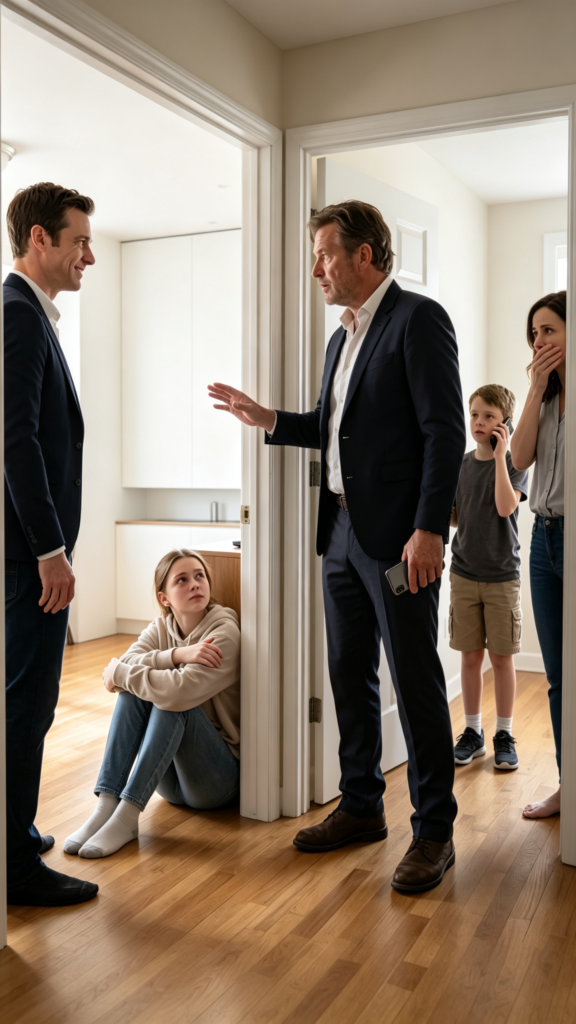
He slowly pulled out the key, as if he were doing Don Ernesto a favor. When he opened the door, Lili sat on the floor, her back against the bed, one hand clutching her arm.
She was 15, but in that moment, she seemed much younger.
She wasn’t crying. That was the worst part.
She stared at the floor like someone who had learned that crying only made things worse.
Don Ernesto knelt in front of her.
"Did he touch you?"
Lili pressed her lips together.
Esteban spoke from the doorway.
"I just stopped her. She was going to leave without permission. Don’t make this bigger than it is."
Mateo, from the hallway, murmured:
"It wasn’t just today."
The whole house froze.
Esteban turned towards the boy with a look that didn’t need shouting to terrify.
"Mateo, shut up."
Don Ernesto stood up slowly.
"Don’t speak to him like that again."
Esteban raised his hands, feigning patience.
"You don’t understand, Don Ernesto. Marisol works all day. I’m the one who keeps order here. These kids need limits."
Lili lifted her sweater sleeve.
There were reddish marks on her arm.
Don Ernesto felt something inside him shatter, but he didn’t scream. Not in front of them. Not yet.
He pulled out his cellphone and took pictures.
Esteban stepped forward.
"What are you doing?"
"What someone should have done a long time ago."
Then he took Lili by the hand and looked at Mateo.
"Grab your backpacks."
Esteban blocked the doorway.
"You’re not taking my kids."
Don Ernesto fixed his gaze on him.
"They’re not yours to control."
At that moment, Mateo’s cellphone vibrated in his hand. A recorded audio file appeared on the screen, dated that very morning.
Mateo showed it, trembling.
"Grandpa... I have more."
And when Esteban saw the file, his face changed as if he had just understood that the door he had locked for years was now opening from the inside.
PART 2
Don Ernesto did not play the audio in front of Esteban.
It wasn't out of fear.
It was because he knew that men like him don't break when confronted in the living room. They adjust their mask, concoct another version, and then punish the weaker ones when no one is watching.
So he simply tucked Mateo's phone into his jacket pocket and walked toward the exit with his two grandchildren.
Esteban stood blocking the door.
"I'm going to call the police," he said.
"Go ahead."
"I'm going to say you took them without permission."
"Go ahead."
"Marisol will back me up."
That sentence hurt.
Don Ernesto knew that his daughter had spent years justifying the unjustifiable. She said Esteban was strict, that he came home tired, that the kids sometimes provoked him, that every family has problems.
But the fear in Mateo's eyes and Lili's silence left no room for excuses.
"Then let her tell it to a judge," Don Ernesto replied.
That afternoon, he took the kids to his home, a simple house with cream-colored walls, a patio adorned with bougainvilleas, and a kitchen where coffee always filled the air.
Lili sat on the couch without taking off her backpack.
Mateo wouldn't let go of his phone.
Don Ernesto made hot chocolate, even though it was warm outside. It was the only thing he could think of to tell them without words that they were safe.
"Your mom gets out of school at 3:20," he said. "I’ll talk to her."
Lili lowered her gaze.
"She won’t believe us."
"Don't say that."
"Grandpa, she knows."
The phrase hit like a stone.
Mateo opened a hidden folder on his phone. There were six audio recordings. Some lasted just a few seconds. Others more than four minutes.
Don Ernesto pressed play on the first one.
Esteban's voice came out dry, cold, unrecognizable to anyone who had only seen him carry boxes at church fairs.
"As long as you live under my roof, you don't breathe unless I give you permission."
Then another one.
"Lili, stop playing the victim. No one believes a dramatic girl."
Another.
"Mateo, you're not going to speak today. Not a word. Let’s see if that teaches you respect."
Don Ernesto closed his eyes.
Mateo was eleven. He should be thinking about homework, soccer, video games, or which snack to buy outside school. Instead, he had learned to record abuse because he didn’t trust adults to protect him.
At 3:20, Don Ernesto waited for Marisol outside the school where she worked as an administrative secretary.
When she came out and saw her father's truck, her face changed three times in two seconds: relief, fear, and exhaustion.
She got in without greeting him.
"Where are my kids?"
"Safe."
"Dad, you can’t just take them like this. Esteban is furious."
"I'm more worried that your kids are terrified."
Marisol clutched her bag to her chest.
"Lili shouldn’t have gone into our room. Mateo shouldn’t have answered back. You know how teenagers are; they really exaggerate sometimes."
"Enough."
Marisol fell silent.
Don Ernesto never spoke to her like that. Not because he didn't love her, but because that tone was a wall.
"Your son called me barefoot from the yard, whispering because he was scared. Your daughter was locked in the room, sitting on the floor, holding her arm. And your husband spoke about rules as if your children were poorly arranged furniture."
Tears filled Marisol's eyes.
"If I confront him, it gets worse," she finally said. "If I leave, he’ll take everything from me. He told me he would prove I’m unstable, that I work too much, that I can’t take care of my children."
There it was.
The true cage.
It wasn’t love. It wasn’t doubt. It was fear.
Don Ernesto pulled out Mateo's phone.
"Your son has been keeping this."
Marisol looked at the device as if it were a bomb.
"He's a child."
"Exactly. And yet he was the only one who thought to gather evidence."
He played the audios.
Marisol covered her mouth before the second one finished.
"I didn't know it sounded like that," she murmured.
Don Ernesto looked through the windshield.
"You knew it felt like that. You just got used to surviving it."
Marisol then cried with her whole body, as if something that had been stuck for years had finally broken free.
"I don’t know how to leave."
"You don’t have to solve your whole life today. Just don’t send them back tonight."
"He's going to call the police."
"Let him call."
"He's going to say you kidnapped them."
"Let him say it."
"He's going to destroy me."
Don Ernesto shook his head slowly.
"He can't do that in silence anymore."
That same afternoon, Don Ernesto called an old acquaintance, Carmen Saldaña, a social worker at a family support center in the municipality.
He didn’t ask for favors. He asked for guidance.
At 5:30, Marisol, Lili, Mateo, and Don Ernesto were sitting in a small office, with half-closed blinds and a box of tissues on the table.
Carmen listened to the audios without interrupting.
Then she asked calm but impossible-to-evade questions.
Had Esteban prevented the children from leaving a room?
Yes.
Had he threatened Marisol with taking away custody?
Yes.
Had he isolated them from the family?
Yes.
Did he use punishments to silence them?
Yes.
Had he ever yanked Lili or Mateo?
Marisol took too long to answer.
"Yes," she finally said.
Lili didn’t cry.
She just closed her eyes.
Carmen helped to organize everything.
Photos of Lili's arm.
Audios saved in three places.
Messages from Esteban.
Dates.
Testimonies.
Emails.
Not to go back home alone.
Not to argue over the phone.
Not to let Esteban turn abuse into "family misunderstandings."
That night, Marisol entered Don Ernesto's house.
Lili saw her from the hallway.
She didn’t run to her.
She stood still, guarding herself, like someone waiting to know which version of her mom had arrived: the one who protects or the one who justifies.
Marisol understood.
Her face broke.
"I'm sorry," she said. "I should have protected you sooner."
Lili pressed her lips together.
Marisol took a step, but she didn’t force her to hug her.
"I'm not going to ask you to endure just to keep the peace at home anymore."
That was the phrase Lili needed.
She crossed the hallway and hugged her mother. Mateo came behind, burying his face in Marisol's side.
The three cried under the yellow light of the living room, while Don Ernesto watched them with his heart tied in knots.
Nothing was fixed.
But for the first time, the lie no longer ruled.
The next morning, Esteban arrived.
His truck parked in front of the house as if he owned that sidewalk too.
Don Ernesto looked out the window and asked Marisol and the kids to stay in the hallway.
Then he stepped outside and closed the door behind him.
Esteban was wearing a pressed shirt, dark pants, and the same reasonable expression he wore to deceive half the world.
"I'm here for my family."
"No."
The smile tightened.
"Don Ernesto, don’t make this uglier. Marisol is confused. You are putting ideas in her head. The kids are sensitive. Lili is dramatic, and Mateo has always been strange."
Don Ernesto pulled out his phone.
Esteban looked at the screen.
His face changed.
Don Ernesto pressed play.
Esteban's voice filled the porch.
"Today you’re not going to speak. Not a word. If I see you moving your mouth, I’ll lock you up too."
Esteban stood frozen.
Don Ernesto stopped the audio.
"There are six. In addition to your messages and the photos of Lili's arm."
"That's illegal."
"Explain that to the Public Ministry and the family judge."
There appeared the true Esteban.
Not innocent.
Not repentant.
Afraid of being discovered.
"You’re going to regret this," he said through clenched teeth.
"No," Don Ernesto replied. "This family is done regretting what you do."
Esteban left without entering.
But he didn’t stay still.
That same afternoon, he began sending messages to Marisol.
That she was a bad mother.
That the kids were manipulating her.
That he had contacts.
That no one would believe a secretary without money against a respected man in the neighborhood.
Then came the twist no one expected.
Carmen reviewed one of the audios with headphones and noticed something in the background.
A female voice.
It was brief, almost lost behind the noise of a door.
It said:
“Just let them be, Esteban. One day, you’re going to go too far.”
Marisol froze.
That voice belonged to her mother-in-law, Doña Elvira.
The woman who every Sunday at family dinner would say, “My son is strict because he loves those kids.”
She not only knew.
She had been there.
And she had stayed silent.
When she was called to testify, Doña Elvira tried to deny everything. She said Marisol was exaggerating, that modern moms couldn’t handle anything, that a good scare educated better than a thousand therapies.
But the audio was there.
Her voice too.
And in front of the social worker, she ended up letting slip the phrase that turned the case around:
“I told him not to do it so harshly.”
Marisol felt nauseous.
Not from surprise, but from confirmation.
The abuse hadn’t only lived in her house. It had been protected by an entire family that preferred Esteban's reputation over the safety of two children.
A week later, the family court issued provisional measures.
The room was cold, with hard benches and gray walls. Esteban arrived with a lawyer, expensive perfume, and a victim's face.
Marisol arrived trembling.
But she didn't lower her gaze.
The judge listened to the audios.
No one spoke as Esteban's voice poured from the speaker.
Not even his lawyer could disguise that as discipline.
When Lili testified, she didn’t exaggerate.
She spoke of the phone charger, the closed door, the hand squeezing her arm, the rules changing depending on Esteban's mood.
“He doesn’t always shout,” she said. “Sometimes the worst part is waiting for him to shout.”
Then Mateo spoke.
His voice was soft, but the whole room heard him.
“I recorded because I wanted someone to believe us.”
The judge removed his glasses.
That gesture said more than any speech.
Esteban's lawyer tried to talk about respect, structure, and paternal authority.
Then Carmen asked a single question:
“At what point is forcing an 11-year-old not to speak for an entire day a healthy way to educate?”
Esteban took too long to respond.
“It teaches self-control.”
The judge wrote something down.
From that moment on, the room tilted against him.
Marisol was granted full temporary custody. Esteban was prohibited from approaching Lili and Mateo without supervision. Therapy for the children was ordered, psychological evaluation for Marisol, and a complete review of the family history.
Then the judge looked at Esteban.
“Emotional abuse is also abuse. No child should have to secretly record an adult to feel safe.”
Esteban tried to stand up.
The judge ordered him to sit down.
That’s when Lili started to cry.
Not because she was scared.
But because she understood she would not be going back to that house.
Three weeks later, Marisol rented a small apartment near the Alameda.
It had two bedrooms, one bathroom, borrowed furniture, and a table that Don Ernesto bought at a flea market. The sink faucet dripped. The bathroom door creaked. The paint was peeling in one corner.
But no one whispered there.
No one checked the hallway before speaking.
No one asked for permission to sit on the couch.
One night, Don Ernesto came over for dinner. Marisol made noodle soup and quesadillas. Lili shared her desire to join a drawing workshop. Mateo talked about a soccer tournament at school.
The table was small.
The plates didn’t match.
One quesadilla got a little burnt.
And yet, it was the most peaceful dinner they had had in years.
Later, while the children washed the dishes, Marisol stayed next to her dad.
“I can’t stop thinking about what would have happened if Mateo hadn’t called you.”
Don Ernesto dried a glass.
“But he did call.”
“I should have done something sooner.”
“You did it when you could.”
Marisol shook her head, tears in her eyes.
“I was afraid of failing them.”
“You were surviving,” he said. “Now you’re protecting them. It’s not the same.”
Marisol leaned on his shoulder, tired, broken, and brave.
That night, when Don Ernesto returned home, the city seemed normal. Streetlights shining, dogs barking in the distance, families watching television behind closed windows.
Quiet houses.
Pretty facades.
Painted doors.
But he already knew that you should never trust only what a house looks like from the outside.
Upon arriving, he left the keys on the table and connected his phone.
Minutes later, he received a message from Lili.
“Good night, Grandpa. Thank you for listening to us.”
Don Ernesto replied:
“Always, my girl. Sleep well.”
He turned off the light and stared at the ceiling.
For the first time in a long while, he could sleep knowing that by morning, his grandchildren would wake up in a place where no one had to whisper to ask for help.
And that, though it didn’t erase the pain, was already a form of justice.