PART 1
For two years, Doña Mercedes believed Alan was the most noble young man to have set foot in her little store in Ecatepec.
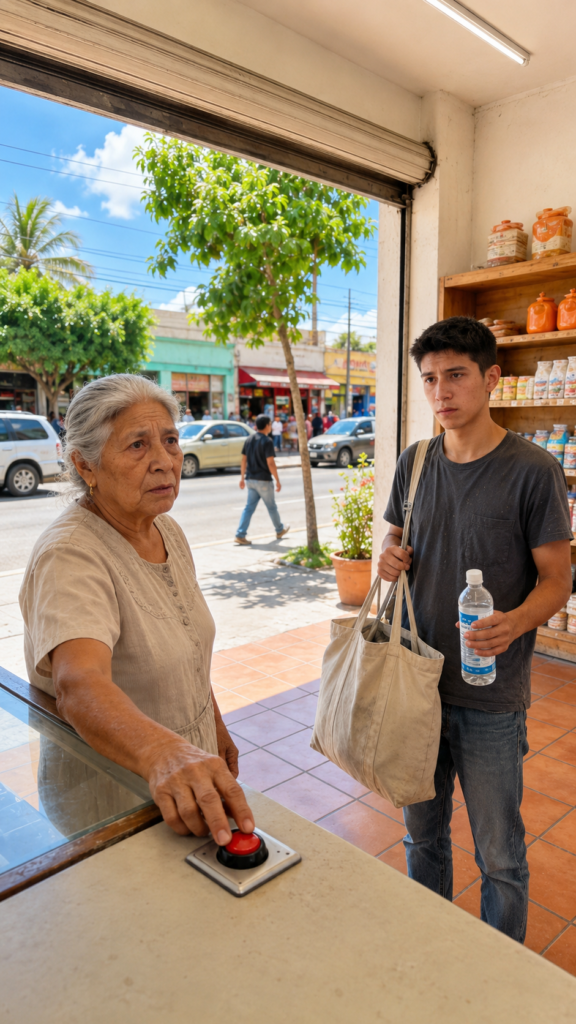
The first night she saw him walk in, she almost slammed the curtain in his face. It was 10:15 p.m., the street was deserted, and he appeared in torn sneakers, a stained sweatshirt, and a scar etched above his left eyebrow.
Doña Mercedes, a widow for eight years, lived alone and ran a small grocery store near a combi stop. She knew how things were in the neighborhood. That’s why, when Alan approached the counter, she slipped her hand under the cash register, where she kept the panic button.
But the boy didn’t ask for money.
He didn’t ask for beer.
He didn’t ask for credit.
He asked for adult diapers, a bottle of alcohol, gauze, and rash cream.
“It’s for my mom,” he said, staring at the floor. “She’s sick. She can’t get up.”
Doña Mercedes didn’t believe him right away.
Alan looked like he had slept on the street. His clothes smelled of dampness and old buses. But there was something in his trembling hands that felt less like a threat and more like desperation.
“I don’t have enough,” he admitted. “But I can clean the bathroom, arrange boxes, sweep the sidewalk. Whatever you need, ma’am. Really.”
He worked for two hours without speaking.
He moved jugs, cleaned the refrigerator, took expired boxes from the stockroom, and mopped the floor until it shone. He didn’t touch a single candy, didn’t check the cash register, didn’t ask for anything for himself.
When he finished, Doña Mercedes handed him the products.
He hugged them to his chest as if they were gold.
Before he left, tears streamed down his face.
“My mom’s name is Socorro,” he murmured. “She had a stroke. They sent her home from the hospital like this, all laid out. I take care of her alone.”
From that night on, Alan started helping in the store.
At first, he came twice a week. Then every day. Over time, Doña Mercedes trusted him so much that she gave him a copy of the keys to open up when she went to the market.
Alan was serious, hardworking, and honest. He never missed a day. He never came drunk. He never took anything without paying.
Every Friday, he bought the same things: diapers, alcohol, gauze, cream, and sometimes a little pasta soup or gelatin.
The only strange thing was that he never let anyone see his mother.
“She’s very delicate, ma’am,” he’d say. “She’s embarrassed to be seen like this.”
One afternoon, Mercedes offered to take her friend Chayo, a nurse from IMSS, to see her.
Alan turned pale.
“No, please. It’s not necessary.”
The reply was so dry that Mercedes was left thinking.
Then came the detail that raised her suspicions.
An abandoned receipt on the counter: diapers, alcohol, cream… and a large steel padlock.
Mercedes thought it was for the door of his house.
Until a neighbor of Alan’s came in to buy rice and accidentally let slip the phrase that changed everything.
“Stroke? What stroke? I saw Doña Socorro walking in the yard a few days ago. Then that boy locked her up in the back room, and she didn’t come out again.”
That night, Alan didn’t come to close the store.
For the first time in two years.
At 9:52 p.m., Mercedes received an audio message.
Alan’s voice sounded broken.
“Ma’am… if I don’t come back, don’t go into the back room. I beg you.”
Mercedes grabbed the copy of the key he had left her “for any emergency” and ran to her house.
The back room had a padlock on the outside.
The same padlock she had sold him.
When she opened it, the smell of confinement, alcohol, and dampness hit her in the face.
On a mattress thrown on the floor lay Socorro: thin, disheveled, with sunken eyes.
The woman raised her hand and gripped Mercedes’ wrist with impossible strength.
“Get me out of here,” she whispered. “He has me locked up.”
Mercedes pulled out her phone to call 911.
But before she could do so, Socorro suddenly sat up, pressed her lips to her ear, and said three words that froze her blood:
“Save him, please.”
PART 2
Doña Mercedes felt the phone slip from her hand.
She didn’t understand anything.
The woman was locked up. The room smelled of abandonment. The mattress lay on the floor. The windows were covered with cardboard to keep out the cold.
Everything seemed like a horror story.
And yet, Socorro hadn’t said “save me.”
She had said:
“Save him.”
Alan appeared at the door carrying a bag of diapers.
He looked pale, sweaty, with red eyes, as if he had been running for hours.
Seeing the padlock open, he froze.
“Doña Mercedes… I asked you not to enter.”
“What did you do to your mother?” she asked, her voice trembling.
Alan didn’t defend himself.
He didn’t shout.
He didn’t come closer.
He just left the bag on the floor and clasped his hands together as if he had nothing left to lose.
“Call the police if you want,” he said. “But first let me tell you the truth. Just once. I can’t keep this in my throat any longer.”
Mercedes already had 911 on her screen.
But something in Alan’s voice stopped her.
He didn’t sound like a criminal caught red-handed.
He sounded like a defeated son.
Socorro, from the mattress, began to cry silently. She looked at Alan with such deep sorrow that Mercedes felt her anger loosen.
“My mom never had a stroke,” Alan confessed.
Mercedes lifted her gaze.
“Then what does she have?”
Alan took a deep breath.
“A tumor in her head. They found it two and a half years ago. They operated on her, but they couldn’t do anything. They told me it was too advanced. That I should take her home. That I should care for her, feed her, clean her… and give her time.”
When Socorro left the hospital, Alan was 20 years old.
His sister Abril was 12.
In the bag, he had 58 pesos, an incomplete prescription, and a mother who sometimes still smiled but sometimes didn’t recognize her own home.
The doctors explained to him that the tumor could change her behavior. That she would have confusion, aggression, memory loss, fear, hallucinations.
But no one taught a 20-year-old boy how to hold a woman who was dying inside while still breathing outside.
At first, Socorro was still herself.
She apologized to Alan for being such a burden. She stroked the old scar on his chin. She asked if Abril had eaten yet.
But then came the other days.
Days when she would wake up screaming that someone wanted to kill her.
Days when she would throw plates against the wall.
Days when she would go out to the yard in the middle of the night, barefoot, believing she was going to look for her dead husband.
Once, she crossed the street without looking at the cars.
Another time, she turned on the stove and left it on.
But the worst was the night with Abril.
Alan looked down.
“My sister was doing homework. My mom grabbed some scissors. She didn’t know who she was. She said there was a stranger in the house.”
Mercedes covered her mouth.
“Did she hurt her?”
“Not like she could have,” Alan said. “I got there in time. I stepped in between.”
Then Mercedes understood the scar on his eyebrow.
That mark he had said was from a fight with a stepfather.
There was no stepfather.
There was no street fight.
It had been Socorro.
His own mother.
“Why did you lie?” Mercedes asked.
Alan looked at the woman on the mattress.
Socorro’s eyes were filled with tears.
“Because when she dies, I don’t want Abril to remember that. I don’t want anyone to say my mom was dangerous. She wasn’t like that, ma’am. The tumor made her this way. My mom was good. My mom sold tamales to buy us school supplies. My mom would go without food to give it to us.”
His voice broke.
“I can carry the ugly part. My sister can’t.”
Mercedes felt shame.
For two years, she had seen Alan buy diapers and alcohol, and she had never asked him if he had slept, if he had eaten, if he was scared.
She congratulated him for being a “good son,” but never imagined how much that kindness cost.
“And the padlock?” she asked.
Alan wiped his face with his sleeve.
“I put it on after she went out in the middle of the night and almost fell off a neighbor’s roof. I had to work. If I didn’t work, there were no diapers. No food. No medicine. Nothing.”
He didn’t say it with pride.
He said it with shame.
“I knew it was wrong. Every time I locked that door, I felt like I was tearing myself in two. But if I left it open, she could hurt herself. Or she could hurt someone without knowing. And if I asked for help, they’d take her away.”
Mercedes understood what he meant.
In the neighborhood, everyone knew stories of sick people abandoned in institutions, of poor families that gave up their elderly because they couldn’t take it anymore, of paperwork that never advanced, of aid that arrived when the person was already six feet under.
Alan was afraid that Socorro would die among strangers.
Tied up.
Sedated.
Alone.
“I preferred to be hated,” he whispered. “I preferred for the neighbor to think I’m a monster. I preferred for you to look at me the way you are right now. But my mom was going to stay in her house.”
Socorro reached out her hand.
Alan approached slowly, as if still fearing he would scare her.
She touched his face, right where the scar crossed his eyebrow.
“My child,” she said softly.
My child.
That boy of 22, with tired adult hands, dark circles under his eyes, and a hunched back from carrying a tragedy alone, was still his mother’s boy.
Mercedes couldn’t hold back any longer.
She sat on the floor and cried.
Not just for Socorro.
She cried for Alan.
For those two years when no one asked him how he was.
For all the times he came in sleepy, and she thought it was laziness.
For all the times he bought diapers counting coins, and she thought it was poverty, not realizing it was also dignity.
Then she remembered something else.
“Where is Abril?”
Alan closed his eyes.
“In Querétaro. With my aunt Rebeca.”
He sent her the day after the scissors incident. He bought her a bus ticket with borrowed money. He packed her a backpack with three changes of clothes and her middle school notebooks.
He told Abril that Socorro was in a special hospital.
That she needed rest.
That she would be better soon.
“She calls me every Sunday,” Alan said. “She always asks if my mom remembers her yet. I tell her yes. I tell her she’s feeling a little better.”
“And why don’t you tell her the truth?”
Alan let out a broken laugh.
“Because she’s 14, ma’am. Because she’s already lost too much. Because if I tell her her mom isn’t going to be the same as before, her childhood ends abruptly.”
Mercedes looked at Socorro.
And then she understood the three words.
“Save him.”
Socorro, in her moments of clarity, knew exactly what was happening.
She knew Alan was sacrificing his youth.
She knew he was allowing himself to be hated to protect her.
She knew he was lying to save the memory of his sister.
And that’s why she didn’t ask to leave.
She asked that they save her son.
Mercedes put away her phone.
She didn’t call 911.
She called Chayo.
Her friend arrived 35 minutes later, still in her IMSS uniform and carrying a bag of instruments. She entered the room without asking questions, examined Socorro, took her blood pressure, observed her breathing, looked at the old medicines and the small wounds on her back.
Then she came out to the hallway with Mercedes.
“This lady doesn’t need a jail,” Chayo said quietly. “She needs palliative care. The right medication. A proper bed. And that boy needs to sleep before he falls dead.”
That same week, the struggle began.
It wasn’t pretty.
It wasn’t easy.
It wasn’t one of those stories where a magic solution appears.
It was real Mexico: calls, lines, favors, prescriptions, trips to the health center, social workers who helped, and others who just shuffled papers from one desk to another.
Mercedes put money from her purse.
Chayo got in touch with a palliative care doctor.
A neighbor lent a hospital bed he had kept since his father passed away.
The lady from the stationery store donated blankets.
The butcher sent broth twice a week.
Little by little, Alan stopped being the only support for a household that was sinking.
The doctor explained that Socorro could have episodes, but that there were medications to calm her without needing to lock her up.
He also taught them how to protect her without turning her room into a prison.
That night, Mercedes stood in front of the door.
She took the padlock.
The same one she had sold without knowing.
She opened it.
She removed it.
And she tossed it into her shopping bag.
Alan panicked.
“What if she gets up? What if she gets worse?”
Mercedes looked at him firmly.
“Then we get up with you. But you’re not going to take care of her alone anymore, son.”
Alan covered his face with his hands.
And he cried as if finally, someone had lifted a stone from his chest.
In the following three weeks, the house changed.
It didn’t fill with joy, because Socorro was still dying.
But it filled with company.
The window opened in the mornings.
The mattress on the floor was replaced with a bed.
The sheets smelled of soap.
Socorro had bad days, yes. Days when she didn’t recognize anyone. Days when she murmured names that no longer existed.
But she also had clear moments.
In one of those moments, she asked Alan to come closer.
“Forgive me,” she said.
Alan shook his head.
“There’s nothing to forgive, Mom.”
“Yes, there is,” she whispered. “You know there is.”
He kissed her hand.
“I’ll keep the good mom.”
Socorro cried silently.
Mercedes, from the door, understood that there are some apologies that don’t need explaining because they hurt too much.
Socorro died one November morning.
She didn’t die alone.
She didn’t die locked up.
She didn’t die in fear.
She left in her bed, with Alan holding her hand, Chayo checking to ensure she wasn’t in pain, and Mercedes softly praying a Our Father.
When they called Abril, the girl arrived from Querétaro with a pink backpack and swollen eyes.
She entered the room slowly.
She saw her mother looking tidy, clean, in a blue blouse with her hair done.
She approached, touched her forehead, and broke into tears.
Then she hugged Alan.
“Thank you for taking such good care of her,” she said. “Thank you for not leaving her alone.”
Alan closed his eyes.
He didn’t tell her about the scissors.
He didn’t tell her about the padlock.
He didn’t tell her there were nights when he was afraid of his own mother.
He didn’t tell her that the scar was made by her.
Because Alan chose to carry that truth so Abril could keep the sweetest version of Socorro.
The version that made rice pudding.
The one who sang while hanging clothes.
The one who sold tamales in the rain to buy uniforms.
After the funeral, many neighbors changed how they looked at Alan.
Some apologized.
Others didn’t.
The neighbor who had said he was hiding something left a candle at the door but never dared to knock.
Doña Mercedes didn’t feel innocent either.
It hurt to remember the first night when she almost lowered the curtain because of his appearance.
It hurt to remember all the times she thought, “this boy is weird.”
It hurt to have been so close to his pain and not see it.
Months later, Alan returned to work in the store.
He no longer came in with sunken eyes.
He remained serious, but sometimes smiled when a customer made a joke. He started to eat better. He regained color. He even bought new sneakers with his first full paycheck, without pending prescriptions.
Abril stayed to live with their aunt, but visited Alan during holidays.
She still believed her mom had been sick and that her brother had cared for her with love.
And that was enough for Alan.
Doña Mercedes stored the padlock in the cash register drawer.
Right next to the panic button.
Sometimes, when the store is empty and the street falls silent, she takes it out and holds it in her hand.
It weighs more now than when she locked a door.
Because it’s no longer just a piece of metal.
It’s the memory of a boy who was judged for doing the impossible with the little he had.
It’s the proof that not all stories are understood from the outside.
And it’s the lesson Mercedes repeats every time someone in the neighborhood starts talking about another family without knowing:
“Before calling someone a monster, ask yourself how many nights they’ve spent crying on the other side of a door no one wanted to open.