HE LEFT HER AT THE ALTAR The Wedding Video Showed Exactly Who He Left Her For
PART ONE: The Morning Of
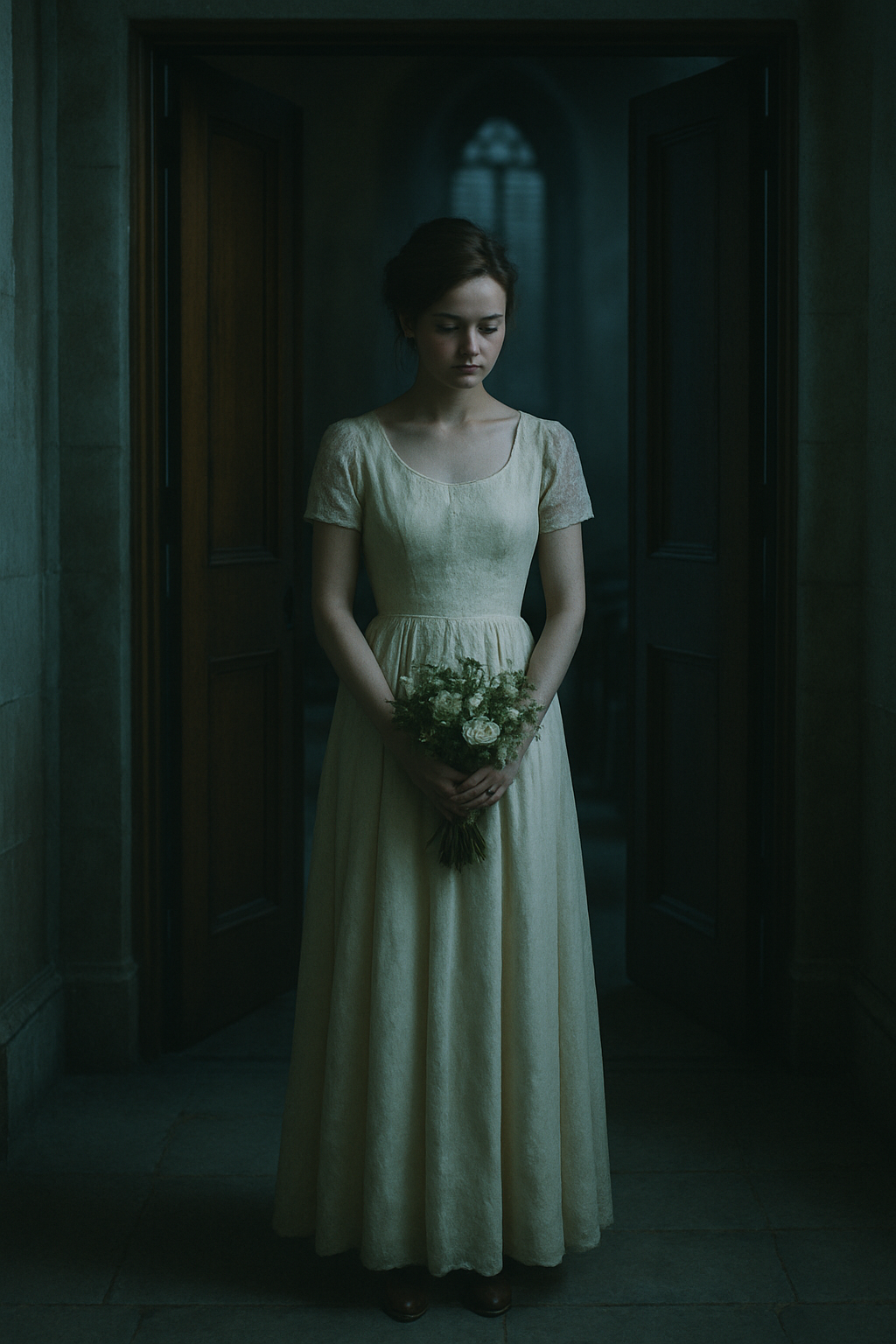
The dress was ivory, not white. Claire had been particular about that. White felt like a statement she wasn't sure she could make. Ivory felt like honesty — like something worn rather than performed. Her mother had agreed. James's mother had not said anything at all when she first saw it, which was its own kind of verdict.
That morning, she put it on in the back room of St. Bartholomew's — a church the Fuller family attended twice a year and claimed as their own — with her mother doing up the buttons and her cousin Natalie holding a bobby pin between her teeth and Oliver standing in the doorway the way he always did when he didn't know what to do with his hands.
"You look good," Oliver said.
"I look terrified," Claire said.
"Yeah, well. That's what good looks like today."
She laughed. It was a real laugh, which surprised her. She had expected the morning to feel like the inside of a jewelry box — precious and airless — but it didn't. It felt like a regular morning that happened to contain a dress. She ate half a croissant. She drank one cup of coffee. She let Natalie do her makeup and tried not to think about the three hundred people in the nave who were already, at twelve fifteen, beginning to wonder why the music hadn't changed.
The ceremony was scheduled for one o'clock.
James's family had opinions about the schedule.
His mother, Diane Fuller — who preferred Mrs. Fuller unless she was explicitly inviting you to use her first name, which she rarely was — had wanted the ceremony at noon. "More light," she'd said, as if light were a resource the Fulshers controlled. But the venue coordinator had explained that noon conflicted with a prior booking and James had said one o'clock was fine, and that had been that, at least on paper.
What that meant in practice was that the Fullers had been there since eleven thirty, sitting in the front left pews with the particular stillness of people who are accustomed to being accommodated and have not yet needed to be. Claire's family — her parents, her aunts, Oliver, her father's brother who'd driven up from Cardiff — sat on the right. They were louder. They had brought a tin of shortbread that her Auntie Rose had baked at five in the morning.
Claire knew this because Oliver had texted her a photo of the tin at eleven forty-seven with the caption: "Mam brought biscuits to your wedding. We love her. We are also mortified."
She had written back: "Tell her to save me one."
He had sent a thumbs up.
That was the last message she'd received before things stopped being ordinary.
At twelve thirty, she was in the vestibule with her father.
He was a man who didn't say much, her father. Tom Walsh. He'd spent thirty years as a site manager for a construction company in Bristol, a man who read situations and assessed risk and kept his opinions close. He was not a crier. He was not sentimental. He had once fixed a broken boiler at two in the morning without waking anyone up and left a note on the kitchen table that just said SORTED with a small star next to it, as if gold stars were something you gave yourself.
He cried a little when he saw Claire in the dress.
"Don't," she said.
"I'm not," he said, and looked at the ceiling, and then at his shoes, and then at her. "You're brilliant, you are."
"Dad."
"I mean it. You've always been — " He stopped. He patted her arm instead of finishing. It was enough.
They stood together in the vestibule and waited for the signal from the coordinator that it was time. Through the wooden doors, they could hear the low murmur of three hundred people and the organist playing something Claire recognized as Pachelbel's Canon, which she had not chosen. That had been one of Diane Fuller's adjustments. Claire had let it go because she had, over the course of this engagement, become expert at identifying which battles were worth the cost.
At twelve forty-five, the coordinator came to the door.
She was a small, efficient woman named Trudy who wore a headset and had a clipboard that she seemed to treat as a kind of emotional support object. She had shepherded this family through three planning sessions and had, Claire thought, developed a particular fondness for Tom Walsh and his no-nonsense questions about parking.
Trudy did not look right.
"Just a small delay," Trudy said. "We're just — James is just — we're confirming he's ready."
Claire looked at her. "He's not in position yet?"
"He'll be there," Trudy said, and it was the speed with which she said it that made Claire's stomach tighten. "Just a couple more minutes."
Tom Walsh looked at Trudy. Trudy looked at her clipboard.
"All right," Claire said.
She was calm. Later, she would think about this — the calmness, where it came from, whether it was denial or something else. But in the moment she was simply calm. She adjusted her bouquet. She looked at the pattern in the vestibule tile. She thought about the croissant.
At twelve fifty, Trudy came back.
"Still just another moment," she said. Her voice was perfectly controlled. She was a professional. She had done this long enough to know how to say something without saying it.
"Where is he?" Tom asked.
"We're — he stepped outside for some air, we believe. Just confirming."
"Stepped outside," Tom said.
"Dad," Claire said.
"No, I'm asking. He stepped outside. His wedding. At twelve fifty."
"Mr. Walsh — "
"It's fine," Claire said. It was not fine. She knew it was not fine. But the alternative — the thing that happened if it was not fine — was something she was not yet able to hold. "I'll wait."
So she waited.
She stood in the vestibule in her ivory dress with her father next to her and the tin of her mother's shortbread somewhere in the nave and the Fullers in the front pews and Pachelbel's Canon cycling back to the beginning for what was probably the fourth time, and she waited.
At one fifteen, Trudy came back a third time.
Her clipboard was against her chest now, held with both hands, like armor.
"Trudy," Claire said.
"Claire — "
"Where is he."
"We haven't been able to reach him," Trudy said. "I've sent one of my team to check the car park. His groomsmen — Marcus — he's been trying the phone — "
"His phone goes to voicemail," Claire said. She had tried at one oh three. She had not told her father this.
"Yes," Trudy said.
The silence was very particular.
Tom Walsh looked at the door. He looked at Trudy. He looked at his daughter. He said, in a voice that was very quiet and very careful, "Where in the car park is he, then?"
That question — where in the car park is he, then — hung in the air of the vestibule for the better part of the next two hours.
The answer, of course, was that he was not in the car park.
He was not anywhere they looked. His car was gone. Marcus, his best man, had called six times and sent eight texts and finally, at one forty-five, knocked on the door of James's parents' house three miles away and found no one home. Diane Fuller had been sitting in the front pew with her hands folded and her face very still, and at some point in the second hour she had stood and quietly left, and no one had stopped her, and that was its own kind of information.
The guests were told — gently, by the vicar and then by Trudy, who was by now the most competent person in the building — that the ceremony was postponed. There were murmurs. There was the sound of three hundred people deciding what to do with their bodies. Claire's Auntie Rose began to cry and had to be taken outside. Oliver found Claire in the vestibule and stood in front of her and didn't say anything for a long moment.
"Okay," he finally said.
"Okay," she said back.
"We're going to go home now."
"Yes."
"And we're going to get you out of that dress."
"Not yet," she said.
He looked at her.
"I just — " She stopped. She looked at the tile. "Not yet."
He nodded. He took her hand. He did not let go of it for the next two hours.
She sat with the not-yet in the vestibule while her mother handled the guests and her father handled the vicar and Oliver handled everything else. She did not cry. She sat very still in her ivory dress and thought about the croissant, and the shortbread, and the Pachelbel's Canon that no one had chosen to turn off, and it kept playing, softly, in the empty nave, cycling back to the beginning, cycling back, cycling back.
At two thirty, Marcus came and found her. He looked like a man who had been hit by something.
"Claire," he said. "I'm — I don't know. I don't know what happened. He — I haven't been able to reach him."
"I know," she said.
"I'm so sorry."
"I know."
He stood there. He didn't seem to know how to leave. She thought, briefly, that it was not his fault and that she should probably say so, but she didn't have the energy for that yet. She would have it later. Not yet.
"Has anyone told his family?" she asked.
"His mother left," Marcus said.
"I know. Has anyone spoken to her?"
"I don't — I think my wife called. They weren't — no one's heard from him."
"All right." She stood up. The dress moved with her, heavy and quiet. "Thank you, Marcus."
He looked helpless. She almost felt sorry for him.
At three in the afternoon, Claire Walsh went home in her wedding dress.
Oliver drove. Their parents were in the back seat, her mother holding Claire's bouquet because no one had known what to do with it, her father staring at the motorway with his jaw set in a particular way she recognized from the time the construction firm had gone under when she was twelve. The look of a man recalculating.
She sat in the passenger seat in her ivory dress and watched the city go past.
She didn't take the dress off until ten o'clock that night.
Not because she forgot. Not because she was being dramatic. She just — couldn't, quite. Not yet. She sat on the edge of her childhood bed in the room that still had her GCSE certificates on the wall and the poster of a band she'd loved at sixteen, and she kept the dress on until she couldn't keep it on anymore.
Oliver knocked at nine forty-five. "Do you want me to get it?"
"Yeah," she said. "Okay."
He undid the buttons without saying anything. He was not gentle with them — not rough, exactly, but purposeful. Like removing something that needed to come off.
When it was done, she stood in her slip in her childhood bedroom and the dress was in Oliver's hands and she felt — not better, not worse. Just different. Like the before and after of something she didn't have a name for yet.
"I'm going to hang it up," Oliver said.
"You don't have to."
"I know." He looked at the dress. "But I'm going to."
He hung it on the back of the door. They both looked at it for a moment.
"I'm not going back to him," Claire said. She didn't know, at that point, if it was true. She said it anyway.
Oliver said, "I know."
Then he sat on the floor of her childhood bedroom with his back against the bed and she sat next to him and they stayed there until well past midnight, her father's old radio playing in the kitchen downstairs, the shortbread on the side table — her mother had saved her one — and outside, the ordinary sound of a neighborhood not caring at all about what had happened today.
That was the first night.
She did not hear from James for eleven days.
She did not call him. She thought about it — thought about it the way you think about touching a bruise, cataloguing the specific shape of the pain. But she didn't call. There was nothing she needed from him that she could get over the phone.
On the third day, she returned to her flat. She had her own life — a job she was good at, a flat she'd chosen herself, friends who were furious on her behalf in the specific helpless way that friends are when they can't fix things. She went back to work after a week. She said she was fine. She was not fine, but she was not not-fine in the way people worried about. She was just — adjusting. Recalibrating. Learning the shape of the new thing.
The dress stayed in her childhood bedroom at her parents' house. She didn't go back for it. Returning it felt like a surrender — an acknowledgment that the dress had been wrong about something, when in fact the dress had just been standing there, doing its job.
On day eleven, James called.
She looked at his name on her phone and felt — not the fury she expected. Not the collapse. Something more like recognition. Like spotting something at a distance and understanding exactly what it was.
She didn't pick up.
He left a voicemail.
She listened to it three days later, after she'd had enough sleep and enough distance that she could hear his voice as just a voice, a collection of sounds, a man talking into a phone.
"Claire, I — I know. I know. I don't expect you to — I just wanted you to know that I'm sorry. I'm so sorry. What I did was — there's no — I owe you a real explanation. If you'll let me give you one. I'm not asking you to forgive me. I just — I think you deserve to hear it from me. Whatever you decide after that."
She listened to it twice. She did not call back.
Two weeks after the wedding that didn't happen, the envelope arrived.
It came via courier, on a Tuesday, addressed to Claire Walsh, from the venue's administrative office. Inside was a covering letter from the venue manager explaining that as part of their standard procedure for insurance documentation, they were providing copies of the security camera footage from the day in question, covering the hours of ten AM through four PM.
The letter was professional. Apologetic. She could tell someone had spent time on it.
She put the envelope on her kitchen table and made a cup of tea. She drank the tea. She washed the cup. She put it on the drying rack.
Then she sat back down at the kitchen table and opened the envelope.
The USB was in a small padded sleeve. There was an index card inside with two timestamps marked in pen: 12:47 and 12:50. She didn't know what those meant yet. She slotted the USB into her laptop.
But that — that moment, and what she saw — belongs to Part Two.
END OF PART ONE
What she felt that night, going to bed in her flat in her own bed in clothes she'd chosen herself, was not grief exactly. Not yet. It was something quieter and more specific — the sensation of a world that had contained one kind of future and now contained a different kind, and the strange, disorienting awareness that she was still in it. Still here. Still having ordinary evenings and ordinary cups of tea and ordinary conversations with Oliver on the phone about nothing in particular.
Still here. Which was, she was beginning to understand, not nothing.
She kept the shortbread on the side table for three more days.
Not because she was sentimental about it. Not because she'd forgotten it was there. She kept it because her mother had been up at five in the morning baking it, had packed it in a tin and carried it to a wedding, had saved her one piece through the whole long strange disaster of that afternoon — and that mattered. That was something. Not a cure. Not a comfort, exactly. Just a fact she didn't want to lose yet.
On the fourth morning she ate it with her coffee and it was good, the way shortbread made by someone who loves you is always good, and then the tin was empty and the day continued.
She had that. She had Oliver on the floor beside her and her father's radio and the ordinary sound of the neighborhood. She had those things. Whatever came next — the explanation, the footage, all of it — she had those things first.
HE LEFT HER AT THE ALTAR The Wedding Video Showed Exactly Who He Left Her For
PART TWO: The Footage
The USB drive was small and matte and completely unremarkable.
Claire sat at her kitchen table on a Tuesday evening with a cup of tea and the index card that had come with it, the two timestamps written in blue ballpoint, and she thought: I should wait. Call Oliver first. Have someone here.
She didn't call Oliver.
She slotted the USB into her laptop.
The footage was standard security camera quality — slightly washed out, the color of old photographs, the kind of image that is good enough to be useful and not good enough to be pleasant to look at. There were three camera angles: the car park, the main entrance, and the side entrance that opened from the vestibule corridor.
She clicked on the side entrance file first. She didn't know why. Maybe because that was the one she didn't know — the entrance she'd never used, the door she'd stood twenty feet from all morning without knowing what was happening on the other side.
The timestamp in the corner read 10:00:00 when the file opened.
She fast-forwarded.
At 12:31, she saw herself. A flicker — the door opening and the hem of her dress visible for two seconds as someone stepped through. She stopped. Watched it again. The hem of her ivory dress. She hadn't known there was a camera there. She'd been in the corridor looking for the coordinator at twelve thirty, apparently. She hadn't remembered.
She kept going.
At 12:47, the door opened again.
It took her a moment.
The woman was wearing a coat — deep green wool, the kind of coat that cost money and wore it quietly. Dark hair cut to the shoulder. She was moving quickly, head slightly down, in the particular way of someone who does not want to be in the main entrance camera.
Claire paused the footage.
She had met Rachel three times. Once at a dinner party at James's friends' house eighteen months ago, where Rachel had been warm and sharp and talked about a project she was doing in Edinburgh, something to do with architecture and public spaces. Once at a Christmas thing — James's office, she'd come as someone's plus-one. And once very briefly at a birthday of someone Claire didn't know well, where Rachel had given her a bottle of wine and called her "Claire, lovely" with what had seemed at the time like genuine warmth.
She knew that coat.
She had mentioned it, actually, to James, the first time she'd seen Rachel wearing it. "That green is incredible," she'd said. He'd said something — she couldn't remember what.
She looked at the timestamp.
12:47.
She looked at the index card on the table.
12:47. 12:50.
She played the footage from 12:47 to 12:55 four times.
At 12:47, Rachel enters through the side entrance. She does not look at the camera. She moves quickly down the corridor.
At 12:50, there is movement at the far edge of the frame — someone passing the door. The camera angle is such that you can't see clearly. But the timestamp is 12:50.
The ceremony was scheduled for one o'clock.
James left at 12:50.
Rachel entered at 12:47.
She sat with the footage for a while.
She thought: this is what it is.
She had known, in the oblique way you know things you're not letting yourself look at directly, that the explanation would not be simple. That it would have a shape she hadn't fully assembled. She had not suspected Rachel specifically — Rachel had been, or seemed, a person from James's life who existed at a remove, a childhood friend, someone who sent a card at Christmas and was pleasant at parties. But she had known there was a shape she wasn't seeing.
Now she was seeing it.
The coat at 12:47.
The disappearance at 12:50.
Three hundred people in a nave. Her father in the vestibule asking where in the car park is he, then.
She watched it again. And then once more after that.
Then she got up and rinsed her mug and stood at the kitchen window and looked out at the street.
She wasn't crying. She noticed this, the way you notice the weather — just an observation. She had cried, some, in the first two weeks. Quietly, usually late, in the particular way of someone who is keeping it contained so the rest of life can still function. But right now she wasn't crying. She was something else entirely.
She went back to the table.
She looked at the frozen image on her laptop — the side entrance, empty now, 12:48.
Then she picked up her phone and found Rachel's number. They were not friends. She had Rachel's number because at some point — the birthday party, maybe — they had exchanged numbers for no particular reason, the way you do.
She dialed.
Rachel picked up on the third ring.
"Claire." She said it immediately, her voice doing something complicated. Not surprise — something more like recognition. Like she'd been waiting, or had been aware that this was coming, and was not entirely sure how to be inside the moment now that it was here.
"Hi, Rachel," Claire said.
Silence. Not long. Three seconds.
"I got the venue footage," Claire said. "From the insurance claim."
Another silence.
"There are timestamps," Claire said. "You come in at twelve forty-seven. Through the side entrance."
Rachel didn't say anything.
"I watched it four times," Claire said. "I wanted to make sure I was seeing it correctly."
"Claire — "
"I'm not asking you to explain it. I just wanted you to know that I watched it. That I know."
Her voice was even. She had not planned what she was going to say. It was just — what came out. The thing she needed to say, which was not a confrontation, exactly. Not a demand. Just: I see this. I saw it. You should know I saw it.
Rachel's response came in pieces.
The first piece was silence — ten, maybe fifteen seconds of it, which is a long time on a phone call.
The second piece was: "I'm sorry."
Not — I didn't do anything, you're misreading it. Not — let me explain. Just: I'm sorry.
"Okay," Claire said.
"I know that doesn't — " Rachel stopped. "I know that's not enough."
"No," Claire said. "It's not."
Another silence.
"Were you — " Claire started, and then paused, and recalibrated, because she had almost asked were you together before, which was a question she wasn't sure she wanted answered. Not because she couldn't handle it, but because there was a version of that answer that would require her to rebuild the last two years from the ground up and she didn't have the energy for that today.
"I don't need to know the details," she said instead. "I don't think it changes anything that matters."
"No," Rachel said quietly. "I suppose it doesn't."
"I just wanted you to know that I watched the footage," Claire said again. "That's all."
"Okay," Rachel said. Her voice was very small.
"Okay," Claire said.
She hung up.
She sat in her kitchen for a long time after.
The footage was still open on her laptop. She closed it. She didn't delete the file — she put it in a folder on her desktop with a date stamp and left it there. She wasn't sure why. Evidence of something, though she wasn't pursuing anything. Just — a record.
She called Oliver that evening.
He picked up immediately, the way he always did.
"Hey," he said.
"I watched the footage," she said.
"Oh." A pause. "Are you okay?"
"I'm fine, actually. I'm — yes. I'm okay."
He waited.
"There was someone on the footage. Going in through the side entrance at twelve forty-seven." She paused. "Rachel."
"Rachel," Oliver repeated. The word was flat. She could hear him processing it.
"His childhood friend," she said, even though he knew.
"I know who Rachel is," Oliver said. His voice had gone quiet in the particular way it went quiet when he was deciding how angry he was allowed to be.
"I called her."
"You — Claire."
"I didn't yell. I just told her I'd watched the footage. That I knew."
He was quiet for a moment.
"What did she say?"
"She said she was sorry."
"And?"
"That's about it."
Another pause. She could hear him breathing.
"Oliver," she said.
"Yeah."
"I'm okay. I actually — I think I'm okay."
He didn't say anything for a moment. She knew him well enough to know he was deciding whether to believe her.
"Okay," he said finally. "I believe you."
"You don't, entirely."
"I believe that you think you are," he said. "Which is not quite the same thing but it's something."
"That's fair," she said.
What she did not tell Oliver that night, because she hadn't fully processed it herself:
The thing that struck her most about the footage was not the betrayal, exactly. The betrayal was there — yes, the green coat, the timestamp, the side entrance. But she had been sitting with some version of the shape of that for two weeks, even if she hadn't let herself look at it directly.
What struck her was the detail that had been there all along: the side entrance.
She had been in the vestibule all morning. Twenty feet from that door. Three hundred people in the nave. Her father recalculating. Oliver holding her hand.
And the thing that was actually happening had been happening twenty feet away, through a door she hadn't known to look at.
She thought about that a lot, in the weeks after. How proximity is not the same as visibility. How you can be right next to something and not see it because you're looking at the wrong door.
It was not a comfortable thought. But it was, she found, a useful one.
She did not hear from James during this period.
He had called once, two weeks ago, and left the voicemail. She had not called back. She supposed he was waiting. Or managing the situation. Or doing whatever James Fuller did when his private and his public lives stopped being manageable.
She didn't have the bandwidth to think about James right now.
She had the footage. She had the phone call. She had the small, strange satisfaction of having said: I see this, and having meant it.
That was enough for now.
END OF PART TWO
The thing about footage is it doesn't lie. It doesn't explain. It just shows you what was there.
At 12:47, a green coat enters through the side door. At 12:50, a man leaves. At 1:00, three hundred people are still waiting.
That was what happened.
The question of why — the full shape of it, the history, what James would eventually say about it when he finally called — that was still coming.
She was, she found, almost ready to hear it.
She was almost ready to hear it. That was how Part Two ended, in her own mind — a kind of preparation, the way you set a table before a meal. Not anticipation exactly. More like a door she had left open, knowing something would eventually walk through it.
She did not know, when she said that, that it would be another two weeks before James called. She would spend those two weeks rearranging the furniture of her understanding — moving things, testing weight, seeing what held.
She went back to the footage once more. Not to watch it again — she had watched it enough — but to confirm that she had put it away properly.
She had. The file was in a folder on her desktop, dated, labeled plainly. She was not a person who needed to revisit things to believe they had happened. She had seen it. She knew what she had seen.
She closed the folder.
She made herself a bowl of pasta and ate it standing at the counter because there was no one to make her sit down and she didn't feel like the ceremony of it tonight. She ate the pasta. She washed the bowl. She put it on the drying rack next to the mug.
The domesticity of it was, she was finding, a kind of anchor. The small repeated acts of a life that continued. Mug on drying rack. Bowl on drying rack. The window above the sink and the ordinary street below it.
She was fine. She kept checking and finding that it was still true.
What Oliver had said — I believe that you think you are — stayed with her.
She thought about it the next morning, in the shower. Then at her desk. She turned it over a few times. Not defensively. Just curiously.
It was a good distinction, she thought. There was the version of fine that was performance — the clenched jaw, the keeping-it-together, the thing you said so other people would stop worrying. And there was the version that was actual. She had been in the first category for the first week, probably. Maybe ten days.
The footage had moved her into the second category.
Not because it made things worse — it had, in an odd way, made things cleaner. Before the footage she had the fact of what he'd done without the mechanism. The how without the why. The vanishing without the story. Now she had the story, or the beginning of it. The green coat at 12:47. The side entrance.
A shape she could hold.
Holding a shape was easier than not holding one.
Her colleague Priya brought her lunch on the Wednesday.
They had been friends for three years, she and Priya, the kind of work friendship that had grown into something real — honest and unceremonious. Priya had been furious on her behalf in the early days and had since dialed it down to something more useful, a watchful steadiness.
She set a container of lentil soup on Claire's desk without comment.
"Thank you," Claire said.
"How are you doing." It was not quite a question, from Priya. More an opening.
"Better," Claire said. "Actually better. I got the venue footage."
Priya looked at her.
"It was — instructive," Claire said.
"Instructive," Priya repeated. "That's a word for it."
"I saw someone on it. His childhood friend. Rachel."
Priya was quiet for a moment. "His childhood friend."
"Yes."
"And she was at the side entrance at twelve forty-seven."
"Yes."
"Right," Priya said. She looked at her desk. She looked back at Claire. "How are you actually doing."
"I called her," Claire said. "Rachel. I just — I told her I'd watched the footage. That I'd seen it. She said she was sorry."
"And?"
"And that was it. I hung up." Claire paused. "It was — I don't know. I needed to say I'd seen it. I needed her to know. That was all I wanted from the call."
"Okay," Priya said slowly.
"I'm not in pieces," Claire said. "I keep waiting to be in pieces and I'm just not."
"You're allowed to not be," Priya said.
"I know. I just — people keep expecting me to be. And I'm not sure if I should be worried about that."
"Are you worried about it?"
Claire thought about it honestly. "No," she said. "I'm sad. It's a sad thing that happened. But I'm not — undone. I don't think it was going to make me undone even if it hadn't happened. I think I know who I am."
Priya looked at her for a moment. "Eat the soup," she said.
Claire ate the soup.
She wrote down the timestamps once.
Not in a journal — she didn't keep one. Just on a piece of paper, for herself, to see it laid out plainly.
12:31 — hem of dress visible, side entrance corridor. That was her. 12:47 — green coat, Rachel, entering through side entrance. 12:50 — movement at far edge of frame, departure. 1:00 — ceremony scheduled. 1:15 — Trudy comes back to the vestibule a third time with her clipboard held like armor.
She looked at it. Then she folded the paper in half. Then in quarters. Then she put it in the kitchen drawer where she kept batteries and rubber bands and the spare key to her sister-in-law's flat.
She did not throw it away. She did not need to look at it again. She just put it somewhere it could exist without taking up space.
The question she almost asked Rachel — were you together before, during — was one she sat with for a few days without asking it.
Not because she needed the answer for her own peace. She was, she found, genuinely not certain whether she wanted the full picture. There was a version of the full picture that would require her to spool back through two years of ordinary weekends and dinner parties and conversations about where to spend Christmas, and audit them. Check each memory for something hidden in the corner of the frame, like the side entrance on the footage.
She decided she didn't want to do that.
It was not denial. It was more like a practical decision about what was worth her time. She had the footage. She had the phone call with Rachel. She had the shape of it. She did not need every detail in order to know what had happened, and knowing every detail would not change what she was going to do, which was: nothing. Move forward. Live her life.
She had seen the footage. That was enough.
On the Thursday evening, she called her mother.
Not because anything specific had happened. She just wanted to hear her voice.
"Hello, love," her mother said. "How are you getting on?"
"I'm fine," Claire said. "I'm actually fine. I got the footage from the venue."
Her mother was quiet for a moment. "The security footage?"
"Yes. They sent it as part of the insurance paperwork."
"And you watched it."
"Yes."
Another pause. "Was it — did it tell you anything?"
"It told me what I thought it would tell me," Claire said. "The shape of it. Someone who shouldn't have been there."
Her mother said, carefully, "Oh."
"It's all right," Claire said. "I mean — it's not all right. But it's knowable now. It has a shape. I can hold something with a shape."
Her mother was quiet. Claire could hear the television on low in the background — her parents' ordinary Thursday evening.
"I called her," Claire said. "The woman on the footage."
"You called her."
"I just wanted her to know I'd seen it. That I knew."
"And?"
"She apologized."
Her mother said nothing for a long moment. Then: "Your father will want to know."
"I know."
"He won't say much. But he'll want to know."
"Tell him," Claire said. "Tell him I'm okay. Tell him the shape of it makes sense now."
"He'll know what that means," her mother said.
"I know he will," Claire said.
She slept well that night, which surprised her.
She had not been sleeping badly — she had been sleeping the way you sleep when you are managing things, lightly and in shifts. But that night she slept the way she'd slept before any of it happened, deeply and without waking, and in the morning she lay in bed for a moment and noticed that the ceiling looked the same as always and the room smelled the same as always and she was the same person she had been the day before, which was the day before that, which was — herself. Just herself.
She got up. She made coffee. She stood at the kitchen window.
The street was doing its ordinary morning things: a woman walking a small dog, a delivery van idling, someone jogging with headphones in. It was the same street it had been yesterday. She was in it, as she had always been in it.
She was, she thought, almost ready.
HE LEFT HER AT THE ALTAR The Wedding Video Showed Exactly Who He Left Her For
PART THREE: The Call, and After
James called on a Thursday afternoon in late August.
It had been six weeks since the wedding that didn't happen, five weeks since the footage, four weeks since the phone call with Rachel. Claire was at work when her phone buzzed and his name appeared on the screen, and she looked at it for two rings, three, and then pressed accept.
"James," she said.
"Claire." His voice was careful, relieved, the voice of someone who had been preparing to get a voicemail. "I wasn't sure you'd pick up."
"I almost didn't," she said.
"Right." A pause. "Thank you. For — thank you."
She said nothing.
"I want to explain," he said. "I know I said that in the voicemail. I meant it. You deserve a real explanation and I haven't — I've been — I know I should have called sooner."
"Six weeks," she said.
"I know."
"I watched the venue footage," she said. "Two weeks ago. I don't know if you knew it existed."
Silence.
"I recognized Rachel's coat," she said. "The green one."
The silence was longer this time.
"I called her," Claire said. "She said she was sorry. That was about it."
"Claire — "
"I'm not calling to punish you," she said. "I just want you to know what I know. So we're starting from the same place."
James's explanation came in the way that explanations do when someone has been rehearsing them: in clean sentences, organized, with the particular shape of a man who has been over the ground many times in the preceding weeks and knows which turns to take.
He and Rachel had been — it was complicated, he said. It had been over for years, he said. It had started again, he said, slowly, in the last year of his engagement to Claire, and it should not have, and he had been trying to manage it, and the morning of the wedding he had understood that he could not.
He did not say he loved Rachel. He did not say he did not.
He said: "I should have told you before it got that far. I should have — I kept telling myself I could manage it. I kept thinking it would stop on its own."
"Did you think it would stop on its own?" she asked.
"I don't know," he said. "I think I didn't let myself think about it clearly."
"Right," she said.
"I know that's not an excuse."
"No," she said. "It's not."
What she noticed, during the call:
She was standing at the window of her flat. The same window she'd stood at the morning after the footage. The street was doing its ordinary things — a cyclist, a woman with a pushchair, someone unlocking a car.
She was not crying. She had not cried once during this phone call.
She was listening with the part of herself that assessed, that recalibrated, that wanted to understand the structure of the thing. Not to forgive. Not to condemn. Just to understand.
James was, she thought, a man who had been managing too many things for too long. That was not an excuse. It was a pattern she recognized and could see clearly now because she was outside it.
She asked one question.
"How long ago, really?"
He paused. "What?"
"The original — you and Rachel. Years ago. How long ago."
"We were — it was before you and I — we had something in our mid-twenties. Before I met you."
"And it came back in the last year."
"Yes."
She thought about this. She thought about the dinner party eighteen months ago, which was seventeen months before the wedding. She thought about Rachel in the green coat, warm and sharp, giving her a bottle of wine, calling her "Claire, lovely."
She thought: I will spend a lot of time not thinking about this and that is fine.
"Okay," she said.
"Okay?"
"I mean — not okay. But I've heard what you're saying."
He was quiet.
"Is there anything else?" she said.
"I'm — I am genuinely sorry, Claire. I know what I did. I know what it cost you."
"Yes," she said. "You do."
And then: "I hope you figure out what you actually want, James. I mean that. I hope you work it out. I just don't need to be part of it."
He said: "You've always been clearer than I am."
She said: "Goodbye, James."
She hung up.
She stood at the window for a while.
The cyclist came back — or a different cyclist, she couldn't tell. The pushchair woman turned the corner and disappeared. Ordinary Thursday afternoon.
She called Oliver.
"He called," she said.
"And?"
"He explained. It was — as expected, roughly."
"He's an idiot," Oliver said.
"He's not an idiot," she said. "He's just someone who couldn't manage what he was carrying and handled it badly and the badness cost me a lot."
"That's a very charitable framing."
"I've had six weeks," she said.
A pause.
"Are you okay?" he asked.
"I actually am," she said. "I think this is — I think I needed this call. Not to forgive him or to fight with him. Just to hear his voice and know that I'm not devastated by it. That I can hear his voice and feel nothing in particular and hang up and stand here at the window and feel like myself."
Oliver was quiet for a moment.
"Yeah," he said. "That sounds like okay to me."
"I'm going to make dinner," she said.
"Good."
"Oliver."
"Yeah."
"Thank you. For — for all of it. The whole thing."
"You don't have to thank me for that," he said.
"I know," she said. "I'm thanking you anyway."
She made dinner. She ate it. She went to bed.
In the morning she woke up and went to work and did her job and had lunch with a colleague and came home and watched something on television. An ordinary day.
And then another ordinary day after that.
And another.
She did not return the dress that autumn.
She had been storing it, still in the garment bag, at her parents' house. She thought about it several times. But every time she tried to make the call to the dress shop, she found she didn't quite have the impulse. Not yet.
In October, she asked her mother to check on it — make sure it wasn't getting damp in the wardrobe.
Her mother said it was fine.
"I'll deal with it eventually," Claire said.
"There's no rush," her mother said.
She didn't deal with it until the following spring, and when she did, she gave it to a charity that altered wedding dresses for women who couldn't afford them. She didn't make a thing of it. She just dropped it off on a Saturday morning, in the rain, and drove home.
ONE YEAR LATER
The year that followed was not a recovery story.
It was not a montage of self-improvement — she did not take up running in a meaningful way, she did not reinvent herself, she did not, crucially, have a triumphant moment at which she turned to the camera and said: this is who I am now.
She just — lived.
She was good at her job and got better at it. She spent weekends with her family and with friends. She went on one date in November that was fine and led to nothing and that was also fine. She went on another in February that was genuinely fun and led to two more dates and then fizzled out in the natural way things fizzle, which was not devastating, which was just the ordinary texture of being a person in the world.
She moved flat. Not for any dramatic reason — her lease was up and she found somewhere slightly larger, with better light, and she moved.
She and Oliver went to Portugal for a week in March. He got badly sunburned on the first day and complained about it for the remaining six days and it was one of the best weeks she'd had in a long time.
She did not think about James often.
When she did, it was — not nothing. There was still a residue. The shape of two years was not fully erased. But it did not take up room anymore. It was a thing that had happened. One of the things that had happened.
She did not think about Rachel at all, for the most part. Occasionally — in the green coat, the side entrance, 12:47 — but not often. She had said what she needed to say. The rest was not her business.
One year after the wedding that didn't happen, her father called.
Not for a particular reason. He called every couple of weeks. He asked about work, about the new flat, about the friends she mentioned occasionally. He did not, in general, talk about James or what had happened. That was not his style.
But at the end of this call, before he rang off, he said: "I'm proud of you, love."
She was standing in her kitchen, the new kitchen, with better light.
"For what?" she said.
He thought about it.
"For getting on with it," he said. "For not letting it define you."
"It happened a year ago," she said. "It wasn't — "
"I know what it was," he said. His voice was quiet. "I was there."
A small silence.
"Thank you, Dad," she said.
"All right," he said. "Good night, then."
"Good night."
She stood in her kitchen with better light.
She thought about the vestibule. The tile. The dress on the back of the door. The first night on the floor of her childhood bedroom with Oliver next to her and her father's radio playing downstairs.
She thought about the footage. The green coat at 12:47. The phone call. Rachel saying I'm sorry. James explaining, finally, in the clean organized sentences of someone who had been over the ground many times.
She thought about all of it for a moment, cleanly, the whole year of it.
Then she put the kettle on.
Then she called Oliver to tell him their father had been uncharacteristically sentimental and he would want to process this together.
He answered on the second ring, as he always did.
"Hey," he said.
"Hey," she said.
And that — the ordinary ease of it, the fact of her brother's voice and her kitchen and her own life — that was the whole point.
Not a triumph. Not a conclusion. Just: her own life, belonging to her again. Which was, she had learned, exactly enough.
END OF PART THREE
Not a triumph. Not a conclusion. Just: her own life, belonging to her again. Which was, she had learned, exactly enough.
She stood at the window for another few minutes after getting off the phone with Oliver.
The street below was doing what streets do on Saturday mornings. A man walked a terrier. Two teenagers on bikes went past without looking. Someone was pulling a wheeled shopping bag over the pavement seam, that particular rhythmic knock.
She thought: I have been standing at this window for a year.
Not literally. But in the way that mattered — she had returned to it in her mind, the window, the view, the particular quality of light. The window where she'd stood after the footage. The window where she'd stood during the call with James. The window where she'd come to understand, slowly and without fanfare, that she was going to be all right.
She put the kettle on and went to ring Oliver back.
"Dad was uncharacteristically sentimental," she told him.
"What did he say?"
"He said he was proud of me for getting on with it. For not letting it define me."
A pause. "He said that?"
"He said that."
"Hm." She could hear Oliver thinking. "That's — yeah. That tracks actually. He said something similar to me a few months ago. Not about you. Just — in general. He said, there are things that happen to you and things you do with what happens to you, and that's the whole difference."
"He said that to you."
"He did."
"And he couldn't have led with that twelve months ago."
"He couldn't have led with that," Oliver agreed. "He's a man of specific timing."
She laughed. A real one.
"How are you actually?" Oliver said.
"I'm making tea," she said. "I just got off a genuinely fine call with Dad. I'm going to make dinner in a bit. Tomorrow I'm going to the farmer's market with Priya if it doesn't rain."
"That's very — normal."
"Yes," she said. "That's the point."
The farmer's market did not rain.
Priya bought tomatoes and complained about the price of tomatoes. Claire bought a sourdough loaf and a jar of honey and spent longer than was strictly necessary looking at someone's display of dried flowers, not because she wanted to buy dried flowers but because they were beautiful in the particular unsentimental way of things that had just been what they were.
Priya came up beside her. "Are you having a moment?"
"I'm looking at dried flowers."
"I can see that."
"They're nice."
"They are nice," Priya agreed. "Are you okay?"
"I'm extremely okay," Claire said. "I've been okay for a while. I'm only just starting to fully believe it."
"What changed?"
Claire thought about it. She picked up a bunch of dried lavender and looked at it. Put it back.
"I think I just — stopped waiting for the bad part," she said. "There was a while where I kept expecting the real grief to hit. Like I was in the anteroom of something much worse. And at some point I realized — no. This is it. This is all it is. A thing happened and I dealt with it and I'm still here."
Priya looked at her. "That sounds like wisdom."
"It sounds like six weeks of insomnia followed by ten months of very consistent sleeping," Claire said.
Priya laughed. "Those aren't mutually exclusive."
She bought the dried lavender.
She put the lavender on the windowsill in the kitchen.
It was not a grand gesture. She was not making a statement about new beginnings or recovery or the renovation of herself. She put it on the windowsill because it looked nice there and it smelled like something.
She stood back and looked at it.
Good, she thought.
In November, her mother asked about the dress.
Not directly — her mother was not a direct person about things that carried weight. She mentioned it at the end of a phone call, casually, the way she mentioned things she had been thinking about for weeks.
"Have you — I was just thinking about the dress. The one still here. Whether you've thought about what to do with it."
"Not yet," Claire said.
"No rush," her mother said. "I just wanted to check. It's fine in the wardrobe."
"I'll figure it out."
She did not figure it out in November. Or December. She thought about it a few times — the ivory dress, the buttons Oliver had undone with such purposeful efficiency, the way it had moved with her when she stood up in the vestibule. The dress had done nothing wrong. It had been a dress. It had just stood there doing its job, as she had said to herself at the time, and the wrong thing had happened around it.
She could not quite bring herself to return it. Returning it felt like accepting a verdict on something she didn't think was guilty.
She read, somewhere, about charities that altered wedding dresses for women who couldn't afford them. She did not read about it in a pointed way — it was not a sign from the universe or a resolution crystallizing. She read about it because she was on a website for unrelated reasons and there was an article linked, and she clicked the link the way you do.
She bookmarked it.
In the spring, on a Saturday when it was raining and she had nothing particular on, she drove to her parents' house, had lunch, and came away with the dress in a garment bag.
Her mother had asked, "Are you sure?" and she had said, "Yes," and that had been it.
She dropped it off at the charity shop on her way home, in the rain, handed it over to a woman with paint on her sleeve who said, "Oh, it's lovely," and Claire said, "It is, isn't it." And then she got back in her car and drove home.
She did not cry in the car. She thought about that — checked for it — and found it wasn't there. What she found instead was something quieter. A sense of something finding its right place.
The dress would become something else. It would be worn by someone for whom it was exactly the right thing, altered and fitted and chosen fresh. It would stand at the front of a different church, holding a different kind of morning. That was fine. That was good.
Spring came in properly around April.
She had moved into the new flat in February — better light, as she'd said, and a longer kitchen counter, which mattered more than she'd expected. She had put the dried lavender on the new windowsill. She had organized the kitchen the way she wanted, not the way someone else thought it should be. She had put the spare key on a hook she'd chosen.
Small things. The accumulated small things of a life that was hers.
Oliver came to see the flat on a Saturday in March, the weekend before Portugal. He walked around it with the look of a person taking inventory and said, "It's good. It's actually very good."
"Thank you," she said.
"The light is — yeah."
"I know."
He stopped in the kitchen and looked out the window. "You always go for good windows."
"I've been thinking about that," she said.
He looked at her.
"I spent a lot of time at windows this year," she said. "After the footage. After the call with James. I kept going to the window. I think I was — I don't know. Looking at the ordinary world. Checking it was still there."
"And was it?"
"Always," she said. "Always exactly there."
He nodded slowly.
"I think I chose this flat for the window before I chose it for anything else," she said. "And I think that's fine."
He said, "Yeah. That makes sense to me."
Portugal was Oliver getting sunburned on day one and complaining about it for six days.
She bought him a sun hat at a market on day three — a wide-brimmed straw thing, slightly absurd — and he wore it with complete seriousness for the rest of the week, and every time she looked at him in it she laughed, and every time she laughed she felt like herself. Completely, straightforwardly herself.
On the last evening they sat at a table outside a small restaurant and drank wine and Oliver said, "This was a good idea."
"It was your idea," she said.
"It was my idea," he agreed, "but you agreed quickly, which meant you needed it."
"I needed it," she admitted.
They sat for a while without talking. The evening was warm. People moved past on the street. A cat sat on a windowsill across the road and watched them with complete indifference.
"Are you going to be okay?" Oliver said. Not in the worried way he'd said it early on — not the checking, not the watching for collapse. Just the ordinary question, the one you ask people you love.
"Yes," she said.
"Good," he said.
And they finished their wine in the warm evening and the cat on the windowsill watched them and the street continued to be what it was, and she was there in it, present and intact.
One year on, standing in her kitchen with better light, she thought about what her father had said.
For getting on with it. For not letting it define you.
She thought: that is not quite it, though. Or not just it.
Getting on with things — yes. She had done that, and it had mattered. The morning routine resumed, the job continued, the small repeated acts of a functioning life. That was real.
But the other thing — not letting it define you — that was trickier. Because it had defined something. It had changed her in ways she was still mapping. She was more careful now, in a way she hadn't known to be. More attentive to what was happening twenty feet away, through doors she hadn't thought to look at. More willing to be in the vestibule — uncertain, waiting — without needing to resolve it immediately.
Those were not bad things. They were just — the new geography. The shape of herself, after.
She thought: I am someone who stood in a vestibule in an ivory dress and waited and then went home and sat on the floor with her brother and listened to the radio. I am someone who watched the footage alone at her kitchen table and called the woman in the green coat and said: I see this. I saw it.
I am someone who put the dress in a garment bag and drove through the rain and handed it over and said, It is, isn't it. And meant it. Not as a wound. As a fact.
That was who she was now. That was the definition.
She put the kettle on.