PART 1
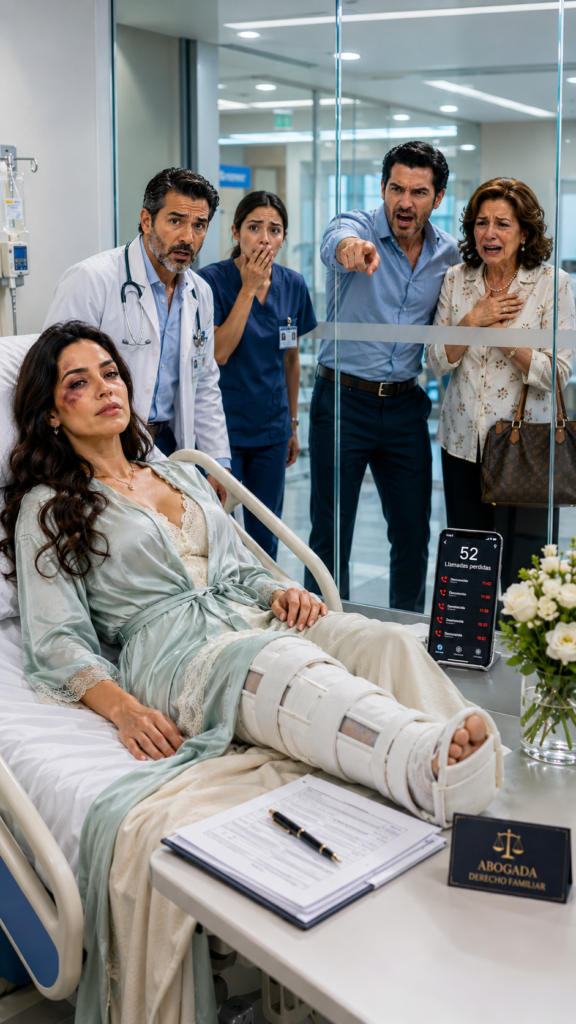
The call came in when Andrea Salgado could barely keep her eyes open at the Spanish Hospital in Mexico City. The room smelled of disinfectant, warm milk, and dying flowers. Outside, the rain pounded the windows as if it too wanted to witness the disaster.
Andrea had been awake for 28 hours. She'd gone through a complicated delivery, a minor hemorrhage, and a loneliness so heavy that even the nurses didn't dare ask about the father.
In the acrylic crib, a baby girl slept wrapped in a pink blanket. She had a tiny nose, dark hair, and the same small mark next to her lip that Sebastián Arriaga hid with a beard since he was 20.
The cell phone vibrated on the table. SEBASTIÁN. Andrea looked at the name without moving.
Sebastián was her ex-husband, the man from Polanco who signed the divorce papers eight months earlier and left the courtroom saying he was finally rid of “a house with no future.” He was also the one who let his mother, Doña Ofelia, call her useless in front of the whole family during a dinner in San Ángel.
“My son needs a woman who can give him descendants,” the lady had said, raising a glass as if toasting to cruelty.
Andrea answered.
“I thought you'd never wake up,” said Sebastián, with a venomous calm. “I heard you were in the hospital. Still so dramatic.”
Andrea breathed slowly. The wound burned. The baby let out a soft whimper.
“I'm calling for something important,” he continued. “I'm getting married this Sunday.”
Andrea closed her eyes.
“Lucía is pregnant,” Sebastián added. “See? It wasn't that hard. It just took the right woman.”
She said nothing. On the other end, he let out a brief laugh.
“I invited you because I want you to close your cycle. Come, see me happy. It'll do you good to understand that the problem was never me.”
Andrea opened her eyes and looked at her daughter. The girl moved a tiny hand, as if wanting to touch her face.
“I'll be there,” Andrea replied.
Sebastián fell silent. He expected tears. He expected complaints. He expected to hear the same woman he left crying amidst fertility tests, medicines, and cribs bought too soon.
But that Andrea was gone.
The one replying now had just become a mother.
“Don't come with a martyr's face,” said Sebastián. “There will be important people. I don't want any scenes.”
Andrea turned her gaze to a black bag next to the armchair. Inside was a prenatal genetic test, another confirmation taken after birth, recordings of Doña Ofelia, strange invoices, marked transfers, and emails sent by Lucía from an account she thought was untraceable.
Sebastián didn't know he had a daughter.
Lucía didn't know her supposed pregnancy had already been unraveled.
Doña Ofelia didn't know that every insult of hers was recorded.
“Don't worry,” said Andrea. “I won’t make a scene.”
Sebastián smiled arrogantly on the phone.
“I hope so.”
Andrea looked at her baby.
“I’m going to do justice.”
He didn’t understand.
“What did you say?”
“See you at your wedding, Sebastián.”
When she hung up, the location arrived: a hacienda in San Miguel de Allende, private ceremony, social press, politicians, businessmen, and the Arriaga name everywhere.
Andrea held her daughter against her chest.
“Your dad opened the door for us, my girl,” she whispered. “And this time we won’t enter with our heads bowed.”
Then she took the first document from the black bag and read again the line that could turn that wedding into a social funeral.
PART 2
On Sunday, Andrea left Mexico City before dawn. Her mom, Doña Graciela, tried to stop her at the apartment door. She wore her shawl haphazardly, eyes swollen, and a cup of coffee that had already gone cold in her hands.
“Daughter, you just gave birth,” she said. “That man doesn’t deserve a single step into his party.”
Andrea carefully adjusted the baby carrier. The girl slept peacefully, unaware of all the venom surrounding her arrival into the world.
“I’m not going for him, Mom,” Andrea replied. “I’m going so my daughter never hears their version.”
Doña Graciela pressed her lips together. She didn’t insist further. She only straightened the collar of Andrea’s dress and gave her a blessing.
Andrea didn’t choose flashy clothes. She wore a dark green dress, long-sleeved, elegant, and serious. No sequins, no exaggerated makeup, nothing that looked like cheap revenge. She wanted to enter like a truth does: without shouting, but impossible to ignore.
She dressed the baby in a simple white dress, knitted socks, and a silver bracelet with the surname Salgado. Not Arriaga. Salgado.
The SUV moved along the highway to Guanajuato as the sun rose between gray clouds. Andrea looked out the window without crying.
She remembered the four years of marriage. The medical appointments. The injections. The calls from clinics. The tests where everything seemed to point to her, while Sebastián refused to retake tests because, according to him, “an Arriaga didn’t have those kinds of faults.”
She also remembered Lucía. The impeccably dressed executive assistant, always near, always with a pitying smile when Andrea walked into the office.
Lucía sent her a floral arrangement after her last loss.
The card read:
“There are women born to be wives and others to learn to let go.”
Andrea kept that card for months. Not out of pain. Out of intuition.
The hacienda appeared at noon, white and enormous, surrounded by bougainvillea, pink stone, and luxury SUVs parked in a row.
The wedding looked like a magazine cover. There were mariachis at the entrance, orchid arrangements, crystal glasses, waiters with black gloves, and a floral arch so exaggerated it seemed built to hide a lie.
At the door, a coordinator checked the list.
“Name, please?”
“Andrea Salgado.”
The man looked up immediately. His professional smile cracked.
“One moment, ma’am.”
He spoke quietly into a radio. A few minutes later, Doña Ofelia Arriaga appeared. She wore a golden dress, an emerald necklace, and the same look with which she once made Andrea feel less than nothing in her own home.
When she saw the stroller, she pursed her lips.
“What a necessity, Andrea,” she said through clenched teeth. “Bringing someone else’s baby to my son’s wedding is too low, even for you.”
Andrea didn’t lower her gaze.
“It’s not someone else’s.”
Doña Ofelia let out a dry laugh.
“Oh, please. Don’t start with fantasies. Sebastián is finally going to have a legitimate child with a decent woman.”
The baby opened her eyes. Doña Ofelia stood still. It was just one second, but it was enough. The lady saw something in that small face that pierced her pride.
The same eyebrows. The same serious Arriaga expression. The same mark next to the lip.
But Doña Ofelia chose to cling to her arrogance.
“Enter,” she murmured. “But don’t even think about making a scene. We’re not in a market here.”
Andrea entered.
The main hall was full. Businessmen, society ladies with long surnames, influencers, a local congressman, Sebastián’s golf buddies, and several social journalists pretended not to look at the entrance.
But everyone looked.
Sebastián was at the front, next to the civil judge and under a roof covered with white flowers. He wore a black suit, an expensive watch, and that smile of a man used to buying, silencing, or fixing everything with connections.
Next to him, Lucía looked like a store mannequin. Fitted wedding dress, long veil, and a hand placed on her flat belly as if posing for a photograph.
When Sebastián saw Andrea, he smiled mockingly. Then he looked at the stroller. His smile faded.
Lucía looked at it too. And for a moment, her face showed neither jealousy nor surprise. It showed fear.
Andrea noticed.
That fear was the confirmation she needed.
The ceremony started late. No one explained why, but the atmosphere was already tainted.
The musicians played softly. The glasses sparkled. The flowers smelled too strong.
Sebastián tried to look only at the judge, but his eyes kept drifting towards the back row, where Andrea held the baby with a calm that unnerved everyone.
When the judge spoke of commitment, a murmur ran through the hall.
When he mentioned honesty as the foundation of marriage, a guest coughed to hide a laugh.
Then the question came.
“If anyone knows a legal or moral reason why this union should not be celebrated, speak now.”
The silence dropped like a stone.
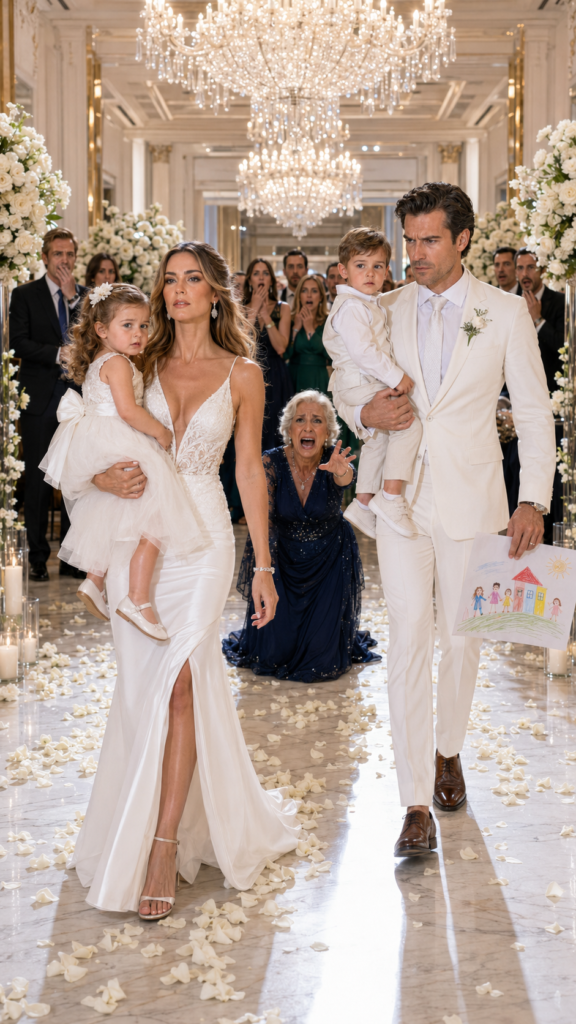
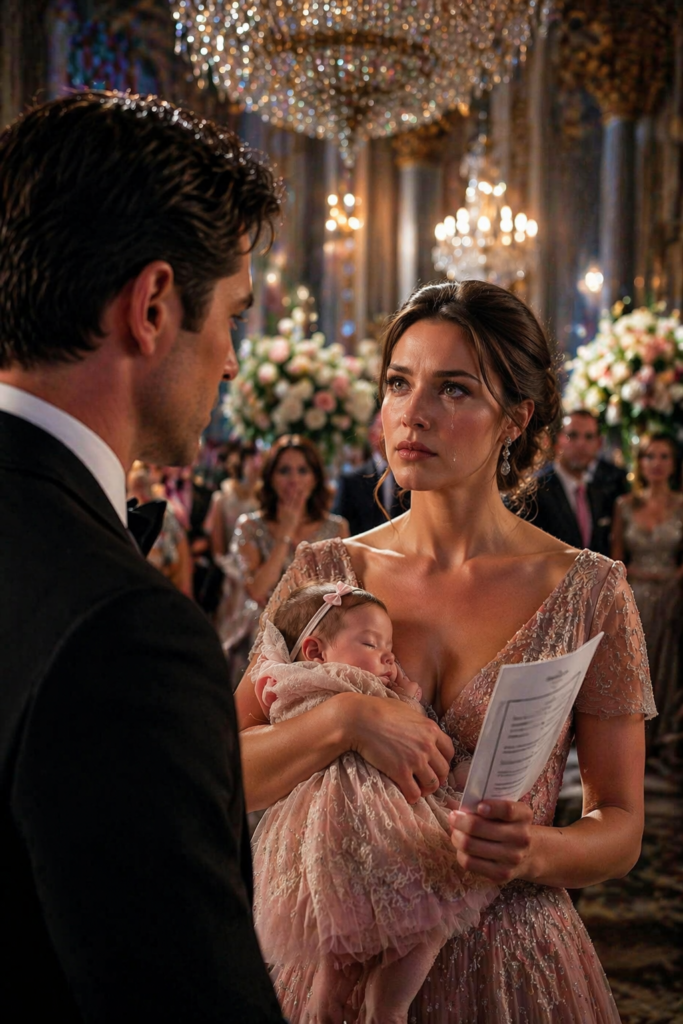
Andrea stood up. She didn’t shout. She didn’t cry. She just walked down the central aisle with her daughter in her arms and the black bag slung over her shoulder.
Every step sounded firm on the stone floor.
Sebastián clenched his jaw.
“Andrea, don’t do something stupid.”
She stopped in front of him.
“How curious,” she said. “You invited me to see me humiliated.”
Lucía raised the bouquet.
“Security, please. This woman is unhinged.”
Andrea opened the black bag.
“No, Lucía. You’ll be unhinged in two minutes.”
The cell phones began to rise.
Doña Ofelia wanted to advance, but one of Sebastián’s partners put a hand on her arm.
“Let her speak,” the man said. “We’re all here now.”
Andrea took out the first envelope.
“Paternity test. Sebastián Arriaga is the biological father of this girl. She was conceived before the divorce, when he was still married to me.”
The hall erupted in murmurs.
Sebastián looked at the document as if it were a gun pointed at his chest.
“That’s impossible,” he whispered.
Andrea held the baby closer.
“The impossible was your ego fitting through that door, and look, here it is.”
Lucía took a step back.
“She could be anyone’s,” she said, her voice trembling. “This woman always wanted to take your money.”
Andrea took out another document.
“That’s why there are two studies. One non-invasive prenatal, conducted in Lomas de Chapultepec, and another confirmed after birth with chain of custody. Both say the same thing.”
The judge received the papers. His face hardened as he read.
Sebastián didn’t move. For the first time since Andrea knew him, he seemed to have no answer.
Doña Ofelia approached the baby slowly.
“It can’t be,” she murmured. “She has my mother’s mouth.”
Andrea looked at her.
“She also has the right not to be insulted before she learns to speak.”
Doña Ofelia lowered her eyes.
But Andrea wasn’t finished.
She took out several stapled pages, highlighted.
“These are transactions from Arriaga Developments’ corporate account. Payments to aesthetic clinics, jewelry stores, trips to Los Cabos, apartment rentals in Santa Fe, and deposits to a personal account of Lucía Maldonado.”
One of the senior partners stood up.
“Sebastián, what the hell is this?”
Sebastián blinked, confused.
“Lucía handled some administrative payments, but…”
“But you authorized them,” Andrea interrupted. “With your digital signature. With your password. With the token you gave her while telling me I was a burden.”
Lucía clenched the bouquet until the stems bent.
“That doesn’t prove anything.”
Andrea took out the card from the floral arrangement and lifted it for everyone.
“You sent me this bouquet after I lost a pregnancy. You paid for it with Sebastián’s corporate card. The invoice is here.”
The crowd went silent.
Even the mariachis stopped playing.
The phrase on the card passed from hand to hand among the guests. Several women looked at Lucía with disgust.
Doña Ofelia clutched her chest.
“You knew my daughter-in-law was suffering…”
Andrea turned to her.
“She wasn’t your daughter-in-law to you. She was the barren one, remember?”
The lady was left breathless.
Sebastián closed his eyes.
He seemed to want to disappear into his expensive suit.
But the biggest blow hadn’t arrived yet.
Andrea took out a gray envelope.
“And since everyone came to celebrate the supposed Arriaga heir, it’s worth clarifying something.”
Lucía paled.
“Don’t you dare.”
Andrea ignored her.
“The ultrasound Lucía presented isn’t hers. It belongs to a woman from León. The image was bought in a private group and modified with her details.”
Sebastián turned slowly to Lucía.
“What?”
Lucía opened her mouth, but no words came out.
Andrea placed on the table copies of the original ultrasound, the messages, the payment proof, and a screenshot where Lucía requested “one of 9 weeks, make it believable.”
The hall turned into a boiling pot.
“You’re not pregnant?” asked Sebastián.
Lucía tried to cry. Only her chin trembled.
“I was going to fix it,” she said. “I needed time.”
“How were you going to fix it?” he asked, his voice breaking.
Andrea answered first.
“By marrying quickly, entering the family trust, and taking shares before the audit discovered the embezzlements.”
The senior partner reviewed the documents with a red face.
“There are at least 14 million pesos mismanaged here.”
Sebastián took a step towards Lucía.
“You used me.”
Lucía let out a bitter laugh.
“And you didn’t use Andrea? You threw her away when you thought she was of no use. Don’t play the saint, Sebastián. I just learned from you.”
That phrase left the hall frozen.
Because it was cruel.
But it was also true.
Andrea felt something heavy break inside her. It wasn’t joy. It wasn’t revenge. It was a deep sadness for having loved such an empty man.
Sebastián turned to her.
“Andrea, I didn’t know about the baby.”
She looked at him without hatred.
That destroyed him even more.
“You didn’t know because you didn’t want to know. Because when the doctor said there were still possibilities, you were already playing prince with your assistant. Because you preferred to call me useless rather than retake your own tests.”
Sebastián swallowed.
“Let me hold her. Just once.”
Andrea stepped back.
“No.”
The word was dry.
The man who had commanded houses, employees, and bank accounts couldn’t cross that small boundary.
“She’s my daughter,” he said, almost pleading.
“She’s a girl,” Andrea replied. “Not a trophy to wash away your guilt.”
Doña Ofelia started to cry.
“Andrea, forgive me. I was unfair. I was a proud old woman, truly I was.”
Andrea looked at her with fatigue.
“You weren’t unfair. You were cruel. And cruelty doesn’t erase because now the blood suits you.”
The judge suspended the ceremony.
The guests spoke loudly. Some kept recording. Others went out to the garden, pretending urgent calls to spread the gossip first.
Lucía tried to leave through a side door, but two hacienda guards stopped her at the partners’ request.
They didn’t touch her further.
They just blocked her path.
“This is abuse,” she screamed.
The senior partner raised the phone.
“Abuse was looting the company. The lawyer’s on his way.”
Sebastián sat in the front row.
His boutonniere was crooked, his eyes red, and his gaze lost. In a matter of minutes, he went from a millionaire groom to a man exposed in front of all high society Mexico.
Andrea closed the black bag.
She no longer needed to say more.
She walked to the exit with the baby in her arms.
No one dared stop her.
Outside, the San Miguel air smelled of wet earth and fresh flowers. Doña Ofelia followed her to the patio.
“She’s my granddaughter,” she said, broken. “Don’t take her from me.”
Andrea stopped by the SUV.
“No one takes what you never cared for. If you ever want to meet her, it’ll be with respect, therapy, and a judge’s permission. Not with tears from a canceled wedding.”
Doña Ofelia covered her mouth.
Andrea got into the SUV.
As the driver started, the cell phone began to vibrate incessantly.
Videos.
Messages.
Improvised headlines.
“EX-WIFE ARRIVES WITH BABY AND DNA AT BUSINESSMAN’S WEDDING.”
“BRIDE FAKES PREGNANCY TO ENTER MILLIONAIRE FAMILY.”
“SHE WAS CALLED BARREN, AND IT TURNED OUT HE HAD A DAUGHTER.”
Andrea turned off the phone.
She didn’t want fame.
She wanted silence.
She wanted to sleep without fear.
She wanted her daughter to grow up far from a family that confused surname with right.
The following weeks were an earthquake.
Arriaga Developments opened a formal audit. Lucía was charged with fraud, forgery, and disloyal administration. Payments surfaced to surgeons, apartments, jewelry stores, and trips that Sebastián had authorized without reading, just because she smiled and said “my love” softly.
But Sebastián didn’t come out clean either.
His partners removed him from the general management.
The social press turned him into a meme.
The same friends who toasted with him stopped answering his calls.
Doña Ofelia sold two antique watches to pay lawyers and started therapy, pushed by shame more than humility.
Lucía tried to sell interviews saying Andrea was a resentful ex.
But when the emails, the fake ultrasound, and the card sent after the loss leaked, even the gossip shows stopped calling her.
The family court hearing came two months later.
Sebastián entered the courtroom without an expensive suit, with dark circles and hands in his pockets. Andrea arrived with her daughter, her lawyer, and Doña Graciela.
The judge recognized paternity.
Ordered provisional support, supervised visits, parental therapy, and a restraining order outside authorized hours.
Sebastián cried silently.
“I want to fix this,” he said.
Andrea adjusted the baby’s blanket.
“Some things don’t get fixed, Sebastián. You just stop causing more harm.”
He lowered his head.
Months later, the baby turned six months old.
Andrea held a simple meal at Doña Graciela’s house in Colonia Del Valle. There was pozole, mosaic gelatin, vanilla cake, and balloons taped to the wall.
No luxuries.
No heavy surnames.
No people recording.
Just peace.
Doña Ofelia sent a knitted blanket and a long letter. Andrea stored it unopened in a drawer.
Maybe one day she’d read it.
Maybe not.
Sebastián sent white flowers.
Andrea returned them.
Not out of revenge.
Out of memory.
That night, when the city quieted down, Andrea held her daughter by the window. A tamale vendor passed shouting in the street, and the baby smiled as if the world were simple.
Andrea understood that the victory wasn’t destroying a wedding.
Or exposing Lucía.
Or watching Sebastián fall in front of everyone.
The real victory was that her daughter would never have to learn that love is begged, that family is tolerated even if it humiliates, or that a woman is worth less for not meeting a man’s whims.
Sebastián invited a broken ex-wife to flaunt his happiness.
But a broken woman didn’t arrive at that hacienda.
A mother did.
And when a mother understands her worth, not even the heaviest surname in the country can make her kneel again.