PART 1
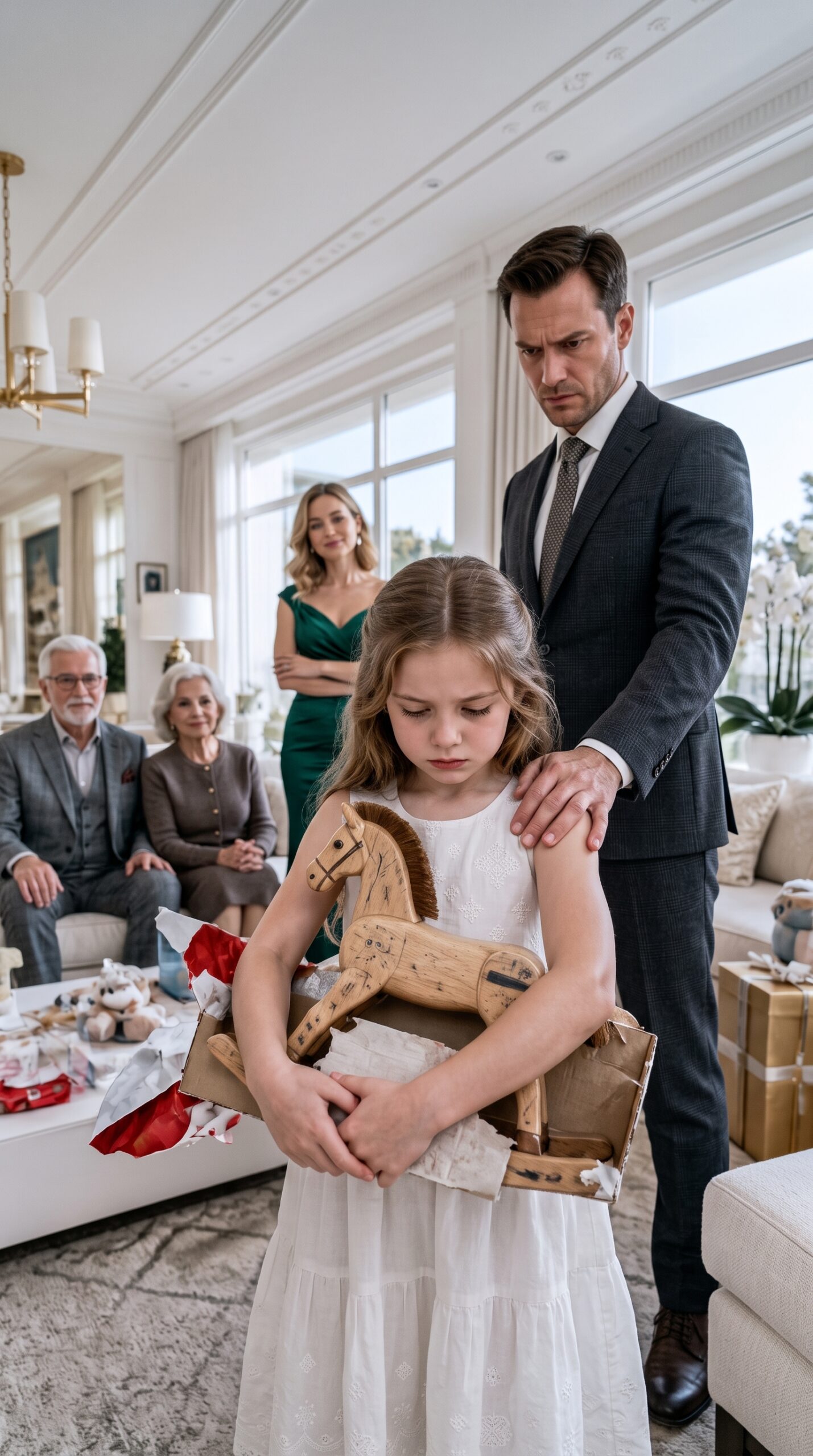
"Give that broken doll to Sofía. After all, that girl doesn’t count."
Don Armando Cárdenas said it right in the middle of the New Year’s meal, seated at the head of the dining room table as if he still owned the world.
The family room of the elegant house in a gated community in San Pedro Garza García fell silent.
Sofía, who was just 8 years old, stood next to the nativity scene still set up in the corner. She wore a light blue dress, white shoes, and a tiara she had chosen herself because she wanted to look "like a princess" in front of her grandparents.
In her hands, she held a tattered doll, with hair cut haphazardly, one arm taped on, and a dress stained with marker.
It had been wrapped in a supermarket bag.
Around her, Mariela’s children, Julián’s older sister, tore open enormous gifts: an electric bike, new cell phones, designer sneakers, tablets, imported backpacks, and even a console that Don Armando boasted about as if he had bought half of Palacio de Hierro.
Sofía received a broken doll.
Doña Leonor, her grandmother, pretended to adjust the cutlery. She said nothing. Mariela barely smiled, one of those smiles that are silent but cut deep.
"The good gifts are for the grandchildren who will continue the family," Don Armando added, raising his glass. "Not for the daughter of a divorce."
Sofía looked at Julián.
She didn’t cry at first. She just blinked several times, as if trying to understand when she had done something wrong.
Julián felt the blood rush to his face.
For years, he had endured comments like this. That Sofía was too shy. That a girl didn’t carry the surname "the right way." That he was a bad son for separating from his daughter’s mother. That he should be grateful they still let him work at Transportes Cárdenas.
But everyone knew the truth.
Julián was the one who arrived before anyone else at the office. He solved problems with suppliers, extinguished fights with clients, fixed erroneous invoices, and salvaged contracts that his father ruined with shouting.
Don Armando only signed.
Mariela took the applause.
And Sofía paid the price.
The girl clutched the doll to her chest.
"Dad... is my good gift hidden?" she asked softly.
That question shattered his soul.
Julián knelt in front of her.
"No, my love. It’s not hidden."
Then Sofía cried.
It wasn’t a loud cry. It was worse. It was a small, contained sob, the kind children make when they learn their pain makes others uncomfortable.
Uncle Ricardo, Julián’s younger brother, stood up furiously.
"Are you seriously going to humiliate a girl on New Year’s? What’s wrong with you?"
Don Armando slammed the table.
"You shut up. I’m in charge here."
Julián took Sofía’s hand and led her to the hallway. The girl continued to clutch the broken doll, as if letting it go would mean accepting that she was worth nothing.
Twenty minutes later, Julián returned alone.
He walked to the tree, picked up two elegant boxes he had brought for his parents, and pulled out an expensive watch and a designer handbag.
Everyone stared at him.
"What are you doing?" Don Armando roared.
Julián took a deep breath.
"I brought another New Year’s gift."
The room froze.
"I quit Transportes Cárdenas. Effective immediately."
No one imagined that this phrase would shatter much more than a family meal.
PART 2
At first, Don Armando laughed.
Not because he found it funny, but because he didn’t know how to react to someone challenging him.
"Tomorrow you’ll get over your anger. I want to see you in the office at 7. We have a meeting with the folks from Saltillo."
"I’m not going tomorrow," Julián replied. "Or the day after. Or ever."
Doña Leonor placed her hand on her chest.
"After everything we’ve done for you, this is how you repay us?"
Julián let out a bitter laugh.
"Everything you did for me? You used me. You made me carry a company you boasted about as if it ran itself. And you even let my daughter be treated worse than the family dog."
Mariela clicked her tongue.
"Oh, there you go with your drama. You always hated that my kids were the favorites."
Julián stared at her.
"Your kids aren’t to blame. You are. You saw Sofía cry and you liked it."
Mariela lowered her gaze.
Not out of shame.
Out of fear that someone else had noticed it too.
Ricardo appeared from the hallway with Sofía wrapped in a blanket.
"I’m taking her to the playroom. It smells like pure hypocrisy down here."
No one responded.
That night, Julián drove to his apartment in the Narvarte neighborhood of Mexico City. Sofía fell asleep in the back seat clutching the broken doll.
Julián looked at her in the rearview mirror and felt something that was no longer anger.
It was resolve.
When he laid her down, he opened his laptop and sent his formal resignation.
But what no one knew was that this resignation didn’t originate that night.
He had been preparing it for a year.
While his family treated him like an invisible employee, Julián had taken courses in logistics, management, and finance. He had talked to clients who trusted him, not the Cárdenas name. He had sought investors in Monterrey and Querétaro.
And, above all, he had created a new company: Ruta Norte.
A small, clean firm, without bribes, without disguised invoices, without shouting, and without humiliating anyone for their surname.
The first investment came from Elisa Aguirre, a businesswoman from Monterrey who had watched for years as Julián salvaged impossible deliveries while his father only gave orders from a leather chair.
In January, they signed four contracts.
By February, they had thirteen.
By March, several long-time clients of Transportes Cárdenas began calling Julián directly.
"Look, buddy," said Don Ramiro, owner of a chain of hardware stores, "we can’t work with your dad anymore. We always knew you were the one getting the job done."
Julián didn’t steal clients.
He just let them choose.
And they chose.
For weeks, his family didn’t look for him. They thought he would come crawling back when the money ran out. Don Armando even said at a meal that Julián "couldn’t last a month without the Cárdenas surname."
But by the end of March, an invitation arrived.
"Family dinner. Urgent to talk."
It didn’t say "sorry."
It didn’t mention Sofía.
Julián went alone.
Doña Leonor opened the door dressed as if she were receiving a senator. Don Armando was in the dining room with a glass of whiskey. Mariela kept fiddling with her pearl necklace.
After thirty minutes of false conversation, Don Armando spoke.
"We offer you to come back as a partner. 25% of shares and operational leadership. Enough of the tantrums."
Julián didn’t blink.
"Tantrum?"
"It was an unfortunate joke," Doña Leonor intervened. "No one wanted to hurt the little girl."
"She has a name," Julián said. "Her name is Sofía."
The silence weighed heavily.
Julián pulled out an envelope and placed it on the table.
"I have a proposal too."
Don Armando opened it expecting an apology or a condition to return.
Instead, he found a formal offer to buy part of Transportes Cárdenas, accompanied by a preliminary audit.
His expression changed.
"Who gave you this?"
"The truth always leaves receipts," Julián replied.
There it was: unreported cash payments, inflated contracts, fuel charged to non-existent units, duplicate invoices, and hidden personal loans disguised as operating expenses.
Doña Leonor turned pale.
Mariela tried to snatch the papers, but Ricardo, who had just arrived unannounced, stopped her at the door.
"Don’t tear them up, sister. There are copies."
Don Armando stood up furiously.
"Ungrateful! That company fed you!"
"No," Julián said. "That company feasted on me for years."
At that moment, Don Armando's phone rang.
On the screen appeared: "Accountant Estela."
He rejected the call.
But it was too late.
Two days later, Estela called Julián in tears. She had worked with the family for 22 years, and Don Armando wanted to blame her for the embezzlement.
"Attorney, I can’t take it anymore. They want to use me as a scapegoat."
Julián met her in his office.
Estela arrived with a box of files, printed emails, and a USB drive.
Then came the first brutal twist.
Mariela not only knew about the strange movements.
She had used company money to pay for trips, tuition, cosmetic surgeries, and even her twins' birthday party.
While Sofía was given a broken doll, Mariela had bought two electric scooters charged to a supplier account.
Julián felt disgust.
But the worst was yet to come.
That same week, Sofía’s school called him urgently.
Mariela had tried to take the girl away saying she had family authorization. She had a driver and a bag with clothes.
"She said you were sick and that the grandparents would take care of Sofía for a few days," the principal explained.
Julián arrived with his lawyer in under forty minutes.
From that day on, he made it clear that only he and Ricardo could pick up the girl.
When Sofía found out, she asked in a voice that didn’t sound like it belonged to an 8-year-old:
"Did my aunt want to take me because now she really loves me?"
Julián swallowed hard.
"Love isn’t shown by scaring someone."
Sofía lowered her gaze.
"Then I don’t want to go."
The war ceased to be about business.
Now it was about protection.
In April, the SAT (Tax Administration Service) initiated a formal audit against Transportes Cárdenas. Banks froze credit lines. Major clients canceled contracts. Several operators resigned and joined Ruta Norte.
Not because Julián called them.
They came on their own.
"Over there, you don’t work, boss. You just survive," said a yard coordinator.
Estela came in as accounting director. Ricardo became operational partner. Elisa Aguirre increased her investment after seeing the numbers.
In less than five months, Ruta Norte went from a small office to occupying two floors in a building in Santa Fe.
Meanwhile, Don Armando began selling trucks.
Doña Leonor stopped going to brunches with her friends.
Mariela posted indirect comments on Facebook:
"There are children who bite the hand that fed them everything."
"God sees family betrayals."
But the true betrayal still hadn’t fully emerged.
Mariela’s husband, Óscar, asked to meet Julián at a café.
He arrived looking haggard.
"I’m getting a divorce," he said. "I reviewed the accounts. Mariela opened cards in my name and used money from your company to maintain a lifestyle we couldn’t afford. And what she did to Sofía… that embarrassed me. My kids were learning that mocking a girl was normal."
Julián didn’t feel joy.
He felt exhaustion.
Because there are families where cruelty doesn’t explode overnight. It’s inherited, applauded, and disguised as tradition.
By the end of May, Don Armando requested to see him.
He arrived at the Ruta Norte office accompanied by Doña Leonor. He no longer appeared to be the invincible patriarch. He walked slower, spoke softer, and avoided looking at the pictures of Sofía that Julián had on his desk.
He placed a folder on the table.
"We’re ready to sell."
Transportes Cárdenas was practically bankrupt. It owed taxes, payroll, loans, gasoline, and fines. Its reputation was destroyed.
Julián reviewed everything in silence.
"I’m not going to buy the company to save you," he finally said. "I’m buying what’s useful to save jobs and clean up what you soiled."
Doña Leonor cried.
"We deserve it, don’t we?"
Julián didn’t answer immediately.
"You deserve to live with the consequences. That’s not the same as wishing ruin upon you."
The purchase was signed in June.
Transportes Cárdenas disappeared as an independent company. Its assets passed to Ruta Norte. Don Armando and Doña Leonor received just enough to pay debts and move to a modest house in Querétaro.
They were not left on the street.
But they were no longer on the throne.
After signing, Don Armando extended his hand.
"Thank you," he murmured. "I know you didn’t do it for me."
Julián shook his hand.
"No. I did it in spite of you."
Days later, Doña Leonor sent an envelope for Sofía.
Julián showed it to her without pressuring her.
Inside was a pink card with a hand-drawn doll.
"I’m sorry for not defending you. It wasn’t your fault. With love, Grandma."
Sofía read it twice.
"Do I have to see her?"
"No," Julián replied. "No one who has hurt you has the right to enter your life just because they repented late."
The girl thought for a few seconds.
"Then maybe later. But not now."
"As you wish, my love."
In July, Sofía had a school presentation. She read a text about family.
At first, her voice trembled.
Then it became clear.
"A family is not one that gives you expensive gifts," she read, "it’s the one that doesn’t laugh when you’re hurting."
Julián, Ricardo, Estela, and Elisa applauded standing up.
Near the exit were Don Armando and Doña Leonor. They didn’t approach. They didn’t interrupt. They just watched from a distance.
Sofía saw them, but she didn’t run towards them.
She simply took her father’s hand.
"Today I counted, right?"
Julián knelt in front of her.
"You always counted. They were the ones who couldn’t see it."
That night, Sofía left the broken doll in a box.
Not out of sadness.
But because she no longer needed to carry what others gave her to make her feel less.
Sometimes, cutting ties with family isn’t revenge.
Sometimes it’s the first time someone truly protects the one they love the most.