PART 1
When Mauricio Valdés handed a white apron to his mother, he couldn’t even bear to look her in the eyes.
They stood at the entrance of his mansion in Lomas de Chapultepec, surrounded by private guards, luxury SUVs parked outside, and a garden so perfect it looked like it belonged in a magazine.
—Today you’re not my mom, Doña Rosa —he said quietly—. Today you’re the lady who helps in the kitchen. Please don’t ruin dinner for me.
Rosa Martínez clenched the apron between her tired fingers.
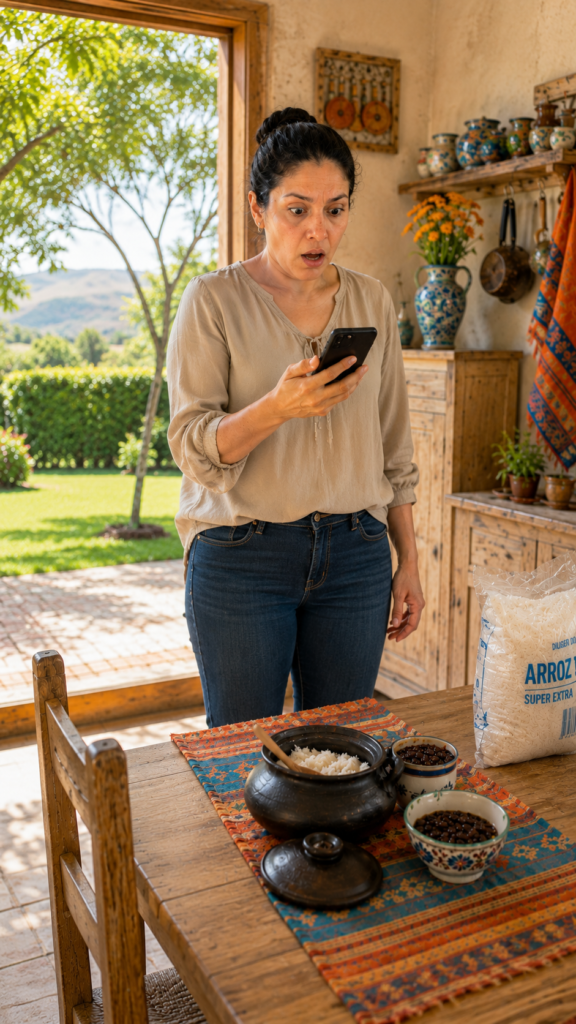
She was 63, wearing simple sandals, her hair tied back with a black scrunchie, and her hands marked by years of selling tamales outside the Chabacano Metro station.
Those very hands had paid for uniforms, medicine, overdue tuition, and even Mauricio's first suit.
But that night, for her only son, those hands were a source of shame.
—You told me you wanted me to meet your fiancée's family —Rosa whispered.
Mauricio glanced toward the living room, nervous.
—Yeah, but everything got complicated. Natalia's parents are very important people. Her dad is going to invest in my company. I can’t show up as the son of a tamale vendor.
The word hit like a slap.
Rosa felt her throat tighten.
For years, she had woken up at 3 AM to grind masa, prepare green salsa, wrap corn husks, and venture out with a huge pot on an old dolly.
While others slept, she worked.
As Mauricio grew, she shrank, so he could feel big.
—And what did you tell them about me? —she asked.
Mauricio swallowed hard.
—that my mom died when I was a child.
Rosa didn’t cry.
She didn’t scream.
She simply lowered her gaze.
Some pains are silent because they fracture you from within.
At that moment, Natalia, the fiancée, appeared. She was elegantly dressed in a champagne-colored gown and wore a kind smile.
—Honey, my parents are arriving in 15 minutes.
Then she saw Rosa.
—Good evening, ma’am.
Mauricio stepped forward.
—This is Rosita; she’ll help out in the kitchen tonight.
Rosita.
Not mom.
Not my mother.
Just Rosita.
Natalia smiled politely and gestured to the hallway. She didn’t know anything. The disdain didn’t come from her.
Rosa put on the apron and entered the kitchen.
The cook, Lupita, looked at her strangely.
—Do you actually work here, ma’am?
Rosa washed her hands in the marble sink.
—Today it seems like I do, chica.
Lupita understood that there was a wound behind that phrase and didn’t ask further.
Dinner began with soft music, expensive glasses, and dishes Rosa couldn’t pronounce.
Mauricio talked about projects, buildings, investments, trips to Miami, and million-dollar contracts.
He said three times that he made it all on his own.
Rosa served in silence.
When she placed a dish in front of Don Ernesto Cárdenas, Natalia's father, he stared at her hands.
He had a serious face, gray hair, and the presence of a man accustomed to commanding.
But when he saw the thick scar near Rosa’s left thumb, his expression changed.
As if an old memory had struck him in the chest.
Mauricio noticed.
—Rosita, please serve properly. We’re not in a diner.
Natalia frowned.
—Mauricio, don’t talk to her like that.
He let out a fake laugh.
—It's just that if you give them too much trust, they take advantage, babe.
Rosa felt her face burning.
Don Ernesto set down his fork on the table.
—Excuse me, ma’am… what’s your name?
Mauricio quickly replied.
—Rosita, I told you.
Don Ernesto didn’t look at him.
—I asked her.
Rosa raised her gaze.
—Rosa Martínez, sir.
Ernesto’s face turned pale.
—Rosa Martínez… from the Doctores neighborhood?
Silence fell over the table.
Mauricio stiffened.
—It’s probably just a coincidence, Don Ernesto. There are many Rosas.
The man stood up slowly.
—Did you have a stall selling tamales near the Hospital General years ago?
Rosa felt a chill.
—Yes, sir.
Don Ernesto looked again at her scar.
His eyes filled with tears.
Natalia stood up, confused.
—Dad, what’s wrong?
Ernesto walked toward Rosa, shaking.
Mauricio tried to stop him.
—Don Ernesto, she’s working; it’s not necessary...
—Shut up —Ernesto said, not raising his voice.
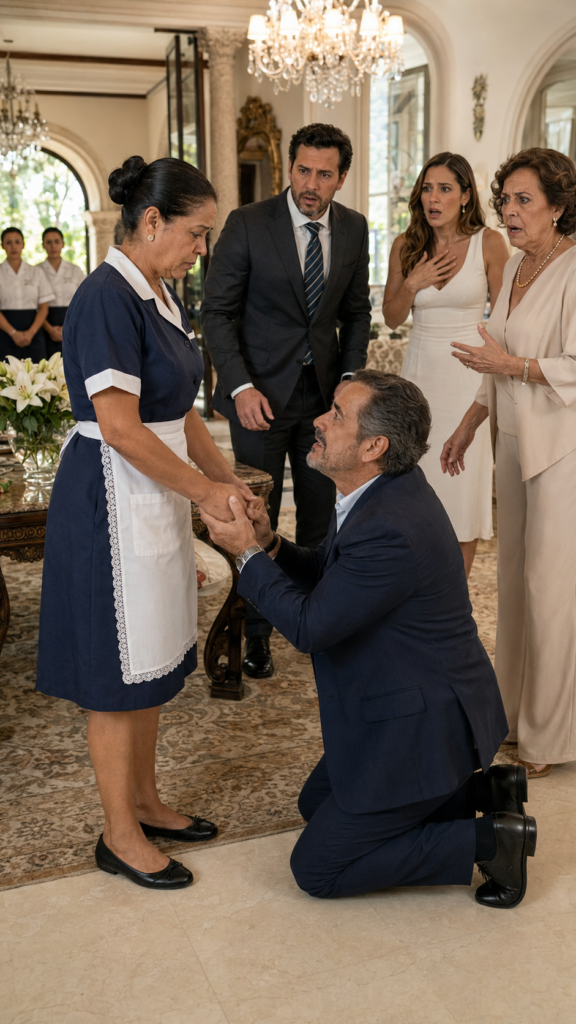
And then, in front of everyone, the most powerful man at the table knelt before Rosa.
He took her hands as if touching something sacred.
—My God… it’s you.
Rosa didn’t understand.
Natalia covered her mouth.
Ernesto’s wife, Doña Carmen, began to cry, not knowing why.
Ernesto’s voice broke as he spoke.
—This woman saved my life. And she also saved my daughter’s life.
Then he looked at Mauricio with a cold rage.
—Now tell me, boy… why is your own mother dressed as a maid in your house?
PART 2
Don Ernesto’s question left the mansion colder than any winter night in Mexico City.
Mauricio didn’t know what to say.
The confidence of a successful businessman faded away, along with the fake accent, the magazine smile, and even the posture of an important man.
Natalia looked at him as if she had just met a stranger.
—Mauricio… is she your mom?
He opened his mouth, but nothing came out.
Rosa tried to pull her hands away.
—Please, sir, get up. Don’t do this.
Don Ernesto shook his head.
—I have to do this. I should have done it 25 years ago.
Doña Carmen approached, pale.
—Ernesto, explain.
He took a deep breath.
—It was on the Tlalpan highway. Natalia was four years old. We were coming from the hospital after she had some tests done. A minibus lost its brakes, crashed into several cars, and ours got crushed. I was trapped, Carmen was unconscious, and Natalia was crying in the back seat.
Natalia started to cry.
—I don’t remember that...
—Because you were very small —Ernesto said—. But I remember everything. I remember the smell of gasoline. I remember people screaming. I remember that no one approached because the car could catch fire.
He looked at Rosa.
—And I remember this woman running through the smoke with a shawl over her face. She broke the glass with a stone, cut her hand, and pulled Natalia out first. Then she came back for me.
Everyone looked at Rosa’s scar.
She lowered her head.
—I only did what anyone would have done.
—No —Ernesto replied—. Not anyone did it. You did.
Rosa swallowed hard.
—I had to leave quickly. My son was waiting alone in the room we rented. I didn’t want him to be scared.
That phrase fell like another sentence.
She had saved an unknown child, an unknown man, and still returned running because her boy was hungry.
Natalia turned to Mauricio.
—Is she your mother?
Mauricio closed his eyes.
—Yes.
Doña Carmen let out a groan of indignation.
—And you told us she was dead?
Natalia took a step back.
—You told me your mom died when you were six.
Mauricio panicked.
—I was going to explain everything later. Seriously, I was under pressure. You don’t understand how this world works.
Rosa looked at him with deep sadness.
—I don’t understand your world either, son. In mine, a mother doesn’t bury herself alive to please rich people.
He ran his hand through his hair.
—Mom, please, don’t make a scene.
—It’s not a scene —Natalia said, her voice breaking—. It’s disgust.
Mauricio turned to her.
—Natalia, don’t exaggerate. It was just for tonight.
Rosa raised her face.
—No, Mauricio. It wasn’t just for tonight.
The room fell silent.
Lupita, from the kitchen, wiped her tears with her apron.
Rosa took a deep breath.
—It was also when you didn’t invite me to your graduation from Tec because, according to you, they only gave out two tickets. Then I saw photos where you took your partner’s mother.
Mauricio lowered his gaze.
—It was when you bought your first apartment in Santa Fe and told your neighbors that I was the lady who did the cleaning.
Natalia’s eyes widened in horror.
—It was when you asked me not to go to the opening of your office because investors were coming. It was when you sent me money by transfer but never came to eat with me because my house smelled of comal and salsa.
Mauricio clenched his fists.
—I helped you.
—No, son. You paid me to stay away.
The phrase left him defenseless.
Don Ernesto slowly stood up.
—Mauricio, six months ago you came to me to invest 80 million pesos in your new development in Querétaro. You talked to me about values, family, effort, and roots.
He let out a dry laugh.
—What a damned thing to use those words while hiding the woman who raised you.
Mauricio paled.
—Don Ernesto, let’s not mix personal and business.
—Business is done with numbers —Ernesto replied—, but also with character. And tonight I met yours.
Natalia took off her engagement ring.
Mauricio stepped toward her.
—No, babe. Don’t do that. All this can be fixed.
She held the ring between her fingers.
—Fix it? How do you fix discovering that the man I was going to marry asked his mom to pretend to be a maid?
—I wanted to give you a better life.
—No. You wanted a life where no one knew where you came from.
Natalia placed the ring on the table.
The sound was small, but to Mauricio, it sounded like a collapse.
—It’s over.
He started breathing rapidly.
—You’re leaving me for this?
—I’m not leaving you for being poor, Mauricio. I’m leaving you for being a coward.
Doña Carmen hugged her daughter.
Rosa felt pain for Natalia but also a strange calm. For the first time, someone was saying aloud what she had kept silent for years.
Then Don Ernesto pulled out his cellphone.
—And there’s something more.
Mauricio tensed up.
—What thing?
Ernesto looked at Rosa.
—Mrs. Rosa, I’m sorry to say this here, but I believe you have the right to know.
Rosa felt her heart leap.
—Know what?
—My lawyers reviewed Mauricio’s project. There are plots with weird documents. One of them is transferred from a property in Iztapalapa… in the name of Rosa Martínez.
Rosa froze.
—My land?
Mauricio closed his eyes.
There was the answer.
Rosa remembered when her son came four months earlier with some papers. He told her he needed her signature to “protect” a small plot she had inherited from her mother.
She signed.
Because she still trusted him.
—What did you do, Mauricio? —she asked.
He tried to approach.
—Mom, I was going to compensate you. That land was abandoned.
Rosa felt something inside her shatter completely.
—It wasn’t abandoned. I told you I wanted to set up a community kitchen there for women who needed work.
Mauricio let out a phrase that finished sinking him.
—It was a small dream.
Rosa looked at him with a firmness she had never shown before.
—Small was your heart when you decided to steal from your mother.
Natalia covered her mouth.
Doña Carmen murmured:
—Holy God.
Don Ernesto put away his cellphone.
—Tomorrow my lawyers will review everything. If there was fraud, there will be a complaint. And, of course, there will be no investment.
Mauricio lost color.
—That destroys me.
—No —Ernesto said—. You destroyed yourself. It’s just that today we all saw it.
Mauricio turned to Rosa, desperate.
—Mom, say something. Help me. I’m your son.
She felt the impact of that word.
Son.
The same word she had defended all her life.
But a mother’s love cannot be a carpet for a son to clean his lies.
—Yes, you are my son —Rosa said—. That’s why it hurt more. But I won’t lie for you.
Mauricio began to cry.
Not as a businessman.
Not as a millionaire.
As a scared child facing the consequences.
Dinner ended without a toast, without a commitment, and without a contract.
Rosa took off the white apron, folded it carefully, and left it in front of Mauricio.
—This is yours. I’ve already carried too much shame that didn’t belong to me.
Natalia approached Rosa and hugged her.
—I’m sorry for not knowing who you were.
Rosa caressed her back.
—Honey, a well-dressed lie can also deceive.
Don Ernesto offered to take her home, but Rosa preferred to go with Lupita. She wanted no armored SUVs or chauffeurs. She wanted silence.
In the following days, the news spread like wildfire.
Employees talked.
Partners asked.
Lawyers investigated.
In less than two weeks, Mauricio lost the 80 million investment, the project was halted, and more dubious signatures came to light.
His company began to fall.
The banks that once smiled at him started to collect.
The friends who called him “brother” stopped answering.
One rainy afternoon, Mauricio appeared at Rosa’s house in the Portales neighborhood.
He wasn’t wearing a suit.
He wasn’t wearing an expensive watch.
He had swollen eyes and a soul in pieces.
—Mom —he said from the doorway—. I lost almost everything.
Rosa was preparing coffee in a clay pot.
The smell of cinnamon filled the small kitchen.
—Come in before you get sick —she replied.
He stepped inside slowly, looking at the table where, as a child, he did homework while she counted coins.
He sat down.
—I was a scoundrel.
—Yes.
—I was ashamed of you.
—Me too.
—Do you hate me?
Rosa placed a cup in front of him.
—No. But I’m not going to destroy myself to save you from yourself.
Mauricio cried in silence.
—I don’t know who I am without money.
She sat down in front of him.
—Then learn. Because before wanting to be great, you should have learned to be decent.
Months later, the lawyers managed to return the land to Rosa’s name.
Mauricio had to face legal consequences for forgery and sell several properties to pay debts. Natalia never returned to him. Don Ernesto didn’t destroy him for revenge; he simply let the truth do its work.
But one day, Ernesto sought out Rosa.
—I want to help you with that community kitchen —he said.
Rosa initially refused.
—I don’t want charity.
—It’s not charity —he replied—. It’s gratitude turned into justice.
She accepted with one condition: there wouldn’t be a plaque with rich surnames.
The place would bear her mother’s name.
Lupita Martínez Community Kitchen.
On the day of the inauguration, women from Iztapalapa, Neza, Tláhuac, and Doctores arrived. Some wanted to learn to sell food. Others sought to escape homes where they were humiliated. Others just needed to hear that they could still start anew.
Natalia arrived with flowers.
Don Ernesto lingered in the back, discreet.
And Mauricio appeared too.
Not as the owner.
Not as an important guest.
He came carrying boxes of tomatoes and onions.
Wearing a simple shirt, without bodyguards, without arrogance.
Some people looked at him badly.
He lowered his head and kept working.
At the end of the day, Rosa found him sweeping the hall.
—Where do I put the broom, mom?
The word came out without shame.
Without calculation.
Without an audience to impress.
Rosa pointed to a corner.
—There, son.
He looked at her with tears.
—I didn’t deserve to have a living mother.
Rosa approached him.
—No one deserves a mother. You receive one. What you do with that love shows who you are.
Mauricio didn’t respond.
He just kept sweeping.
And for the first time in many years, he didn’t try to appear more than what he was.
That night, Rosa closed the community kitchen and looked at her new apron hanging on the wall.
It wasn’t white.
It was blue.
It had her name embroidered:
Rosa Martínez, founder.
She ran her fingers over the letters and smiled.
Her son wanted to hide her for a night to seem powerful.
But life brought down a millionaire before her to remind everyone of a well-known Mexican truth:
The saddest poverty isn’t in selling tamales, riding the Metro, or having cracked hands.
The saddest poverty is feeling ashamed of the roots that held you when you were nobody.
Because a tree that spits on its roots may look tall for a while.
But sooner or later, it falls on its own.