Scene 1 — The Request
The call came at 4:47 in the morning.
Eleanor Whitmore had not been sleeping. She had not truly slept in eleven days, not since they moved Charles to the palliative wing on the third floor of St. Augustine's, not since Dr. Pemberton had sat across from her in the family consultation room with his hands folded and his voice very careful and said the words she had known were coming for six months and still could not absorb. She had been sitting in the chair beside her husband's bed with a book open in her lap and the words completely opaque to her, watching the slow mechanical rise and fall of his chest, counting the seconds between breaths the way you count seconds between lightning and thunder, calibrating distance, calculating how much time remained.
When the nurse came to the door it was a young man she hadn't learned the name of yet, third-shift staff she'd only seen twice. He stood in the doorway with the posture of someone delivering difficult information and said, "Mrs. Whitmore? Your husband is asking to speak with you."
Eleanor set the book down carefully on the bedside table, spine up to hold her page though she couldn't have said what page she was on, and rose from the chair. Charles was awake. She hadn't seen him awake, truly awake and lucid, in four days. The morphine kept him mostly under, which Dr. Pemberton said was a mercy, which Eleanor privately agreed with and privately felt guilty for agreeing with.
"Eleanor," he said. His voice was the consistency of wet paper.
"I'm here." She sat on the edge of the bed and took his hand. His hands had always been large and capable, the hands of the architect he'd been for forty years, hands that had drafted plans for buildings still standing in this city, in four cities. Now they were liver-spotted and reduced, the skin loose over the knuckles. She held his hand the way you hold something that might break.
"I need to ask you something," he said.
"You can ask me anything." She had been saying this for eleven days and she had mostly meant it.
He looked at the ceiling for a long moment. The machines beeped their patient rhythms. Outside the window the car park was amber-lit and empty, and beyond it the city was dark except for the distant motorway where lorries moved like lit beads on a string at this hour.
"There's a nurse," he said. "Adaeze. She works days, mostly. Sometimes evenings."
Eleanor did not move. "All right."
"I want to see her. Before—" He stopped. Started again. "I need to see her. Will you ask them to call her? Will you arrange it?"
Eleanor looked at her husband's face. She had been looking at this face for forty-eight years. She knew it the way you know a landscape you have walked every day of your life — every change of light, every variation, every small shift in the weather of it. She knew the way his jaw set when he was afraid. She knew the way his eyes went distant when he was carrying something he hadn't told her.
His eyes were very distant now.
"Is there something you want to tell me first?" she said. Her voice was entirely steady. Her hands were entirely still. These were things she had learned over forty-eight years: how to keep her voice steady, how to keep her hands still, when everything else in her was not.
"No," he said. Then: "I'm sorry, Eleanor."
She looked at him for a long moment.
"I'll arrange it," she said.
Scene 2 — James
James arrived at half past seven, before the morning shift change, in the suit he'd worn to court the day before. He was a barrister, her eldest, and he carried the suit the way he carried everything — as if it were armor. Eleanor had already spoken to the ward manager. She had already asked them to contact the nurse called Adaeze.
"Mum." He kissed her cheek. His face was tight with the controlled grief she recognized from her own face in mirrors. "You should have called me earlier. You shouldn't be here alone all night."
"I'm fine." She handed him the paper cup of tea she'd made from the family room kettle. "Your father had a lucid period around five. He asked for someone."
James wrapped both hands around the cup. "Who?"
"A nurse. Adaeze Okafor. She works days."
Something moved across her son's face. It was very brief, a quarter-second, like a shadow crossing water. Eleanor had the eyes of a woman who had been watching faces closely for forty-eight years. She caught it.
"You know who that is," she said.
It wasn't a question.
James set the cup down on the windowsill. He looked out at the car park where the morning shift was arriving in ones and twos, nurses and orderlies in their dark coats. "Mum," he said.
"James."
"This isn't the time—"
"Your father is dying," Eleanor said. Her voice was very quiet. "If not now, when?"
He was quiet for a long time. She watched his profile. He had Charles's jaw, all three of her children had Charles's jaw, it was the thing you noticed first about the Whitmore children, that jaw, that particular set of it.
"I don't know the whole story," he said finally. "Dad mentioned her, once. Years ago. After a few drinks at Christmas. He was — it wasn't coherent. I thought I'd misunderstood."
"What did he say?"
James turned from the window. His face was the face of a man who had spent his professional life learning to deliver information without flinching and was finding the skill insufficient this morning. "He said there was a woman. Someone he'd known. He said it had ended before you got married. That there was—" He stopped.
"A child," Eleanor said.
James closed his eyes.
"I've known for thirty years," Eleanor said. It was the first time she had said it out loud to anyone. The words felt strange in her mouth, after so long, like furniture moved to different places in a familiar room. "Not who. Not exactly. But I knew."
"Mum—"
"He sent money," she said. "For years. I did the household accounts. I noticed the withdrawals. I asked him once and he said it was a debt from before we were married that he was settling, and I knew that was a lie and I let it be a lie because we had three small children and a mortgage and I didn't—" She stopped. "I didn't want to know."
The morning light was coming through the window now, thin and grey. Down the corridor someone was moving a trolley, the wheels squeaking on linoleum. Eleanor's hands were in her lap, absolutely still.
"He's dying," she said. "And he wants to see her. And I want to know who she is." She looked at her son. "So I asked them to call her."
Scene 3 — The Ward
The morning shift change happened at eight. Eleanor sat in the chair beside her husband's bed while he slept and listened to the sounds of the ward reshaping itself — voices at the nurses' station, the squeak of shoes on the floor, the rattle of medication trolleys, the particular institutional sounds she had memorized over eleven days until they had become a kind of wallpaper, unremarkable, constant.
She had the book in her lap again. She turned pages at intervals. She did not read a single word.
At twenty past eight James came back with two coffees from the machine in the lobby. He handed her one and sat in the second chair without speaking. They were good at this, the two of them, at sitting in proximity without filling it. She'd always thought James was most like her in that particular way, the capacity for companionable silence. Caroline and David needed words, needed the air between people filled with something. James could sit in a room with her for an hour and it would feel like enough.
Charles slept. His breathing was the slow effortful breathing of a man for whom breathing had become work.
At five minutes to nine, Eleanor heard the ward door.
She did not look up immediately. She heard footsteps — a particular quick, efficient cadence she hadn't heard before — and then a voice at the nurses' station, low and warm, and then a pause. She heard the ward manager's voice saying, "Room seven, he's been asking for you, his wife is with him."
Eleanor set the book down on the bedside table.
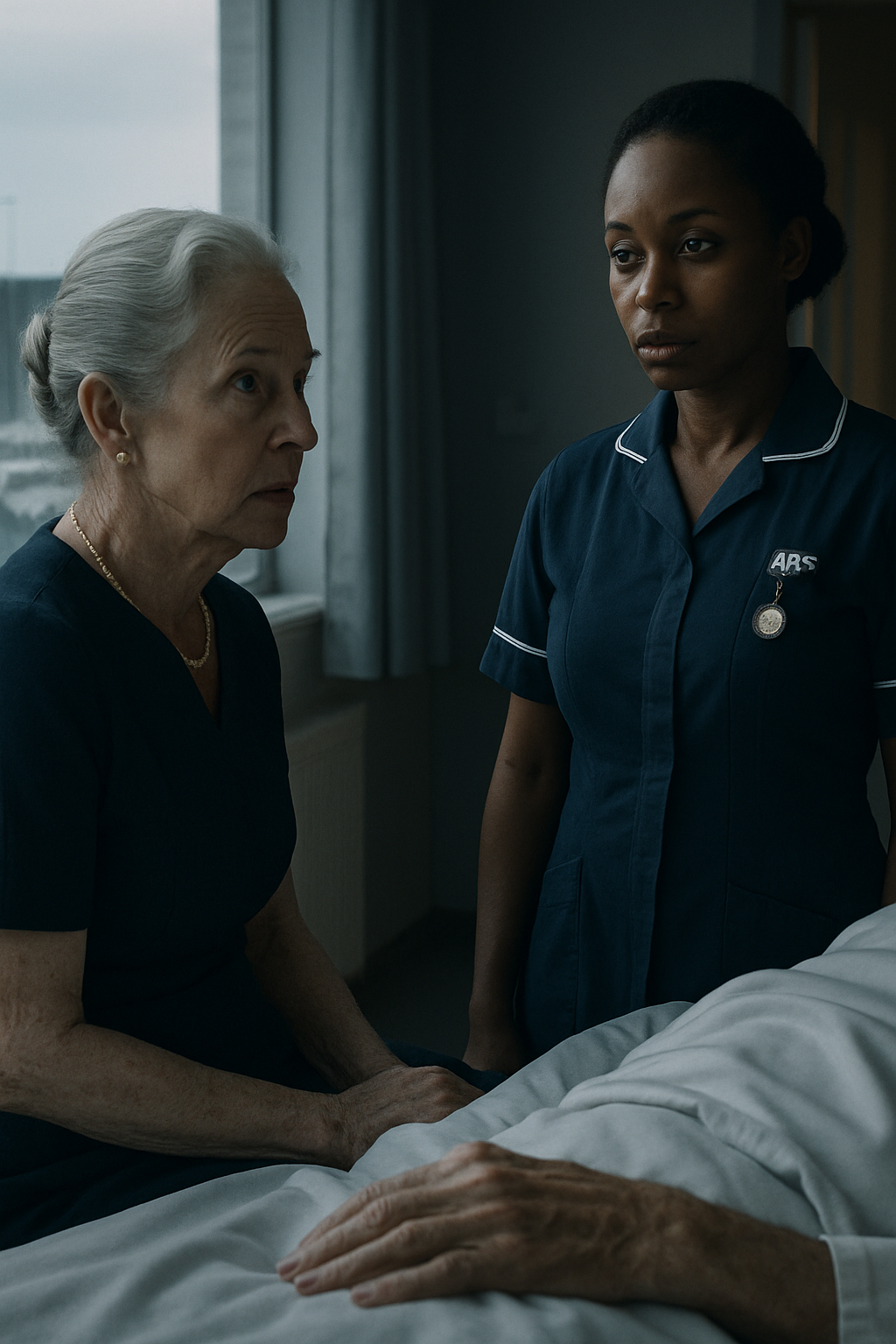
She looked at her hands for a moment. Pearl earrings, navy dress, the hands folded in her lap. Seventy-one years old and this was the morning, this was the room, this was the moment she had been moving toward without knowing it for thirty years.
The footsteps came down the corridor.
James straightened in his chair beside her.
The door opened.
Scene 4 — First Look
She was younger than Eleanor had expected. That was the first thought, unreasonable and immediate: she's younger than I expected. Thirty-eight, perhaps, or close to it. A Nigerian-British woman with her natural hair pulled back from her face, in nursing uniform, a small silver cross at her throat. Dark kind eyes that moved first to the bed, to Charles, with a professional assessment that was also something more than professional — something that looked like grief already prepared for, grief that had been carried somewhere private for some time.
Then those eyes moved to Eleanor.
And Eleanor looked at her.
She looked at her for a long time. Long enough that James made a small sound beside her, a slight intake of breath, the beginning of something that didn't become words.
Eleanor had known for thirty years, in the abstract, theoretical way you can know something you refuse to examine directly. She had known there was a woman, a child, money sent monthly, a whole other life running parallel to hers at some distance she had chosen not to calculate. She had built their life — their good, solid, full life, the three children, the house in Henley, the holidays, the anniversaries, the grandchildren who called Charles Grandpa and meant it — she had built all of that at a careful remove from what she didn't want to know.
But she had not known about the eyes.
Adaeze Okafor had her husband's eyes.
Not his colouring — her skin was deep brown where his was fair, her features her own, her mother's clearly, some other lineage entirely. But the eyes. The particular shape of them, the way the outer corners lifted slightly, the way the left one had a faint asymmetry, the way they held light. Eleanor had looked into those eyes across a breakfast table for forty-eight years. She had looked into them in three children, with varying degrees, but mostly in Charles, always most clearly in Charles.
She was looking at them now in a stranger's face.
The stranger was also looking at her.
No one in the room spoke.
The machines beeped. Charles slept. Outside the window the morning had become properly light, grey London light coming through the glass. The ward sounds continued in the corridor — ordinary, indifferent, the sounds of a place that processed death as routine, as it must.
Eleanor Whitmore looked at the eyes her husband had given this woman.
She felt, with great precision, the exact shape of thirty years.
Scene 5 — The Conversation Begins
"You're Adaeze," Eleanor said.
"Yes." Her voice was low and steady. The kind of voice that had learned to be steady in rooms like this one. "Mrs. Whitmore. I'm so sorry to come like this. He—" She stopped. "He asked."
"He asked," Eleanor agreed. "Please sit down."
James rose from his chair immediately, the instinct of a man who had been trained to cede space, and Adaeze looked at him and then back at Eleanor with an expression that held something unreadable, something that had not yet decided what it was.
"James," Eleanor said. "Would you give us a few minutes?"
He looked at her. His face had the expression of a barrister whose witness is about to say something he can't predict. "Mum—"
"Please."
He went.
The door closed. Eleanor looked at the bed where her husband was breathing his slow, labored, medicated breaths. She looked at the window. She looked at her hands.
Then she looked at Adaeze.
"Sit down," she said again. "Please. I'm not — I don't intend to make this worse than it already is."
Adaeze sat in the chair James had vacated. She sat with her hands in her lap and her back straight and her face very still in the way that Eleanor recognized, the way Eleanor herself sat when she was afraid. She wondered if that was also something inherited, some posture of fear, or just coincidence, just what a person's body does when it's prepared for something terrible.
"You knew him," Eleanor said. "Before."
Adaeze looked at her. "I didn't know him when I was young. My mother did."
"Your mother."
"Nkechi Okafor. She died four years ago." Adaeze's voice was careful. The voice of someone who has rehearsed this, who has thought about this moment and what she would say if it ever came. "She told me about him before she died. His name, where to find him. She said she'd never told him about me. She said it wasn't — she said it hadn't been that kind of relationship. That it ended before either of them intended it to."
Eleanor was quiet for a moment. "He knew," she said. "He found out somehow. I think he found out when you were small." She looked at her hands. "He sent money. For years."
Adaeze went very still.
"I didn't know that," she said.
"No." Eleanor looked up. "I don't imagine you would. Your mother didn't tell you that either?"
"No." A pause. "She was very — she was a private woman. She didn't talk about him. She raised me alone. She worked as a healthcare assistant herself, here in London, until she retired. She—" Adaeze stopped. When she continued her voice was slightly less steady. "She did all right. We did all right. She didn't need the money by the time I was old enough to understand money."
"But she took it."
"I didn't know she took it."
"I'm not—" Eleanor stopped. "I'm not accusing you. I'm not accusing anyone." She looked at her hands again. Her pearl earrings. Her navy dress. The architecture of a woman who had built herself for decades into something that could withstand almost anything if she kept her hands still. "I'm trying to understand," she said. "Before he goes. I'm trying to understand the shape of it."
Scene 6 — What He Knew
Charles stirred at half past nine.
They had been sitting in a careful quiet for nearly half an hour, Eleanor and Adaeze, the machines marking time between them. Adaeze had not left. Eleanor had not asked her to. They had spoken in fragments, small exchanges, the careful archaeology of a conversation neither of them had been prepared for. Adaeze told her that she had become a nurse because of her mother's work in healthcare, had trained at King's, had been at St. Augustine's for six years. She had not known, when she took the position, that Charles Whitmore was a patient — not until three months ago, when he was first admitted and she'd looked at his file and seen the name and felt, she said, as if the floor had tilted.
"Did you go to him?" Eleanor asked.
"No." Adaeze's voice was firm. "I almost transferred to another ward. I spoke to one of the senior nurses, without explaining why, and asked to be moved. But then—" She paused. "He was having a lucid day. I was the nearest nurse when he needed water. I came to his room." She looked at her hands. "He looked at me and he said my name. Just like that. Adaeze. He knew. He must have known what I looked like somehow, found a photograph—" She stopped. "I don't know how. But he said my name and I—" Her voice softened. "I couldn't go."
Eleanor looked at the bed where her husband lay.
He had found her. He had known her. He had watched her, from the strange and terrible proximity of being her patient, for three months. Eleanor tried to fit this into the shape of the man she knew and found that it fit, in the way that terrible things often fit, cleanly and completely, once you saw them clearly.
Charles opened his eyes.
He looked at the ceiling. Then he turned his head and he saw Eleanor, and his face did something complicated and private. Then he turned his head further and he saw Adaeze.
"You came," he said.
"I came," Adaeze said.
His hand moved on the sheet. An uncertain, reaching gesture. Adaeze looked at Eleanor. Eleanor looked back at her. Then Eleanor nodded, a single small nod, and Adaeze leaned forward and put her hand over his.
Eleanor watched her husband's face change. She watched something in it release, some held tension of years or months or of these last eleven days, she couldn't have said which. She watched him look at Adaeze's face with an expression that was grief and relief in equal measure.
"I wanted to tell you," he said to Adaeze. "I didn't know how."
"It's all right," Adaeze said.
"I found out when you were three. Your mother wrote to me. Just once." He stopped to breathe. The breathing cost him. "She didn't ask for anything. She said she thought I should know. I—" Another breath. "I wanted to come. I was afraid."
"I know," Adaeze said, and Eleanor noticed that she said it without bitterness, without accusation, with the tone of someone who had processed this already, who had done the work of understanding the fear of someone who hadn't been brave enough.
"You look like me," he said. His voice held something startled in it, as if this was still new to him, after three months. "The eyes."
"I know," she said.
He was quiet for a moment. Then he looked at Eleanor.
Eleanor held his gaze.
"I'm sorry," he said.
"I know you are," she said.
"I should have—"
"Yes," she said. "You should have." She paused. "But here we are."
Scene 7 — The Photograph
Charles slept again at ten, slipping under between one breath and the next, quietly, almost peacefully, in the way the morphine permitted. Adaeze stayed. She checked his vitals with the careful professionalism of someone doing two things at once — being a nurse, being a daughter — and she was very good at both, Eleanor observed. She moved with the competence of someone who had chosen a vocation and not merely a job.
When she was done she stood beside the bed for a moment with her hand near but not touching his arm, in a posture Eleanor understood to be farewell without being told it was farewell.
Then she turned to go.
"Wait," Eleanor said.
Adaeze stopped.
Eleanor reached for her handbag. It was a good leather bag, navy, old enough that the leather had softened to something almost textile, a bag she'd carried for fifteen years because she'd stopped seeing the point of new ones. She opened it with the practiced ease of forty-eight years of opening bags while thinking about something else entirely.
She found the envelope. She had put it there this morning, before James arrived, because she'd known — she had known in the half-lit hours before dawn that this was coming, that she had been carrying this toward this morning for thirty years, that the envelope belonged here.
She held it out to Adaeze.
Adaeze looked at it. Then she looked at Eleanor's face. "What is that?"
"Open it."
Adaeze took the envelope. She opened it with careful hands, the flap already unsealed, and inside was a photograph.
A young man, twenty-one or twenty-two, standing in front of a building with bright sun behind him. Not a professional photograph — something amateur, caught in movement almost, the young man slightly surprised by the camera. He was laughing at something off-frame. He had his father's jaw. He had, unmistakably, his sister's eyes.
"That's Marcus," Eleanor said. "My son. My youngest. He's forty-three." She paused. "He doesn't know about you. None of my children do, except that James — James suspects. Marcus doesn't." She paused again. "But I thought you should see him."
Adaeze was very still looking at the photograph.
"You have a brother," Eleanor said. "Two, actually. And a sister. Three nieces and two nephews. A family who doesn't know you exist." She looked at the window. "I don't know what to do with that. I've had eleven days in this room to think about it and I still don't know. But I thought you should see him."
Adaeze looked up from the photograph.
Her eyes — those eyes, Charles's eyes in this different, separate, entirely her own face — were bright with something that wasn't quite tears but was adjacent to them.
"Why are you doing this?" she asked. Not hostile. Not accusatory. Genuinely asking.
Eleanor looked at her for a moment.
"Because he's dying," she said. "And when he's gone, you'll be the only one who has those eyes." She paused. "I've spent thirty years looking at those eyes across a breakfast table. I'm not sure I'm ready to not see them anymore."
The room was very quiet.
"I don't want anything from you," Adaeze said carefully. "I want you to know that. I didn't come here for—"
"I know," Eleanor said. "That's not what I'm offering." She took the photograph back, gently, and looked at it for a moment before she put it back in the envelope. "I'm not offering anything yet. I'm an old woman with a dying husband and I have absolutely no idea what the correct thing to do is." She looked up at Adaeze with something that was, if not a smile exactly, the shape that her face made when she was being honest. "But I find I don't want you to walk out that door and have that be the end of it."
Scene 8 — The Long Afternoon
James came back at half past ten and stood in the doorway looking between his mother and Adaeze with the expression of a man who had prepared himself for a disaster and found something he couldn't classify.
Eleanor introduced them.
James shook Adaeze's hand. His face was a study in controlled emotion, in the professional management of things that wanted to be otherwise, and Eleanor felt a wave of love for him that was almost painful in its acuity. He was so like her. He had spent his whole life being like her. She wondered, not for the first time, whether that was entirely a gift.
They took turns sitting with Charles through the morning. He woke twice more, briefly, never fully lucid again. Adaeze came and went on the rhythms of her shift — checking on him, checking on the others in her care, returning. The ward moved around them. A patient in the room next door had a family visit that involved, at one point, a great deal of subdued weeping in the corridor. A consultant did rounds. The lunch trolley came. Eleanor ate half a sandwich from the family room and couldn't taste it.
At two in the afternoon Caroline arrived from Gloucester with David, who had come on the train from Edinburgh that morning. Eleanor's daughter and her second son, the remaining two, filling the room suddenly with the warm complicated grief of people who were losing their father in real time. Caroline, who had Charles's height and her mother's eyes and wept openly and without embarrassment, the way Eleanor never had, the way Eleanor sometimes envied. David, who was quiet and held his father's hand for a long time saying nothing, who looked up once and caught Eleanor's eye and held it with an expression that was thirty years of being his parents' middle child.
Adaeze was not in the room when they arrived. Eleanor said nothing about her to Caroline or David.
At four, when Caroline and David had stepped out to get food, and James had gone with them because he had been awake for thirty-six hours and needed the air, Eleanor was alone with Charles again.
He was awake. Barely. The way you are awake at the very edge of sleep, or the very edge of something else, with the eyes open but the weight of everything else pulling.
"She was kind," he said. Not directly to her. To the ceiling, perhaps, or to himself.
"She is kind," Eleanor said.
"Nkechi was kind." A long pause. "I was twenty-five. She was twenty-three. It was the summer before I met you."
"You don't have to explain."
"I know." He looked at her. His eyes were very clear suddenly, with the strange clarity of the very ill in their final days, the hours when the morphine thins and the consciousness sharpens. "I need to say it anyway. We were together for three months. She went back to Lagos. She didn't tell me. I found out when she wrote to me, years later. By then you and I—" He stopped. "By then everything was different. By then I had three children and a mortgage and a life that felt—"
"You were afraid," Eleanor said.
"I was a coward."
"Those aren't the same thing," she said. "I spent thirty years deciding they were the same thing and I don't think they are."
He looked at her. The machines beeped.
"I sent money," he said.
"I know. I always knew."
"I thought—" He stopped. "I thought I was making it right somehow. I thought if I just kept sending—"
"It doesn't work like that," Eleanor said, not unkindly.
"No." He closed his eyes. "But she came. She's here. I got to see her face." His voice was very quiet. "That's more than I deserved."
Eleanor looked at the face she had been looking at for forty-eight years. All the weather of it. All the years of it. The man she had known and not known, loved and been angry at and chosen every morning to continue choosing, the daily quiet decision of a marriage.
"She's coming back tomorrow," Eleanor said.
He opened his eyes.
"I asked her," Eleanor said. "She said yes."
Something moved through his face that was too complex to name. "You asked her."
"She should be there," Eleanor said. "At the end. She should be there."
He closed his eyes again. The machines continued. Outside the window the afternoon was thinning toward evening.
"Thank you," he said.
Eleanor said nothing. She held his hand. She counted the seconds between his breaths, the way she had been doing for eleven days, measuring the distance.
Scene 9 — Evening
Adaeze found her in the family room at six o'clock, after her shift ended. Eleanor was sitting with a cup of cold tea and a view of the car park and the orange-lit dusk beyond it. The hospital was shifting into its evening register, quieter, the daytime traffic gone, the night staff arriving in their dark coats.
"My shift's ended," Adaeze said from the doorway.
"I know." Eleanor looked at the car park. "Sit down for a minute, if you have time."
Adaeze sat across from her. She had changed out of her uniform into a coat and bag, a different person somehow, the professional competence still there but softer at the edges, the woman rather than the nurse, or both at once.
"Tomorrow," Eleanor said. "His children will be here. All three of them. They know something — James knows something, the others don't. I haven't decided how much to tell them." She paused. "I think I'd like to tell them. I think they should know you exist. But I'm asking you first. Whether that's all right with you."
Adaeze looked at her for a long moment.
"You're asking my permission."
"Yes."
"You're his wife. It's his family. You don't need—"
"You're part of this," Eleanor said simply. "You deserve to have some say in how it's handled."
The room was quiet. The fluorescent light hummed above them. Down the corridor someone was laughing at something, a small bright sound in the institutional evening.
"Yes," Adaeze said. "Tell them. If you think it's the right thing." She paused. "I don't want to be—" She stopped, choosing words carefully. "I don't want to be something that happens to your family. Something that lands on you like a—" She stopped again.
"Like what I spent thirty years fearing you'd be?" Eleanor said.
Adaeze looked at her.
"You're not," Eleanor said. "You're a woman who lost her mother four years ago and found out before she died that she had a father she'd never met. That's not a disaster landing on my family. That's a person." She looked at the car park, at the orange evening light. "A person my husband loved enough to keep track of for thirty-eight years, even if he was too afraid to do it properly."
Adaeze was quiet for a moment. When she spoke her voice was slightly different, slightly lower, the control of it less complete. "He watched me, these past three months. I knew he was watching me. I told myself it was just — that it was normal, that patients attach to nurses, that it didn't mean anything. But I knew." She paused. "I knew from the first day. When he said my name. He looked at me like — like he was looking at something he'd been waiting a very long time to see."
Eleanor felt the familiar sharp precision in her chest. The exact shape of thirty years. She had spent so long making it an abstraction, a line item in the accounts, a thing she chose not to examine. Now it had a face, and the face was kind, and the face had her husband's eyes.
"He was," she said.
Scene 10 — The Last Day
Charles Whitmore died the following afternoon at twenty minutes past three.
He was not alone. Eleanor was there, and James, and Caroline and David, and Adaeze who had come in on her day off because Eleanor had asked her and she had said yes without hesitation, who stood a little apart from the family but not outside it, in the room but at its margin, present in the way that felt, to Eleanor, precisely right.
He did not speak, in the end. He had spoken what he needed to speak. He simply breathed, and then he breathed less, and then he stopped.
The machines made their sound and then the nurse on duty came and the official, gentle machinery of death in a hospital ward engaged and continued. Caroline wept against David's shoulder. David held her and looked at the wall. James stood very straight in his expensive suit with his jaw set the way their father's jaw had set and his eyes wet.
Eleanor sat in her chair beside the bed.
She held Charles's hand, which was still warm, which would be warm for a little while yet before it stopped being warm, and she looked at his face — the face she had been looking at for forty-eight years — and she thought: I knew you. I didn't know you. I loved you. I am furious with you. I will miss you every day for the rest of my life.
All of these things were true. None of them cancelled out the others.
After a while she became aware that Adaeze had come to stand beside her. She could feel her presence the way you feel presence when you've been alone for a long time and someone enters the room — a change in the air, a warmth, a new weight in the space.
She looked up.
Adaeze was looking at the bed, at the face of the man who had been her father in the most attenuated, inadequate, long-distance sense of the word. Her face was wet and she wasn't trying to make it otherwise.
She had his eyes.
Eleanor reached out and took her hand.
Adaeze looked at her.
"Come to the house," Eleanor said. "When this is done. When everything is — when we've done what needs to be done. Come for a meal. Meet Marcus. He has no idea, and it will be — it will be a great deal to manage." A pause. "But he should know."
Adaeze looked at her for a long moment.
"Why are you being kind to me?" she asked. The same question as yesterday. The same tone — not hostile, not accusatory. Genuinely, quietly asking.
Eleanor thought about it.
"Because I spent thirty years being afraid of you," she said finally. "And you're not frightening at all." She paused. "And because my husband is dead and you're the only person in this room who is also grieving someone they barely got to know." She looked at the bed. "That seems like a thing to acknowledge."
Adaeze looked at the bed too. At the face. At the eyes that were closed now and would not open again, but that they both carried, in their different ways, in their different lives.
"All right," she said.
The machines were silent. The afternoon light came through the window. Outside, the ordinary world continued its ordinary business, indifferent and relentless, the way the world is, the way it must be.
Eleanor held the hand of the woman she had been afraid of for thirty years.
She thought: here we are.
Scene 11 — After
It took three weeks to arrange the first meal. There were funerals to plan and execute, legal and financial affairs to manage, a house in Henley to begin the process of deciding about. Eleanor's children descended and then dispersed and then descended again in the rotating pattern of adult children managing collective grief at a distance. Marcus flew in from Singapore where he'd been based for two years, arriving with his suit and his father's jaw and a look of subdued devastation that Eleanor felt personally as a second grief layered over the first.
She told him on the second day.
She sat him down in the kitchen of the Henley house, at the table where they'd had ten thousand breakfasts, and she told him. Everything. Adaeze, Nkechi, the money, the three months when Charles was twenty-five, the thirty years of knowing, the eleven days in the hospital, the photograph, the hand held in a hospital room.
Marcus listened. He had Eleanor's capacity for stillness when he was afraid. He sat very still and listened and didn't say anything for a long time at the end.
Then he said: "I want to meet her."
"I know," Eleanor said. "I've already called her."
He looked at her with the expression of a son who has been underestimating his mother for forty-three years. "You already called her."
"She's coming on the fifteenth." Eleanor rose to put the kettle on. "She's bringing her husband, apparently. They've been married for seven years. She has two daughters." She paused. "You have nieces in London you've never met."
Marcus sat at the kitchen table with his father's jaw and his mother's eyes and his whole face rearranging itself around new information, new coordinates, a new map of his own family.
"Mum," he said.
"Marcus."
"How are you—" He stopped. "How are you doing this? All of this. How are you—"
Eleanor set the kettle on. She looked out the kitchen window at the garden, at the overgrown corner where Charles had always meant to plant something and never got around to it, the square of untended earth she had been looking at for twenty years.
"I'm seventy-one years old," she said. "I've been married for forty-eight years to a man I loved and a man who was a coward and a man who sent money every month for thirty years to a child he was too afraid to meet." She paused. "I've been angry at him since 1996. I've had a long time to practice." She turned from the window. "And she's not frightening," she said again. "She's a nurse. She has a husband and two daughters and she was kind to your father when he was dying. That's who she is." She looked at her son. "That's enough for me to start with."
Marcus looked at her for a long moment.
"Yeah," he said, quietly. "Okay."
The kettle began to boil.
Epilogue — The Fifteenth
The fifteenth was a Saturday in late autumn. Eleanor had made a lamb shoulder that had been in the oven since morning and filled the house with the smell of rosemary. Marcus had arrived the night before from the hotel where he was staying while he worked out the Singapore situation, which was a whole separate conversation. James arrived at noon with his wife Sara and their eldest, Phoebe, who was fourteen and had not been told the full story but who was fourteen and perceptive and would understand more than she was told. Caroline came from Gloucester with her two.
Adaeze Okafor arrived at half past twelve.
She arrived with her husband Kelechi, a tall quiet man with a warm handshake and the look of someone who had been briefed carefully and was taking it seriously. And she arrived with her daughters — Chidera, nine, and Nnia, six — who came through Eleanor's door in the way that children enter unfamiliar places, with the combination of wariness and curiosity that is the particular property of childhood.
Nnia looked up at Eleanor in the hallway with large dark eyes and said, without preamble: "Your house smells really good."
Eleanor looked down at the six-year-old with her grandmother's cheekbones and her grandfather's eyes, standing in the hallway of the house Eleanor had lived in for thirty-two years, and felt something in her chest do something complicated and complete.
"It's lamb," she said. "Do you like lamb?"
"Yes," said Nnia.
"Then come in," said Eleanor, and stepped back to let them through.
Later, when the meal was over and the children were in the garden with Phoebe nominally in charge, and Marcus and Adaeze were sitting on the sofa with the family photograph albums open between them — Marcus pointing at pictures, explaining, Adaeze leaning forward to look with the focused attention of someone reading a book they've waited years to find — Eleanor stood in the kitchen doorway with a glass of wine and watched.
Marcus was showing Adaeze a photograph of Charles at thirty, before the children, before Henley, before all of it. Standing in front of a building in the sun. The same photograph she'd kept in the envelope. The same jaw. The same eyes.
Adaeze looked at it for a long time.
Then she looked up and across the room and met Eleanor's eyes.
Eleanor raised her glass slightly.
Adaeze smiled.
Outside, through the garden door, the children were running over the overgrown lawn, in the corner where Charles had never gotten around to planting anything, their voices bright and immediate in the autumn afternoon.
Here we are, Eleanor thought.
She drank her wine.
Here, at last, we are.